

Cryptocurrency markets contain thousands of digital assets.
Yet many investors make a critical mistake:
They treat all cryptocurrencies as if they belong to the same category.
In reality, different types of crypto assets behave very differently.
Some are built around infrastructure and long-term adoption.
Others are driven primarily by community enthusiasm.
Some experience explosive growth because they become attached to powerful market narratives.
Understanding the differences between altcoins, memecoins, and hype coins is essential for managing risk, setting realistic expectations, and developing a successful investment strategy.
In This Analysis, We’ll Explore:
- what altcoins are
- what memecoins are
- what hype coins are
- how these categories overlap
- risk and reward characteristics
- market cycle behavior
- investor psychology
- common investing mistakes
- how professional investors evaluate different crypto assets
- long-term positioning considerations
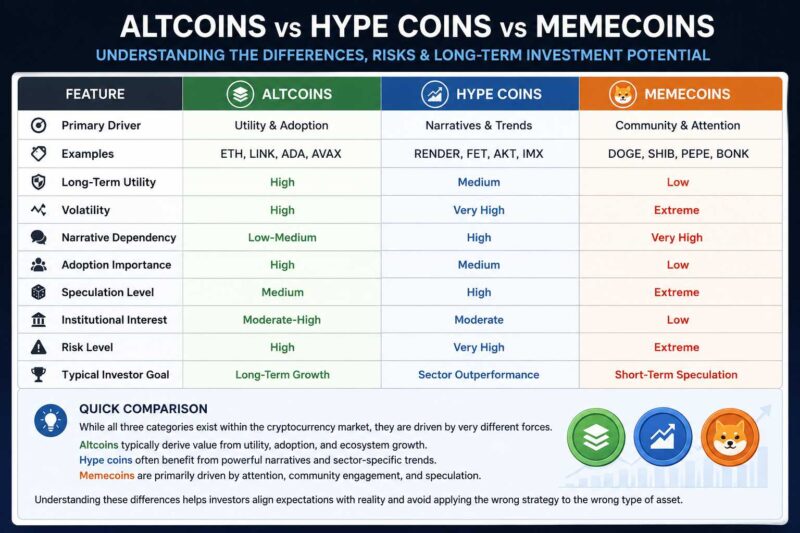
Why Classification Matters
Many investors focus exclusively on potential returns.
Far fewer spend time understanding what type of asset they actually own.
This creates problems.
Different categories of crypto assets often require:
- different expectations
- different holding periods
- different risk management approaches
- different portfolio allocations
Using the wrong strategy for the wrong asset is one of the fastest ways to lose money in crypto.
What Are Altcoins?
An altcoin is any cryptocurrency other than Bitcoin.
However, in practice, investors typically use the term to describe projects with genuine utility, infrastructure, or technological objectives.
Altcoins often focus on:
- smart contracts
- blockchain scalability
- interoperability
- decentralized finance
- Web3 infrastructure
- decentralized applications
Examples include:
Characteristics of Altcoins
Altcoins typically offer:
- real-world utility
- active development teams
- long-term roadmaps
- growing ecosystems
- measurable adoption metrics
Their value is often linked to:
- user growth
- developer activity
- transaction volume
- ecosystem expansion
- network effects
Risks of Altcoins
Altcoins are not risk-free.
Common risks include:
- technological failure
- ecosystem stagnation
- regulatory pressure
- competition
- declining adoption
Even fundamentally strong projects can experience significant drawdowns.
What Are Memecoins?
Memecoins are cryptocurrencies primarily driven by community engagement, internet culture, and social momentum rather than technological innovation.
Unlike infrastructure-focused altcoins, memecoins often have limited utility.
Examples include:
- Dogecoin (DOGE)
- Shiba Inu (SHIB)
- Pepe (PEPE)
- Bonk (BONK)
Characteristics of Memecoins
Memecoins often exhibit:
- extreme volatility
- strong community participation
- social media influence
- rapid narrative shifts
- speculative trading activity
Their value is frequently determined by attention rather than adoption.
Why Memecoins Can Rise So Quickly
Memecoins often outperform during speculative phases because:
- they are easy to understand
- communities grow rapidly
- viral marketing is powerful
- retail participation increases
As a result, memecoins can experience explosive gains in short periods.
Risks of Memecoins
Risks include:
- weak fundamentals
- unpredictable sentiment shifts
- severe drawdowns
- limited long-term utility
- dependence on attention
Memecoins can generate extraordinary returns.
They can also collapse rapidly.
What Are Hype Coins?
Hype coins occupy a middle ground between altcoins and memecoins.
Many hype coins possess real technology.
However, their price appreciation is driven primarily by market narratives.
Examples of popular narratives include:
- Artificial Intelligence (AI)
- Gaming
- Layer-2 scaling
- Real World Assets (RWA)
- DePIN
- SocialFi
- Modular blockchains
Examples of hype-driven projects at various points include:
- Render (RENDER)
- Fetch.ai (FET)
- Akash (AKT)
- Immutable (IMX)
Characteristics of Hype Coins
Hype coins often experience:
- rapid appreciation
- narrative-driven capital inflows
- elevated volatility
- dramatic boom-and-bust cycles
Unlike memecoins, they usually possess genuine technology.
Unlike traditional altcoins, price performance is often driven more by attention than adoption.
Why Narratives Matter
Crypto markets frequently move through narrative cycles.
Capital rotates between themes.
Examples include:
- DeFi
- NFTs
- Metaverse
- AI
- Layer-2 ecosystems
- Real World Assets
When a narrative becomes dominant, projects associated with that theme can significantly outperform.
When attention fades, performance often deteriorates.
This is why timing becomes particularly important for hype coins.
Crypto Narratives: How Trends Drive Market Cycles and Capital Flows
How Market Cycles Affect Each Category
Bull Markets
During strong bull markets:
- Bitcoin leads initially
- quality altcoins follow
- hype coins accelerate
- memecoins often peak last
Bear Markets
During bear markets:
- memecoins typically suffer most
- hype coins often collapse after narratives fade
- quality altcoins generally retain stronger fundamentals
This distinction is important for long-term investors.
How Crypto Cycles Shape Long-Term Opportunities
The Psychology Behind Each Category
Different categories attract different investor behaviors.
Altcoins
Investors focus on:
- technology
- adoption
- fundamentals
- long-term growth
Memecoins
Investors focus on:
- excitement
- community
- speculation
- momentum
Hype Coins
Investors focus on:
- narratives
- trends
- sector growth
- market attention
Understanding this psychology helps explain price behavior.
Common Investor Mistakes
Many investors lose money because they confuse these categories.
Examples include:
- holding memecoins like infrastructure investments
- treating hype coins as permanent holdings
- abandoning quality altcoins during normal corrections
- confusing popularity with adoption
- confusing narratives with fundamentals
These mistakes often lead to poor risk management.
How Professional Investors Evaluate Crypto Assets
Professional investors typically ask:
- What problem does this project solve?
- How large is the addressable market?
- Is adoption increasing?
- Is the valuation reasonable?
- What drives demand for the token?
- Is growth sustainable?
The answers vary significantly between altcoins, memecoins, and hype coins.
Long-Term Positioning
For many investors:
- Bitcoin serves as the core allocation
- infrastructure altcoins provide growth exposure
- hype coins offer tactical opportunities
- memecoins remain speculative positions
The appropriate allocation depends on individual risk tolerance and objectives.
Conclusion
Not all cryptocurrencies are created equal.
Altcoins, memecoins, and hype coins may all exist within the same market, but they operate according to very different dynamics.
Understanding:
- utility
- adoption
- narratives
- speculation
- investor psychology
- market cycles
can help investors make better decisions and avoid common mistakes.
Successful crypto investing is not simply about finding the next asset that might rise.
It is about understanding what type of asset you own, why it has value, and how it behaves throughout different market environments.
For long-term investors, that distinction can be one of the most important advantages in the entire cryptocurrency market.
Think Like a Smart Crypto Investor – Part 1: Introduction & Mindset
What Actually Moves Crypto Prices? Understanding the Real Market Forces
Disclaimer: This article is for educational purposes only and does not constitute financial advice. Always do your own research and manage risk accordingly.