
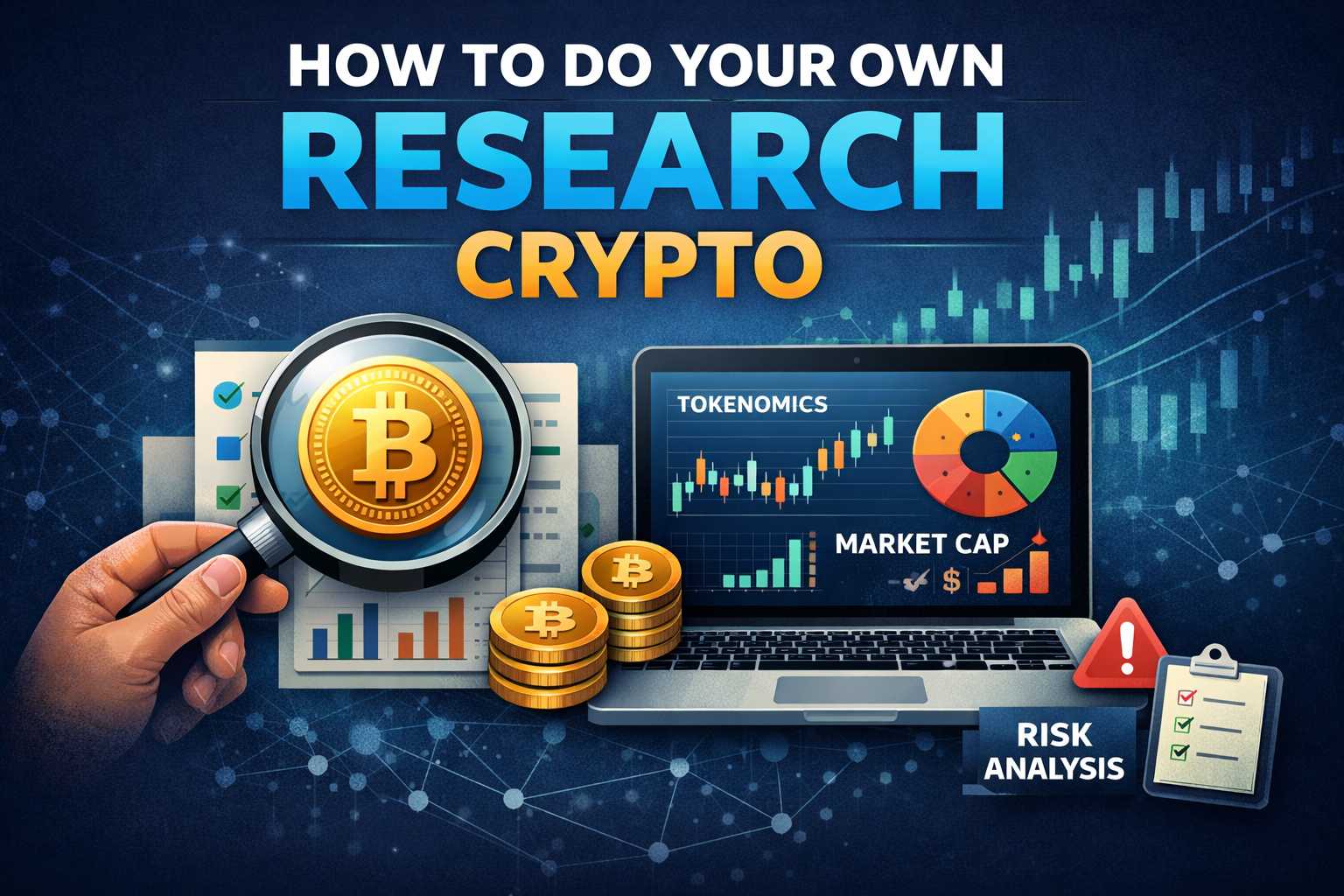
The phrase Do Your Own Research, or DYOR, appears almost everywhere in cryptocurrency.
But being told to “do your own research” is much easier than knowing what that research should actually involve.
Crypto investors are surrounded by information.
Project websites explain why their technology matters. Social media highlights potential opportunities. Influencers discuss price targets. Communities promote their favorite tokens. Market narratives can make entire sectors appear attractive almost overnight.
The challenge is separating useful information from marketing, speculation and noise.
Proper crypto research is not about finding information that confirms why a token should rise.
It is about understanding what you are buying, why the token exists, how the project works, what could create long-term demand and what could cause the investment thesis to fail.
A structured DYOR process cannot eliminate investment risk.
It can, however, help investors make decisions based on evidence rather than excitement.
In This Analysis, We’ll Explore:
- What DYOR means in crypto
- What DYOR can and cannot achieve
- How to understand what a crypto project actually does
- Why token utility matters
- How to evaluate tokenomics
- How to research teams and development activity
- How to evaluate adoption and real network usage
- How to analyze crypto valuation
- Why competition and positioning matter
- How narratives influence investment decisions
- How on-chain data can support research
- Why liquidity matters
- How to verify information
- Common crypto red flags
- How to build a repeatable DYOR process
What Does DYOR Mean in Crypto?
DYOR stands for:
Do Your Own Research
At its simplest, it means taking responsibility for understanding an investment rather than relying entirely on somebody else’s opinion.
That sounds obvious.In practice, it is surprisingly difficult.
Crypto investors frequently encounter statements such as:
“This project has huge potential.”
“Major partnerships are coming.”
“The token is undervalued.”
“This could be the next 100x.”
None of these statements provides enough information to make an investment decision.
Proper research asks for evidence.
If adoption is supposedly growing, what metrics demonstrate that growth?
If the project has important partnerships, what do those partnerships actually involve?
If the token is described as undervalued, undervalued relative to what?
If the technology is unique, what prevents competitors from providing something similar?
DYOR means moving beyond the claim and investigating the evidence behind it.
What DYOR Is — and What It Is Not
DYOR is sometimes treated as a method for discovering which cryptocurrency will rise next.
That is not what research can reliably do.
A thoroughly researched project can still decline dramatically.
A weak project can rise because of speculation.
Macroeconomic conditions can overwhelm project-specific fundamentals.
Regulation, security incidents, competition or changing market narratives can alter an investment thesis.
Research therefore does not eliminate uncertainty.
Its purpose is to understand uncertainty better.
Good research should help an investor understand:
- What the project does
- Why the blockchain or protocol exists
- Why the token exists
- How supply develops
- Where demand could come from
- Whether people actually use the network
- Who the competitors are
- What the major risks are
- What evidence would invalidate the investment thesis
There is also an important psychological difference between research and confirmation.
If an investor buys a token first and then searches only for reasons why it will succeed, that is not objective research.
Effective DYOR should actively search for weaknesses as well as strengths.
Step 1 – Understand What the Project Actually Does
Before analyzing token price, market capitalization or technical indicators, understand the project itself.
Start with a simple question:
What problem is this project trying to solve?
The answer should eventually be understandable without relying entirely on complicated terminology.
For example, a project might provide:
- Smart contract infrastructure
- Decentralized lending
- Blockchain scaling
- Data storage
- Oracle services
- Cross-chain communication
- Decentralized computing
- Tokenization infrastructure
Once the purpose is clear, ask a second question:
Why is blockchain useful for solving this problem?
Not every application needs decentralization or a token.
A project may use sophisticated blockchain terminology without demonstrating why blockchain technology improves the product.
Then examine the competitive advantage.
Ask:
- What makes the project different?
- Does it solve the problem better than existing alternatives?
- Is the technology already working?
- Who actually needs the product?
- What prevents competitors from copying or replacing it?
The objective is not to become an expert developer.
It is to understand the basic economic and technological reason the project exists.
If you cannot explain that reason clearly after researching it, more investigation may be necessary.
Step 2 – Ask Whether the Token Is Actually Necessary
Understanding the project is only the beginning.
Investors are usually not buying the project itself.
They are buying its token.
That distinction matters.
A blockchain ecosystem could become successful while its token captures relatively little of the value created by that success.
Ask:
Why does this ecosystem need the token?
The token might be used for:
- Transaction fees
- Staking
- Network security
- Governance
- Collateral
- Access to services
- Payments within the ecosystem
Then go one step further.
Ask whether growing usage creates additional demand for the token.
Suppose an application attracts millions of users but those users barely need the native token.
The project may be successful while the investment thesis for the token remains less obvious.
This is why statements such as:
“The project has strong adoption.”
and:
“The token has strong value capture.”
should not automatically be treated as equivalent.
A good DYOR process analyzes both.
Step 3 – Analyze Tokenomics
Once the purpose and utility of the token are clear, examine its economic structure.
Tokenomics determines how tokens are created, distributed and released into circulation.
Important questions include:
- What is the circulating supply?
- What is the total supply?
- Is there a maximum supply?
- Are new tokens continuously issued?
- How large are future unlocks?
- Who owns the locked tokens?
- How much was allocated to founders and early investors?
- What is the token used for?
- Are tokens burned or otherwise removed from supply?
One particularly important area is the difference between circulating supply and future supply.
A project may initially release only a small percentage of its tokens.
This can create a relatively small market capitalization while its fully diluted valuation is much larger.
Future unlocks may then increase circulating supply substantially.
That does not automatically make the token a bad investment.
But investors need to understand how much additional supply could enter circulation and whether future demand may be sufficient to absorb it.
Staking rewards also deserve attention.
A high staking yield can look attractive, but if those rewards are funded primarily through rapid token issuance, holders may also experience significant supply inflation.
The objective is not to search for a perfect tokenomics model.
There isn’t one.
The objective is to understand how supply and demand could develop over time.
Crypto Tokenomics Explained: Supply, Unlocks, Inflation, Utility & Long-Term Value
Step 4 – Research the Team and Development Activity
A strong idea still needs to be executed.
Researching the people and development behind a project can therefore provide useful context.
Depending on the project, investors may examine:
- Founder backgrounds
- Developer experience
- Previous projects
- Technical documentation
- Development updates
- Public code repositories
- Governance activity
- Project roadmaps
An anonymous team is not automatically evidence of a scam.
Crypto has a long history of pseudonymous development.
Likewise, a publicly known team does not guarantee success.
The important question is whether there is evidence that the project is being actively developed and whether the people behind it appear capable of executing its objectives.Investors should also be careful with roadmap promises.
A roadmap describes what a team intends to build.
It does not prove that those products will be delivered successfully.
Compare previous promises with actual progress.
A project that consistently announces ambitious future developments while repeatedly failing to deliver deserves greater scrutiny.
Development activity can provide additional evidence, but raw numbers should also be interpreted carefully.
A large number of software updates does not automatically mean meaningful progress.
Quality matters more than simply counting activity.
Step 5 – Evaluate Adoption and Real Network Usage
A project can have excellent technology without meaningful adoption.
That is why research should eventually move from:
What could this project do?
to:
What is actually happening?
The relevant metrics depend on the type of project.
Investors might examine:
- Active users or addresses
- Transaction activity
- Developer adoption
- Protocol usage
- Fees generated
- Total value locked
- Application growth
- Stablecoin activity
- Ecosystem development
No individual metric tells the entire story.
Transaction counts, for example, can be misleading if transactions are extremely cheap and easy to automate.
A high number of addresses does not necessarily represent the same number of individual users.
Total value locked can increase because token prices rise rather than because new capital entered the ecosystem.
Context matters.
Partnerships require similar scrutiny.
A project announcing a partnership with a recognizable company can sound impressive.
But investors should determine what the relationship actually involves.
Is the technology being used?
Is it a pilot program?
Is there measurable economic activity?
Or is the relationship primarily promotional?
The strongest evidence of adoption is usually not an announcement.It is continued usage.
Over time, investors want to see evidence that users, developers or businesses continue finding value in the network.
This also helps distinguish temporary hype from more durable growth.
A project with strong technology, reasonable tokenomics and increasing real usage has a fundamentally different profile from a token rising primarily because it belongs to a popular market narrative.
But even strong fundamentals do not tell investors whether the current token valuation is attractive.
Step 6 – Analyze Market Cap and Valuation
A strong project is not automatically an attractive investment at every valuation.
This is why DYOR should include an assessment of what the market is already pricing in.
Start with market capitalization:
Market Cap = Token Price × Circulating Supply
Then compare it with the project’s fully diluted valuation, or FDV, which considers the broader token supply if additional tokens eventually enter circulation.
A large difference between market cap and FDV deserves further investigation.
Ask:
- How much supply is currently circulating?
- How much remains locked?
- When will additional tokens unlock?
- Who receives those tokens?
- How quickly could circulating supply increase?
A large market cap-to-FDV gap is not automatically negative. Tokens may unlock gradually over many years while network demand grows alongside supply.
The important point is to understand the valuation in combination with the supply structure.
This also explains why token price alone tells investors very little.
A token trading at $0.10 is not necessarily cheaper than one trading at $1,000.
Valuation depends on price and supply together.
What Is Market Cap in Crypto? Market Capitalization, FDV, Supply & Valuation Explained
Step 7 – Understand Competition and Positioning
Crypto projects rarely operate without competition.
A smart contract platform competes with other blockchain networks.
A decentralized exchange competes with other trading protocols.
An oracle network competes with alternative data infrastructure.
A strong DYOR process therefore asks not only whether a project is useful, but also:
Why would users choose this project instead of its competitors?
Look at factors such as:
- Technology
- Costs
- Speed
- Security
- Liquidity
- Developer ecosystem
- Network effects
- User experience
- Decentralization
- Existing adoption
Competition can also change over time.
A project that had a major technological advantage two years ago may face several credible alternatives today.
This is why research should not be a one-time exercise.
An investment thesis should evolve as the competitive environment changes.
Step 8 – Examine the Narrative Without Confusing It With Fundamentals
Crypto narratives can strongly influence where capital flows.
Themes such as DeFi, Layer 2 scaling, artificial intelligence and real-world assets can attract significant investor attention.
Understanding the narrative surrounding a project can help explain why demand is increasing.
But narrative strength and fundamental strength are different things.
A weak project can rise because it belongs to a popular sector.
A strong project can receive little market attention because its sector is temporarily out of favor.
When researching a narrative, ask:
- Why is this theme attracting attention?
- Is there genuine technological progress?
- Is adoption increasing?
- Are capital flows spreading across the sector?
- Is the project genuinely connected to the trend?
- Has speculation moved far ahead of fundamentals?
Narratives provide useful market context.
They should not replace analysis of the individual project.
Crypto Narratives Explained: How Trends, Attention & Capital Rotation Move Markets
Step 9 – Use On-Chain Data
One advantage of blockchain markets is that significant amounts of activity can be observed directly on-chain.
Depending on the network, investors may examine:
- Transaction activity
- Active addresses
- Exchange flows
- Token holder distribution
- Staking activity
- Network fees
- Large wallet movements
- Stablecoin flows
This can provide another layer of evidence when evaluating a project.
For example, a network claiming rapid adoption should ideally show some evidence of increasing usage.
But on-chain metrics require context.
More transactions do not automatically mean more genuine users.
Large wallet movements do not automatically indicate buying or selling.
Exchange inflows can have several explanations.
Individual metrics should therefore rarely be interpreted in isolation.
The goal is to combine multiple signals and look for consistent patterns.
Advanced Crypto Investing Strategies – Part 3: Reading On-Chain Data & Indicators
Step 10 – Understand Liquidity and Trading Conditions
Fundamental research often focuses on the project while overlooking the market in which its token trades.
Liquidity matters because it determines how easily capital can enter or leave an asset without significantly affecting price.
A cryptocurrency may have interesting technology but extremely thin trading markets.
That can create:
- Larger bid-ask spreads
- Greater slippage
- Higher volatility
- Greater manipulation risk
- More difficult exits during market stress
Trading volume can provide useful information, but volume alone does not measure liquidity perfectly.
Investors should also consider market depth and where the token actually trades.
This becomes especially important for smaller cryptocurrencies.
A large headline market capitalization does not necessarily mean large amounts of capital can enter or exit at the displayed price.
Liquidity should therefore be part of risk analysis, not just trading analysis.
Crypto Liquidity Explained: Market Depth, Capital Flows, Slippage & Why Prices Move
Verify Information Instead of Trusting One Source
One of the most important DYOR habits is verification.
Every source has limitations.
Project websites naturally present their own technology positively.
Communities may become emotionally attached to a token.
Influencers can have financial incentives.
Social media can amplify rumors before they are verified.
Even statistics can be misleading when removed from context.
Whenever an important claim affects your investment thesis, try to find the original evidence.
If a project announces a partnership, investigate what was actually announced.
If someone claims network activity is exploding, examine the underlying data.
If tokenomics appear attractive, check the supply and unlock structure rather than relying on a summary.
If a major technical upgrade is supposedly approaching, look for evidence from the project’s development channels or documentation.
The objective is not to distrust everything.
It is to distinguish between:
claim → evidence → interpretation.
Those are three different things.
Crypto Red Flags to Watch For
No individual warning sign automatically proves that a cryptocurrency is a bad project.
But combinations of warning signs deserve additional investigation.
Unclear Purpose
If it is difficult to determine what problem the project solves or why blockchain is required, the investment thesis may depend primarily on speculation.
Weak Token Utility
A useful project does not automatically create a useful token.
Understand why people need to own or use the asset.
Aggressive Token Unlocks
Large future unlocks can increase circulating supply significantly, particularly when early investors or insiders control substantial allocations.
Extreme Valuation
Strong technology can still be priced too aggressively if expectations already assume enormous future growth.
Heavy Dependence on Marketing
Constant announcements and social media activity are not substitutes for development and adoption.
Unrealistic Promises
Guaranteed returns, extreme price predictions or claims that an investment has little downside deserve particular skepticism.
Limited Development
A project that claims ambitious technological goals but shows little evidence of continued development deserves closer investigation.
Concentrated Ownership
If a small number of wallets or insiders control a large percentage of supply, investors should understand the resulting governance and liquidity risks.
Red flags should trigger more research rather than automatic conclusions.
Building a Simple DYOR Process
Crypto research can easily become overwhelming.
There are thousands of metrics, dashboards and opinions available.
A repeatable process makes research more manageable.
Before considering a cryptocurrency, try answering ten questions:
- What problem does the project solve?
- Why is blockchain necessary?
- Why does the token need to exist?
- How does the token supply develop over time?
- Who is building the project, and are they delivering?
- Is there evidence of genuine adoption?
- How is the token currently valued?
- Who are the major competitors?
- What are the biggest risks?
- What would prove my investment thesis wrong?
That final question is particularly valuable.
Investors often spend considerable time identifying reasons why an investment could succeed while spending far less time defining what failure would look like.
A good thesis should be testable.
If the expected adoption never develops, competitors take market share or token economics deteriorate, the original thesis may need to be reconsidered.
What DYOR Cannot Tell You
Even excellent research has limits.DYOR cannot reliably predict short-term prices.
It cannot guarantee that strong technology will achieve adoption.
It cannot eliminate regulatory, security or macroeconomic risk.
And it cannot guarantee that markets will value a project the way an investor expects.
Crypto markets can remain irrational for long periods.
Weak projects can outperform strong ones during speculative phases.
Strong projects can decline sharply during bear markets.
Unexpected events can completely change an investment thesis.
The purpose of research is therefore not certainty.
It is to make uncertainty more understandable.
Good DYOR helps investors know what risks they are taking and why they are taking them.
Conclusion
Doing your own research is much more than reading a project’s website or checking its token price.
A complete crypto research process connects several different areas:
Technology tells you what the project can do.
Tokenomics tells you how the token economy works.
Adoption tells you whether people are actually using it.
Valuation tells you what expectations may already be priced in.
Competition tells you whether the project’s position can be defended.
Narratives help explain where market attention is moving.
On-chain data provides evidence of blockchain activity.
Liquidity helps reveal the market risks surrounding the token.
None of these factors should be viewed alone.
A project can have impressive technology but poor tokenomics.
It can have strong adoption but an excessive valuation.
It can dominate a popular narrative without having sustainable fundamentals.
And a fundamentally strong project can still be a risky investment.
This is why DYOR should not be about finding reasons to buy.
It should be about building the clearest possible picture of both the opportunity and the risk.
The strongest research process is one that remains open to changing its conclusion when the evidence changes.
In a market driven by technology, speculation, narratives and rapidly changing capital flows, that ability may be more valuable than any individual metric.
Think Like a Smart Crypto Investor Part 1: Why Mindset Matters More Than Price
Disclaimer: This article is for informational purposes only and does not constitute financial advice. Cryptocurrency markets are volatile and involve significant risk. Always conduct your own research before making investment decisions.