
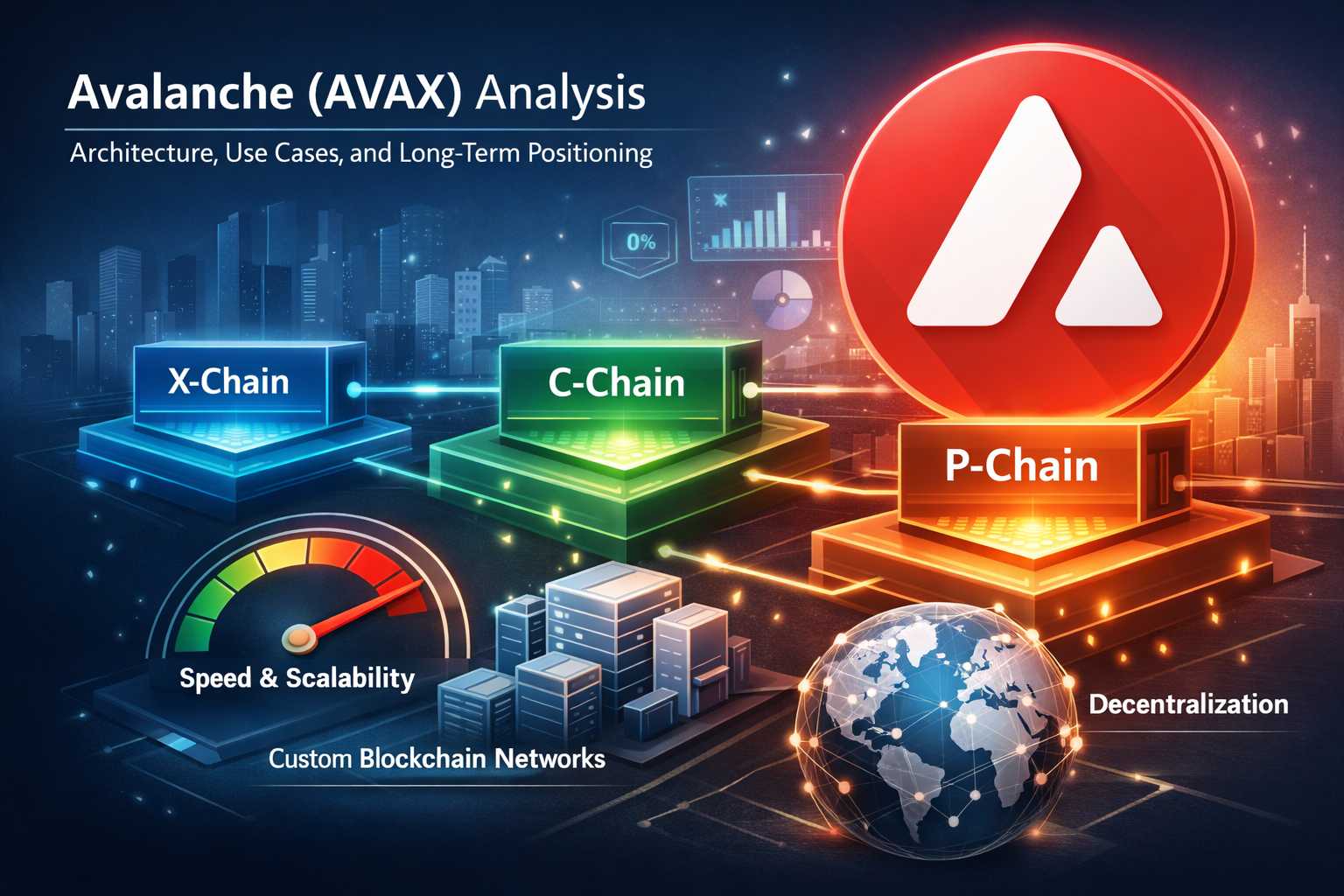
Avalanche (AVAX) is positioned as a high-performance Layer-1 blockchain designed to balance scalability, speed, and decentralization. Rather than competing purely on transaction speed, Avalanche focuses on flexible infrastructure and customized blockchain environments.
The key question is not whether Avalanche is fast — but whether its architecture gives it a durable role in the evolving crypto ecosystem.
Network Architecture and Subnets
Avalanche’s core innovation lies in its subnet architecture.
Instead of forcing all applications onto a single shared chain, Avalanche allows developers to launch custom subnets — independent blockchains with their own rules, validators, and fee structures.
This design offers:
- High scalability without congesting the main network
- Custom compliance or permissioned environments
- Reduced competition for block space
In theory, this makes Avalanche attractive for institutions and enterprises that require flexibility.
Use Cases and Ecosystem Growth
Avalanche’s ecosystem has focused primarily on:
- DeFi protocols
- Gaming and metaverse infrastructure
- Enterprise and institutional blockchain solutions
Adoption has fluctuated across cycles, but the network has shown the ability to attract developers during both expansion and contraction phases of the market.
Long-term strength depends on whether subnets evolve from a technical feature into a widely adopted deployment model.
Token Economics and Incentives
AVAX plays multiple roles within the network:
- Transaction fees
- Staking and validator incentives
- Governance participation
A notable feature is that transaction fees are burned, introducing a deflationary pressure during periods of high network activity.
However, validator requirements and staking dynamics create a balance between decentralization and performance that continues to evolve.
Strengths and Limitations
Strengths
- Flexible, modular network design
- High throughput with low latency
- Clear differentiation through subnets
Limitations
- Complex architecture for new users
- Subnet adoption still early-stage
- Competition from Ethereum rollups and other Layer-1s
Avalanche’s success depends less on raw performance and more on real-world deployment of its infrastructure model.
Market Positioning Among Layer-1 Networks
Avalanche occupies a middle ground between:
- Ethereum’s dominant ecosystem
- Solana’s performance-focused design
- Modular and interoperability-driven networks
Rather than replacing Ethereum, Avalanche positions itself as an alternative execution environment — particularly for applications that require control, scalability, or compliance.
Long-Term Scenarios
Avalanche’s long-term relevance depends on:
- Continued subnet adoption
- Sustainable developer engagement
- Clear differentiation from competing Layer-1 and Layer-2 solutions
If subnets become a standard deployment model for specialized blockchains, Avalanche could secure a durable role in crypto infrastructure. If not, it risks being overshadowed by simpler scaling solutions.
What Avalanche Represents for Investors
Avalanche is not a short-term narrative play. It represents a bet on infrastructure flexibility and custom blockchain environments.
Understanding AVAX requires focusing on:
- Architecture, not hype
- Adoption, not headlines
- Survivability across cycles
Also Read ->
Bitcoin (BTC) Analysis: Market Structure, Key Drivers & What Comes Next
Ethereum (ETH) Analysis: Market Structure, Key Drivers & What Comes Next
Altcoins vs Memecoins vs Hype Coins: What’s the Difference and Why It Matters
Disclaimer: This article is for educational purposes only and does not constitute financial advice. Always do your own research.