
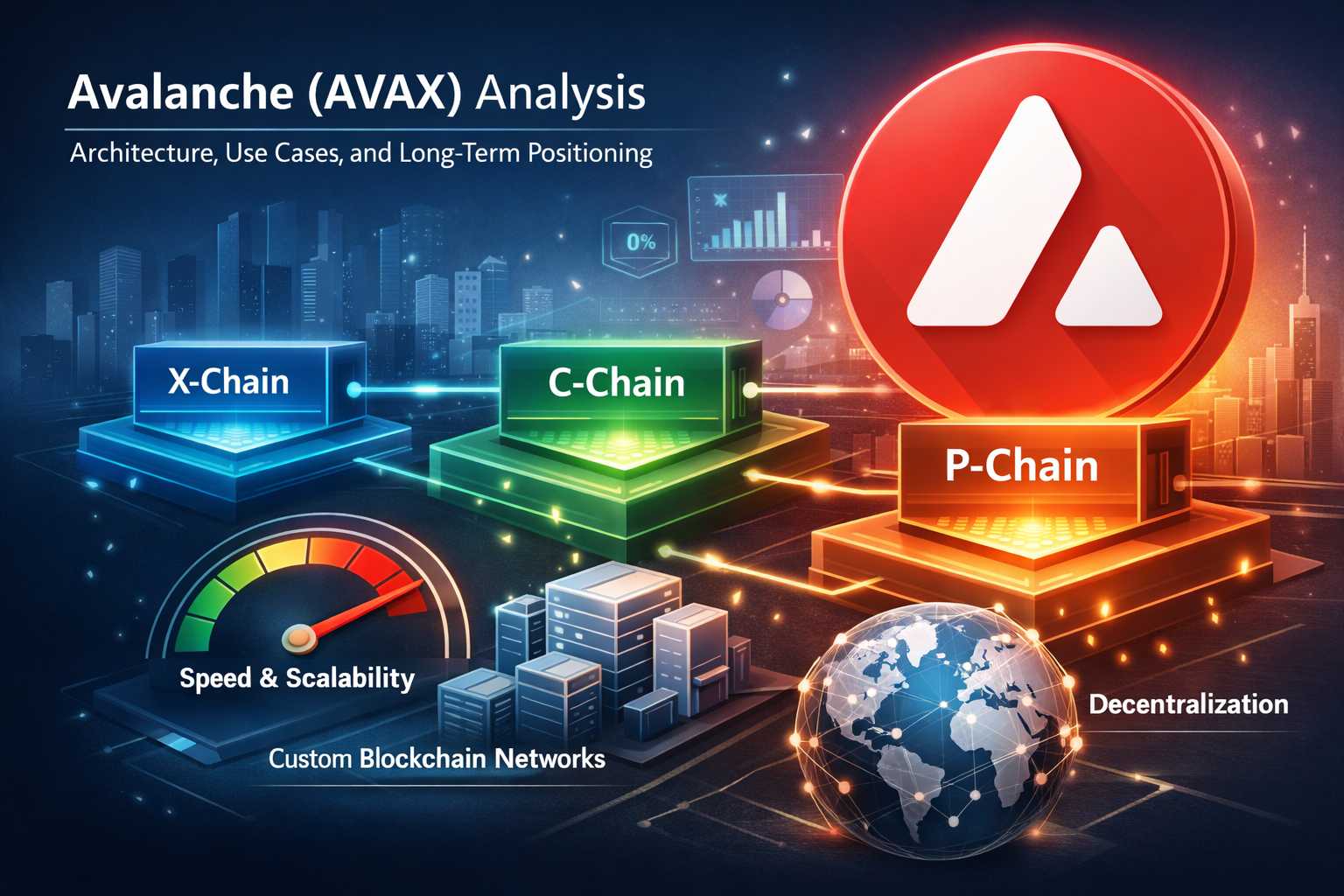
Avalanche (AVAX) remains one of the most structurally ambitious Layer-1 blockchain ecosystems within the cryptocurrency market.
Unlike blockchain networks focused purely on transaction speed or speculative hype cycles, Avalanche was designed around a broader infrastructure vision centered on:
- scalability
- custom blockchain environments
- high-performance execution
- institutional flexibility
- modular blockchain architecture
At the center of Avalanche’s long-term thesis is its subnet architecture — a system designed to allow developers, enterprises, and institutions to launch customized blockchain environments with independent rules and validator structures.
Because of this design, Avalanche occupies a unique position within crypto infrastructure markets.
Supporters view Avalanche as one of the strongest candidates for scalable blockchain deployment and institutional infrastructure adoption.
Critics argue that subnet adoption remains relatively early-stage and faces increasing competition from Ethereum Layer-2 ecosystems, modular infrastructure networks, and alternative high-performance Layer-1 blockchains.
Regardless of market opinion, Avalanche continues remaining one of the most recognized blockchain infrastructure ecosystems within crypto markets.
Today, Avalanche’s market behavior is influenced heavily by:
- Layer-1 competition
- subnet adoption
- institutional blockchain narratives
- developer activity
- DeFi participation
- gaming infrastructure
- market liquidity conditions
- broader crypto sentiment
In this analysis, we’ll explore:
- how Avalanche functions
- what makes Avalanche different
- the importance of subnet architecture
- AVAX tokenomics and staking
- Avalanche’s role within DeFi and blockchain infrastructure
- how Avalanche differs from Ethereum and Solana
- institutional and enterprise infrastructure potential
- the biggest strengths and risks surrounding Avalanche
- how investors often position AVAX within crypto portfolios
What Makes Avalanche Different?
Avalanche was designed to address one of blockchain’s largest structural challenges:
how to scale efficiently without sacrificing decentralization or flexibility.
Unlike many Layer-1 ecosystems that rely heavily on a single shared blockchain environment,
Avalanche introduced a modular architecture centered around multiple interoperable blockchains and customizable subnet infrastructure.
This allows Avalanche to support:
- high transaction throughput
- custom blockchain deployment
- specialized application ecosystems
- independent validator environments
- scalable execution layers
Rather than forcing all activity onto one congested blockchain, Avalanche enables different applications and ecosystems to operate in separate blockchain environments.
This became one of Avalanche’s defining architectural advantages.
Avalanche Consensus and Network Architecture
Avalanche operates using a unique consensus mechanism designed to optimize:
- speed
- scalability
- low latency
- network efficiency
The ecosystem consists of three primary chains:
- X-Chain (Exchange Chain)
- C-Chain (Contract Chain)
- P-Chain (Platform Chain)
Each chain serves different functions within the network.
The C-Chain is particularly important because it supports Ethereum-compatible smart contracts and decentralized applications.
This compatibility helped Avalanche attract developers already familiar with Ethereum tooling and infrastructure.
Avalanche’s consensus mechanism allows transactions to finalize rapidly while supporting high throughput compared to many older blockchain networks.
Supporters argue this creates strong infrastructure potential for large-scale blockchain activity.
Avalanche Subnets Explained
Subnets remain Avalanche’s most important long-term infrastructure feature.
A subnet is a customizable blockchain environment operating within the broader Avalanche ecosystem.
Subnets allow developers or institutions to create blockchains with:
- custom validator requirements
- specific governance rules
- specialized compliance structures
- independent execution environments
- custom fee systems
This flexibility differentiates Avalanche from many competing blockchain ecosystems.
For example, enterprises or institutions could theoretically launch:
- permissioned financial blockchains
- gaming ecosystems
- tokenized asset infrastructure
- region-specific blockchain systems
- compliance-focused environments
without congesting the broader Avalanche network.
Supporters believe subnet architecture could become increasingly valuable as blockchain adoption expands into specialized infrastructure markets.
Critics argue widespread subnet adoption remains uncertain and still requires significant ecosystem growth.
Avalanche and DeFi Infrastructure
Avalanche experienced major growth during earlier decentralized finance expansion cycles.
Its ecosystem attracted users because of:
- fast execution
- lower transaction fees
- Ethereum compatibility
- efficient smart contract infrastructure
Avalanche supports:
- decentralized exchanges
- lending protocols
- liquidity systems
- yield farming applications
- stablecoin infrastructure
- on-chain trading platforms
Because Avalanche remains compatible with Ethereum tooling, developers could migrate or expand applications relatively efficiently.
This helped Avalanche compete more effectively during periods of broader DeFi expansion.
However, Avalanche still faces strong competition from:
- Ethereum Layer-2 ecosystems
- Solana
- Base
- Arbitrum
- Optimism
- other Layer-1 networks
Maintaining ecosystem growth remains one of Avalanche’s largest long-term challenges.
AVAX Tokenomics and Staking
AVAX functions as the core utility asset within the Avalanche ecosystem.
AVAX is used for:
- transaction fees
- staking participation
- validator incentives
- network security
- subnet participation
One important characteristic of Avalanche’s tokenomics is fee burning.
Transaction fees paid on Avalanche are burned permanently rather than redistributed entirely to validators.
Supporters argue this introduces long-term scarcity pressure as network activity increases.
Staking also plays an important role within Avalanche infrastructure.
Validators stake AVAX to help secure the network and participate in consensus operations.
This creates additional utility for the asset beyond speculative trading.
Tokenomics in Crypto: Why Supply Design Determines Long-Term Value
Avalanche vs Ethereum
Avalanche and Ethereum differ significantly in architecture and scaling philosophy.
Ethereum increasingly follows a modular scaling model built around:
- Layer-2 rollups
- external execution layers
- distributed scalability infrastructure
Avalanche instead emphasizes:
- customizable blockchain environments
- subnet architecture
- high-performance Layer-1 execution
- integrated scalability systems
Supporters argue Avalanche’s architecture creates stronger flexibility for specialized blockchain infrastructure.
Ethereum supporters argue Ethereum maintains stronger:
- liquidity depth
- developer activity
- institutional adoption
- network effects
This competition between customizable infrastructure and dominant ecosystem liquidity remains one of the most important long-term themes within blockchain markets.
Avalanche vs Solana
Avalanche and Solana are often grouped together as high-performance Layer-1 ecosystems, but their infrastructure approaches differ significantly.
Solana prioritizes:
- maximum throughput
- integrated execution
- monolithic blockchain scaling
Avalanche prioritizes:
- modular subnet infrastructure
- custom blockchain deployment
- multi-chain scalability
Supporters of Avalanche believe subnet flexibility creates broader institutional and enterprise potential.
Supporters of Solana argue simplified architecture improves user experience and ecosystem activity.
This creates two very different long-term infrastructure strategies.
Avalanche and Institutional Infrastructure
Institutional blockchain adoption remains one of Avalanche’s most important long-term narratives.
Avalanche’s subnet architecture may allow institutions to launch:
- permissioned blockchains
- regulated financial infrastructure
- tokenized asset systems
- private settlement networks
- enterprise blockchain applications
while still maintaining interoperability with broader blockchain ecosystems.
Because of this flexibility, Avalanche is often discussed within institutional infrastructure conversations more frequently than many purely retail-focused ecosystems.
However, institutional blockchain adoption remains dependent on:
- regulation
- compliance standards
- security
- real-world implementation
- long-term ecosystem stability
Many enterprise blockchain initiatives also develop far more slowly than retail crypto narratives.
Avalanche Gaming and Consumer Applications
Avalanche also positioned itself within blockchain gaming and consumer application infrastructure.
Gaming ecosystems often require:
- high transaction throughput
- low fees
- customizable blockchain environments
- specialized execution systems
Subnet architecture may provide advantages for these types of applications because developers can launch dedicated blockchain infrastructure without competing for global network capacity.
Supporters believe gaming and consumer applications could become one of Avalanche’s largest long-term growth sectors.
However, blockchain gaming adoption remains highly uncertain and speculative.
Risks and Criticism
Despite its strong infrastructure design, Avalanche still faces important long-term risks and challenges.
These include:
- competition from Ethereum Layer-2 ecosystems
- slower-than-expected subnet adoption
- developer competition
- ecosystem fragmentation
- market volatility
- liquidity concentration risk
- speculative market cycles
- institutional adoption uncertainty
Critics also argue that Avalanche’s architecture may become unnecessarily complex compared to simpler blockchain ecosystems.
Others question whether large-scale subnet deployment will achieve meaningful long-term adoption.
Like most crypto ecosystems, Avalanche remains heavily influenced by broader liquidity cycles and investor sentiment.
How Investors Often View Avalanche
Within crypto markets, Avalanche is often viewed as infrastructure-focused Layer-1 exposure.
For many investors, AVAX represents exposure to:
- custom blockchain deployment
- subnet infrastructure
- high-performance blockchain systems
- DeFi infrastructure
- enterprise blockchain narratives
- scalable Layer-1 architecture
Compared to purely speculative ecosystems, Avalanche is often positioned more around infrastructure flexibility and long-term scalability potential.
At the same time, AVAX remains highly volatile and sensitive to broader crypto market conditions.
Conclusion
Avalanche remains one of the most structurally differentiated Layer-1 blockchain ecosystems within cryptocurrency markets.
Unlike blockchain networks focused purely on transaction speed or speculative narratives, Avalanche emphasizes:
- customizable blockchain infrastructure
- subnet scalability
- high-performance execution
- institutional flexibility
- modular ecosystem design
Its subnet architecture continues differentiating Avalanche from many competing Layer-1 ecosystems by allowing specialized blockchain environments to operate independently within the broader network.
At the same time, Avalanche still faces important challenges involving:
- subnet adoption
- developer competition
- ecosystem growth
- institutional implementation
- Layer-2 competition
- market volatility
Future developments surrounding enterprise blockchain infrastructure, gaming ecosystems, tokenized assets, and subnet deployment may play major roles in determining Avalanche’s long-term trajectory.
For investors, Avalanche is often viewed less as a short-term speculative asset and more as infrastructure exposure tied to scalable blockchain deployment and modular blockchain architecture.
Whether Avalanche ultimately becomes a dominant long-term infrastructure ecosystem will depend heavily on adoption, execution, developer growth, and its ability to compete within an increasingly crowded blockchain scalability market.
Bitcoin (BTC) Analysis: Market Structure, Key Drivers & What Comes Next
XRP Analysis: Cross-Border Liquidity, Institutional Adoption & Long-Term Positioning
Altcoins vs Memecoins vs Hype Coins: What’s the Difference and Why It Matters
Disclaimer: This article is for educational purposes only and does not constitute financial advice. Always do your own research.