
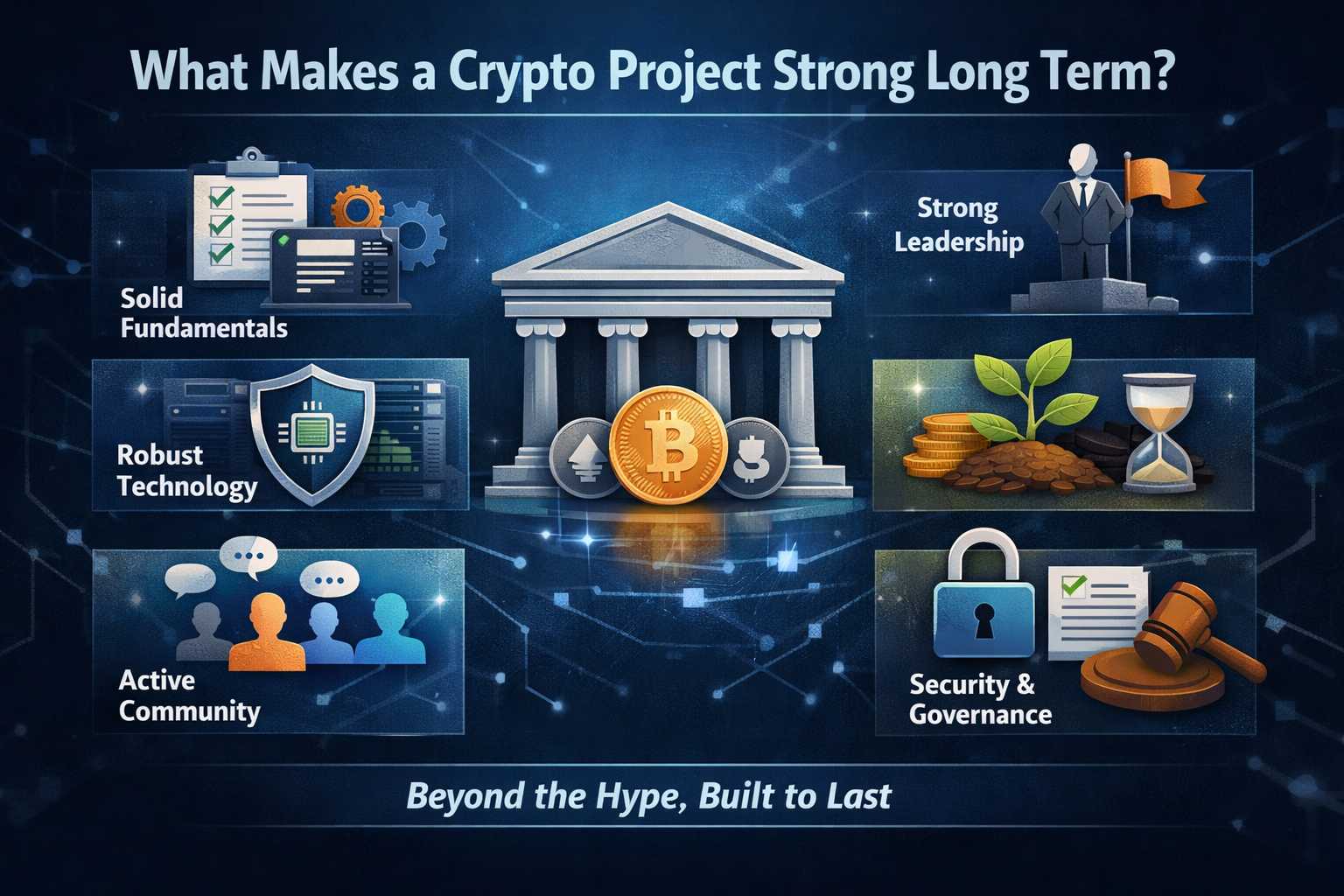
Thousands of cryptocurrency projects compete for investor capital, developer attention and real-world adoption.Some promise faster transactions.
Others focus on decentralized finance, artificial intelligence, tokenization, interoperability, payments or blockchain infrastructure.
During strong bull markets, many of these projects can appear successful.
Token prices rise.
Trading volume increases.
Social media attention grows.
New users enter the ecosystem.
But rising prices do not necessarily mean that a cryptocurrency project is becoming fundamentally stronger.
Speculation can push weak projects to extraordinary valuations.
At the same time, fundamentally important blockchain networks can experience long periods of disappointing price performance while development continues beneath the surface.
This creates one of the most important challenges in cryptocurrency investing:
How do you separate a genuinely strong crypto project from temporary market hype?
There is no single metric that provides the answer.
Long-term project strength depends on a combination of factors including:
- Real-world utility.
- Network adoption.
- Developer activity.
- Ecosystem growth.
- Token utility.
- Tokenomics.
- Security.
- Decentralization.
- Competition.
- Economic sustainability.
Investors must also make another crucial distinction.
A strong blockchain does not automatically create a strong investment.
A network can have impressive technology and growing adoption while the associated token suffers from poor tokenomics, excessive dilution or weak value capture.
Understanding these differences is the foundation of crypto fundamental analysis.
Rather than asking which cryptocurrency might pump next, fundamental analysis asks a much more important long-term question:
Which projects have the structure, economics and adoption required to remain relevant across multiple market cycles?
In This Analysis, We’ll Explore:
- What crypto fundamental analysis means
- Why price and project quality are different
- Whether a project solves a real problem
- Whether blockchain technology is actually necessary
- How to evaluate real-world utility
- Network adoption and active users
- Transaction activity and economic activity
- Organic growth vs incentivized activity
- Developer activity
- Ecosystem growth
- Network effects
- Token utility and value capture
- Token supply and distribution
- Inflation, emissions and token unlocks
- Market capitalization vs Fully Diluted Valuation
- Network fees and economic sustainability
- Security and decentralization
- Governance
- Competition and competitive advantages
- Partnerships vs genuine adoption
- Team, foundation and funding
- Regulatory risk
- Liquidity
- Market-cycle survivability
- Fundamental red flags
- Why good technology can still produce a poor investment
- How investors can compare crypto projects
- A practical fundamental-analysis checklist
What Is Crypto Fundamental Analysis?
Crypto fundamental analysis is the process of evaluating the underlying strength of a cryptocurrency project rather than focusing primarily on its current price.
Technical analysis examines price behavior, momentum, volume and market structure.
Fundamental analysis asks different questions.
Why does the network exist?
Who uses it?
What creates demand?
Are developers building on it?
Does the token serve an essential purpose?
Can the ecosystem survive without constant speculation?
These questions help investors understand whether a project has characteristics that could support long-term relevance.
Unlike traditional companies, cryptocurrency networks cannot always be evaluated through familiar metrics such as earnings, profit margins or cash flow.
Bitcoin is not a corporation.
Ethereum does not operate like a publicly traded company.
Decentralized protocols can function without traditional management structures.
Crypto fundamental analysis therefore requires investors to evaluate several different layers simultaneously.
These include:
Technology: What does the network actually do?
Adoption: Are people or businesses using it?
Economics: Does usage create sustainable economic activity?
Tokenomics: How is the token created, distributed and used?
Ecosystem: Are developers and applications building around the network?
Security: Can the infrastructure operate reliably over long periods?
A strong project generally needs several of these elements working together.
Price Performance Is Not the Same as Project Quality
One of the easiest mistakes in cryptocurrency investing is assuming that rising prices confirm strong fundamentals.
Crypto markets regularly demonstrate why this assumption is dangerous.
During speculative periods, token prices can rise because of:
- Market narratives.
- Social media attention.
- Exchange listings.
- Low circulating supply.
- Leverage.
- Memecoin speculation.
- Short-term capital rotation.
- Fear of missing out.
None of these automatically improve the underlying network.
A cryptocurrency can therefore experience a 500% rally without becoming five times more useful.
The opposite can also happen.
A token can decline substantially while its ecosystem continues expanding.
Developers may continue building.
Network upgrades may improve scalability.
Applications may attract new users.
Infrastructure may become more reliable.
Fundamental development and token price can therefore diverge for significant periods.
Eventually, price matters.
Investors ultimately require demand for the asset itself.
But evaluating long-term potential requires understanding what might create sustainable demand after speculative excitement disappears.
Does the Project Solve a Real Problem?
The first fundamental question should be simple:
Why does this project need to exist?
Strong blockchain projects generally attempt to solve identifiable problems.
Examples can include:
- Decentralized payments.
- Smart-contract execution.
- Blockchain scalability.
- Cross-chain communication.
- Decentralized data.
- Digital asset ownership.
- Real World Asset tokenization.
- Decentralized computing.
- Data storage.
- Privacy.
- Digital identity.
A project does not necessarily need millions of users immediately.
Emerging infrastructure can require years to develop.
But investors should be able to understand what problem the network is attempting to solve.
Several questions can help.
Who needs this technology?
What does the network improve?
Are existing solutions inadequate?
Could demand realistically grow over time?
Is there evidence that users actually want the solution?
Projects built primarily around a token rather than a genuine problem may struggle once speculative demand disappears.
Does the Project Actually Need a Blockchain?
Solving a real problem is only the first step.
The next question is:
Why does solving this problem require blockchain technology?
Not every digital service benefits from decentralization.
Traditional databases can often process information faster and more cheaply than decentralized networks.
Blockchain becomes more compelling when characteristics such as these matter:
- Trustless settlement.
- Censorship resistance.
- Transparent verification.
- Permissionless participation.
- Decentralized ownership.
- Cross-border transfer.
- Digital scarcity.
- Reduced dependence on centralized intermediaries.
If a project could provide essentially the same service through conventional infrastructure, investors should question what the blockchain actually contributes.
The same applies to the token.
A project may have a legitimate product but still lack a convincing reason for its cryptocurrency to exist.
Ideally, there should be a logical connection:
Real problem → blockchain solution → network usage → token demand
The stronger this relationship becomes, the stronger the potential fundamental investment case.
Real-World Utility
Utility describes what people can actually do with a blockchain or token.
Different cryptocurrencies can provide completely different forms of utility.
Bitcoin may be evaluated around monetary properties and settlement.
Smart-contract platforms may be evaluated through applications built on their infrastructure.
Oracle networks may be evaluated through the data services they provide to other blockchain applications.
Interoperability projects may be evaluated by their ability to connect otherwise separate networks.
The important question is not whether a project claims to have utility.
Almost every cryptocurrency claims that.
The question is:
Is the utility creating actual demand?
A project with impressive technology but almost no usage remains largely theoretical.
A project whose infrastructure becomes increasingly integrated into other applications provides stronger evidence that the technology serves a genuine purpose.
Network Adoption and Real Users
Technology becomes considerably more valuable when people actually use it.
Network adoption is therefore one of the most important components of fundamental analysis.
Depending on the blockchain, investors may examine:
- Active addresses.
- Transaction activity.
- Application users.
- Stablecoin activity.
- DeFi participation.
- Staking.
- Wallet growth.
- Protocol integrations.
- Institutional usage.
However, adoption metrics require careful interpretation.
One address does not equal one person.
One individual can control multiple wallets.
Automated bots can create enormous amounts of activity.
Airdrop campaigns can temporarily attract users.
Token rewards can incentivize behavior that disappears once the rewards stop.
Raw numbers can therefore exaggerate genuine adoption.
Investors should look for persistent usage rather than temporary activity.
Active Addresses: What Do They Really Tell Investors?
Active addresses are frequently used to estimate blockchain participation.
If the number of addresses interacting with a network increases consistently over several years, that can provide evidence that usage is expanding.
But active addresses have limitations.
One user may control ten addresses.
A trading bot may interact with hundreds.
Airdrop farmers may create multiple wallets specifically to qualify for rewards.
This means a headline such as:
“Active addresses increased 200%”
requires additional context.
Investors should ask:
Why did activity increase?
Did it remain elevated?
Did transaction value increase as well?
Did application usage grow?
Did fees or other forms of economic activity increase?
The strongest adoption signals generally appear when multiple independent metrics improve together.
Transaction Count vs Meaningful Economic Activity
Transaction count is another metric that can appear more impressive than it really is.
Suppose Blockchain A processes ten million transactions per day while Blockchain B processes one million.
At first glance, Blockchain A appears significantly more successful.
But what if most of those transactions are automated bots?
Or validator communications?
Or extremely small transactions created because using the network costs almost nothing?
Transaction quantity does not automatically equal economic value.
Investors should therefore investigate what the network is actually being used for.
Meaningful activity may include:
- Payments.
- Trading.
- Lending.
- Tokenization.
- Smart-contract execution.
- Business settlement.
- Application usage.
- Infrastructure services.
The objective is not simply to identify the blockchain producing the largest number.
It is to determine whether the network is supporting economic activity that users genuinely value.
Organic Growth vs Incentivized Growth
Crypto projects frequently use financial incentives to accelerate adoption.
Examples include:
- Airdrops.
- Liquidity mining.
- Staking rewards.
- Trading incentives.
- Developer grants.
- Token rewards.
These programs are not automatically negative.
Incentives can help new ecosystems attract liquidity, developers and early users.
But investors need to understand what happens when those incentives disappear.
Imagine a blockchain attracts enormous activity because users receive valuable tokens for interacting with applications.
Once the rewards stop, activity collapses.
Was the network genuinely adopted?
Or were users primarily there to collect rewards?
This distinction matters enormously.
Incentivized activity can create growth.
Organic activity demonstrates retention.
Strong ecosystems eventually need users who remain because the network itself provides value.
Developer Activity
Users create demand for blockchain services.
Developers create the applications and infrastructure that make those services possible.
Developer activity can therefore provide important information about the health of an ecosystem.
Investors may examine:
- Protocol upgrades.
- Active development teams.
- New applications.
- Development tools.
- Software libraries.
- Infrastructure improvements.
- Developer documentation.
- Hackathons.
- Grants.
- Ecosystem expansion.
But developer metrics can also be misinterpreted.
A project with thousands of minor code updates is not automatically stronger than one producing fewer but more meaningful upgrades.
The relevant question is:
What is actually being built?
Long-term developer commitment becomes particularly interesting during bear markets.
When token prices fall and speculative attention disappears, developers who continue building provide evidence that the ecosystem extends beyond short-term market excitement.
Developers and Network Effects
Successful blockchain ecosystems can develop powerful network effects.
Developers create applications.
Applications attract users.
Users attract liquidity.
Liquidity makes applications more useful.
Greater activity attracts additional developers.
The cycle can become:
Developers → Applications → Users → Liquidity → More Developers
This is one reason why technological superiority alone does not guarantee that a new blockchain will defeat an established competitor.
A newer network may offer:
- Faster transactions.
- Lower fees.
- Better scalability
But an established ecosystem may already have:
- Thousands of developers.
- Deep liquidity.
- Major applications.
- Wallet infrastructure.
- Institutional integrations.
- Established users.
Recreating that ecosystem can be significantly harder than building faster technology.
Evaluating Ecosystem Growth
A blockchain should therefore be evaluated as more than an isolated network.
Its surrounding ecosystem can become one of its strongest competitive advantages.
Depending on the project, investors can examine growth in:
- Decentralized applications.
- DeFi protocols.
- Stablecoins.
- Wallets.
- Developer tools.
- Oracles.
- Bridges.
- Institutional infrastructure.
- Payment applications.
- Real World Asset platforms.
- Gaming.
- Decentralized infrastructure.
But once again, quantity alone is not enough.
A blockchain with 500 applications that almost nobody uses may be fundamentally weaker than a blockchain with 50 applications supporting substantial economic activity.
Investors should focus on:
- Usage
- Retention
- Liquidity
- Integration
- Economic relevance
rather than simply counting projects.
The Bear Market Test
Bull markets can make almost every cryptocurrency ecosystem appear healthy.
Capital is abundant.
Token prices rise.
Developers receive funding.
Users chase new opportunities.
Trading activity expands.
Narratives attract attention.
Bear markets reveal something much more useful.
They test whether the ecosystem can survive when speculation disappears.
Investors should observe:
- Does development continue?
- Do users remain?
- Does liquidity remain?
- Does the network continue operating reliably?
- Are important applications still active?
- Does the project continue attracting integrations?
- Is funding sustainable?
Projects that remain active across multiple difficult market environments demonstrate something that short-term price performance cannot:
resilience.
And resilience matters enormously in cryptocurrency.
The long-term winners are not simply the projects capable of attracting attention during a bull market.
They are the projects capable of remaining relevant after that attention disappears.
Token Utility and Value Capture
A strong blockchain does not automatically mean its token is a strong investment.
This is one of the most important distinctions in crypto fundamental analysis.
A token may be used for:
- Transaction fees.
- Staking.
- Governance.
- Network security.
- Payments.
- Access to services.
- Collateral.
However, simply having utility does not guarantee long-term demand.
Investors should ask whether increased network usage actually creates additional demand for the token.
For example, if a blockchain attracts millions of users but those users rarely need to hold or use the native token, the relationship between adoption and token value may be relatively weak.
This is known as value capture.
Strong token economics generally create a clear relationship between:
Network growth → increased usage → token demand
The stronger that relationship becomes, the more directly the token may benefit from ecosystem growth.
Understanding Tokenomics
Tokenomics describes the economic structure surrounding a cryptocurrency.
It determines how tokens are created, distributed and introduced into circulation.
Important factors include:
- Circulating supply.
- Maximum supply.
- Inflation.
- Token distribution.
- Vesting schedules.
- Token unlocks.
- Staking rewards.
- Token burns.
These factors can significantly influence long-term performance.
A technically impressive blockchain can still struggle as an investment if enormous amounts of new supply continuously enter the market.
Investors should therefore evaluate demand and supply together.
Growing adoption is positive.
But if token supply expands even faster than demand, existing holders may experience substantial dilution.
Tokenomics in Crypto: Why Supply Design Determines Long-Term Value
Circulating Supply vs Maximum Supply
One of the easiest ways to misunderstand cryptocurrency valuations is by looking only at token price.
A cryptocurrency trading at $0.10 is not necessarily cheaper than one trading at $100.
Supply matters.
Suppose:
Token A
Price: $0.10
Circulating supply: 100 billion
Market cap: $10 billion
Token B
Price: $100
Circulating supply: 10 million
Market cap: $1 billion
Despite having a much higher individual token price, Token B has the lower overall market valuation.
This is why investors should focus on market capitalization rather than simply comparing token prices.
But even market capitalization does not tell the entire story.
Investors also need to understand how much supply has not yet entered circulation.
What Is Market Cap in Crypto? Meaning, Calculation and Investment Impact
Token Unlocks and Dilution
Many cryptocurrency projects release their token supply gradually.
Tokens may initially be allocated to:
- Founders.
- Employees.
- Early investors.
- Foundations.
- Ecosystem incentives.
- Community programs.
These tokens are often locked for predetermined periods before gradually entering circulation.
This creates token unlocks.
Large future unlocks deserve attention because they increase the amount of supply potentially available to the market.
However, an unlock does not automatically mean prices will fall.
Newly unlocked tokens still need to be sold before they create direct selling pressure.
The important issue is dilution.
If circulating supply increases significantly while demand remains unchanged, each existing token represents a smaller share of the overall supply.
Investors should therefore understand not only how many tokens exist today, but how many could enter circulation in the future.
Inflation and Token Emissions
Some cryptocurrencies continuously create new tokens.
These may be distributed through:
- Mining rewards.
- Staking rewards.
- Validator incentives.
- Ecosystem incentives.
New issuance can serve an important purpose.
Networks need mechanisms to reward participants who provide security, liquidity or other services.
But high emissions also increase supply.
This becomes particularly important when evaluating staking yields.
A project offering a 15% staking return may initially appear attractive.
But if token supply is also expanding rapidly, part of that yield may simply compensate investors for dilution.
The relevant question is therefore not:
How high is the staking yield?
But:
Where does that yield come from?
Sustainable economic activity and continuous token issuance are very different sources of returns.
Market Capitalization vs Fully Diluted Valuation
Market capitalization measures the value of the tokens currently circulating.
The basic calculation is:
Token Price × Circulating Supply = Market Capitalization
Fully Diluted Valuation, commonly known as FDV, looks at the broader potential supply.
Suppose a cryptocurrency trades at $2.
There are currently 500 million tokens circulating.
Its market capitalization would be:
$1 billion
But imagine the project eventually has 5 billion tokens.
At the same $2 price, its Fully Diluted Valuation would be:
$10 billion
That difference matters.
A project can appear relatively small based on current market capitalization while already carrying a much larger valuation when future supply is considered.
A large gap between market cap and FDV can therefore indicate significant future dilution risk.
It does not automatically make the project unattractive.
But investors should understand how much additional demand may eventually be required to absorb future supply.
Market Cap vs Fully Diluted Valuation: How to Value a Cryptocurrency Properly
Network Fees and Economic Activity
Network activity becomes more meaningful when users are willing to pay for the services a blockchain provides.
Depending on the project, fees may come from:
- Transactions.
- Smart-contract execution.
- Trading.
- Cross-chain communication.
- Data services.
- Storage.
- Other network services.
Growing fees can indicate that users place genuine economic value on the network.
But investors should also examine where those fees go.
They may be distributed to:
- Validators.
- Stakers.
- Protocol treasuries.
- Liquidity providers.
- Token burns.
This helps investors understand whether increasing network activity creates economic benefits for participants within the ecosystem.
A network generating significant activity but almost no sustainable economic value may be less attractive than headline transaction numbers suggest.
Security and Network Reliability
A blockchain can have excellent technology and attractive tokenomics, but none of that matters if users cannot trust the network.
Security is therefore fundamental.
Investors should examine:
- Network uptime.
- Major exploits.
- Validator security.
- Smart-contract vulnerabilities.
- Previous outages.
- Response to security incidents.
No blockchain is completely immune to technical problems.
The important question is how frequently problems occur and how effectively the ecosystem responds.
Repeated outages or major security failures can damage confidence and discourage developers, users and institutions from building on the network.
Long-term infrastructure needs to be reliable.
Decentralization
Decentralization is another important factor, although different blockchains make different trade-offs.
Investors can examine:
- Validator concentration.
- Token ownership.
- Governance power.
- Infrastructure dependence.
- Control by foundations or development teams.
Greater decentralization can improve censorship resistance and reduce dependence on individual organizations.
However, decentralization often comes with trade-offs involving speed, scalability and coordination.
The objective is therefore not necessarily to identify the blockchain with the largest number of validators.
Investors should understand where control exists within the system and what risks that creates.
Competition and Competitive Advantage
Almost every major crypto sector contains multiple competing projects.
Smart-contract platforms compete for developers and users.
Layer-2 networks compete for Ethereum activity.
Oracle networks compete for data integrations.
Interoperability projects compete to connect different blockchains.
Having strong technology is therefore not enough.
Investors should ask:
Why would users choose this project instead of its competitors?
Potential competitive advantages include:
- Strong network effects.
- Deep liquidity.
- Large developer ecosystems.
- Superior technology.
- Lower costs.
- Better user experience.
- Institutional adoption.
- Security.
- Established infrastructure.
The stronger and harder to replicate these advantages become, the more defensible the project’s long-term position may be.
Partnerships vs Real Adoption
Crypto projects frequently announce partnerships.
These announcements can sound impressive.
But a partnership does not necessarily mean meaningful adoption has occurred.
Investors should distinguish between:
Announcement
and
actual usage.
A company exploring blockchain technology is very different from a company actively using a network for significant economic activity.
The strongest evidence usually appears after the announcement.
Is the technology actually being deployed?
Are transactions occurring?
Are users interacting with the service?
Is the partnership expanding?
Real adoption matters more than logos displayed on a project website.
Surviving Multiple Crypto Cycles
One of the strongest tests of a cryptocurrency project is time.
Crypto markets repeatedly move through periods of:
- Euphoria.
- Speculation.
- Crashes.
- Fear.
- Consolidation.
- Recovery.
Thousands of projects attract attention during bull markets.
Far fewer remain relevant several years later.
Projects that survive multiple cycles demonstrate several valuable characteristics.
They may retain:
- Developers.
- Users.
- Liquidity.
- Infrastructure.
- Community support.
- Network security.
Survival alone does not guarantee future success.
Older projects can still lose relevance.
But a network that continues developing through several difficult market environments has demonstrated resilience that a newly launched project has not yet proven.
Fundamental Red Flags
No individual warning sign automatically makes a cryptocurrency a bad investment.
But several red flags together deserve attention.
These include:
- No clear use case.
- Very limited real usage.
- Heavy dependence on token incentives.
- Extremely concentrated token ownership.
- Large future unlocks.
- High inflation.
- Weak developer activity.
- Repeated security problems.
- Declining ecosystem activity.
- Unrealistic promises.
- Partnerships without measurable adoption.
- Weak token utility.
- Extremely high valuation relative to current adoption.
Fundamental analysis is partly about identifying strengths.
It is equally about recognizing risks before market sentiment makes them obvious.
Why a Great Blockchain Can Still Be a Bad Investment
This is one of the most important lessons in crypto investing.
A project can have:
- Excellent technology.
- Strong developers.
- Growing users.
- Fast transactions.
- Important partnerships.
and still produce disappointing returns for token holders.
Why?
Because investment returns depend on more than technological success.
The token may suffer from:
- Excessive dilution.
- Weak value capture.
- High initial valuation.
- Large insider allocations.
- Limited token demand.
This creates three separate questions:
Is the technology good?
Is the network successful?
Is the token attractive as an investment?
The answer does not always have to be yes to all three.
A Practical Crypto Fundamental Analysis Checklist
Before investing in a cryptocurrency, investors can work through a relatively simple framework.
Purpose: Does the project solve a genuine problem?
Blockchain Necessity: Does the solution actually benefit from blockchain technology?
Adoption: Are users genuinely using the network?
Developers: Is the ecosystem actively being developed?
Token Utility: Does the token serve an important function?
Tokenomics: Is supply growth sustainable?
Unlocks: How much future supply remains locked?
Valuation: How do market capitalization and FDV compare?
Economics: Does network usage generate meaningful economic activity?
Security: Has the network demonstrated reliability?
Competition: Does the project have a defensible advantage?
Survivability: Can the ecosystem remain active when market hype disappears?
No single answer determines whether an investment will succeed.
The purpose of the checklist is to build a complete picture.
Conclusion
Evaluating a cryptocurrency project requires much more than watching price.
Strong long-term projects generally combine several characteristics:
Real utility.
Growing adoption.
Active development.
Sustainable tokenomics.
Reliable infrastructure.
Competitive advantages.
And the ability to survive changing market conditions.
But investors must also distinguish between the success of a blockchain and the investment potential of its token.
A network can become widely used while token holders experience dilution.
A technically advanced project can struggle to attract users.
A popular token can rise dramatically without creating meaningful long-term value.
This is why fundamental analysis should never depend on one metric.
Instead, investors should examine how technology, adoption, economics, tokenomics and competition interact.
The goal is not to identify the cryptocurrency with the most impressive marketing or fastest recent price increase.
It is to answer a more difficult question:
Is this ecosystem creating something valuable enough to remain relevant when the hype disappears?
That question cannot predict the next market move.
But for long-term investors, it provides a much stronger foundation than price alone.
Put Fundamental Analysis Into Practice
Bitcoin (BTC) Analysis: Liquidity, Market Dominance, Institutional Adoption & Long-Term Positioning
Ethereum (ETH) Analysis: Smart Contract Infrastructure, Layer-2 Scaling & Long-Term Positioning
Solana (SOL) Analysis: High-Speed Infrastructure, Scalability & Long-Term Positioning
Chainlink (LINK) Analysis: Oracles, Cross-Chain Infrastructure & Long-Term Positioning
Sui (SUI) Analysis: Architecture, Scalability, Tokenomics & Long-Term Positioning
Disclaimer: This article is for educational and informational purposes only and does not constitute financial or investment advice. Cryptocurrency investments involve significant risk. Fundamental strength does not guarantee positive investment returns. Always conduct your own research before making investment decisions.