
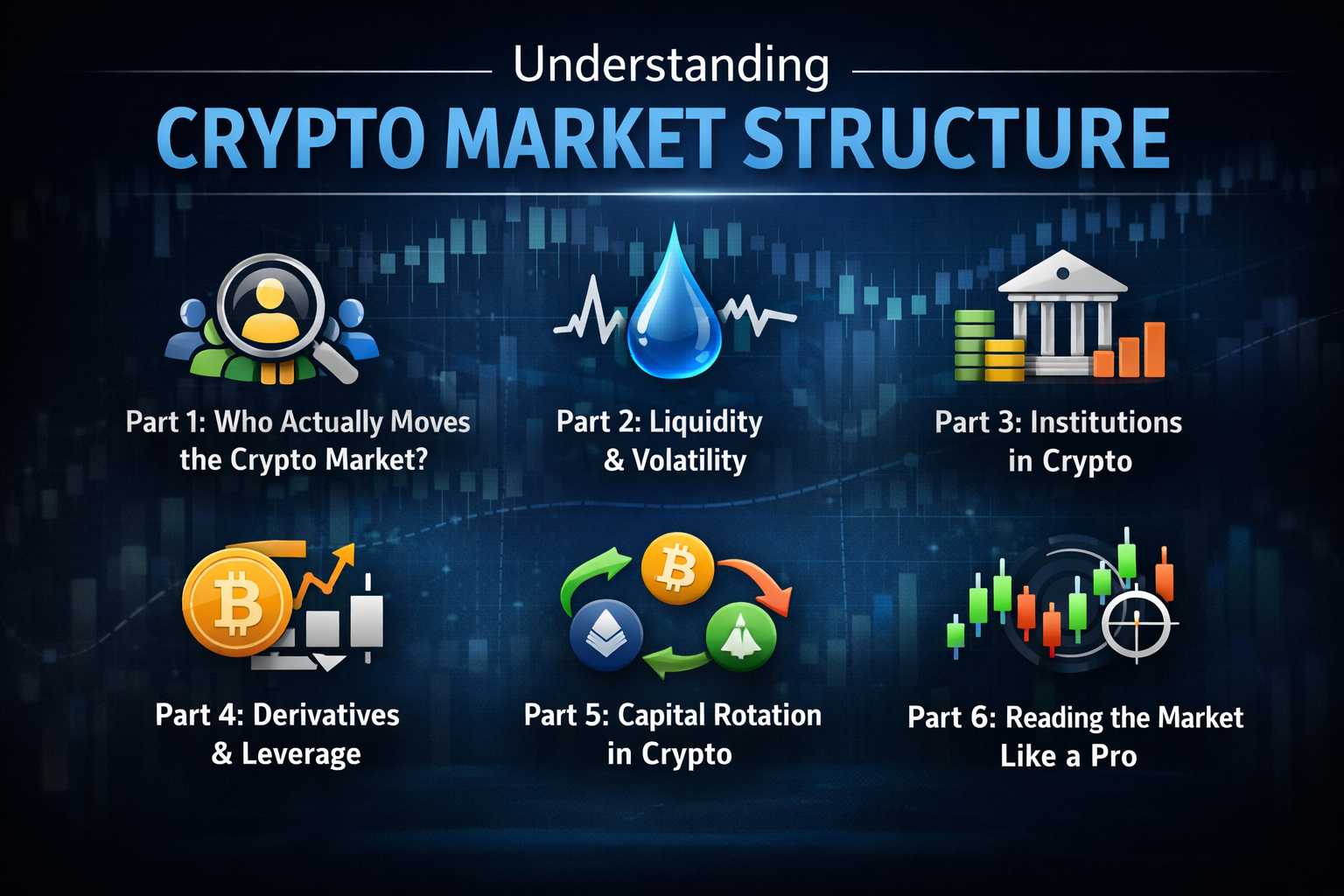
Many retail investors believe cryptocurrency prices move randomly or are driven primarily by news and social media trends.
In reality, markets are shaped by different types of participants, each with their own strategies, capital levels and time horizons.
Understanding who these participants are — and how they influence the market — can provide valuable insight into price behavior. Instead of reacting emotionally to short-term volatility, investors can begin to interpret market movements within a broader structural framework.
To understand how crypto markets function, it is useful to examine the roles of three key groups: retail investors, institutional capital and market makers.
Retail Investors
Retail investors represent individual market participants trading with personal capital.
This group includes everyday traders, long-term holders and new investors entering the market during periods of strong price momentum.
Retail activity is often heavily influenced by:
- social media narratives
- trending news headlines
- price momentum
- fear of missing out (FOMO)
Because retail participation tends to increase during bull markets, it can amplify price movements when optimism spreads quickly across online communities.
However, retail investors usually operate with smaller capital amounts compared to professional market participants, which limits their ability to move markets independently.
Institutional Capital
Institutional investors include hedge funds, asset managers, venture capital firms and other large financial entities.
These participants typically operate with significantly larger pools of capital and often follow structured investment strategies.
Institutional activity in crypto has increased over the past decade as digital assets have become more widely accepted within traditional financial markets.
Institutions tend to focus on:
- long-term strategic positions
- liquidity conditions
- macroeconomic factors
- risk management frameworks
Because of their larger capital allocations, institutional investors can influence market trends over longer periods, especially when entering or exiting positions in major assets.
Market Makers
Market makers play a different but equally important role in crypto markets.
Their primary objective is to provide liquidity by continuously offering buy and sell orders. This helps maintain smoother trading conditions and reduces extreme price gaps.
Market makers earn profits from the spread between bid and ask prices while helping exchanges maintain functional order books.
Without market makers, many cryptocurrency markets would experience significantly higher volatility and lower liquidity.
How These Participants Interact
Crypto markets are dynamic environments where retail investors, institutions and market makers interact constantly.
Retail traders often react quickly to price movements and market narratives, while institutional investors typically operate on longer time horizons.Market makers facilitate this interaction by ensuring that trades can occur efficiently.
During periods of strong bullish sentiment, retail participation tends to increase dramatically, pushing prices higher as demand expands.
During market corrections, institutional investors sometimes take advantage of lower prices to accumulate positions, while retail traders may exit the market due to fear or uncertainty.
This constant interaction between different market participants helps shape the overall structure of the crypto market.
Why This Matters for Investors
Understanding who moves the market can help investors interpret price action more effectively.
Rather than assuming that every market movement is purely random, investors can begin to recognize patterns in behavior.
For example:
- rapid retail enthusiasm can sometimes signal overheated markets
- institutional accumulation may occur quietly during periods of low sentiment
- liquidity providers influence short-term volatility
Recognizing these dynamics allows investors to approach the market with greater awareness and discipline.
Conclusion
Cryptocurrency markets are influenced by multiple types of participants, each playing a unique role in shaping price movements.
Retail investors contribute momentum and market enthusiasm, institutional capital provides large-scale investment flows, and market makers help maintain liquidity and trading efficiency.
By understanding how these groups interact, investors can gain deeper insight into how markets function and why price movements occur.
This structural perspective forms the foundation for interpreting broader market behavior. You May Also Like ->
Part 1: Mindset – Think Like a Smart Crypto Investor
Part 1: Portfolio Allocation & Diversification – Advanced Crypto Investing Strategies

Disclaimer: This article is for informational purposes only and does not constitute financial advice. Cryptocurrency markets are volatile and involve significant risk. Always conduct your own research before making investment decisions.