
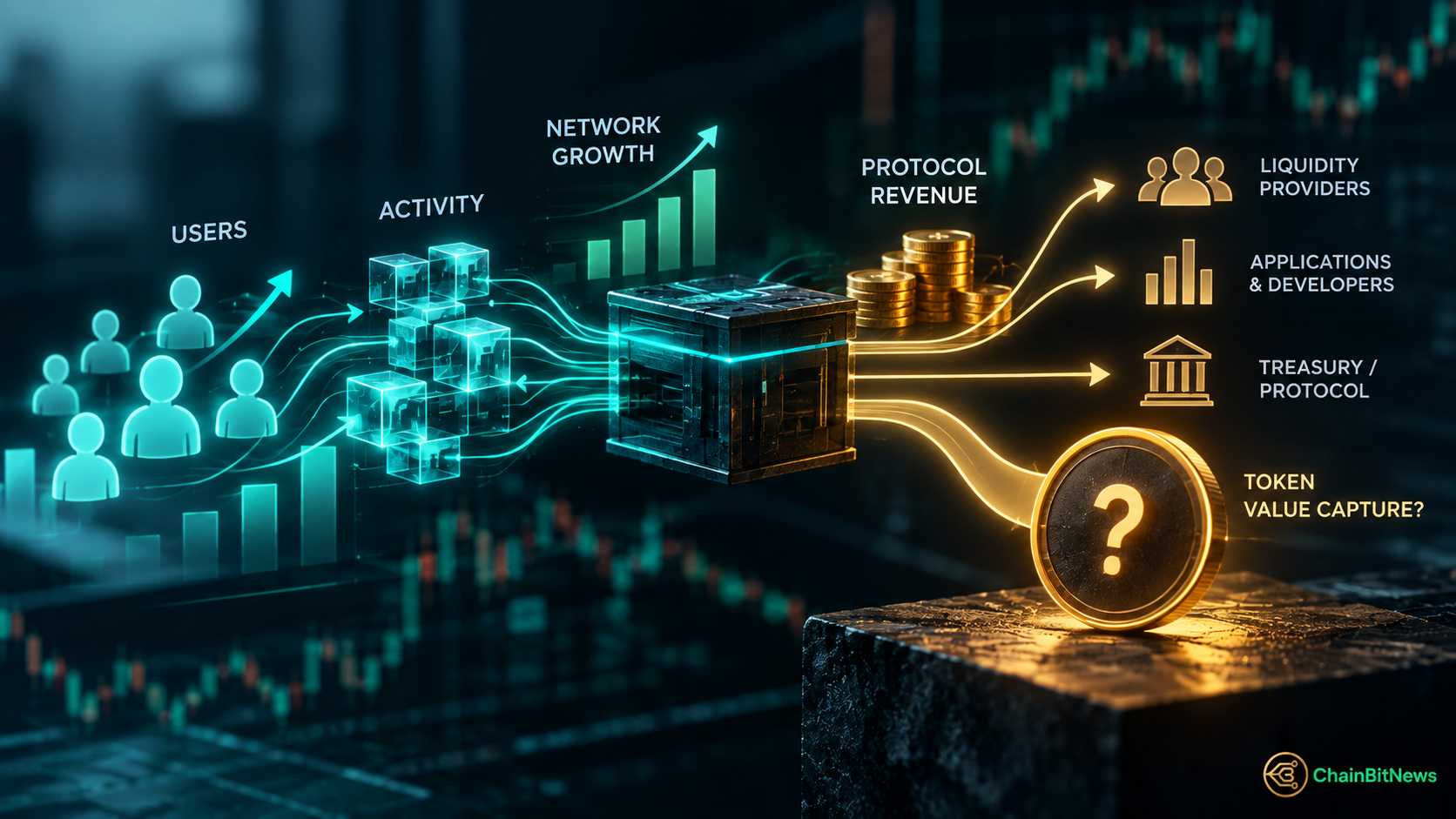
A blockchain network attracts more users. Transaction activity increases, developers launch new applications, and the ecosystem begins processing more economic activity than ever before.
The native token, however, tells a different story.
Its price may stagnate. New supply enters circulation. Network fees remain small, or the revenue generated by applications flows to businesses and participants who have no obligation to share it with token holders.
Nothing about this outcome necessarily means the network has failed.
It exposes a distinction that is often lost in cryptocurrency analysis: a network can create substantial economic value without its token capturing a meaningful share of that value.
The difference is not merely theoretical. It determines whether adoption, transaction volume and protocol revenue provide genuine evidence for a token’s economic relevance or simply demonstrate that the underlying technology is being used.
Understanding token value capture requires following the economics from the original activity to the parties receiving its benefits, then examining whether a durable mechanism connects those benefits to the token.
That connection can be strong, weak, indirect or almost nonexistent. And even when it works, a token can still be an unattractive investment at the wrong valuation.
A Growing Network Is Not the Same as a Valuable Token
Imagine a decentralized trading protocol that becomes increasingly popular.
In its first year, traders execute $2 billion in transactions. A few years later, annual trading volume reaches $20 billion. The platform attracts professional market makers, improves execution and becomes an important part of its sector.
Its activity has increased tenfold.
Does that mean its native token should become ten times more valuable?
Not necessarily.
Trading volume measures the value of transactions processed. It does not measure the revenue retained by the protocol, the amount of economic benefit reaching the token or what investors should pay for that benefit.
Suppose the platform charges an average effective fee of 0.05% on its original $2 billion in trading volume. That produces $1 million in gross trading fees.
Now suppose volume increases to $20 billion, but competition forces the effective fee down to 0.005%. Gross fees remain $1 million.
The platform has become far more widely used, yet its gross fee generation has not increased.
These figures are hypothetical. They illustrate a structural problem: activity can grow faster than the economic value generated per unit of activity.
Even that is only the beginning of the analysis. Gross fees may be shared with liquidity providers, market makers, application developers or other participants. The protocol may retain only a fraction, and its token may have no direct claim on the remainder.
A successful product, a productive protocol and an economically valuable token are therefore three different propositions.
The distinctions matter because crypto investors often move too quickly from evidence of adoption to expectations about token performance.
Adoption can establish that a service is useful. It cannot, by itself, establish who benefits financially from providing that service.
ChainBitNews examines adoption, project quality, tokenomics and economic sustainability in its broader guide to evaluating a crypto project. Token value capture begins where that general assessment becomes more specific: identifying the economic mechanism that connects the project’s success to its native asset.
Where Does the Economic Value Actually Go?
Return to the hypothetical trading protocol.
Traders pay fees because the platform provides something useful: access to markets, execution infrastructure and liquidity. That willingness to pay is evidence of economic demand for the service.
But the payment does not automatically become value for the native token.
Part of the fees may compensate liquidity providers for supplying capital. Another portion may go to market operators, infrastructure providers or a treasury. Some may be spent on incentives designed to attract new users.
Each recipient performs a different economic function.
Liquidity providers may be earning compensation for risk. Operators may be paid for running infrastructure. A treasury may accumulate resources that support development or subsidize future growth.
Those outcomes can strengthen the ecosystem without creating a direct economic entitlement for token holders.
This is where terminology becomes important.
Fees describe what users pay for a service.
Protocol revenue generally refers to the portion retained by the protocol or its designated treasury, although reporting conventions vary.
Token-holder economic benefits depend on what the token actually receives through distributions, supply mechanisms, required usage or other enforceable arrangements.
These categories should not be treated as interchangeable.
A protocol reporting $10 million in annual fees may retain far less than that amount. A treasury receiving several million dollars may not distribute any of it. A governance token may influence treasury decisions without granting holders an automatic right to the treasury’s assets.
The distinction becomes even more complicated when applications operate on top of a blockchain.
An application might generate substantial revenue by serving customers, while the underlying blockchain receives only relatively small transaction fees. The application can become a successful business without creating equivalent economic benefits for the blockchain’s native token.
Conversely, the blockchain can provide valuable settlement or security services while capturing only a small portion of the commercial value generated by applications.
Neither arrangement is inherently defective. Low infrastructure costs can be precisely what makes a network competitive.
The analytical mistake is assuming that every dollar of economic activity occurring within an ecosystem belongs economically to the native token.
The value may be real. It may simply belong somewhere else.
The Mechanisms That Can Connect Growth to the Token
A token does not need to resemble a company share to have economic relevance. Crypto networks use several mechanisms that can connect activity to demand for the native asset or alter its supply.
The important distinction is between a mechanism that merely gives a token a role and one that creates a meaningful economic consequence as the network grows.
Required Token Usage: Demand Without Guaranteed Holding
Some blockchains require their native asset to pay transaction fees or participate in network operations.
This creates a direct functional relationship between using the network and acquiring the token. But the strength of that relationship depends on how much of the asset users actually need and how long they need to hold it.
Consider a payment network processing millions of transactions at extremely low fees. Its infrastructure may become widely adopted while individual users need only tiny token balances to cover transaction costs.
Businesses might also acquire the token immediately before transactions and convert remaining balances afterward. Intermediaries can manage token requirements on behalf of users, making the native asset almost invisible to the customer.
Functional necessity therefore does not automatically produce large or persistent investment demand.
The economics depend on the amount of token required, the frequency of use, the availability of substitutes and the extent to which participants need to maintain balances.
A token can be essential to the operation of a network without being economically scarce relative to demand.
Token Burns: A Connection Through Supply
Token burns establish a different connection.
Rather than distributing income to holders, a protocol permanently removes tokens from supply. If the amount burned is linked to economically meaningful activity, network usage can contribute to a reduction in outstanding supply.
Ethereum provides an established example.
Under EIP-1559, Ethereum’s transaction-fee mechanism burns the base-fee component of eligible transactions. This connects demand for block space to a supply-reduction mechanism affecting ETH.
It does not mean that all transaction fees are burned or that every increase in network activity produces a proportional increase in ETH’s value. The base fee changes with demand for block space, while other fee components and issuance must be considered separately.
The mechanism is real, but its economic significance depends on the amount burned relative to issuance, total supply and market demand.
A burn also differs fundamentally from a cash distribution. Existing holders do not receive money when tokens are destroyed. Instead, the number of outstanding tokens is reduced, potentially changing the scarcity characteristics of the remaining supply.
Whether the market assigns greater value to that scarcity is a separate question.
The original EIP-1559 specification documents the Ethereum base-fee burn mechanism.
Buybacks: Economic Demand With Important Conditions
Buyback mechanisms can connect protocol activity to token purchases.
Suppose a trading protocol directs a defined portion of its fees toward purchasing its native token. Higher retained fee income may then support additional token demand, provided the allocation and purchasing mechanism remain in place.
Some systems subsequently burn the purchased tokens. Others hold them in a treasury or use them for ecosystem purposes.
These outcomes are not equivalent.
A purchase creates demand when it occurs. A burn removes the acquired tokens from supply. Treasury accumulation changes ownership and potentially reduces immediately available supply, but the tokens may later be redistributed or sold.
The economic strength of a buyback mechanism depends on how much revenue is allocated, whether purchases are automatic or discretionary, how the tokens are treated afterward and whether the mechanism can be changed.
Hyperliquid offers a concrete protocol-specific example of this relationship. Its documented fee arrangements include an Assistance Fund that converts allocated fees into HYPE, with accumulated HYPE treated as burned.
This creates an identifiable route from certain trading fees to token purchases and supply reduction. It does not create a contractual claim to cash profits for every HYPE holder.
It also does not imply that all trading fees reach the fund. Fee schedules, rebates and allocation rules determine how much economic activity enters the mechanism.
The official Hyperliquid fee documentation describes these arrangements, including the Assistance Fund and the treatment of accumulated HYPE.
ChainBitNews examines the interaction between trading demand, fee generation, competition and HYPE supply reduction in its dedicated Hyperliquid analysis. The broader lesson is that a buyback-and-burn mechanism can be economically meaningful while remaining sensitive to fee compression, changes in allocation and the durability of underlying activity.
Staking, Collateral and Governance: Different Forms of Economic Relevance
Not all value capture takes the form of revenue distribution or token burns.
A native token may be required as collateral, to participate in network security or to operate infrastructure. These functions can create demand for holding the asset, particularly when participation requires meaningful capital commitments.
Staking illustrates both the potential and the limitation.
If participants must acquire and stake a token to provide network security, the asset serves an economic purpose. Staking may also reduce the quantity readily available for trading.
However, staking rewards can be funded by newly issued tokens rather than external economic revenue. In that case, the apparent return may partly represent a redistribution of newly created supply, with dilution affecting participants differently.
The existence of a staking yield therefore does not prove that network usage is generating income for token holders.
Governance introduces another distinction.
A token can give holders influence over fee structures, treasury spending or protocol upgrades. Those rights may be economically important, particularly where governance controls valuable resources.
But governance rights are not necessarily ownership rights. A vote over treasury policy does not automatically entitle an individual holder to a share of treasury assets.
These mechanisms should be evaluated according to what they actually provide: required token demand, participation rights, potential economic influence or direct distributions.
Calling all of them ‘revenue sharing’ would conceal the differences that matter most.
For a detailed treatment of emissions, staking rewards, supply schedules, governance utility and token burns, see Crypto Tokenomics Explained. Those features matter here primarily because they determine whether a value-capture mechanism remains economically meaningful after accounting for the token’s broader supply and incentive structure.
When the Connection Breaks
Return once more to the hypothetical trading protocol.
Its trading volume has increased tenfold, but fee compression has prevented gross fee income from growing. Liquidity providers and operators receive part of those fees, and the remaining amount supports development and user incentives.
Suppose the native token also has a buyback mechanism funded by a portion of retained fees.
At first glance, that appears to solve the value-capture problem. The protocol has a mechanism that links economic activity to token demand.
But the connection still depends on several conditions.
If effective fees continue falling, the amount available for buybacks may remain small even as trading activity expands. If the protocol increases token incentives to defend market share, additional circulating supply may offset some of the economic effects of purchases. If governance can redirect fee income, the mechanism may become less reliable than investors originally assumed.
The protocol can become a stronger product while the economic case for its token becomes weaker.
This is not necessarily a contradiction. It reflects a trade-off between the economics required to compete for users and those available to support the token.
Lower fees can be good for customers. They may help a network attract more activity, build liquidity and strengthen its competitive position. Yet the same decision can reduce the revenue generated per transaction.
Whether lower fees improve the overall economics depends on how much additional activity they attract and what portion of the resulting benefits reaches the token.
The Supply Side Can Offset Economic Capture
Demand mechanisms are only half of the picture.
Imagine a protocol directs $5 million annually toward token purchases. That may represent meaningful economic demand, depending on the token’s market size and liquidity.
But suppose it also distributes a substantial quantity of tokens to contributors, early investors and ecosystem participants during the same period.
Those distributions do not automatically create selling pressure. Recipients may hold their tokens, stake them or use them within the ecosystem.
They do, however, change the amount of supply potentially available to the market.
A token can therefore experience genuine economic value capture while its circulating supply expands. Neither observation cancels the other.
The result depends on the scale, timing and behavior associated with both flows.
This is why a protocol’s reported burns or buybacks cannot be interpreted in isolation from its emissions, unlocks and existing valuation.
There is also a more fundamental problem: a mechanism can exist without being economically material.
A network generating billions of dollars in transaction activity may require only modest native-token balances. A burn mechanism may remove a very small fraction of supply. A treasury may accumulate revenue while token holders have no defined economic entitlement to it.
These are not necessarily failed projects. They may be examples of infrastructure whose economic benefits are captured primarily by users, operators or applications.
The strongest counterargument is that indirect token demand can become significant even without direct distributions. A token required for security, collateral or settlement may benefit from expanding usage through a mechanism that does not resemble corporate cash flow.
That argument deserves consideration.
But it must still explain why growth requires participants to acquire or retain meaningful amounts of the token, rather than simply passing small quantities through the system.
The presence of an indirect mechanism is not sufficient evidence of its magnitude.
What Would Actually Prove Token Value Capture?
The most useful analysis follows the economic relationship rather than starting with the token’s price.
ChainBitNews can express that relationship through a simple sequence:
Network Usage → Economic Value Created → Value Distribution → Token Mechanism → Net Token Economics
Each stage answers a different question.
Network usage establishes whether people are interacting with the service. Economic value creation examines whether that activity produces meaningful fees or other economic benefits. Value distribution identifies the participants receiving those benefits.
Only then does the token mechanism become relevant.
Does activity create recurring purchases of the token? Does it reduce supply through burns? Does it require participants to maintain collateral or staking balances? Does it create an economic right that holders can actually exercise?
The final stage considers the mechanism alongside issuance, unlocks, token availability and the broader supply structure.
The sequence is useful because it reveals where an apparently convincing growth story may fail.
A protocol can demonstrate strong usage but weak fee generation. It can generate meaningful fees while retaining very little revenue. It can retain revenue without directing any of it toward the token. It can create genuine token demand while simultaneously introducing substantial additional supply.
Evidence at one stage does not establish success at every stage that follows.
For the hypothetical trading protocol, stronger evidence of value capture would not simply be another record trading-volume figure.
It would be evidence that the platform continues attracting economically valuable activity, that effective fee generation remains meaningful, and that a defined share of those economics consistently reaches the token through a mechanism large enough to matter.
Evidence would become more convincing if the relationship persisted through different market conditions rather than depending on a temporary surge in speculative trading.
Conversely, the value-capture thesis would weaken if activity grew while effective fees, retained economics or token-related benefits remained persistently insignificant.
A change in protocol rules could also alter the conclusion. A previously automatic allocation might become discretionary, or a treasury might change how it uses its resources.
This makes token value capture a testable economic proposition rather than a permanent characteristic attached to a project.
Strong Value Capture Still Does Not Establish Fair Value
Even after identifying a credible mechanism, one final distinction remains.
A token may capture meaningful economic benefits while trading at a valuation that already assumes years of exceptional growth.
The network can perform well. Its fee generation can improve. The token mechanism can operate exactly as intended.
Investors can still experience disappointing returns if the original price reflected expectations that were too optimistic.
Unlike ordinary corporate shares, many crypto tokens do not represent a legally defined claim on profits, assets or liquidation proceeds. Conventional earnings-based valuation methods therefore cannot be applied indiscriminately.
The appropriate analysis depends on the actual rights and economic functions associated with the asset.
A fee-funded burn, a staking requirement and a contractual distribution mechanism may all create economic relevance, but they do not create identical financial claims.
Token value capture establishes whether a connection exists between network success and the asset. Valuation asks what that connection is worth under uncertain future conditions.
Confusing those questions can turn a sound analysis of protocol economics into an unjustified investment conclusion.
ChainBitNews explores this distinction further in How to Test a Crypto Investment Thesis, where adoption, protocol economics, token value capture and valuation are treated as separate assumptions that require their own evidence. A credible thesis must be capable of weakening even when the underlying project continues to grow.
Conclusion
The economic success of a crypto network and the economic success of its token are connected only to the extent that the underlying mechanisms make them connected.
A blockchain can become useful infrastructure while its native asset captures relatively little of the value generated around it. A trading protocol can attract substantial volume while fee competition limits revenue. A treasury can accumulate resources without creating a direct financial claim for token holders.
None of these outcomes necessarily represents failure.
They demonstrate that value creation and value capture occur at different levels of a crypto ecosystem.
The strongest token models make the relationship between activity and the asset economically identifiable. They establish a reason for participants to acquire or retain the token, or they direct meaningful economic benefits toward it through mechanisms that can be examined and tested.
Even then, supply expansion, governance decisions, competitive pressure and market valuation can change the outcome.
For ChainBitNews, the central distinction is therefore not between growing and declining networks. It is between networks whose success produces a meaningful economic consequence for their tokens and networks where most of the benefits accumulate elsewhere.
Network growth establishes that something is being used. Token value capture establishes whether the token participates economically in that success.
A sound analysis needs evidence for both claims — and must remain open to the possibility that one is true while the other is not.
Disclaimer: This article is for educational and informational purposes only and does not constitute financial or investment advice. Cryptocurrency assets involve significant risks, including market volatility, dilution, liquidity constraints, governance changes and potential loss of capital. Readers should conduct independent research before making investment decisions.