
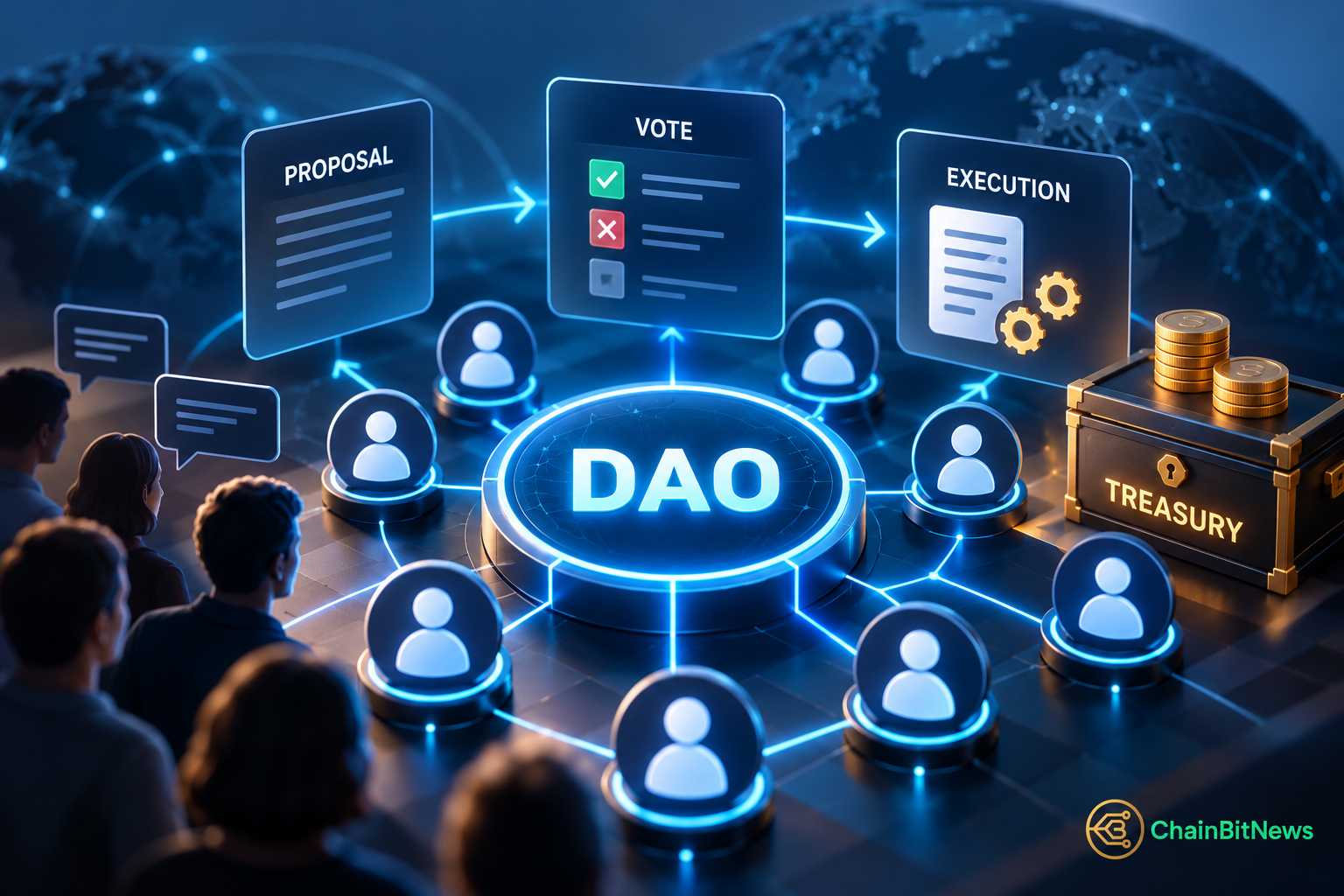
Decentralized autonomous organizations, better known as DAOs, are an attempt to coordinate people, digital assets and decision-making through blockchain-based governance rather than relying entirely on a traditional management hierarchy.
At first glance, the concept appears simple.
Participants can submit proposals, governance rights can be distributed among a community, votes can be recorded transparently and smart contracts can help execute approved decisions.
But that description leaves out the most important question:
Where does power actually sit?
A DAO can have thousands of tokenholders while effective voting power remains concentrated among a relatively small number of participants. Governance can happen on-chain while much of the discussion that shapes proposals takes place elsewhere. Tokenholders may approve decisions while developers, foundations, multisignature wallets or security councils retain important execution or emergency powers.
This means decentralization cannot be determined simply by asking whether an organization uses a governance token or records votes on a blockchain.
A more useful analysis examines how authority is distributed across the entire governance process — from proposing and debating changes to voting, execution, treasury control and emergency intervention.
That distinction is central to understanding both the potential and the limitations of DAOs.
In This Analysis, We’ll Explore:
- What a DAO actually is
- How DAO governance works
- The role of smart contracts and DAO treasuries
- Different DAO governance models
- Governance tokens and concentrated voting power
- Why human coordination remains important
- The ChainBitNews DAO Governance Test
- Governance capture, voter apathy and security risks
- Why real-world DAO governance is often hybrid
- DAOs compared with traditional organizations
- What decentralization really means for a DAO
- What can make decentralized governance sustainable
What Is a DAO?
A DAO is a blockchain-based organizational structure in which participants can coordinate decisions and shared resources through governance rules that may be enforced partly through smart contracts.
Unlike a conventional organization with a fixed management hierarchy, a DAO can distribute certain decision-making rights among tokenholders, delegates, members or other authorized participants.
However, there is no single architecture that defines every DAO.
Governance can involve token-based voting, delegated voting, multisignature wallets, councils, reputation systems or combinations of these mechanisms. Some decisions may be executed directly through smart contracts, while others still require action from developers or designated signers.
Ethereum’s documentation describes DAOs as collectively owned organizations that use proposals and voting for decision-making, while noting that different membership and governance structures can be used.
This is why the word autonomous needs context.
A DAO does not necessarily operate independently of humans. Software can enforce rules and automate specific actions, but people still identify problems, debate priorities, develop proposals, write software and decide how the governance system itself should evolve.
A more useful definition is therefore:
A DAO does not eliminate governance. It changes how governance authority can be distributed, verified and executed.
That distinction becomes increasingly important once we look at how governance works in practice.
How Does a DAO Work?
DAO architectures differ, but many governance processes can be simplified into five stages:
Proposal → Discussion → Voting → Approval → Execution
The sequence looks straightforward. The details behind each stage determine how much influence different participants actually have.
Proposal
Governance begins when someone proposes a change.
Depending on the DAO, proposals may concern:
- protocol parameters;
- treasury spending;
- ecosystem grants;
- incentive programs;
- governance rules;
- software upgrades;
- other decisions controlled by governance.
Not every participant necessarily has an unrestricted ability to submit proposals.
Some governance systems require a minimum amount of voting power or delegated support before a proposal can formally enter the governance process. Such thresholds can reduce spam, but they also influence who can place issues before the wider community.
Governance power therefore begins before voting.
A system in which everyone can vote but only a small group can realistically create proposals is distributed differently from one in which both proposal and voting rights are broadly accessible.
Discussion
Many governance decisions develop before an on-chain vote begins.
Participants may debate proposals through governance forums and other community channels.
Developers can explain technical implications, delegates can publish their reasoning and proposals may change substantially before reaching a formal vote.
This creates an important distinction:
Formal governance is not the same as governance influence.
The blockchain may provide a transparent record of the final vote without capturing every discussion, negotiation or relationship that shaped the available choices.
That does not make off-chain discussion inherently problematic. Complex decisions often require deliberation.
It does mean that evaluating a DAO solely from on-chain votes can provide an incomplete picture of how decisions are actually formed.
Voting
Once a proposal reaches the voting stage, eligible participants express their preferences according to the governance rules.
Voting power may be determined by:
- governance-token ownership;
- delegated tokens;
- membership rights;
- reputation;
- identity;
- another governance-specific mechanism.
The design matters because different voting systems distribute influence differently.
In a token-weighted system, participants with larger amounts of voting power can exercise greater influence. This can align governance influence with economic exposure to a protocol, but it can also allow concentrated token ownership to become concentrated political power inside the DAO.
Other systems attempt to reduce the direct relationship between capital and governance, but they introduce their own trade-offs around identity, participation and manipulation.
There is no governance mechanism that automatically eliminates the problem of allocating power.
Approval
A vote does not necessarily pass simply because more participants support it than oppose it.
Governance systems can include requirements such as:
- minimum participation or quorum;
- proposal thresholds;
- voting periods;
- approval thresholds;
- execution delays.
OpenZeppelin’s modular Governor framework illustrates how on-chain governance can separately define voting power, quorum, proposal thresholds, voting periods and execution mechanisms rather than treating governance as a single voting function.
These safeguards can make governance more resistant to manipulation or poorly supported proposals.
But stronger safeguards can also make governance slower or harder to use.
This creates one of the recurring DAO trade-offs:
Governance must be difficult enough to attack without becoming so difficult that legitimate participants cannot govern effectively.
Execution
Approval and execution are separate questions.
Some governance systems allow a successful proposal to trigger an on-chain action after the required conditions have been satisfied. Others rely partly on developers, foundations, multisignature signers or specialized governance bodies to implement approved decisions.
Timelocks can also deliberately create a delay between approval and execution, providing time for participants to observe a pending governance action before it becomes effective.
This distinction matters because a DAO may distribute voting authority more widely than execution authority.
If thousands of participants can approve a proposal but a small group ultimately controls whether or how that decision is implemented, the governance system cannot be understood from the vote alone.
The relevant questions are therefore:
Who can propose? Who can vote? Who can block? Who can execute?
Those questions reveal considerably more about effective governance than the number of governance-token holders by itself.
Smart Contracts and DAO Treasuries
Smart contracts provide part of the infrastructure that allows DAO governance to operate without every decision depending on a traditional administrator.
They can define permissions, voting rules, execution conditions and access to shared assets. Once predefined conditions are satisfied, some governance actions can be executed according to those rules.
However, smart contracts should not be confused with the governance process itself.
They can enforce a rule such as execute this transaction after a proposal receives sufficient approval and the timelock expires.
They cannot independently determine whether that proposal was a good strategic decision.
This creates a useful separation:
Governance decides what should happen. Smart contracts can help enforce how an approved action happens.
For a deeper explanation of the underlying technology, ChainBitNews covers how smart contracts execute blockchain-based rules in a dedicated guide.
A DAO treasury demonstrates this relationship clearly.
Treasuries can hold crypto assets used for grants, development, incentives, operations or other community-approved purposes.
Smart contracts and permission systems can determine which governance mechanisms are allowed to move those assets.
This can make treasury activity more transparent and reduce dependence on a single individual controlling organizational funds.
But putting a treasury on-chain does not automatically decentralize its control.
A serious governance analysis still has to ask:
- Who can propose treasury spending?
- Who has enough voting power to approve it?
- Can a multisig or council intervene?
- Is there a delay before funds move?
- Can governance permissions themselves be changed?
The treasury is therefore not merely a pool of blockchain assets.
It is one of the clearest places where a DAO’s formal governance structure becomes economically meaningful.
Different DAO Governance Models
There is no universal governance model that works for every DAO.
Different organizations face different coordination problems, and each governance mechanism creates advantages alongside new weaknesses.
Understanding those trade-offs is more useful than trying to identify one theoretically perfect model.
Token-Based Governance
Token-based governance assigns voting power through a governance token.
In its simplest form, greater token ownership means greater voting influence.
This model has several advantages. Voting rights can be transparent, transferable and measurable on-chain. Participants can obtain or dispose of governance exposure without requiring permission from a centralized membership authority.
But the model creates an obvious tension.
If token ownership becomes concentrated, governance influence can become concentrated as well.
This is why token distribution is not only a tokenomics issue. In governance systems, it can determine who possesses meaningful organizational power.
For a deeper explanation of supply distribution, unlocks and token incentives, see our analysis of crypto tokenomics.
The important distinction is:
Token Distribution ≠ Governance Distribution
Even widely distributed token ownership does not guarantee widely distributed decision-making.
That becomes especially clear once delegation enters the system.
Delegated Governance
Delegation allows participants to assign their voting power to another participant without necessarily transferring ownership of the underlying tokens.
This addresses a practical weakness of direct governance.
DAO participants may not have the time, expertise or interest required to analyze every technical proposal. Delegates can specialize in governance, follow proposals more closely and represent participants who would otherwise remain inactive.
But delegation changes rather than eliminates concentration risk.
A token may be distributed among thousands of holders while substantial voting power becomes delegated to a much smaller group.
This produces an important governance distinction:
Distributed ownership does not necessarily produce distributed influence.
Delegation can therefore improve governance participation and expertise while simultaneously creating a more recognizable political layer inside the DAO.
That is not automatically a failure.
The relevant question is whether delegated power remains transparent, contestable and capable of moving when participants lose confidence in a delegate.
Multisig and Council-Based Governance
Not every governance decision is suitable for a large community vote.
A protocol may need to respond quickly to a security vulnerability, manage operational permissions or perform an action that would be impractical to coordinate through a lengthy governance process.
Multisignature wallets and specialized councils can address this problem by assigning limited authority to a smaller group.
The advantage is speed and operational coordination.
The disadvantage is concentrated authority.
This creates another DAO trade-off:
Faster Response → Fewer Decision-Makers → Greater Concentration Risk
The existence of a multisig or council therefore does not by itself prove that a DAO is centralized.
What matters is the scope of its authority.
A stronger governance design makes it possible to ask:
- What can the council actually do?
- Is its authority limited?
- Are its actions transparent?
- Can members be replaced?
- Can broader governance override it?
- Are emergency powers temporary or permanent?
A small emergency body with narrow, transparent and replaceable powers represents a very different governance structure from a small group with indefinite control over core protocol functions.
Reputation and Identity-Based Governance
Token voting is not the only way to allocate governance rights.
Alternative systems can attempt to base influence on identity, reputation, contribution or other forms of membership.
The potential advantage is that governance power becomes less directly purchasable.
But removing the direct connection between capital and voting does not remove the underlying allocation problem.
It creates different questions:
Who determines identity?
How is reputation earned?
Can participants create multiple identities?
Who decides which contributions deserve influence?
Can reputation be lost or transferred?
Every governance model therefore answers the same fundamental question differently:
Who should have authority, and why?
That is why DAO governance should be analyzed as a system of trade-offs rather than a progression from “centralized” to “decentralized” based on a single metric.
Governance Tokens: Rights, Power and Concentration
Governance tokens are often presented as evidence that a protocol is community-controlled.
That conclusion is too simple.
A governance token can give holders the ability to participate in certain decisions, but the rights attached to that token depend entirely on the protocol’s governance architecture.
Depending on the system, governance may influence:
- treasury spending;
- protocol parameters;
- incentive programs;
- governance procedures;
- software upgrades;
- ecosystem funding.
A governance token does not automatically represent equity, legal ownership of an organization or a claim on protocol revenue.
More importantly, the existence of voting rights does not tell us how effective voting power is distributed.
Imagine two DAOs.
In the first, governance tokens are held by thousands of participants, but most rarely vote and a handful of delegates control the majority of active voting power.
In the second, fewer participants exist, but governance participation is consistently distributed and major powers require approval from several independent groups.
Simply counting tokenholders could make the first system appear more decentralized.
Analyzing effective authority could produce a very different picture.
This leads to a central ChainBitNews principle:
Governance decentralization should be measured by effective control, not merely by the number of people theoretically allowed to participate.
That principle becomes even more important when we examine the part of DAO governance that cannot be reduced to smart contracts: human coordination.
The Hidden Governance Layer: Humans Still Matter
The word autonomous can make DAOs sound as though software has replaced organizational decision-making.
In practice, smart contracts automate only part of governance.
Humans still:
- identify problems;
- develop proposals;
- debate trade-offs;
- persuade other participants;
- delegate voting power;
- write and audit code;
- interpret governance decisions;
- respond to unexpected situations.
Even highly on-chain governance therefore operates alongside a social layer.
This is not necessarily a weakness.Complex decisions require information, judgment and coordination. Smart contracts can make certain rules transparent and enforceable, but they cannot independently determine which goals a community should pursue.
A governance forum may shape a proposal before it reaches a vote. Delegates may influence whether an idea gains sufficient support. Developers may determine what is technically feasible. Foundations or working groups may contribute research and implementation capacity.
The formal vote is therefore only one part of the governance process.
This leads to an important distinction:
Code can execute a decision. It cannot eliminate the need to form one.
A DAO should therefore not be evaluated simply by measuring how much governance activity takes place on-chain.
The deeper question is whether the combination of code, participants and governance institutions distributes authority in a way that remains transparent, contestable and capable of making decisions.
The ChainBitNews DAO Governance Test
Calling a DAO “decentralized” compresses several different governance questions into a single label.
A more useful approach is to separate them.
The ChainBitNews DAO Governance Test evaluates governance through five connected dimensions:
Authority Distribution → Participation → Security → Execution Capacity → Governance Resilience
The framework is not designed to produce a numerical decentralization score.
Instead, it helps identify where effective power exists and where a governance system may become vulnerable.
1. Authority Distribution
The first question is straightforward:
Who can actually exercise power?
That requires looking beyond token ownership.
Relevant questions include:
- Who can submit proposals?
- Who can vote?
- Who controls delegated voting power?
- Who can move treasury assets?
- Who can change protocol parameters?
- Who can upgrade smart contracts?
- Who holds emergency powers?
- Who ultimately executes approved decisions?
A DAO can be decentralized across one dimension and concentrated across another.
For example, voting rights may be widely distributed while software upgrades require action from a smaller technical group.
This means decentralization is better understood as a distribution of different forms of authority rather than as a single property that a DAO either has or does not have.
2. Participation
Theoretical governance rights have limited value if they are rarely exercised.
A protocol may distribute voting rights across a large community while only a small fraction of eligible governance power regularly participates.
Low participation creates several possible problems.
Active minorities can gain disproportionate influence. Important proposals may struggle to reach quorum. Participants may vote without having enough time to evaluate increasingly technical decisions.
Delegation can partly address this problem by allowing participants to transfer voting responsibility to more active representatives.
But as discussed earlier, delegation can also concentrate effective voting power.
The relevant question is therefore not whether every participant votes personally.
It is whether the governance structure can convert broadly distributed rights into meaningful and accountable participation.
3. Security
Governance is itself part of a protocol’s attack surface.
If governance can change contracts, transfer treasury assets or modify important protocol parameters, obtaining enough governance influence can become economically valuable to an attacker.
The security problem is therefore broader than protecting private keys or auditing smart-contract code.
A DAO also has to consider how malicious or captured governance power could be used.
Potential defenses can include:
- proposal thresholds;
- quorum requirements;
- voting delays;
- timelocks;
- restricted emergency powers;
- multisignature controls;
- additional review before sensitive actions.
No mechanism removes governance risk completely.
More safeguards can reduce the ability to execute a malicious decision quickly, but excessive friction can also make legitimate governance less responsive.
Security and usability therefore have to be considered together.
4. Execution Capacity
A DAO that cannot make or implement decisions effectively can be decentralized and still fail as an organization.
This creates one of the central tensions in decentralized governance.
Distributing authority can reduce dependence on individual decision-makers. But requiring broad coordination for every action can make governance slow, expensive or operationally difficult.
Different decisions also have different time requirements.
Changing a long-term incentive structure may reasonably require extensive discussion.
Responding to an active security incident may not allow several weeks of governance deliberation.
This is one reason hybrid governance structures emerge.
They can give broad governance authority over major strategic decisions while assigning narrower operational or emergency powers to smaller groups.
The analytical question is not simply whether those groups exist.
It is whether their powers are proportionate to the problem they are designed to solve.
5. Governance Resilience
The final test is what happens when governance operates under pressure.
A governance system may appear effective while participants broadly agree.
Its weaknesses become more visible when:
- important stakeholders disagree;
- participation declines;
- voting power becomes concentrated;
- a security incident requires rapid action;
- delegates lose community support;
- governance bodies conflict;
- an existing rule no longer works as intended.
A resilient governance system needs mechanisms for dealing with these situations without depending indefinitely on the goodwill of a small number of actors.
This produces the central insight behind the framework:
A DAO can become more decentralized on one dimension while becoming more concentrated on another.
Delegation can increase participation while concentrating voting influence.
A security council can improve emergency response while concentrating temporary execution authority.
A high proposal threshold can reduce spam while concentrating agenda-setting power.
Governance design therefore cannot be understood through a simple decentralized-versus-centralized binary.
The relevant question is whether the trade-offs created by each governance mechanism remain visible, limited and accountable.
When Decentralization Creates New Problems
Removing a traditional management hierarchy does not remove organizational problems.
It changes them.
DAOs can face coordination and security problems that emerge specifically because authority is distributed among participants with different incentives, information and levels of engagement.
Voter Apathy
Governance participation requires time.
As a DAO becomes more complex, proposals can involve technical parameters, treasury decisions, incentive systems and protocol upgrades that require substantial knowledge to evaluate properly.
Many tokenholders may therefore choose not to participate.
This creates a paradox.
A DAO can offer broad governance access while practical decision-making becomes dominated by the smaller group willing to participate consistently.
The problem is not solved simply by encouraging more votes.
Higher participation is useful only when participants have enough information to make meaningful decisions.
Governance Capture
If voting power can be accumulated or delegated, a sufficiently influential participant or coalition may gain disproportionate control over governance.
The precise risk depends on the governance architecture.
Token-weighted voting can make large holdings important.
Delegated governance can concentrate influence among major delegates.
Multisigs and councils can concentrate execution authority.
The important point is that governance capture does not require every component of a DAO to become centralized.
Control over one strategically important part of the process may be enough to influence outcomes.
Governance Fatigue
Frequent voting can create another problem.
More governance does not necessarily mean better governance.
If participants are asked to decide on large numbers of relatively minor issues, attention becomes a scarce resource. Important proposals can compete with routine decisions for the same limited participant attention.
Governance design therefore also involves deciding what should not require a full community vote.
Delegation, specialized committees and predefined operational permissions can reduce this burden, although each mechanism introduces its own accountability requirements.
Slow Emergency Response
Decentralized decision-making can become particularly difficult during security incidents.
Long voting periods and execution delays may protect against rushed governance under normal circumstances but become disadvantages when immediate intervention is required.
Giving a smaller group emergency authority can solve the speed problem while reintroducing concentrated power.
This is not a contradiction that governance design can completely eliminate.
It is a trade-off that needs to be managed.
The strongest question is therefore not:
Does the DAO have emergency powers?
It is:
Are those powers narrow, transparent, accountable and removable?
Real DAO Governance Is Often Hybrid
The idea of a DAO can create an expectation that every important decision is made directly by every tokenholder.
Real governance systems are often more complicated.
Different functions can use different mechanisms.
A protocol might combine:
- Tokenholder voting for major decisions
- Delegation for representation
- Forums for discussion
- A treasury controlled through governance
- A timelock before execution
- A multisig or security council for limited emergency actions
- Developers responsible for technical implementation
This should not automatically be interpreted as a failure of decentralization.
A hybrid structure can be a deliberate response to the fact that strategic decisions, routine operations and emergency security actions have different coordination requirements.
Uniswap provides a useful example of governance in which UNI voting power can be delegated and formal governance proposals move through defined voting and execution processes. Its governance documentation also demonstrates that delegated voting power is a meaningful part of how participation is organized.
The important analytical point is not that Uniswap represents the model every DAO should follow.
It demonstrates that even token-based governance requires additional structures around the vote itself.
Other protocols may make different choices about councils, delegates, execution delays or emergency authority because they face different technical and organizational risks.
That diversity makes the term DAO less useful as a description of a specific governance architecture.
Two organizations can both call themselves DAOs while distributing effective authority very differently.
DAOs vs Traditional Organizations
DAOs are sometimes presented as replacements for traditional companies.
That comparison is too broad.
A traditional organization can assign authority to executives, directors, employees and shareholders through corporate governance and legal agreements. Responsibilities are often explicitly associated with identifiable individuals or institutions.
A DAO can instead use blockchain-based rules to distribute certain rights, make decisions publicly verifiable and allow participants to coordinate without relying entirely on a conventional management hierarchy.
That can provide advantages such as:
- transparent governance records
- programmable permissions
- open participation in some governance systems
- shared control over on-chain assets
- reduced dependence on individual administrators.
But traditional organizations can have advantages of their own.
Clear management authority can make responsibility easier to identify. Smaller decision-making groups can respond faster. Legal structures can define obligations and accountability in ways that smart-contract governance alone does not provide.
DAOs also do not exist outside the legal world simply because their governance happens on a blockchain. The legal treatment of DAO participants, entities and activities can depend on jurisdiction and organizational structure.
The meaningful comparison is therefore not:
DAO = decentralized and transparent
versus
Company = centralized and opaque
The better comparison is:
What type of authority should be distributed, what type should be delegated, and what accountability mechanism exists for each?
That question applies to both blockchain-based and traditional organizations.
What Actually Makes a DAO Decentralized?
There is no single metric that can answer this question.
Counting wallets is insufficient.
Counting governance-token holders is insufficient.
Counting proposals is insufficient.
Even measuring voting participation provides only part of the picture.
A more complete analysis examines several forms of control simultaneously:
Proposal Power + Voting Power + Treasury Control + Upgrade Authority + Execution Power + Emergency Authority
If one participant or tightly coordinated group dominates several of these functions, the governance system may be substantially more concentrated than its number of tokenholders suggests.
Conversely, a DAO does not necessarily need to distribute every operational permission equally to every participant.
Some specialization can make governance more functional.
The key distinction is between delegated authority and unaccountable authority.
Delegated authority can be limited, transparent and revocable.
Unaccountable authority can persist even when the wider community nominally possesses governance rights.
This leads back to the central ChainBitNews thesis:
The real test of a DAO is not whether governance happens on-chain, but whether authority, participation, execution and emergency powers are distributed in a way that remains both accountable and functional.
That standard is more demanding than simply identifying a governance token.
It is also more useful.
Can DAOs Become More Effective Over Time?
DAO governance remains an evolving organizational design space.
The challenge is not simply to maximize decentralization.
It is to find governance structures that can distribute meaningful authority without making coordination ineffective or security unmanageable.
Several mechanisms can contribute to that process:
- clearer separation between strategic and operational decisions
- transparent delegation
- limited and revocable emergency powers
- execution delays for sensitive actions
- better governance interfaces
- stronger disclosure by delegates and governance bodies
- clearer rules for modifying governance itself.
None guarantees successful governance.
Every additional mechanism creates its own assumptions and potential failure modes.
The deeper development to watch is therefore whether DAOs become better at separating different types of authority.
A protocol does not necessarily need the same governance mechanism for treasury allocations, software upgrades, routine operations and emergency security responses.
Governance may become more resilient when each function uses a mechanism appropriate to the risks involved — while the overall system remains transparent and ultimately accountable.
Conclusion
DAOs introduce a different way to coordinate ownership, resources and decision-making.
Their most important innovation is not that they remove people from organizations.
They do not.
Nor is it simply that votes can be recorded on a blockchain.
The more significant change is that governance rights and execution rules can be made programmable, transparent and distributed across participants in ways that would be difficult to reproduce through a single traditional management hierarchy.
But distribution alone does not guarantee effective decentralization.
Token ownership can concentrate. Delegated voting power can accumulate. Participants can become inactive. Developers can retain important implementation influence. Councils and multisigs can acquire powers that are operationally useful but structurally significant.
This is why DAO governance should be evaluated as a system rather than a label.
The ChainBitNews DAO Governance Test captures that relationship:
Authority Distribution → Participation → Security → Execution Capacity → Governance Resilience
A governance system becomes more convincing when authority is meaningfully distributed, participants can exercise or delegate that authority, attacks remain difficult, legitimate decisions can still be executed and the organization can continue functioning when interests conflict.
Those objectives can pull in different directions.
More distributed authority can make capture harder while slowing coordination. Delegation can improve participation while concentrating influence. Emergency powers can strengthen security while creating smaller centers of control.
The future of DAO governance therefore depends less on eliminating every form of centralized authority than on making authority visible, limited, accountable and contestable.
That also provides a way to test the thesis over time.
If DAOs can distribute meaningful decision-making while maintaining security, execution capacity and mechanisms for challenging concentrated power, decentralized governance becomes more credible as an organizational model.
If practical control repeatedly consolidates around a small number of actors despite formally decentralized voting, then the distinction between governance rights and effective governance power becomes impossible to ignore.
Ultimately, the question is not whether a DAO looks decentralized.
It is whether decentralization continues to function when governance actually becomes difficult.
How to Do Your Own Research (DYOR) in Crypto: A Practical Guide
Disclaimer: This article is for educational and informational purposes only. It does not constitute financial, investment or legal advice. Blockchain governance structures can differ significantly between projects, and governance rights, technical mechanisms and legal treatment may change over time.