
Artificial intelligence is transforming industries at an unprecedented pace.
Large language models are becoming more capable.
AI-generated images and videos continue improving.
3D rendering grows increasingly realistic.
Scientific simulations require ever more computing power.
Behind all of these technologies lies one critical resource:
Graphics Processing Units (GPUs).
Demand for high-performance GPUs has exploded as AI adoption accelerates across the global economy.
Technology companies compete for limited computing resources.
Cloud providers continue expanding data centers.
Developers increasingly struggle to access affordable GPU capacity.
This growing imbalance between supply and demand has created one of the largest infrastructure challenges facing the AI industry.
Rather than building even more centralized data centers, some blockchain projects propose a different solution:
Decentralized computing.
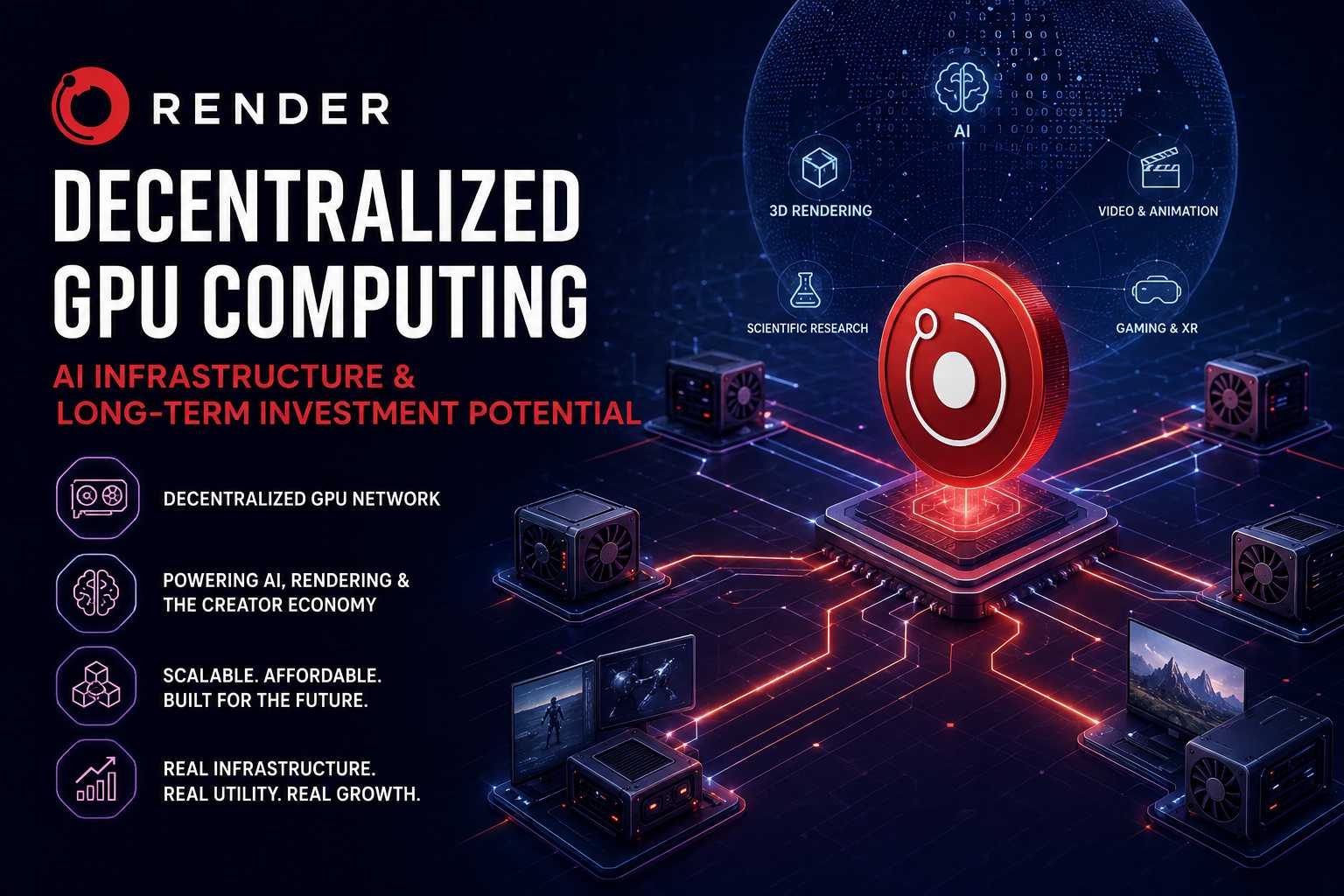
Among the leading projects pursuing this vision is Render (RENDER).
Instead of relying exclusively on centralized cloud providers, Render enables individuals and organizations to share unused GPU power through a decentralized blockchain network.
Supporters believe this approach could help power the next generation of artificial intelligence, digital content creation, virtual reality, gaming, scientific research and the broader creator economy.
Critics argue that decentralized GPU networks still face significant competition from established cloud providers while adoption remains in its early stages.
Regardless of perspective, Render has become one of the most widely discussed infrastructure projects at the intersection of blockchain, artificial intelligence and decentralized computing.
Understanding how Render works can help investors better evaluate one of crypto’s fastest-growing sectors.
In This Analysis, We’ll Explore:
- what Render is
- why GPU computing matters
- the global AI computing shortage
- centralized vs decentralized computing
- how the Render Network works
- GPU providers explained
- creators and rendering jobs
- AI workloads on Render
- why Render migrated to Solana
- token utility
- tokenomics
- ecosystem growth
- adoption and partnerships
- competitors
- strengths and advantages
- risks and limitations
- long-term investment outlook
- why investors should care
What Is Render?
Render is a decentralized GPU computing network that connects people who need computing power with individuals and organizations that have unused GPU capacity.
Instead of purchasing expensive hardware or renting centralized cloud infrastructure, creators can access distributed computing resources through the Render Network.
The network primarily supports workloads involving:
- AI model development
- machine learning
- 3D rendering
- visual effects
- animation
- architecture
- industrial design
- virtual production
- gaming
- scientific computing
Participants offering unused GPU power receive compensation in RENDER tokens, creating an economic marketplace for decentralized computing.
Rather than allowing powerful graphics cards to remain idle, Render transforms unused computing capacity into a globally accessible resource.
Why GPU Computing Matters
Modern computing increasingly depends on GPUs rather than traditional CPUs.
While CPUs excel at handling sequential tasks, GPUs are designed to process thousands of calculations simultaneously.
This makes them ideal for computationally intensive applications such as:
- artificial intelligence
- deep learning
- image generation
- video rendering
- scientific simulations
- engineering software
- blockchain applications
As AI models become larger and more sophisticated, demand for GPU resources continues growing rapidly.
Companies developing advanced AI systems often require thousands—or even tens of thousands—of GPUs operating simultaneously.
This demand has created one of today’s largest technological bottlenecks.
How to Use AI in Crypto Investing — Opportunities, Risks, and the Reality Behind AI-Driven Decisions
The Global AI Computing Shortage
One of the biggest challenges facing artificial intelligence is not software.
It is hardware.
Training modern AI models requires enormous computational resources.
Demand for GPUs has grown significantly faster than manufacturing capacity.
This imbalance has produced:
- higher hardware prices
- longer waiting times
- cloud computing shortages
- increased infrastructure costs
- limited access for smaller developers
Large technology companies often secure substantial portions of available GPU capacity.
Smaller startups, independent creators and research organizations may struggle to compete.
This shortage has encouraged interest in decentralized alternatives capable of expanding available computing resources.
Centralized Computing vs Decentralized Computing
Most cloud computing today remains highly centralized.
Organizations typically rent computing power from providers such as:
- Amazon Web Services
- Microsoft Azure
- Google Cloud
- Oracle Cloud
These companies own enormous data centers containing hundreds of thousands of GPUs.
Render proposes a different model.
Instead of concentrating hardware within centralized facilities, Render aggregates computing resources contributed by participants across the world.
This creates a distributed marketplace where unused GPU capacity becomes available to anyone requiring computational power.
Both approaches offer advantages.
Centralized providers emphasize consistency and enterprise services.
Decentralized networks emphasize scalability, accessibility and resource efficiency.
How the Render Network Works
The Render Network functions as a marketplace connecting two groups of participants.
GPU Providers
These participants contribute unused graphics processing power.
They may include:
- professional rendering farms
- animation studios
- independent creators
- data centers
- GPU owners
- hardware enthusiasts
Creators
These users require GPU resources for computational workloads.
Examples include:
- filmmakers
- architects
- game developers
- AI developers
- product designers
- digital artists
- researchers
When a creator submits a rendering or AI task, the network distributes work to available GPU providers.
After successful completion, providers receive payment in RENDER tokens.
This creates a decentralized economic system benefiting both sides of the marketplace.
Rendering Explained
Although artificial intelligence receives much of today’s attention, Render originally focused on computer graphics.
Rendering converts digital models into finished visual content.
Examples include:
- animated movies
- visual effects
- architectural visualization
- advertising
- product design
- video games
- virtual reality
High-quality rendering often requires enormous computational resources.
Projects that might require days on a single computer can sometimes be completed far more quickly using distributed GPU networks.
This significantly improves productivity for creative professionals.
AI Workloads on Render
The rapid expansion of artificial intelligence has broadened Render’s potential applications.
Today, GPUs perform far more than graphical rendering.
AI increasingly relies on GPUs for:
- training neural networks
- running inference
- image generation
- video generation
- speech synthesis
- language models
- scientific research
As AI adoption accelerates globally, demand for distributed GPU infrastructure may continue increasing.
This evolution positions Render beyond its original focus on computer graphics.
Why Decentralized GPU Networks Could Become More Important
The AI industry continues expanding faster than available hardware.
Building new data centers requires:
- enormous capital investment
- electricity infrastructure
- land
- cooling systems
- semiconductor manufacturing
These limitations cannot be solved overnight.
Meanwhile, millions of GPUs already exist worldwide.
Many remain idle for substantial portions of each day.
Render attempts to unlock this unused capacity.
Rather than manufacturing entirely new infrastructure, decentralized computing improves utilization of hardware that already exists.
Supporters argue this approach represents a more efficient use of global computing resources.
Why Render Migrated to Solana
Render originally operated within the Ethereum ecosystem.
As network activity increased, developers sought a blockchain capable of supporting faster transactions and significantly lower fees.
The project ultimately migrated to Solana, allowing the network to benefit from:
- higher transaction throughput
- lower costs
- faster settlement
- improved scalability
- better user experience
The migration reflected a broader industry trend.
As blockchain infrastructure evolves, many applications increasingly prioritize networks capable of supporting large-scale activity efficiently.
For Render, faster settlement and lower transaction costs help improve the experience for both GPU providers and creators using the network.
Token Utility
Like most blockchain infrastructure projects, Render relies on its native token to coordinate economic activity across the network.
The RENDER token serves several important functions.
These include:
- paying for GPU computing services
- rewarding GPU providers
- securing economic incentives
- facilitating network transactions
- supporting ecosystem growth
- governance participation (as the network evolves)
Whenever creators submit rendering or AI jobs, payment is typically made using RENDER.
GPU operators receive compensation after successfully completing computational tasks.
This creates a marketplace where supply and demand determine the value of decentralized computing resources.
Unlike purely speculative tokens, RENDER is directly connected to real network usage.
As demand for decentralized GPU computing increases, activity within the network may also expand.
Tokenomics
Understanding tokenomics helps investors evaluate how a cryptocurrency functions over the long term.
While exact circulating supply changes over time, investors typically focus on broader characteristics.
Important considerations include:
- circulating supply
- maximum supply
- emission schedule
- staking mechanisms
- ecosystem incentives
- token demand created by network usage
Unlike many speculative projects, Render’s token economy is linked to actual computational demand.
As more creators use the network, more transactions potentially require RENDER tokens.
However, token value ultimately depends on both adoption and overall market conditions.
Strong technology alone does not guarantee price appreciation.
Ecosystem Growth
The Render ecosystem has expanded considerably since its early focus on decentralized rendering.
Today the network increasingly supports industries including:
- artificial intelligence
- machine learning
- digital content creation
- animation
- architecture
- industrial design
- virtual production
- gaming
- metaverse applications
- scientific visualization
This diversification reduces dependence on a single market segment.
As AI adoption accelerates, decentralized GPU networks may benefit from multiple long-term growth trends simultaneously.
Rather than serving only Hollywood studios or digital artists, Render now targets a much broader computing market.
Adoption and Partnerships
Infrastructure projects succeed through adoption rather than speculation.
For this reason, investors often monitor:
- developer activity
- creator adoption
- enterprise interest
- ecosystem partnerships
- network usage
- transaction growth
Render has attracted interest from creators working in visual effects, animation and digital design.
At the same time, growing attention toward artificial intelligence has expanded awareness of decentralized GPU infrastructure.
Although adoption remains significantly smaller than traditional cloud providers, the network continues evolving alongside broader AI development.
Long-term success will depend less on market hype and more on sustained real-world usage.
Competition
Render operates within a highly competitive industry.
It competes not only against blockchain projects but also against some of the world’s largest technology companies.
Centralized competitors include:
- Amazon Web Services
- Microsoft Azure
- Google Cloud
- Oracle Cloud
Blockchain-related competitors include projects focused on decentralized computing and AI infrastructure.
Competition centers around:
- pricing
- scalability
- reliability
- developer experience
- ecosystem growth
- available GPU capacity
While centralized providers currently dominate the market, decentralized alternatives continue attracting attention as AI demand increases.
Why Investors Are Watching AI Infrastructure
Artificial intelligence has become one of the largest investment themes of the decade.
Much attention focuses on companies developing AI models.
However, AI also depends on supporting infrastructure.
Without sufficient computing power, advanced AI systems cannot be trained or deployed efficiently.
This has created growing interest in projects supporting:
- GPU infrastructure
- decentralized computing
- distributed cloud resources
- AI scalability
- high-performance computing
Rather than investing directly in AI applications, some investors seek exposure to the infrastructure enabling future AI growth.
Render occupies this niche.
Strengths of Render
Render offers several potential advantages.
These include:
- exposure to AI infrastructure
- real-world utility
- decentralized GPU marketplace
- growing creator ecosystem
- expanding blockchain adoption
- scalable computing model
- efficient use of idle hardware
- lower barriers to GPU access
- integration with the Solana ecosystem
- long-term relevance beyond cryptocurrency markets
These characteristics help explain why Render has become one of the better-known infrastructure projects within the blockchain industry.
Risks and Limitations
Despite its potential, Render also faces important challenges.
These include:
- strong competition from major cloud providers
- dependence on AI industry growth
- cryptocurrency market volatility
- evolving blockchain infrastructure
- adoption uncertainty
- regulatory developments
- hardware availability
- token price speculation
- execution risk
The project’s long-term success depends on continued growth in both decentralized computing and AI adoption.
Technology alone is not enough.
Sustained demand remains essential.
Common Investor Mistakes
Many investors misunderstand projects like Render.
Common mistakes include:
- assuming AI narratives automatically guarantee higher prices
- focusing only on token performance
- ignoring real network adoption
- overlooking competition
- confusing technological potential with commercial success
- treating infrastructure projects like meme coins
- ignoring broader market conditions
Professional investors evaluate infrastructure using measurable adoption rather than social media excitement.
Why Professional Investors Follow Infrastructure Projects
Professional investors increasingly analyze infrastructure instead of chasing short-term narratives.
Rather than asking:
“Will this token double next month?”
They often ask:
- Does the project solve a genuine problem?
- Is adoption increasing?
- Does demand create sustainable token utility?
- Can the network compete over the next decade?
- Does it benefit from long-term technological trends?
These questions provide a more durable framework for evaluating blockchain projects.
Long-Term Investment Outlook
Predicting Render’s future price is impossible.
However, several structural trends support continued interest in decentralized GPU infrastructure.
These include:
- accelerating AI adoption
- increasing demand for GPU computing
- expanding digital content creation
- growth of virtual production
- blockchain infrastructure development
- tokenization of digital services
- creator economy expansion
If decentralized computing becomes a meaningful part of future cloud infrastructure, projects like Render could benefit from long-term adoption.
Whether Render ultimately becomes a dominant platform remains uncertain.
Competition will remain intense.
Nevertheless, the broader trend toward AI-driven computing appears likely to continue for many years.
Conclusion
Render represents one of the most interesting infrastructure projects at the intersection of blockchain technology and artificial intelligence.
Rather than competing as another payment network or smart contract platform, Render focuses on solving a growing global challenge: providing scalable GPU computing through decentralized infrastructure.
Understanding:
- decentralized GPU computing
- AI infrastructure
- blockchain marketplaces
- token utility
- ecosystem adoption
- creator economy
- Solana integration
- long-term infrastructure trends
- risks and limitations
can help investors evaluate Render from a broader perspective.
Successful investing is rarely about following the latest AI headline.
It is about identifying the infrastructure that may support technological growth over many years.
As artificial intelligence continues reshaping industries around the world, demand for computing power is likely to remain one of the defining trends of the next decade.
For long-term investors, Render offers exposure to that trend through a blockchain network designed to connect unused GPU resources with the growing global demand for high-performance computing.
Aptos (APT) Analysis: Architecture, Scalability, Tokenomics & Long-Term Positioning
Sui (SUI) Analysis: Architecture, Scalability, Tokenomics & Long-Term Positioning
Disclaimer: This article is for educational and informational purposes only and does not constitute financial or investment advice. Cryptocurrency markets are highly volatile, and AI infrastructure projects involve significant technological and adoption risks. Always conduct your own research before making investment decisions.