
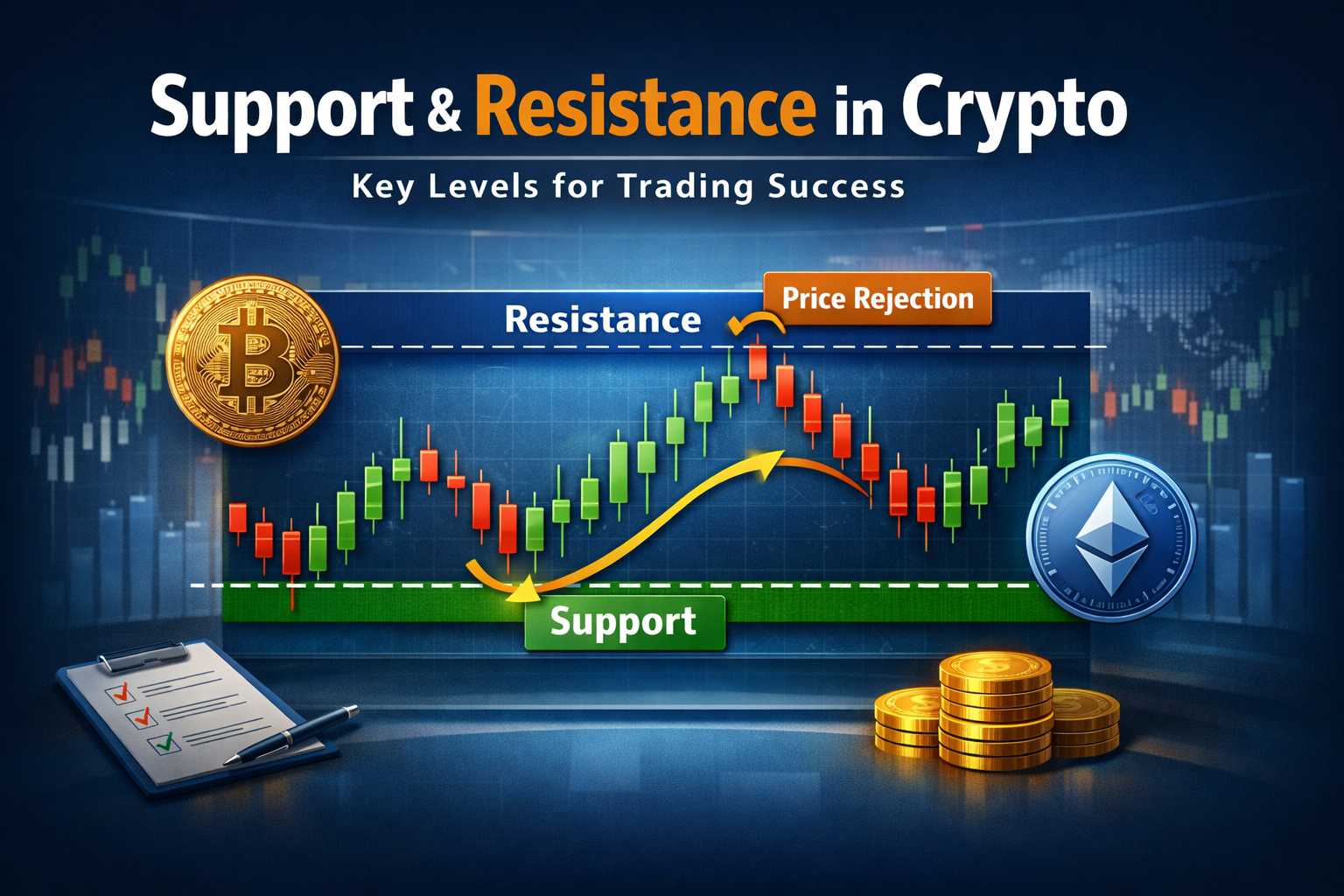
If you have ever looked at a crypto chart and wondered why price suddenly stops, reverses, or struggles at the same levels over and over again, you are not alone.This behavior is not random.
Support and resistance are two of the most important concepts in crypto trading and technical analysis. They explain why price reacts where it does and help investors understand market behavior without predicting the future.
In this article, you will learn what support and resistance are, why they work so well in crypto markets, and how beginners often misunderstand them.
What Is Support in Crypto?
Support is a price level where buying interest becomes strong enough to stop price from falling further.
At support levels:
- Buyers believe the asset is “cheap”
- Selling pressure weakens
- Price often slows down, bounces, or consolidates
In crypto, support often forms:
- At previous lows
- Around psychological levels (round numbers)
- After strong buying reactions in the past
Support does not mean price cannot go lower. It means that, historically, buyers stepped in at that level.
What Is Resistance in Crypto?
Resistance is the opposite of support.
Resistance is a price level where selling pressure becomes strong enough to stop price from rising further.
At resistance levels:
- Sellers take profit
- Buyers hesitate
- Price often struggles, rejects, or moves sideways
Resistance commonly forms:
- At previous highs
- Near psychological price levels
- After strong sell-offs in the past
Just like support, resistance is not a wall. It is an area where price often reacts.
Why Do Support and Resistance Work?
Support and resistance work because markets are driven by human behavior.
Traders remember price levels where:
- They previously bought or sold
- They experienced fear or greed
- They missed an opportunity
When price returns to those levels, emotions return as well.This creates repeated reactions — even in highly volatile crypto markets.
Algorithms, bots, and institutional traders also use these levels, reinforcing their importance.
Support and Resistance Are Zones, Not Lines
One of the biggest beginner mistakes is drawing support and resistance as exact lines.
In reality:
- Support and resistance are zones
- Price can slightly break them and still respect them
- Reactions are more important than precision
Crypto markets are volatile, so small overshoots are normal and expected.
False Breakouts Explained
Sometimes price breaks above resistance or below support, only to quickly reverse.This is called a false breakout.
False breakouts happen because:
- Traders enter too early
- Stop losses get triggered
- Smart money uses liquidity around key levels
False breakouts are not failures of support and resistance — they are part of how markets work.
When Support Becomes Resistance (And Vice Versa)
A very important concept in crypto is the role reversal.
- Old support can become new resistance
- Old resistance can become new support
This happens when market sentiment changes. It is one of the clearest signs of market structure shifts and trend changes.
Common Beginner Mistakes
Many beginners struggle with support and resistance because they:
- Draw too many levels
- Force levels where none exist
- Expect price to react perfectly
- Ignore higher timeframes
Support and resistance work best when used simply and patiently.
How Support and Resistance Fit Into Market Structure
Support and resistance are the building blocks of market structure.
They help identify:
- Trends
- Ranges
- Breakouts
- Reversals
Understanding these levels makes it easier to follow price instead of predicting it.
Support and resistance are not about predicting exact price movements.They are about understanding where price is likely to react and why.
For beginners in crypto, mastering these concepts builds a strong foundation for all future analysis — from trend trading to risk management. Also Read ->
Part 2: Understanding Market Signals – Think Like a Smart Crypto Investor
Part 3: Reading On-Chain Data & Indicators – Advanced Crypto Investing Strategies
Disclaimer: This article is for educational purposes only and does not constitute financial or investment advice. Cryptocurrency markets are volatile and high risk. Always do your own research before making any investment decisions.