
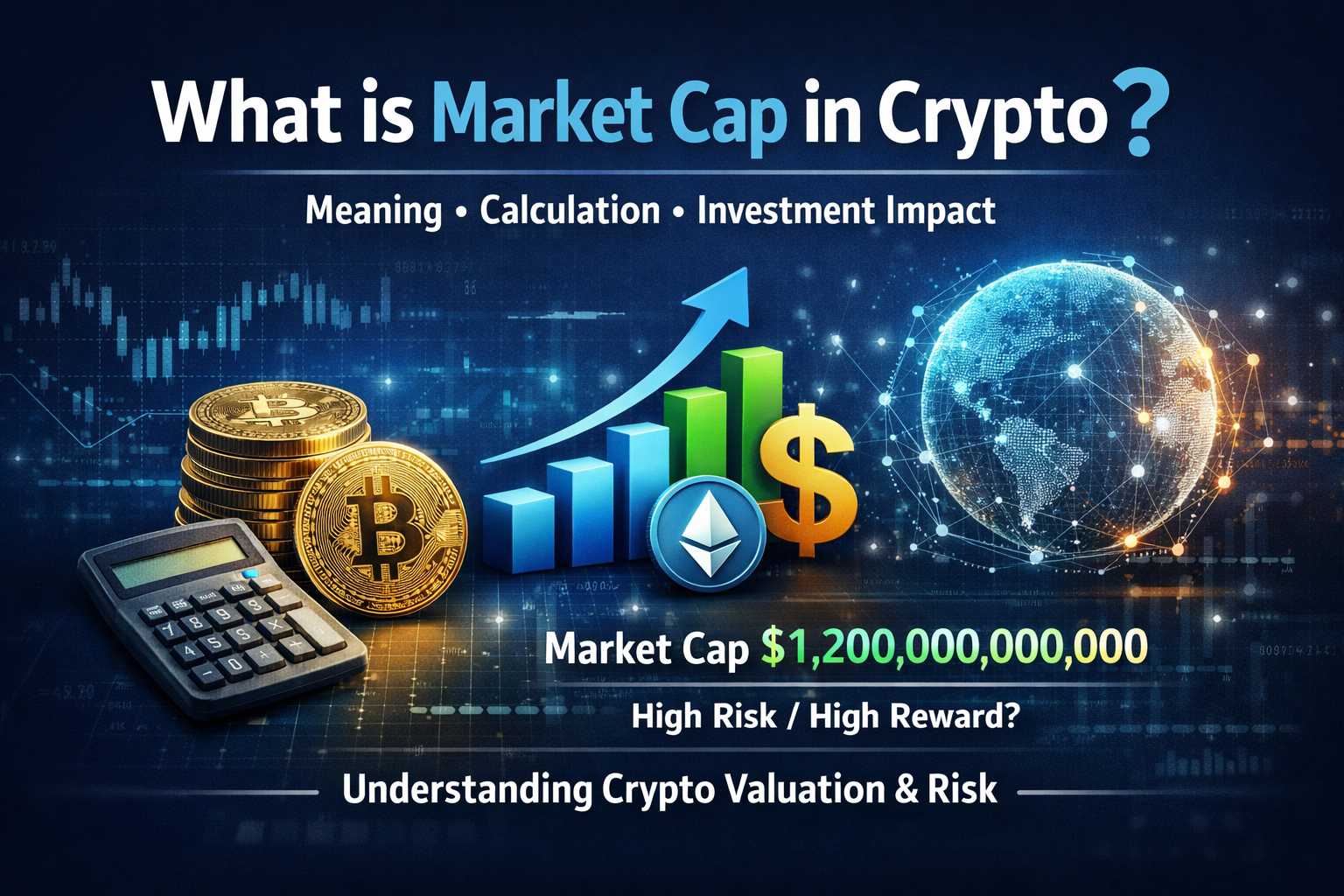
Market capitalization is one of the most referenced metrics in cryptocurrency markets.
It is used to compare projects, measure relative size, and assess positioning within the broader ecosystem. Despite its frequent use, market cap is often misunderstood.
To properly evaluate digital assets, it is essential to understand what market cap represents — and what it does not.
What Is Market Cap in Crypto?
Market cap (short for market capitalization) represents the total market value of a cryptocurrency.
It is calculated using a simple formula:
Market Cap = Current Price × Circulating Supply
For example:
If a cryptocurrency trades at $20 and there are 50 million coins in circulation:
Market Cap = $20 × 50,000,000 = $1,000,000,000
That means the network’s total valuation is 1 billion dollars based on the latest traded price.
It does not mean that 1 billion dollars has flowed into the asset.It reflects the implied value of all circulating coins at the current market price.
Why Market Cap Matters
Market cap provides context.
Price alone does not indicate how large or valuable a cryptocurrency is. A token trading at $0.50 can have a higher valuation than one trading at $500 — depending on supply.
Market cap allows investors to compare projects more objectively.
Cryptocurrencies are commonly categorized into:
Large Cap: Higher market value, typically more established, often lower relative volatility.
Mid Cap: Growing networks with expanding adoption and moderate risk profiles.
Small Cap: Lower valuation assets that may offer higher upside — but carry significantly higher volatility and risk.
Understanding these categories helps investors structure portfolios according to risk tolerance and strategy.
Market Cap vs Price: The Key Difference
A common misconception in crypto markets is assuming that a low-priced coin has more growth potential.This assumption ignores supply.
A token priced at $0.10 with billions of coins in circulation can already have a multi-billion dollar valuation. Price reflects unit cost. Market cap reflects total network valuation.
Serious analysis always considers both.
Circulating Supply, Total Supply and Max Supply
Supply structure plays a major role in valuation.
Circulating Supply – Coins currently available in the market
Total Supply – All coins that exist (including locked or reserved tokens)
Max Supply – The maximum number of coins that will ever be created
Market cap is typically calculated using circulating supply.
However, long-term valuation analysis should consider total and maximum supply to understand potential dilution risk.
The Limitations of Market Cap
While market cap is an important metric, it has limitations.
It does not measure:
- Liquidity depth
- Token distribution concentration
- Real user adoption
- Revenue generation
- Protocol sustainability
A high market cap does not automatically mean strong fundamentals.
Market cap is a starting point — not a final conclusion.
How Investors Use Market Cap
Market cap is often used for:
- Portfolio allocation decisions
- Comparing competing projects
- Risk assessment
- Position sizing
Many investors diversify exposure across different market cap segments to balance stability and growth potential.
Understanding valuation dynamics is a core part of capital preservation.
Market capitalization remains one of the foundational metrics in cryptocurrency analysis.
It provides a quick way to compare projects and assess relative size within the market.However, effective investment decisions require more than a single number.
Market cap offers perspective — but disciplined analysis requires deeper evaluation of fundamentals, adoption, and long-term positioning. Also Read ->
Part 2: Understanding Market Signals – Think Like a Smart Crypto Investor
How Crypto Cycles Shape Long-Term Opportunities
Why Crypto Volatility Is Not the Enemy (And How Smart Investors Use It)
Disclaimer: This article is for educational purposes only and does not constitute financial advice. Cryptocurrency investments involve significant risk. Always conduct your own research before making financial decisions.