
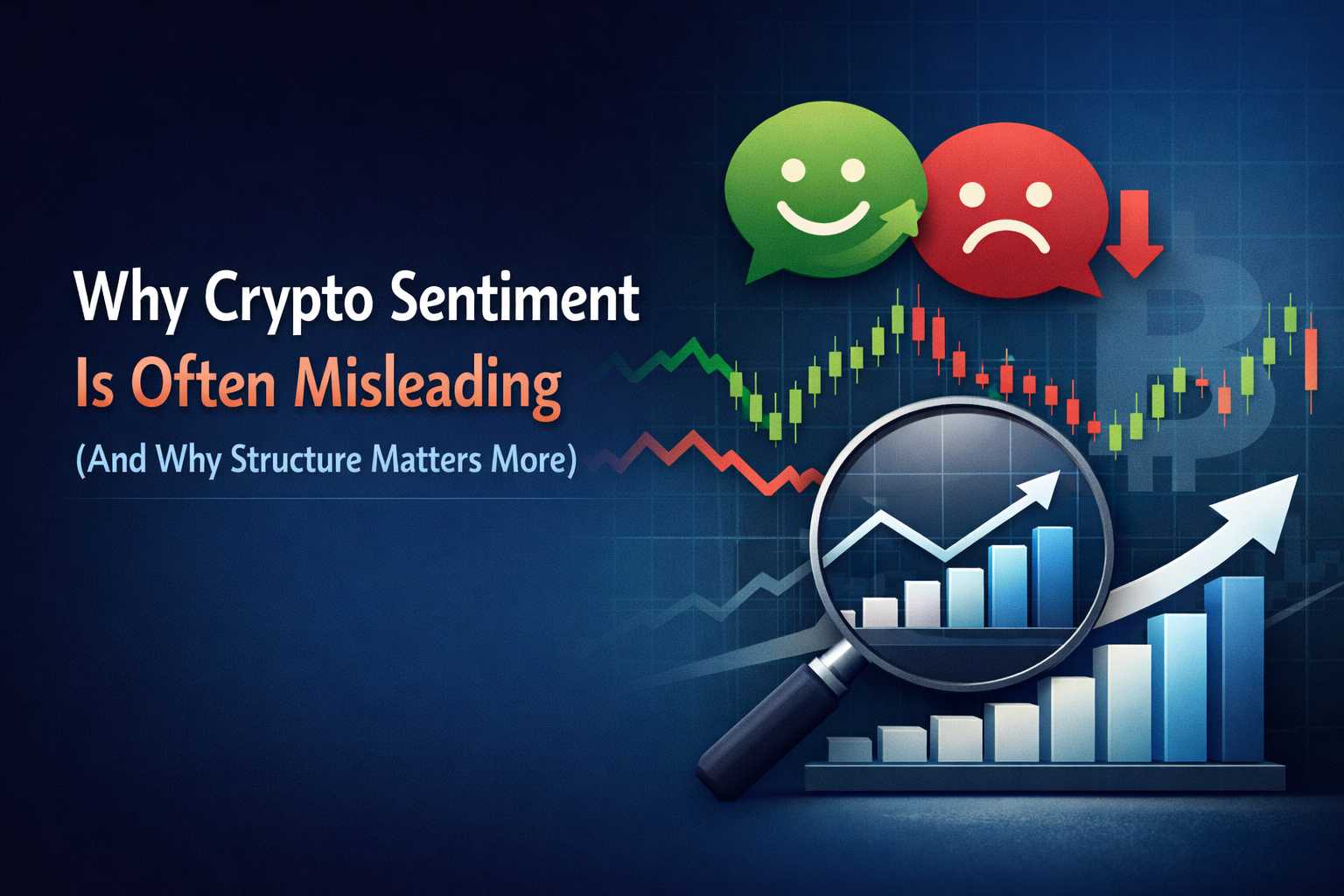
Cryptocurrency markets are driven by more than technology, adoption and liquidity.
They are also driven by people.Investors become optimistic when prices rise.
Fear spreads when markets fall.
Strong rallies attract attention.
Sharp corrections create uncertainty.
Social media amplifies both extremes.
Within hours, the dominant narrative surrounding Bitcoin or the broader cryptocurrency market can shift from extreme optimism to widespread pessimism.
This collective emotional environment is known as market sentiment.
Understanding sentiment can provide valuable insight into how investors are positioned psychologically.
However, sentiment is also one of the easiest market signals to misinterpret.
Extreme optimism does not guarantee that a market top has arrived.
Extreme fear does not automatically create a buying opportunity.
And popular narratives frequently become strongest only after significant price movements have already occurred.
This creates an important distinction.
Sentiment can help investors understand how the market feels.
Market structure helps explain what the market is actually doing.
Professional investors therefore rarely use sentiment as a standalone trading signal.
Instead, they combine it with price structure, liquidity, volume, positioning, macroeconomic conditions and broader market cycles.
Understanding how these factors interact can help investors use sentiment as context rather than allowing the emotions of the crowd to control their decisions.
In This Analysis, We’ll Explore:
- What crypto market sentiment is
- What drives cryptocurrency sentiment
- Why sentiment often follows price
- Fear and greed
- The Crypto Fear & Greed Index
- Social media sentiment
- News and narrative cycles
- Why bullish sentiment can become dangerous
- Why extreme fear does not automatically mean buy
- Sentiment during bull markets
- Sentiment during bear markets
- Sentiment during sideways markets
- Sentiment vs market structure
- The relationship between sentiment and liquidity
- Contrarian sentiment analysis
- How experienced investors use sentiment
- Common sentiment analysis mistakes
- Strengths and limitations of sentiment indicators
- How long-term investors should interpret market psychology
What Is Crypto Market Sentiment?
Crypto market sentiment describes the overall emotional attitude of investors toward Bitcoin, cryptocurrencies or the market as a whole.
Sentiment can range from extreme fear to extreme optimism.
When sentiment is strongly bullish, investors generally expect prices to continue rising.
When sentiment becomes bearish, investors increasingly expect further declines.
These expectations influence behavior.
Optimistic investors may:
- Increase exposure.
- Accept greater risk.
- Buy speculative assets.
- Hold positions longer.
- Use more leverage.
Fearful investors may:
- Reduce exposure.
- Move toward cash or stable assets.
- Avoid speculative cryptocurrencies.
- Sell existing positions.
- Delay new investments.
Because millions of investors make decisions simultaneously, collective psychology can significantly influence short-term market behavior.
However, sentiment itself does not determine long-term value.
A cryptocurrency can remain popular while its fundamentals deteriorate.
Another project can experience negative sentiment while development and adoption continue improving.
For this reason, sentiment should be viewed as one layer of market analysis rather than a complete investment framework.
What Actually Drives Crypto Sentiment?
Crypto sentiment does not emerge randomly.
It is influenced by multiple factors operating simultaneously.
Price
Price is perhaps the strongest driver.
When Bitcoin rises rapidly, investors naturally become more optimistic.
When Bitcoin falls sharply, confidence deteriorates.
This creates a feedback loop.
Rising prices → increasing optimism → greater participation → additional buying pressure
The reverse can occur during declines.
Falling prices → increasing fear → reduced confidence → additional selling pressure
These feedback loops help explain why cryptocurrency markets sometimes move far beyond levels that fundamentals alone might appear to justify.
News
Major headlines can rapidly influence investor expectations.
Examples include:
- Regulatory developments.
- Institutional adoption.
- Exchange failures.
- Security breaches.
- ETF developments.
- Government policy.
- Macroeconomic announcements.
However, the market’s reaction depends heavily on existing positioning and expectations.
Positive news does not always produce higher prices.
Negative news does not always cause declines.
Sometimes the market has already anticipated the development.
Social Media
Cryptocurrency is particularly sensitive to social media because information spreads almost instantly.
X, Reddit, YouTube, Telegram and other platforms can amplify narratives across millions of investors.
As a result, optimism and fear can spread much faster than in traditional financial markets.
Macroeconomic Conditions
Interest rates, inflation, monetary policy and global liquidity also influence sentiment.
When investors become more comfortable taking risk, sentiment toward cryptocurrencies often improves.
When financial conditions tighten or economic uncertainty increases, risk appetite may decline.
Market Performance
Investors also compare cryptocurrency performance with other markets.
Strong equities, improving liquidity conditions or increasing institutional participation can strengthen confidence.
Weak global markets may have the opposite effect.
Sentiment is therefore the result of multiple interconnected forces rather than a single indicator.
Why Retail Investors Always Arrive Late in Crypto Cycles
Why Sentiment Often Follows Price
One of the biggest mistakes investors make is assuming that sentiment always predicts price.
Frequently, the opposite happens.
Price moves first. Sentiment follows.
Imagine Bitcoin rises significantly over several weeks.
Initially, investors remain skeptical.
As the rally continues, confidence improves.
Positive headlines increase.
Social media engagement expands.
Analysts raise expectations.
Retail investors begin entering.
Eventually, sentiment becomes overwhelmingly bullish.
By this point, however, Bitcoin may already have experienced a substantial price increase.
The same process occurs during declines.
Price begins falling.
Investors initially describe the movement as a temporary correction.
The decline continues.
Confidence weakens.
Negative headlines increase.
Eventually, fear becomes widespread.
Again, much of the price movement may already have occurred before sentiment reaches an extreme.
This lagging relationship explains why blindly following market sentiment can produce poor entry and exit decisions.
Investors may become most optimistic after large gains and most pessimistic after significant losses.
Fear and Greed in Cryptocurrency Markets
Fear and greed are two of the strongest psychological forces influencing financial markets.
Crypto amplifies both because of its high volatility.
Greed
Greed becomes increasingly visible during strong bull markets.
Prices rise.
Portfolios increase in value.
Success stories spread across social media.
Investors begin expecting even greater returns.
Risk perception gradually declines.
This can encourage:
- Larger position sizes.
- Greater leverage.
- Speculative altcoin purchases.
- Memecoin speculation.
- Reduced diversification.
- Unrealistic price expectations.
As profits accumulate, investors can begin confusing a favorable market environment with investment skill.
This is particularly dangerous because risk management often becomes weakest precisely when market optimism becomes strongest.
Fear
Fear dominates the opposite environment.
Prices decline.
Losses increase.
Negative forecasts spread.
Investors begin questioning positions they previously considered strong.
Fear can encourage:
- Panic selling.
- Abandoning long-term strategies.
- Avoiding markets entirely.
- Excessive focus on negative information.
- Selling simply because prices have already fallen.
Both emotions can distort rational decision-making.
The objective is therefore not to eliminate fear or greed completely.
That is unrealistic.
Instead, disciplined investors recognize when these emotions are influencing their decisions and return their attention to market structure, risk and long-term objectives.
The Crypto Fear & Greed Index
One of the best-known sentiment indicators in cryptocurrency is the Crypto Fear & Greed Index.
The index attempts to summarize market psychology into a simple numerical reading.
The scale generally ranges from:
0 = Extreme Fear
to
100 = Extreme Greed
Readings are commonly divided into categories such as:
- Extreme Fear.
- Fear.
- Neutral.
- Greed.
- Extreme Greed.
The appeal is obvious.Instead of analyzing thousands of social media posts, market movements and investor reactions individually, traders receive a simplified snapshot of overall sentiment.
This can be useful for understanding the emotional environment surrounding the market.
But the index has an important limitation.
It is not a buy or sell indicator.
Extreme fear does not guarantee that prices have reached a bottom.
Extreme greed does not guarantee that a market top is imminent.
Markets can remain fearful or greedy for extended periods.
During a severe bear market, extreme fear may appear repeatedly while prices continue falling.
During a powerful bull market, extreme greed may persist while prices continue establishing new highs.
The index is therefore most useful as contextual information.
It tells investors something about the current emotional environment—not what price must do next.
Why Extreme Fear Does Not Automatically Mean Buy
A common contrarian investment idea is:
“Buy when everyone is afraid.”
There is logic behind this principle.
Historically, some attractive long-term opportunities have appeared during periods of widespread pessimism.
But the concept is often oversimplified.
Extreme fear can appear:
- Near a market bottom.
- During the middle of a bear market.
- After a major structural breakdown.
- During a liquidity crisis.
- Following genuine deterioration in fundamentals.
Imagine Bitcoin falls 30% and sentiment reaches extreme fear.
That alone does not prevent Bitcoin from falling another 20%.
Fear measures psychology.
It does not establish valuation or confirm market support.
A stronger approach examines whether extreme fear coincides with other evidence such as improving market structure, declining selling pressure or important long-term support.
Fear can identify an environment worth investigating.
It cannot confirm the opportunity by itself.
Why Extreme Greed Does Not Automatically Mean Sell
The opposite misconception appears during bull markets.
When sentiment reaches extreme greed, investors sometimes assume a crash must immediately follow.
Again, reality is more complicated.
Strong bull markets naturally create optimistic sentiment.
If Bitcoin is establishing higher highs and higher lows while liquidity and demand remain supportive, extreme greed can persist for considerable periods.
Selling solely because sentiment becomes optimistic may cause investors to exit strong trends far too early.
However, extreme greed can become increasingly important when combined with other warning signs.
For example:
- Weakening momentum.
- Excessive leverage.
- Declining volume.
- Failed breakouts.
- Euphoric retail participation.
- Deteriorating market structure.
Sentiment becomes more useful when it confirms evidence visible elsewhere in the market.
This illustrates a recurring principle:
Extreme sentiment is a condition—not a timing signal.
Social Media Sentiment
Few financial markets are as closely connected to social media as cryptocurrency.
Crypto markets operate continuously.
Communities are global.
Information spreads instantly.
This allows platforms such as X, Reddit, YouTube and Telegram to influence investor psychology extremely quickly.
During bullish periods, social media tends to amplify:
- Price predictions.
- Success stories.
- New narratives.
- Altcoin opportunities.
- Bullish charts.
- Expectations of further gains.
During bearish periods, the environment reverses.
Discussion becomes dominated by:
- Market crashes.
- Failed projects.
- Regulatory concerns.
- Negative forecasts.
- Predictions of further declines.
This creates powerful echo chambers.
Investors naturally follow accounts and communities that reinforce their existing beliefs.
As a result, social media sentiment can appear much more extreme than the broader market actually is.
For investors, this creates an important risk.
Popularity is not confirmation.
A narrative repeated thousands of times does not automatically become correct.
How Social Media and Crypto Influencers Distort Investor Psychology
News and Narrative Cycles
Cryptocurrency markets constantly move between narratives.
One period may focus on:
- Artificial intelligence.
- Real World Assets.
- Layer-2 networks.
- Memecoins.
- DeFi.
- Gaming.
- Institutional adoption.
As prices rise within a particular sector, attention increases.
More investors discover the narrative.
Media coverage expands.
Social media engagement accelerates.
Eventually, the narrative can become self-reinforcing.
Higher prices create greater attention.
Greater attention attracts additional capital.
Additional capital pushes prices higher.
But narrative cycles can reverse just as quickly.
Once momentum weakens, investors begin searching for the next opportunity.
Capital rotates.
Social media attention disappears.
Previously dominant narratives suddenly appear irrelevant.
This does not necessarily mean the underlying technology has become worse.
It demonstrates how quickly market attention can separate from fundamental development.
Understanding this distinction helps investors avoid confusing a popular narrative with a sustainable long-term investment thesis.
Sentiment During Bull Markets
Bull markets naturally create increasingly positive sentiment.
As prices rise, confidence grows.
Investors become more willing to take risk.
Media coverage expands.
Previously cautious participants begin entering the market.
This process can strengthen the existing trend because optimism attracts additional capital.
During the early stages of a bull market, sentiment may remain surprisingly cautious.
Many investors still remember the previous bear market.
Rallies are treated with skepticism.
Corrections create renewed fear.
As the trend continues, however, confidence gradually changes.
A typical progression may look like:
- Skepticism.
- Optimism.
- Confidence.
- Excitement.
- Greed.
- Euphoria.
The later stages deserve particular attention.
When investors begin believing that significant corrections are impossible, risk management can deteriorate.
Speculative assets attract increasing capital.
Leverage may rise.
Price targets become increasingly aggressive.
However, bullish sentiment alone does not identify the top.
A healthy bull market naturally produces optimism.
The important question is whether sentiment remains supported by market structure, liquidity and genuine demand—or whether expectations have moved far beyond underlying conditions.
Sentiment During Bear Markets
Bear markets create the opposite psychological cycle.
Initially, many investors remain optimistic.
Early declines are interpreted as temporary corrections.
As prices continue falling, confidence gradually deteriorates.
The emotional progression may include:
- Complacency.
- Concern.
- Anxiety.
- Fear.
- Panic.
- Capitulation.
- Apathy.
The final stage is particularly interesting.
After prolonged declines, investors sometimes stop caring altogether.
Trading activity falls.
Social media engagement decreases.
Media coverage disappears.
Rather than widespread panic, the market becomes quiet.
This environment can eventually create conditions associated with long-term accumulation.
But again, negative sentiment does not automatically identify a bottom.
Fundamentals may have deteriorated.
Liquidity may remain weak.
Macroeconomic conditions may still be restrictive.
Investors therefore need evidence beyond psychology before concluding that widespread pessimism represents an attractive opportunity.
Sentiment During Sideways Markets
Sideways markets create a different psychological challenge.
There may be little fear.
There may also be little excitement.Instead, boredom and frustration become dominant.
Bitcoin may trade within the same range for weeks.
Volatility declines.
Volume decreases.
Social media attention moves toward whichever assets happen to be performing better.
Investors begin questioning whether they should change strategy simply because nothing appears to be happening.
This environment can encourage:
- Overtrading.
- Chasing stronger assets.
- Abandoning long-term positions.
- Increasing risk unnecessarily.
- Constantly searching for new narratives.
Quiet markets therefore demonstrate that sentiment is not limited to fear and greed.
Boredom itself can influence investor behavior.
Disciplined investors recognize that inactivity does not necessarily indicate that a strategy has stopped working.
Sometimes markets simply require time before the next major trend develops.
Crypto Sentiment vs Market Structure
This is where the distinction between sentiment and market structure becomes particularly important.
Sentiment describes how investors feel.
Market structure describes how price is behaving.
Market structure may include:
- Higher highs and higher lows.
- Lower highs and lower lows.
- Support and resistance.
- Trading ranges.
- Breakouts and breakdowns.
- Trend direction.
- Volume behavior.
- Liquidity zones.
Imagine social media sentiment becomes extremely bearish.
At the same time, Bitcoin continues establishing higher lows and holding important support.
The emotional narrative and price structure are telling different stories.
Alternatively, sentiment may remain extremely bullish while price repeatedly fails to establish new highs and begins losing important support levels.
Again, there is a disconnect.
Neither sentiment nor structure provides certainty.
However, structure gives investors observable information about the interaction between buyers and sellers.
This makes it generally more useful for evaluating market conditions than emotion alone.
Understanding Crypto Market Structure – Part 6 How to Read the Crypto Market Like a Professional
Sentiment and Liquidity
Sentiment becomes especially powerful when combined with liquidity.
During optimistic markets, investors become increasingly willing to deploy capital.
Liquidity flows toward risk assets.
Trading activity increases.Leverage may expand.
This additional capital can reinforce bullish trends.
During fearful environments, the opposite can occur.
Investors reduce exposure.
Capital moves toward safer assets or cash.Trading activity declines.
Liquidity can become thinner.
These conditions can amplify downside volatility.
But liquidity and sentiment do not always move together.
Investors may remain pessimistic even while financial conditions begin improving.
Alternatively, sentiment may remain euphoric after liquidity conditions have started deteriorating.
These divergences can provide useful context.
Market psychology often reacts to what has already happened.
Liquidity can influence what markets are capable of doing next.
Contrarian Sentiment Analysis
Contrarian investing is based on the idea that extreme crowd behavior can eventually become unsustainable.
When almost everyone expects higher prices, many potential buyers may already be positioned.
When nearly everyone expects further declines, substantial selling may already have occurred.
This creates the logic behind famous ideas such as buying fear and selling greed.
However, contrarian analysis is more complicated than simply doing the opposite of the crowd.
The crowd can remain correct for long periods.
Bullish sentiment during a strong uptrend may remain justified.
Bearish sentiment during a structural decline may also remain justified.
A more useful contrarian framework asks:
Has sentiment become extreme relative to the underlying market structure?
For example, extreme pessimism becomes more interesting when:
- Selling pressure is weakening.
- Important support continues holding.
- Market structure begins improving.
- Negative news produces increasingly smaller price reactions.
Likewise, extreme optimism becomes more concerning when:
- Momentum weakens.
- Breakouts repeatedly fail.
- Leverage becomes excessive.
- Price stops responding strongly to positive developments.
Contrarian sentiment is therefore most useful when crowd psychology becomes disconnected from observable market behavior.
How Experienced Investors Use Sentiment
Experienced investors generally do not ask:
“Is sentiment bullish or bearish?”
They ask:
“What does current sentiment tell me about expectations, positioning and risk?”
Sentiment can help identify environments where emotions may be influencing market behavior.
During extreme optimism, investors may become more cautious about:
- Chasing price.
- Increasing position sizes.
- Using leverage.
- Assuming recent returns will continue indefinitely.
During extreme fear, they may begin investigating whether pessimism has become excessive.
This does not necessarily mean buying immediately.
Instead, they examine:
- Market structure.
- Liquidity.
- Volume.
- Fundamentals.
- Macroeconomic conditions.
- Valuation.
- Risk versus potential reward.
Sentiment becomes one input within a much larger decision-making framework.
Common Crypto Sentiment Analysis Mistakes
Sentiment appears simple, which makes it particularly easy to misuse.
Common mistakes include:
- Buying automatically during extreme fear.
- Selling automatically during extreme greed.
- Treating the Fear & Greed Index as a timing tool.
- Assuming social media represents the entire market.
- Following narratives after prices have already risen substantially.
- Ignoring market structure.
- Confusing popularity with fundamental strength.
- Assuming negative sentiment means an asset is undervalued.
- Assuming positive sentiment means an asset is overvalued.
- Allowing personal emotions to influence interpretation.
Confirmation bias creates another problem.
Investors naturally search for information supporting positions they already own.
A bullish investor may interpret neutral information positively.
A bearish investor may focus primarily on negative developments.
Good sentiment analysis therefore requires investors to evaluate both market psychology and their own psychological biases.
Strengths of Crypto Sentiment Analysis
Despite its limitations, sentiment analysis can provide valuable information.
Its strengths include:
- Identifying emotional market extremes.
- Providing insight into investor psychology.
- Highlighting periods of excessive optimism or pessimism.
- Helping investors recognize FOMO.
- Providing context around narrative-driven markets.
- Identifying potential crowding.
- Complementing market structure and technical analysis.
- Encouraging investors to question emotionally driven decisions.
Sentiment becomes particularly valuable when conditions reach unusual extremes.
Normal optimism tells investors relatively little.
Extreme euphoria combined with deteriorating structure deserves more attention.
Normal concern may also provide limited information.
Extreme pessimism combined with improving structure can become more interesting.
The value comes from context.
Limitations of Crypto Sentiment Analysis
Sentiment analysis has several important limitations.
First, sentiment is difficult to measure accurately.
The cryptocurrency market includes:
- Retail investors.
- Institutions.
- Traders.
- Long-term holders.
- Developers.
- Market makers.
- Automated trading systems.
A social media sample cannot perfectly represent all of these participants.
Second, sentiment can remain extreme for long periods.
Markets do not automatically reverse because investors become too optimistic or pessimistic.
Third, sentiment is frequently reactive.
Price changes psychology faster than psychology predicts price.
Fourth, different groups may have completely different expectations at the same time.
Retail investors may be fearful while institutional investors accumulate.
Social media may appear euphoric while derivatives markets show increasing hedging activity.
No single sentiment indicator captures the complete market.
For these reasons, sentiment should be treated as supporting evidence rather than a standalone forecasting system.
How Long-Term Investors Should Interpret Sentiment
Long-term investors generally benefit from viewing sentiment differently from short-term traders.
Rather than trying to trade every emotional shift, they can use sentiment to evaluate whether their own behavior is becoming influenced by the crowd.
When markets become euphoric, long-term investors can ask:
Am I increasing risk because the investment thesis improved—or simply because prices increased?
During periods of extreme fear:
Has my long-term thesis genuinely deteriorated—or am I reacting to falling prices?
During quiet markets:
Has anything fundamentally changed—or am I becoming impatient because nothing is happening?
These questions shift attention away from the emotions of the market and back toward investment quality, portfolio construction and risk management.
Sentiment then becomes useful not because it predicts the future, but because it helps investors recognize when psychology may be distorting decision-making.
Conclusion
Crypto market sentiment provides valuable insight into the emotional environment surrounding Bitcoin and the broader cryptocurrency market.
Fear, greed, FOMO, narratives, news and social media all influence investor behavior.
But sentiment has an important weakness:
It frequently reacts to price rather than predicting it.
Extreme fear does not automatically identify a market bottom.
Extreme greed does not automatically identify a market top.
And widespread agreement does not guarantee that the crowd is wrong.
This is why sentiment becomes significantly more useful when combined with market structure, liquidity, volume, fundamentals and broader market conditions.
Experienced investors do not ignore sentiment.
They place it in context.
When sentiment and market structure diverge, that difference can become valuable information worth investigating—but neither provides certainty on its own.
For long-term investors, perhaps the greatest value of sentiment analysis is psychological.
It helps reveal when fear, greed or boredom may be influencing decisions that should instead be based on evidence.
Markets will always be emotional.
Successful investors do not need to eliminate those emotions.
They need to recognize them before allowing them to control their strategy.
Advanced Crypto Investing Strategies – Part 4: Managing Emotions & Avoiding FOMO
Disclaimer: This article is for educational and informational purposes only and does not constitute financial advice. Cryptocurrency trading and investing carry significant risk, and individuals should do their own research before making financial decisions.