
Cryptocurrency markets are notoriously difficult to time.
Bitcoin can rally rapidly and then experience a significant correction.
Altcoins can move even more aggressively.
Periods of extreme optimism can suddenly transition into fear, while months of sideways price action can eventually produce major breakouts or breakdowns.
For investors, this creates a difficult question:
When is the right time to invest?
Buying after a major rally can feel risky.
Buying during a crash can feel even more uncomfortable.
Waiting for the perfect entry often results in investors remaining on the sidelines indefinitely.
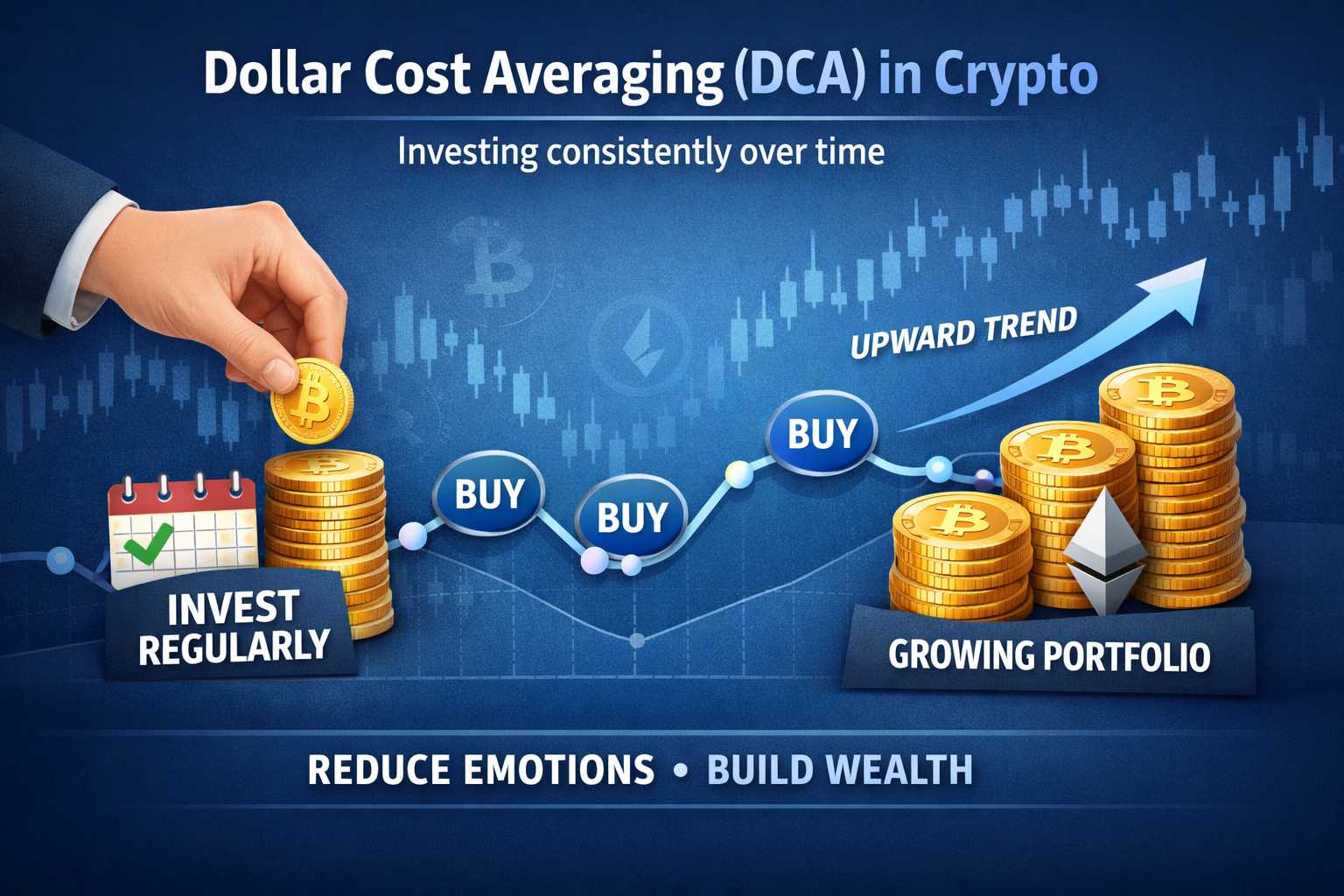
Dollar-Cost Averaging, commonly known as DCA, offers a different approach.
Instead of attempting to predict the perfect moment to enter the market, investors allocate a predetermined amount of capital at regular intervals.
The objective is not to buy every market bottom.
It is to reduce dependence on short-term market timing while building exposure gradually over time.
This makes DCA particularly interesting within cryptocurrency markets, where volatility and investor psychology can make consistent decision-making extremely difficult.
However, Dollar-Cost Averaging is not automatically profitable.
It cannot transform a fundamentally weak cryptocurrency into a strong investment.
It does not eliminate market risk.
And under certain market conditions, investing a lump sum immediately may produce better results.
Understanding both the strengths and limitations of DCA is therefore essential before incorporating it into a long-term cryptocurrency investment strategy.
In This Analysis, We’ll Explore:
- What Dollar-Cost Averaging is
- How DCA works
- An example of a crypto DCA strategy
- Why DCA can be useful in volatile markets
- How DCA interacts with crypto market cycles
- DCA during bull markets
- DCA during bear markets
- DCA during sideways markets
- DCA vs lump sum investing
- DCA vs market timing
- How DCA reduces emotional decision-making
- DCA and average purchase price
- Bitcoin DCA vs altcoin DCA
- Why DCA cannot fix a bad investment
- When investors should reconsider a DCA strategy
- Fixed DCA vs more dynamic approaches
- Common DCA mistakes
- Strengths of Dollar-Cost Averaging
- Limitations and risks
- How long-term investors use DCA
What Is Dollar-Cost Averaging?
Dollar-Cost Averaging is an investment strategy where an investor allocates a fixed amount of money at predetermined intervals regardless of short-term market conditions.
For example, an investor might decide to invest:
- $100 every week.
- $300 every month.
- $1,000 every quarter.
The exact amount and frequency are less important than the underlying principle.
The investment schedule is established in advance.
If Bitcoin rises, the investor continues buying.
If Bitcoin falls, the investor continues buying.
If the market moves sideways for months, the schedule remains unchanged.
This removes one of the most difficult decisions from the investment process:
Trying to determine the perfect entry point.
Rather than attempting to predict short-term price movements, DCA focuses on gradually building exposure over a longer period.
How Does DCA Work?
The mechanics behind Dollar-Cost Averaging are relatively simple.
Because the same amount of money is invested each time, investors naturally purchase different quantities of an asset depending on its price.
When prices are high, the fixed investment buys fewer units.
When prices are low, the same investment buys more units.
Imagine an investor allocates $500 to Bitcoin every month.
Month 1
Bitcoin price: $100,000
Investment: $500
Bitcoin purchased: 0.005 BTC
Month 2
Bitcoin price: $80,000
Investment: $500
Bitcoin purchased: 0.00625 BTC
Month 3
Bitcoin price: $60,000
Investment: $500
Bitcoin purchased: approximately 0.00833 BTC
The investor continues allocating the same dollar amount, but automatically purchases more Bitcoin as the price declines.
If prices subsequently rise, the same process works in reverse.
The investor purchases fewer units at increasingly higher prices.
This creates a blended average acquisition cost over time rather than relying on one single entry price.
Example of a Long-Term Crypto DCA Strategy
Consider an investor who wants long-term exposure to Bitcoin but does not know whether the current market price represents an attractive entry.
Instead of investing $12,000 immediately, the investor could theoretically allocate:
$1,000 per month for 12 months.
During those 12 months, Bitcoin might:
- Rally significantly.
- Experience a correction.
- Enter a bear market.
- Remain range-bound.
- Move through several different conditions.
The investor does not need to predict which scenario will occur.
Capital is gradually deployed according to the predetermined schedule.
If Bitcoin declines during the investment period, later purchases occur at lower prices.
If Bitcoin rises continuously, later purchases become more expensive.
This reveals an important characteristic of DCA:
DCA reduces the importance of the initial entry price, but it does not guarantee a lower average purchase price.
If an asset rises consistently after the strategy begins, investing the entire amount earlier could have produced a better result.
The advantage of DCA lies primarily in managing uncertainty and behavior—not in guaranteeing superior returns.
Why DCA Can Be Useful in Volatile Crypto Markets
Cryptocurrency volatility creates both opportunities and psychological challenges.
Large price movements can happen quickly.
Bitcoin has historically experienced substantial corrections even during longer-term periods of appreciation.
Smaller cryptocurrencies can experience significantly larger drawdowns.
This volatility makes market timing extremely difficult.
An investor waiting for a 20% correction may watch prices rise 50% before that correction arrives.
Another investor may buy after a major decline only to see prices fall significantly further.
DCA reduces dependence on making one large timing decision correctly.
Instead of asking:
“Is this the bottom?”
the investor asks:
“Does my long-term investment thesis still justify continuing my predefined strategy?”
That is a fundamentally different approach.
DCA does not remove volatility.
It changes how investors interact with it.
Why Bitcoin Volatility Scares Retail Investors — But Attracts Smart Money
DCA and Crypto Market Cycles
Cryptocurrency markets historically move through periods of expansion, contraction and consolidation.
A simplified market cycle may include:
Accumulation → Bull Market → Distribution → Bear Market → Accumulation
DCA interacts differently with each phase.
During falling markets, investors purchase increasingly larger quantities with the same fixed contribution.
During rising markets, they gradually purchase fewer units.
During sideways markets, they accumulate around a relatively similar price range.
This can make DCA useful for investors who acknowledge that they cannot consistently identify where one market phase ends and another begins.
However, DCA should not be confused with ignoring market cycles completely.
The fundamental investment thesis still matters.
A disciplined investor should distinguish between:
Price declining while the long-term thesis remains intact
and
Price declining because the underlying investment itself is deteriorating.
This distinction becomes particularly important when DCA is applied to altcoins.
DCA During Bull Markets
Bull markets create an interesting challenge for DCA investors.
As prices rise, each fixed contribution purchases fewer units.
Suppose Bitcoin moves from:
$50,000
to
$70,000
to
$90,000
to
$110,000.
An investor following a fixed DCA schedule continues buying throughout the rally.
This prevents the investor from remaining completely outside the market simply because prices appear expensive.
However, it also means increasingly allocating capital at higher valuations.
During powerful bull markets, a lump sum invested near the beginning of the trend may substantially outperform gradual DCA because more capital participated in the appreciation earlier.
This is one of DCA’s major opportunity costs.
The strategy sacrifices some potential upside in exchange for reducing dependence on the initial entry point.
DCA During Bear Markets
Bear markets represent one of the most psychologically difficult environments for DCA.
Prices continue falling.
Portfolios remain negative.
News becomes increasingly pessimistic.
Investor confidence deteriorates.
Ironically, these conditions allow a fixed contribution to purchase progressively more units.
For investors with a strong long-term thesis, this can reduce the average acquisition price.
However, blindly continuing DCA simply because prices are lower can be dangerous.
A falling price does not automatically represent better value.
Investors should continue evaluating:
- Adoption.
- Network development.
- Tokenomics.
- Competition.
- Security.
- Regulatory risks.
- Long-term demand.
This is particularly important for cryptocurrencies outside established market leaders.
Some assets recover after bear markets.
Others never return to their previous highs.
DCA works only if the underlying asset ultimately retains or increases sufficient long-term value.
DCA During Sideways Markets
Sideways markets may be particularly well suited to the behavioral advantages of DCA.
When prices remain within the same range for months, investors often become impatient.
There is no obvious rally to chase.
There is no dramatic crash creating an obvious entry opportunity.
Market activity simply becomes quiet.
A predetermined DCA schedule removes the need to continuously decide whether the current week or month represents the ideal entry.
Positions gradually accumulate throughout the consolidation period.
However, sideways price action does not guarantee that the eventual breakout will occur upward.
A range can resolve in either direction.
DCA therefore remains dependent on the quality of the underlying asset and the investor’s longer-term thesis.
DCA vs Lump Sum Investing
One of the most important comparisons is between Dollar-Cost Averaging and lump sum investing.
With DCA, capital enters the market gradually.
With lump sum investing, the available capital is invested immediately.
Neither strategy automatically wins.
The result depends largely on what the market does afterward.
When Lump Sum Can Perform Better
If an asset begins a sustained rally shortly after the investment decision, lump sum investing generally has an advantage.
More capital was invested before prices increased.
The investor therefore receives greater exposure to the subsequent appreciation.
Importantly, this does not require buying the exact market bottom.
If markets have a positive long-term expected return, investing earlier simply gives capital more time in the market.
When DCA Can Perform Better
DCA can have an advantage when markets decline substantially after the initial investment date.
Because part of the capital remains undeployed, later contributions can purchase assets at lower prices.
This can reduce the average acquisition cost relative to investing everything immediately before the decline.
The Psychological Difference
The comparison is not purely mathematical.
Imagine investing $20,000 into Bitcoin today and seeing the market fall 35% over the following two months.
Even if the long-term thesis remains intact, the psychological pressure can be significant.
Gradually deploying the same $20,000 reduces the impact of any single entry point.
That can make it easier for some investors to remain committed to their strategy.
The trade-off is therefore clear:
Lump sum maximizes immediate market exposure.
DCA reduces entry-timing concentration and can make behavioral discipline easier.
Choosing between them is ultimately not about identifying a universally superior strategy.
It is about understanding which type of risk the investor is trying to manage.
DCA vs Market Timing
Dollar-Cost Averaging and market timing approach uncertainty in fundamentally different ways.
Market timing attempts to determine when an asset is attractively priced before committing capital.
An investor might wait for:
- A major correction.
- Technical support.
- Improving market structure.
- Oversold conditions.
- A change in liquidity.
- Confirmation of a new trend.
In theory, successful market timing can produce excellent results.
Buying near the beginning of a major market expansion provides significantly greater upside than gradually entering after prices have already risen.
The problem is consistency.
Identifying attractive prices is one challenge.
Actually buying when markets are fearful is another.
Investors frequently wait for lower prices during bull markets, only to watch the market continue rising.
During bear markets, they may finally receive the correction they wanted but become too pessimistic to invest.
DCA approaches this problem by accepting that short-term market timing is uncertain.
Rather than attempting to make every entry optimal, the strategy prioritizes consistency.
This does not mean market analysis becomes irrelevant.
An investor can understand market cycles, valuations and market structure while still using DCA as the primary method for deploying capital.
The difference is that investment decisions are not entirely dependent on correctly predicting the next market move.
Advanced Crypto Investing Strategies – Part 2: Dollar-Cost Averaging vs. Market Timing
How DCA Reduces Emotional Decision-Making
One of the strongest arguments for Dollar-Cost Averaging is behavioral rather than mathematical.
Cryptocurrency markets constantly pressure investors to make emotional decisions.
During rallies:
“I need to buy before it goes higher.”
During crashes:
“I should wait because it might fall further.”
During sideways markets:
“Nothing is happening. Maybe I should invest somewhere else.”
These reactions can produce a destructive pattern.
Investors buy aggressively after prices rise, stop buying after prices fall and constantly change strategy based on recent market performance.
DCA attempts to reverse this behavior.
The investment schedule is determined before those emotions appear.
If the plan is to invest a fixed amount every month, short-term market sentiment no longer determines whether that month’s investment occurs.
This can help reduce:
- FOMO.
- Panic-driven decisions.
- Constant market timing.
- Overreaction to news.
- Performance chasing.
- Decision fatigue.
DCA does not remove emotion.
It creates a structure designed to reduce the influence emotion has over investment decisions.
Advanced Crypto Investing Strategies – Part 4: Managing Emotions & Avoiding FOMO
DCA and Average Purchase Price
Dollar-Cost Averaging is often described as a way to “lower your average price.”
That statement requires an important qualification.
DCA does not automatically lower an investor’s average purchase price.
If prices continuously rise, each new purchase occurs at a higher level and the average acquisition price increases.
If prices decline, later contributions purchase more units and may reduce the average acquisition price.
If markets fluctuate around a relatively stable range, purchases become distributed across those different prices.
The real advantage is therefore not necessarily achieving the lowest possible average.
It is avoiding dependence on one specific purchase price.
This reduces entry-point concentration risk.
Instead of the entire investment outcome being heavily influenced by whether one large purchase happened before a rally or correction, exposure is established across multiple market conditions.
Bitcoin DCA vs Altcoin DCA
Not every cryptocurrency is equally suitable for a long-term DCA strategy.
This distinction is critical.
Bitcoin DCA
Bitcoin has historically remained the dominant cryptocurrency across multiple market cycles.
Its investment thesis commonly focuses on factors such as:
- Fixed maximum supply.
- Network security.
- Decentralization.
- Global liquidity.
- Institutional participation.
- Long-term adoption.
- Its role as a scarce digital monetary asset.
This does not make Bitcoin risk-free.
Bitcoin can experience severe drawdowns and its future returns remain uncertain.
However, investors considering a Bitcoin DCA strategy can evaluate a relatively long operating history and multiple completed market cycles.
Altcoin DCA
Altcoins introduce additional risks.
An altcoin may experience:
- Declining developer activity.
- Token dilution.
- Weakening adoption.
- Increasing competition.
- Changing tokenomics.
- Loss of market relevance.
- Liquidity deterioration.
- Technological obsolescence.
A cryptocurrency falling 80% does not automatically become an attractive investment.
It may simply be an asset whose long-term prospects have deteriorated.
Blindly continuing DCA in such an asset can increase exposure to a failing investment.
This leads to one of the most important rules of Dollar-Cost Averaging:
DCA is an execution strategy—not an investment thesis.
The strategy determines how capital enters an investment.
It does not determine whether that investment deserves capital in the first place.
Why DCA Cannot Fix a Bad Investment
Dollar-Cost Averaging can reduce timing risk.It cannot eliminate fundamental risk.
Imagine an investor repeatedly purchases a cryptocurrency because its price continues falling.
The average acquisition price decreases.
But simultaneously:
- Users leave the network.
- Developers move elsewhere.
- Token supply increases rapidly.
- Competitors gain market share.
- Liquidity disappears.
A lower average purchase price provides little protection if the asset continues losing long-term relevance.
This is sometimes described as averaging down, and the distinction from disciplined DCA is important.
A predetermined DCA strategy is based on an investment thesis established before short-term price movements occur.
Blind averaging down can become an emotional attempt to rescue a losing position.
Investors should therefore periodically reassess whether the original reasons for owning an asset remain valid.
Should You Ever Stop a DCA Strategy?
Consistency is important, but consistency should not become stubbornness.
There are legitimate reasons to reconsider or stop a DCA strategy.
Examples may include:
- The investment thesis has materially changed.
- Fundamentals have deteriorated.
- Tokenomics have become significantly less attractive.
- Security concerns have emerged.
- Adoption is structurally declining.
- Portfolio exposure has become too concentrated.
- Personal financial circumstances have changed.
Price falling by itself is not necessarily a reason to stop.
Likewise, price rising is not necessarily a reason to continue.
The relevant question is:
Does the original long-term reason for allocating capital still exist?
This prevents DCA from becoming an excuse to ignore new information.
Fixed DCA vs Dynamic Approaches
Traditional DCA uses the same contribution regardless of market conditions.
For example:
$500 every month.
Some investors use more dynamic variations.
They may maintain a regular base contribution but adjust additional allocations depending on valuation, market conditions or portfolio weightings.
For example, an investor could theoretically maintain a fixed monthly investment while preserving additional cash for unusually large market corrections.
Another approach is value averaging, where contributions change depending on whether a portfolio is above or below a predetermined growth path.
These approaches may offer greater flexibility.
However, they also reintroduce decision-making.
The more adjustments an investor makes based on market conditions, the further the strategy moves away from pure DCA and toward active allocation.
That is not necessarily bad.
But it removes part of DCA’s greatest advantage:
simplicity.
Common DCA Mistakes
Dollar-Cost Averaging is simple in principle, but investors can still use it poorly.
Stopping When Markets Fall
This defeats one of the central purposes of DCA.
If the investment thesis remains intact, declining prices allow fixed contributions to purchase more units.
Stopping solely because the market becomes uncomfortable reintroduces emotional timing.
Increasing Contributions After Large Rallies
FOMO can transform a disciplined DCA strategy into momentum chasing.
Investors gradually become more aggressive precisely because prices have already increased.
DCA Into Every Altcoin
DCA should not be confused with diversification.
Repeatedly purchasing weak assets does not make a portfolio stronger.
Never Reassessing Fundamentals
A predefined schedule should automate execution—not thinking.
Investment theses still require periodic evaluation.
Investing Money Needed Soon
DCA does not remove volatility.
Capital needed for short-term expenses may still be exposed to substantial losses when required.
Ignoring Portfolio Allocation
A successful position can become increasingly large relative to the rest of a portfolio.
Continuing automatic purchases without monitoring overall allocation can create concentration risk.
Strengths of Dollar-Cost Averaging
DCA offers several advantages for long-term cryptocurrency investors.
These include:
- Reduced dependence on a single entry point.
- Less pressure to identify market bottoms.
- Greater consistency.
- Reduced influence of FOMO.
- Reduced decision fatigue.
- Automatic accumulation during declining markets.
- A simple and repeatable investment process.
- Compatibility with regular income and monthly investing.
- Easier implementation across long investment horizons.
Perhaps its greatest advantage is behavioral.
A simple strategy that an investor can follow consistently may ultimately prove more useful than a theoretically superior strategy that collapses under emotional pressure.
Limitations and Risks of DCA
Dollar-Cost Averaging also has important limitations.
It Does Not Guarantee Profit
If an asset loses value permanently, repeated purchases can increase total losses.
It Can Underperform Lump Sum Investing
If markets rise substantially after capital becomes available, gradually investing means part of that capital remains outside the market while prices increase.
It Does Not Eliminate Drawdowns
An investor following DCA can still experience substantial portfolio losses during a bear market.
It Can Encourage Blind Investing
Automation becomes dangerous when investors stop evaluating the underlying asset.
It Does Not Identify Value
A fixed schedule says nothing about whether an asset is cheap, expensive or fundamentally attractive.
It Requires Time
DCA is designed around repeated investments.
Its behavioral and timing benefits become more relevant across longer investment periods rather than a handful of purchases.
Understanding these limitations prevents investors from treating DCA as a guaranteed wealth-building formula.
How Long-Term Investors Use DCA
Long-term investors can use DCA as part of a broader portfolio strategy rather than treating it as the entire strategy.
The broader process may include:
Asset selection
Determine which investments have a sufficiently strong long-term thesis.
Portfolio allocation
Determine how much exposure each asset should receive.
Contribution schedule
Establish how frequently new capital will be invested.
Risk management
Prevent individual positions from becoming disproportionately large.
Thesis review
Periodically evaluate whether the original investment case remains intact.
Rebalancing
Adjust portfolio exposure when market movements significantly change allocations.
In this framework, DCA handles one specific problem:
How should new capital enter the market over time?
It does not replace portfolio construction, fundamental analysis or risk management.
Conclusion
Dollar-Cost Averaging is one of the simplest cryptocurrency investment strategies, but its real value is often misunderstood.
DCA is not designed to identify market bottoms.
It does not guarantee the lowest average purchase price.
It does not automatically outperform lump sum investing.
And it cannot rescue a fundamentally weak investment.
What DCA does is reduce dependence on making one perfect entry decision.
By investing predetermined amounts at regular intervals, investors spread their purchases across different prices and market conditions.
This can be particularly valuable in cryptocurrency markets, where volatility, fear and greed make consistent decision-making difficult.
During bull markets, DCA may sacrifice some potential upside compared with investing capital earlier.
During bear markets, it can allow investors to accumulate more units at lower prices.
During sideways markets, it provides structure when there is little obvious direction.
But throughout every market environment, the quality of the underlying investment remains more important than the contribution schedule.
That is ultimately the distinction that matters most:
DCA determines how you invest.
It does not determine what is worth investing in.
For long-term crypto investors, Dollar-Cost Averaging can therefore be a powerful tool when combined with strong asset selection, portfolio allocation, risk management and periodic reassessment of the investment thesis.
The strategy is intentionally boring.
And for investors who would otherwise chase rallies, panic during corrections or endlessly wait for the perfect entry, that may be exactly its greatest strength.
Tokenomics in Crypto: Why Supply Design Determines Long-Term Value
Long-Term Investing in Crypto: Strategy, Psychology and Capital Allocation
How to Do Your Own Research (DYOR) in Crypto
Disclaimer: This article is for educational and informational purposes only and does not constitute financial or investment advice. Cryptocurrency investments are highly volatile and involve significant risk. Dollar-Cost Averaging does not guarantee profits or protect against losses. Always conduct your own research and consider your financial circumstances before making investment decisions.