
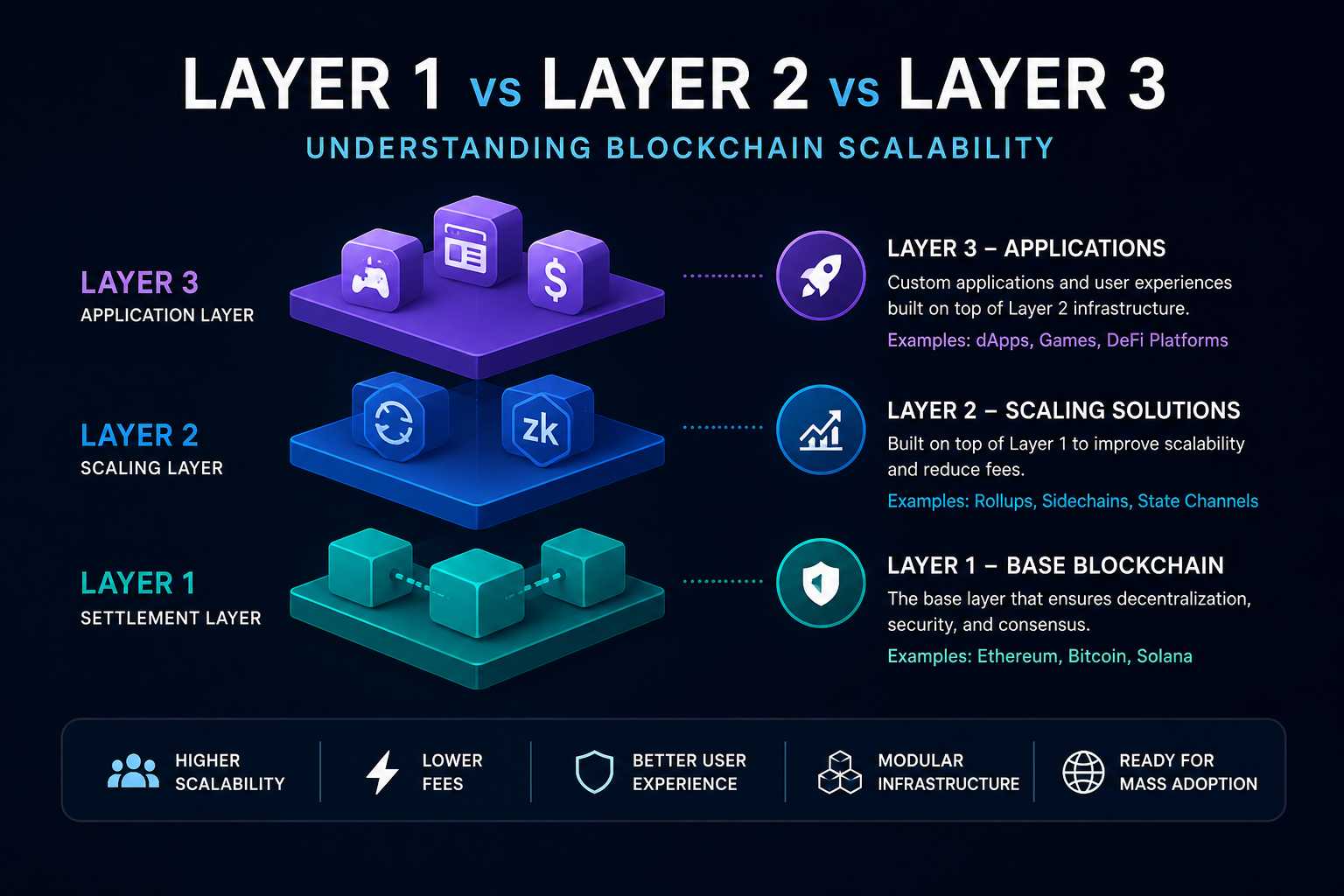
Layered blockchain infrastructure has become one of the most important topics in cryptocurrency markets.
As blockchain adoption grows, networks face increasing pressure to support:
- more users
- faster transactions
- lower fees
- smart contracts
- decentralized applications
- real-time financial activity
- global-scale infrastructure
This challenge is known as scalability.
To solve scalability problems, blockchain ecosystems increasingly rely on layered infrastructure involving:
- Layer 1 blockchains
- Layer 2 scaling solutions
- emerging Layer 3 systems
Understanding these layers is essential for investors because many of the largest crypto ecosystems — including Ethereum, Solana, Arbitrum, Optimism, Polygon, and zk-based networks — are directly connected to blockchain scalability architecture.
In this analysis, we’ll explore:
- what blockchain layers are
- why scalability matters
- how Layer 1 blockchains function
- what Layer 2 scaling solutions do
- the role of rollups
- what Layer 3 infrastructure means
- modular vs monolithic blockchain design
- the biggest tradeoffs surrounding blockchain scaling
- how investors often view blockchain infrastructure ecosystems
Why Scalability Matters in Crypto
Scalability remains one of the largest structural challenges in blockchain technology.
As blockchain activity increases, networks must process:
- more transactions
- larger application ecosystems
- higher trading volume
- stablecoin transfers
- smart contract execution
- decentralized finance activity
Without scalability improvements, blockchain networks often experience:
- high transaction fees
- network congestion
- slower execution speeds
- poor user experience
- reduced adoption potential
This became especially visible during earlier crypto cycles when Ethereum transaction fees surged dramatically during periods of heavy activity.
As a result, scalability infrastructure became one of the most important development areas within crypto markets.
What Is Layer 1?
Layer 1 refers to the main blockchain network itself.
This is the base infrastructure layer where:
- transactions settle
- consensus occurs
- validators secure the network
- blocks are finalized
Examples of Layer 1 blockchains include:
- Bitcoin
- Ethereum
- Solana
- Avalanche
- Cardano
- Near Protocol
- Sui
Layer 1 networks maintain their own:
- consensus systems
- validators or miners
- native tokens
- blockchain security
Each Layer 1 attempts to solve scalability differently.
Bitcoin as a Layer 1
Bitcoin focuses heavily on:
- decentralization
- security
- monetary scarcity
- long-term stability
Bitcoin intentionally sacrifices transaction speed and flexibility in exchange for stronger decentralization and security.
Because of this, Bitcoin processes relatively few transactions per second compared to newer blockchain networks.
However, supporters argue Bitcoin’s simplicity strengthens long-term reliability.
Ethereum as a Layer 1
Ethereum functions as programmable blockchain infrastructure.
Unlike Bitcoin, Ethereum supports:
- smart contracts
- decentralized applications
- DeFi systems
- NFTs
- tokenized assets
However, Ethereum’s popularity created scalability problems.
As activity increased, Ethereum experienced:
- expensive gas fees
- congestion
- slower transaction execution
Rather than maximizing speed directly on the base layer, Ethereum increasingly adopted a modular scaling strategy centered around Layer 2 ecosystems.
This became one of the defining developments within blockchain infrastructure.
Solana and Monolithic Layer 1 Scaling
Solana follows a very different scalability philosophy.
Rather than relying heavily on external scaling layers, Solana attempts to maximize performance directly on the main blockchain itself.
This is often called a monolithic blockchain approach.
Solana prioritizes:
- high throughput
- low transaction costs
- fast execution
- integrated settlement
Supporters argue this creates:
- smoother user experience
- reduced fragmentation
- simpler infrastructure
Critics argue it may increase:
- validator centralization risk
- hardware requirements
- operational complexity
This debate between modular and monolithic blockchain architecture has become one of the most important long-term infrastructure discussions in crypto.
What Is Layer 2?
Layer 2 refers to blockchain scaling solutions built on top of Layer 1 networks.
Layer 2 systems help process transactions externally before settling final data back onto the main blockchain.
The goal of Layer 2 infrastructure is improving:
- scalability
- transaction speed
- cost efficiency
- network throughput
without sacrificing the security of the underlying Layer 1.
Layer 2 solutions became especially important for Ethereum because Ethereum’s base layer prioritizes decentralization and security over maximum transaction speed.
Why Ethereum Uses Layer 2s
Ethereum increasingly scales through Layer 2 ecosystems rather than expanding execution directly on Layer 1.
This modular strategy allows Ethereum to maintain:
- strong decentralization
- validator security
- stable settlement infrastructure
while external networks process activity more efficiently.
Major Ethereum Layer 2 ecosystems include:
- Arbitrum
- Optimism
- Base
- zkSync
- Starknet
- Polygon
These systems significantly reduce transaction costs and improve scalability for users.
What Are Rollups?
Rollups are one of the most important Layer 2 technologies in crypto.
Rollups process transactions outside the main blockchain before submitting compressed transaction data back to Layer 1.
This reduces congestion while still benefiting from Ethereum’s security.
The two largest rollup categories are:
Optimistic Rollups
Examples include:
- Arbitrum
- Optimism
These systems assume transactions are valid unless challenged.
Advantages:
- lower fees
- strong scalability
- mature ecosystems
Tradeoffs:
- withdrawal delays
- fraud-proof reliance
ZK Rollups
Examples include:
- zkSync
- Starknet
These use cryptographic proofs called zero-knowledge proofs to verify transactions efficiently.
Advantages:
- stronger scalability
- faster finality
- improved efficiency
Tradeoffs:
- greater technical complexity
- earlier-stage infrastructure
Supporters believe ZK technology may become one of the most important long-term scaling solutions in crypto.
Ethereum ZK Rollups Explained: Why Layer 2 Growth Matters for Investors
What Is Layer 3?
Layer 3 remains a newer and less clearly defined concept.
Generally, Layer 3 refers to application-focused infrastructure built on top of Layer 2 systems.
Rather than focusing primarily on settlement or scaling, Layer 3 systems often prioritize:
- specialized applications
- gaming ecosystems
- privacy layers
- custom execution environments
- interoperability
- consumer applications
Some developers view Layer 3 as a way to create highly customized blockchain environments without overloading Layer 2 infrastructure.
However, Layer 3 architecture is still evolving and remains relatively experimental compared to Layer 1 and Layer 2 ecosystems.
Modular vs Monolithic Blockchain Design
One of the largest debates in blockchain infrastructure involves modular vs monolithic architecture.
Modular Blockchains
Modular ecosystems separate blockchain functions across multiple layers.
Ethereum increasingly follows this model through:
- Layer 1 settlement
- Layer 2 execution
- external scaling systems
Supporters believe modular systems improve:
- scalability
- flexibility
- decentralization
- specialization
Critics argue modular systems create:
- fragmentation
- bridge complexity
- confusing user experience
Monolithic Blockchains
Monolithic blockchains attempt to keep:
- execution
- consensus
- settlement
on a single integrated chain.
Solana is one of the largest examples.
Supporters argue monolithic systems improve:
- simplicity
- speed
- user experience
Critics argue they may reduce decentralization and increase operational strain.
This infrastructure debate will likely remain central to blockchain development for years.
Risks and Challenges of Blockchain Layering
Despite major innovation, layered blockchain infrastructure still introduces important risks.
These include:
- bridge vulnerabilities
- smart contract exploits
- ecosystem fragmentation
- liquidity fragmentation
- validator centralization concerns
- governance complexity
- user confusion
- interoperability risks
In addition, scaling systems remain heavily dependent on continued adoption and developer participation.
Not all blockchain ecosystems will succeed long term.
How Investors Often View Layer Infrastructure
For investors, blockchain layers represent different types of exposure.
Layer 1 Exposure
- core blockchain ecosystems
- base-layer security
- long-term infrastructure
- liquidity concentration
Examples:
- Bitcoin
- Ethereum
- Solana
Layer 2 Exposure
Often associated with:
- scalability growth
- ecosystem expansion
- transaction efficiency
- Ethereum scaling adoption
Examples:
- Arbitrum
- Optimism
- Polygon
Layer 3 Exposure
Often associated with:
- application-specific ecosystems
- future scalability experimentation
- emerging blockchain architecture
Because blockchain infrastructure continues evolving rapidly, scalability narratives often become major drivers of long-term crypto investment trends.
Conclusion
Layered blockchain infrastructure has become one of the most important structural developments within cryptocurrency markets.
As blockchain adoption expands, networks increasingly rely on:
- Layer 1 blockchains
- Layer 2 scaling solutions
- emerging Layer 3 ecosystems
to improve scalability, reduce transaction costs, and support larger application ecosystems.Layer 1 networks provide the foundational infrastructure securing blockchain systems.
Layer 2 ecosystems improve scalability by processing activity externally while leveraging Layer 1 security.
Layer 3 systems may eventually support more specialized applications and custom blockchain environments.
At the same time, these layered systems introduce new tradeoffs involving:
- complexity
- fragmentation
- interoperability
- decentralization
- bridge security
For investors, understanding blockchain layers is becoming increasingly important because scalability infrastructure continues shaping the future direction of crypto ecosystems.
Whether modular or monolithic architectures ultimately dominate remains uncertain.
However, scalability and infrastructure design will likely remain among the most important long-term themes across the digital asset economy.
Sui (SUI) Analysis: Architecture, Scalability, Tokenomics & Long-Term Positioning
Near Protocol (NEAR) Analysis: Architecture, Use Cases and Long-Term Positioning
Disclaimer: This article is for educational and informational purposes only and does not constitute financial or investment advice. Cryptocurrency markets are highly volatile and involve substantial risk. Always conduct your own research before making investment decisions.