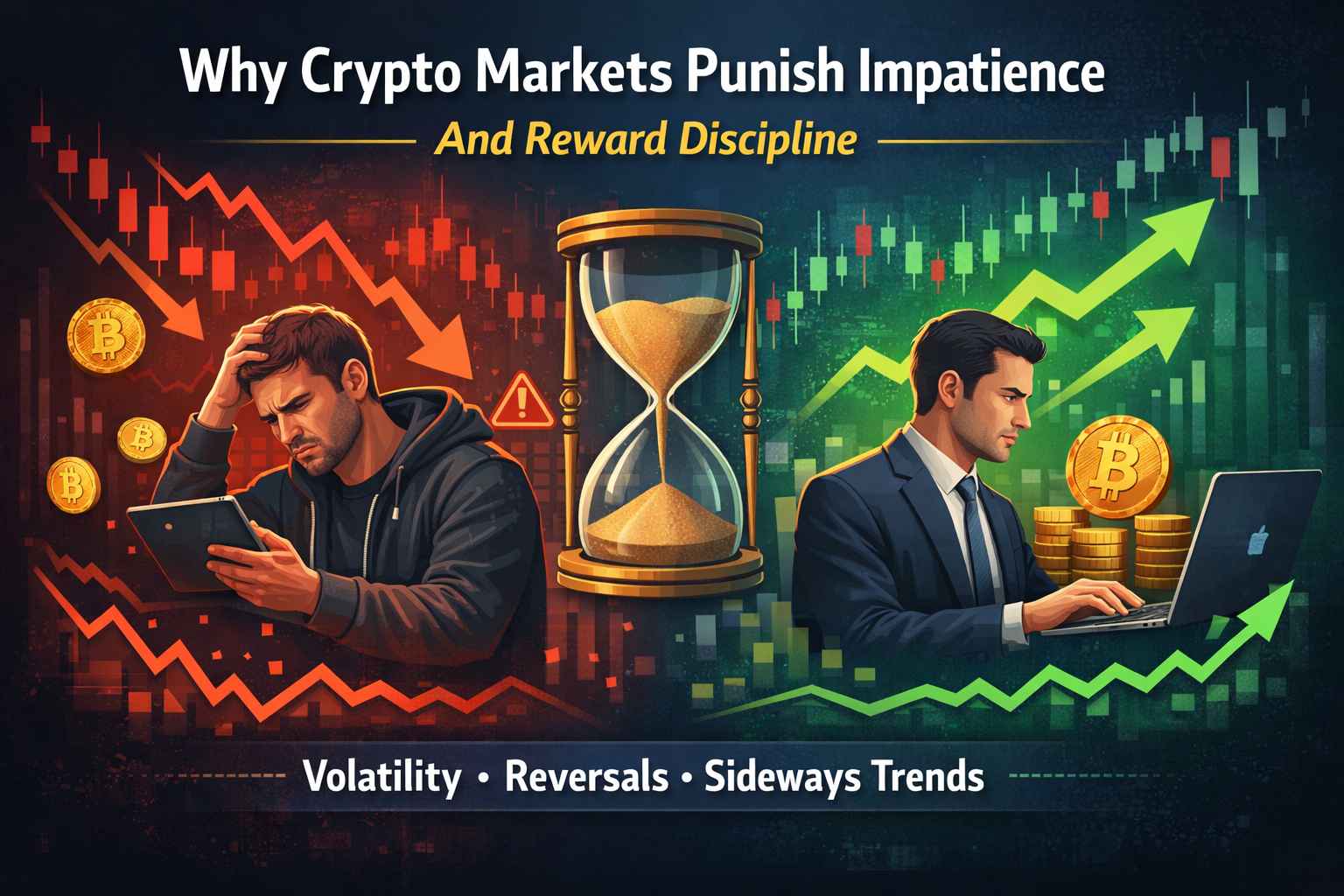
Cryptocurrency markets move faster than almost any other financial market.
Prices can surge within hours.
Sharp corrections may erase weeks of gains.
Periods of excitement are often followed by weeks—or even months—of seemingly endless sideways movement.
For many investors, this constant change creates frustration.
They begin searching for the next opportunity.
They switch strategies.
They chase rapidly rising assets.
Or they abandon positions just before larger trends develop.
Ironically, these reactions are exactly what cryptocurrency markets tend to punish.
Successful investing is rarely determined by finding the perfect entry price or predicting every market movement.
More often, long-term success depends on patience, discipline and the ability to remain consistent when markets become emotionally challenging.
Professional investors understand that markets constantly test investor behavior.
Volatility creates fear.
Strong rallies create greed.
Extended consolidations create boredom.
Each emotional environment encourages impulsive decisions.
Rather than attempting to eliminate uncertainty, disciplined investors learn to manage their own reactions.
They understand that the greatest challenge in cryptocurrency investing is often not the market itself—but the investor’s response to it.
Learning to remain patient while others react emotionally has become one of the most valuable long-term advantages any investor can develop.
In This Analysis, We’ll Explore:
- Why crypto markets punish impatience
- Why discipline matters more than prediction
- The psychology of investing
- Fear and greed
- Fear of Missing Out (FOMO)
- Panic selling
- Why sideways markets test investors
- Delayed gratification
- How market structure rewards patience
- Risk management and discipline
- Long-term investing versus constant trading
- Common psychological mistakes
- Strengths and limitations of disciplined investing
- Long-term success in cryptocurrency markets
Why Crypto Markets Punish Impatience
Many investors assume cryptocurrency markets reward speed.
Prices move quickly.
News spreads instantly.
Social media creates constant excitement.
This creates the impression that successful investing requires continuous action.
In reality, the opposite is often true.
Although short-term volatility is high, meaningful long-term trends usually develop over extended periods.
Large bull markets often begin quietly.
Major corrections frequently unfold over months.
Long consolidation phases regularly test investor patience before stronger trends eventually emerge.
This mismatch between short-term volatility and long-term trend development creates one of the biggest psychological challenges in investing.
Impatient investors often respond by:
- Chasing rapidly rising prices.
- Selling during temporary corrections.
- Switching strategies repeatedly.
- Entering positions without clear planning.
- Trading simply because markets appear active.
Each decision increases the likelihood of emotional mistakes.
Rather than rewarding constant activity, cryptocurrency markets often reward investors who wait for high-quality opportunities while remaining disciplined during periods of uncertainty.
Why Discipline Creates an Edge
Discipline does not guarantee profitable investments.
No strategy can eliminate uncertainty.
However, discipline significantly improves the consistency of decision-making.
Professional investors rarely rely on excitement or emotion.
Instead, they follow structured processes.
These often include:
- Predefined investment plans.
- Risk management rules.
- Position sizing.
- Portfolio diversification.
- Long-term objectives.
Because decisions are made before emotions become overwhelming, disciplined investors are generally less influenced by fear or greed.
They understand that success is rarely determined by one exceptional investment.
Instead, long-term performance is usually the result of hundreds of consistent decisions made across multiple market cycles.
Discipline therefore becomes a competitive advantage.
Not because it predicts markets more accurately—but because it reduces avoidable mistakes.
Understanding Investor Psychology
Financial markets reflect human behavior.
Every transaction involves buyers and sellers making decisions under uncertainty.
As a result, psychology plays a central role in determining market prices.
Several emotions repeatedly influence cryptocurrency investors:
- Fear.
- Greed.
- Hope.
- Anxiety.
- Excitement.
- Regret.
- Overconfidence.
These emotions appear throughout every market cycle.
Although technology continues evolving, human behavior remains remarkably consistent.
Understanding investor psychology allows disciplined investors to recognize emotional extremes before allowing those emotions to influence their own decisions.
Rather than reacting automatically to price movements, they evaluate whether their response is driven by evidence—or emotion.
This distinction often separates successful long-term investors from those who repeatedly buy high and sell low.
Market Sentiment in Crypto: How Psychology Moves Prices
Fear
Fear is one of the strongest emotions influencing cryptocurrency markets.It becomes especially powerful during corrections, bear markets and periods of economic uncertainty.
As prices decline, investors begin questioning decisions they previously felt confident about.
Negative headlines become more persuasive.
Social media fills with predictions of further losses.
Many investors convince themselves that selling immediately is the safest option.
Ironically, periods of maximum fear have historically often occurred after significant declines have already taken place.
Professional investors recognize that fear can distort judgment.
Rather than reacting automatically, they evaluate whether market fundamentals have actually changed or whether emotions are temporarily dominating investor sentiment.
Managing fear does not mean ignoring risk.
It means distinguishing between genuine structural changes and short-term emotional market reactions.
Greed
If fear dominates market bottoms, greed often dominates market tops.
As prices rise rapidly, confidence expands.
Investors begin believing that every purchase will generate profits.
Risk management becomes less important.
Speculation increases.
Greed often encourages investors to:
- Increase position sizes excessively.
- Ignore downside risk.
- Chase rapidly rising assets.
- Hold positions longer than originally planned.
- Believe “this time is different.”
History shows that excessive optimism frequently appears near the later stages of strong bull markets.
Experienced investors understand that rising markets should not automatically increase confidence.
Instead, discipline becomes even more important as emotions become increasingly optimistic.
Fear of Missing Out (FOMO)
Fear of Missing Out, commonly known as FOMO, is one of the most recognizable psychological forces in cryptocurrency investing.
When prices rise quickly, many investors begin worrying that they are missing a once-in-a-lifetime opportunity.
Instead of following a structured investment plan, they react emotionally.
Typical FOMO behavior includes:
- Buying after large rallies.
- Ignoring valuation.
- Investing without research.
- Following influencers instead of independent analysis.
- Entering positions purely because prices continue rising.
Professional investors understand that opportunities constantly appear throughout market cycles.
Missing one investment rarely determines long-term success.
Making emotional decisions repeatedly often does.
Advanced Crypto Investing Strategies – Part 4: Managing Emotions & Avoiding FOMO
Panic Selling
Panic selling frequently occurs during periods of sharp market declines.
Rather than evaluating long-term fundamentals, investors focus entirely on recent price movements.
Selling accelerates.
Volatility increases.
Confidence disappears.
This behavior often transforms temporary paper losses into permanent realized losses.
Disciplined investors recognize that corrections are a normal feature of financial markets.
Instead of reacting immediately, they ask questions such as:
- Has market structure fundamentally changed?
- Has my long-term investment thesis changed?
- Is this normal volatility or genuine structural weakness?
This process helps reduce emotional decision-making during periods of heightened uncertainty.
Why Sideways Markets Test Investors
Many investors believe bear markets represent the greatest psychological challenge.
In reality, extended sideways markets often prove equally difficult.
During consolidation:
- Volatility declines.
- Media attention fades.
- Price appears stagnant.
- Excitement disappears.
Without obvious market direction, investors become impatient.
Some abandon carefully researched positions simply because “nothing is happening.”
Others begin overtrading in search of excitement.
Professional investors often view these periods differently.
They recognize that consolidation allows markets to:
- Absorb previous gains.
- Reduce excessive speculation.
- Rebuild liquidity.
- Prepare for future trends.
Rather than becoming frustrated by inactivity, disciplined investors frequently use these quieter periods to improve research, review portfolio allocations and prepare for the next major market opportunity.
Understanding that patience itself can become a competitive advantage helps investors remain focused when market activity temporarily slows.
Delayed Gratification: The Hidden Advantage
One of the most overlooked investing skills is the ability to delay gratification.
Humans naturally prefer immediate rewards over future benefits.
Cryptocurrency markets constantly exploit this tendency.
Every day, investors see:
- Rapid price movements.
- Viral success stories.
- Social media celebrating quick profits.
- New narratives promising extraordinary returns.
This environment encourages immediate action.
However, long-term investing often requires the opposite.
It requires waiting.
Professional investors understand that meaningful wealth is rarely built through constant excitement.
Instead, it is built through consistency, patience and disciplined decision-making over many years.
Delaying gratification means accepting that:
- Not every day presents an opportunity.
- Cash is sometimes the best position.
- Waiting is an active investment decision.
- Missing low-quality trades is preferable to forcing unnecessary ones.
Rather than seeking constant stimulation, disciplined investors allow high-quality opportunities to develop naturally.
Market Structure Rewards Patience
Market structure itself often rewards patient investors.
Large market moves rarely begin when the majority expects them.
Instead, they frequently emerge after extended periods of uncertainty.
Many important trends follow a familiar pattern.
First comes:
- Accumulation.
- Low volatility.
- Sideways price action.
- Limited public interest.
Only later do:
- Momentum increase.
- Media attention expand.
- Retail participation accelerate.
- Strong trends become obvious.
By the time excitement returns, much of the move may already have occurred.
Impatient investors often lose interest during accumulation.
Patient investors understand that quieter market conditions frequently create the strongest long-term opportunities.
Rather than becoming frustrated by slow progress, they recognize that consolidation forms the foundation for future trends.
Why Retail Investors Always Arrive Late in Crypto Cycles
Risk Management Supports Discipline
Discipline becomes significantly easier when supported by effective risk management.
Investors who risk too much capital on a single position often become emotionally attached to short-term price movements.
Every market fluctuation begins feeling important.
Fear increases.
Stress grows.
Impulsive decisions become more likely.
Professional investors reduce these emotional pressures by applying sound risk management principles.
These include:
- Appropriate position sizing.
- Portfolio diversification.
- Maintaining liquidity.
- Realistic return expectations.
- Accepting uncertainty before entering any investment.
When portfolio risk remains manageable, investors can think more objectively.
Rather than reacting emotionally to every market movement, they remain focused on long-term probabilities.
Risk management therefore protects more than capital.
It also protects decision-making.
Long-Term Investing vs Constant Trading
Many new investors assume that successful investing requires frequent activity.
In reality, long-term investing often involves making fewer—but higher-quality—decisions.
Constant trading creates several challenges:
- Higher transaction costs.
- Greater emotional stress.
- Increased exposure to mistakes.
- More opportunities for impulsive decisions.
- Greater influence from short-term market noise.
Long-term investors approach markets differently.
They focus on:
- High-conviction opportunities.
- Strong fundamentals.
- Long-term adoption trends.
- Portfolio consistency.
- Capital preservation.
Rather than measuring success by the number of trades executed, they measure success by the quality of their overall investment process.
In many cases, doing nothing becomes the most profitable decision.
Knowing when not to act is often just as valuable as knowing when to invest.
Crypto Day Trading: Structural Risks and Capital Erosion
Common Psychological Mistakes
Even experienced investors occasionally allow emotions to influence their decisions.
However, newer investors are particularly vulnerable because cryptocurrency markets move quickly and information is available around the clock.
Some of the most common psychological mistakes include:
- Chasing rapidly rising prices.
- Selling after sharp market declines.
- Constantly changing investment strategies.
- Following influencers instead of independent research.
- Overtrading during periods of uncertainty.
- Confusing confidence with certainty.
- Ignoring long-term fundamentals because of short-term volatility.
- Believing every market movement requires immediate action.
Most of these mistakes have one thing in common:
They are emotional rather than analytical.
Successful investors recognize these behaviors early and develop systems designed to reduce emotional decision-making.
Strengths of Disciplined Investing
Discipline does not eliminate market volatility.
Nor does it guarantee profitable investments.
Its greatest strength lies in improving consistency over long periods.
Some of the key benefits include:
- Better emotional control.
- Stronger risk management.
- Reduced impulsive decision-making.
- Greater patience during market uncertainty.
- More consistent portfolio management.
- Improved long-term performance.
- Better adaptation to changing market conditions.
- Increased confidence in investment decisions.
Perhaps most importantly, discipline allows investors to remain active across multiple market cycles.
Rather than being eliminated by one period of poor decision-making, disciplined investors preserve both their capital and their ability to benefit from future opportunities.
Limitations of Discipline
Although discipline provides a significant long-term advantage, it is not a guarantee of success.
Even the most disciplined investors experience:
- Losing investments.
- Unexpected market events.
- Prolonged bear markets.
- Incorrect analysis.
- Economic uncertainty.
Markets remain unpredictable.No amount of patience can eliminate investment risk.
In addition, excessive discipline without flexibility may also become problematic.
Investors should remain willing to adapt when new information genuinely changes the long-term outlook.
Successful investing therefore requires balance.
Discipline should guide decision-making, while evidence should determine when adjustments become necessary.
Conclusion
Cryptocurrency markets do not consistently reward investors who act the fastest.
More often, they reward those who remain patient while others react emotionally.
Fear, greed, FOMO and panic have influenced every major market cycle, encouraging investors to make decisions driven by emotion rather than evidence.
Disciplined investors approach markets differently.
They accept uncertainty.
They manage risk carefully.
They follow structured investment plans instead of chasing short-term excitement.
Rather than attempting to predict every price movement, they focus on making consistently sound decisions across multiple market cycles.
No strategy can remove volatility from cryptocurrency investing.
However, emotional discipline significantly improves an investor’s ability to navigate changing market conditions while avoiding many of the mistakes that repeatedly transfer wealth from impatient participants to patient ones.
In the long run, successful cryptocurrency investing is rarely determined by making one perfect decision.
It is built through hundreds of disciplined decisions that compound over time.
Think Like a Smart Crypto Investor Part 1: Why Mindset Matters More Than Price
How to Protect Your Capital in Crypto: A Survival Guide for Long-Term Investors