
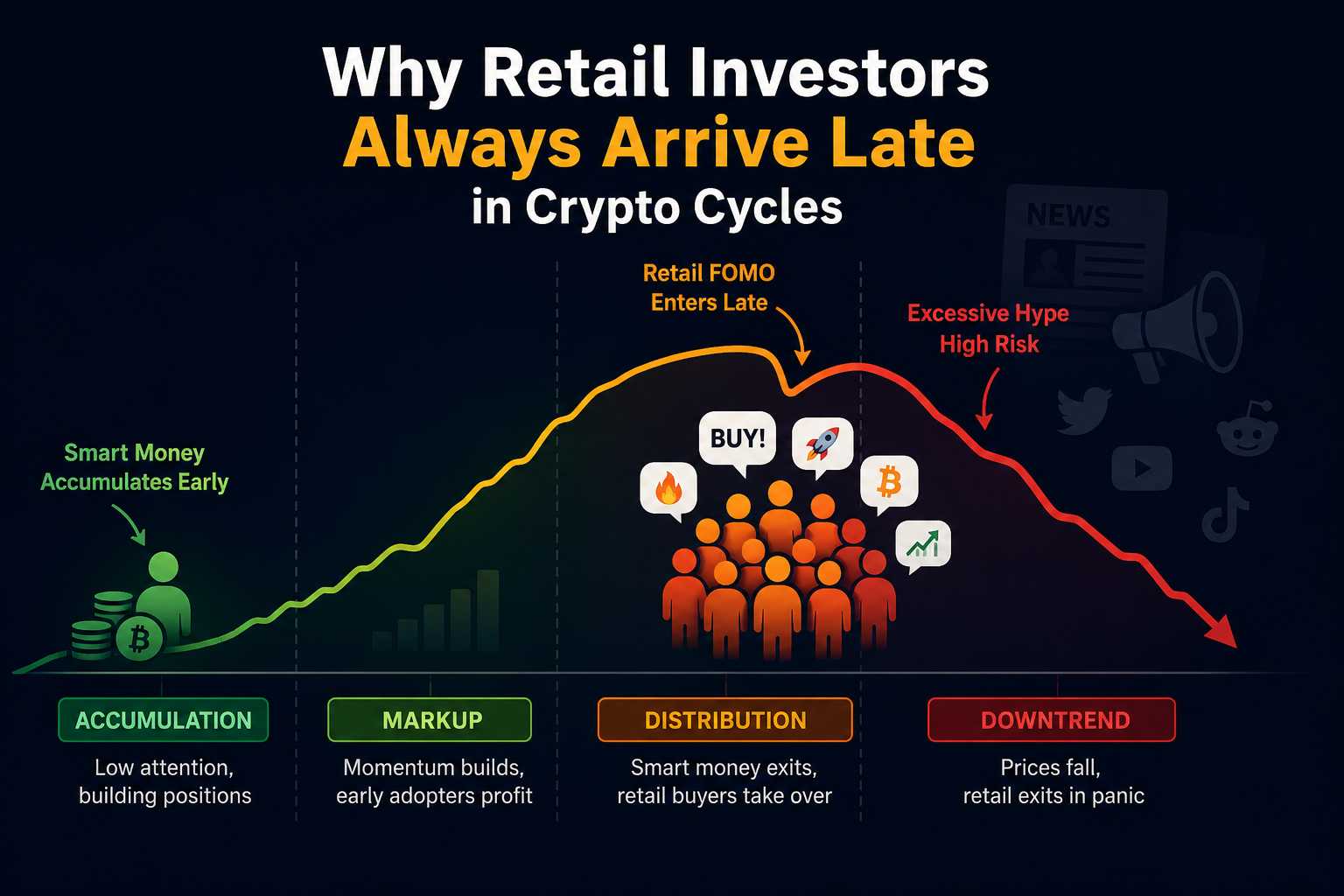
Cryptocurrency markets move in cycles — but one pattern repeats almost every time: Retail investors often enter the market too late.
By the time mainstream excitement reaches social media, news headlines and public conversations, much of the early accumulation phase has already passed. Prices may already be significantly higher, volatility increases rapidly and emotional decision-making begins to dominate market behavior.
Understanding why this happens can help investors recognize market psychology more clearly and avoid becoming part of the late-cycle crowd.
Crypto Cycles Are Driven by Psychology
Markets are not moved by price alone.
They are heavily influenced by:
- fear
- greed
- optimism
- uncertainty
- emotional reactions
- crowd behavior
In crypto, these emotions become amplified because of extreme volatility and constant online activity.
Retail participation tends to follow momentum rather than precede it. As prices rise, confidence increases. Media coverage expands, influencers become more active and new investors begin paying attention.
This creates a feedback loop:
- rising prices attract attention
- attention attracts new buyers
- new buyers push prices even higher
The problem is that this usually happens later in the cycle — not at the beginning.
The Accumulation Phase Usually Feels Boring
One reason retail investors arrive late is because the early stages of a crypto cycle rarely feel exciting.
During accumulation phases:
- sentiment is weak
- volatility slows down
- interest disappears
- media coverage declines
- uncertainty remains high
This is often the period when long-term investors and institutions quietly position themselves.
However, psychologically, most retail investors struggle to buy during periods of fear or low excitement. Waiting feels safer than acting early.
Ironically, the periods that feel emotionally uncomfortable are often where the best long-term opportunities appear.
Euphoria Changes Investor Behavior
As the cycle progresses and prices continue rising, emotions begin to shift dramatically.
Fear slowly transforms into:
- optimism
- excitement
- confidence
- eventually euphoria
At this stage:
- profits are widely shared online
- “easy money” narratives appear
- unrealistic expectations spread quickly
- risk management disappears.
Many investors who ignored crypto during accumulation suddenly feel pressure to participate.
This is where FOMO becomes dangerous.
Instead of following a structured strategy, investors begin chasing momentum simply because prices continue moving higher.
Why Experienced Investors Often Approach Cycles Differently
Experienced investors and professional market participants are not immune to poor timing or emotional decisions.
The difference is often found in the process rather than the ability to predict the market.
Instead of waiting for widespread excitement, disciplined investors may focus on factors such as:
- Market structure
- Valuation
- Liquidity conditions
- Capital flows
- Sentiment extremes
- Risk versus potential reward
This can lead them to investigate opportunities when general interest is still low.
However, buying during periods of fear does not automatically produce good returns. Markets can continue falling, and weak projects may never recover.
The advantage is therefore not simply buying before everyone else.
It is having a framework that allows decisions to be made without depending entirely on the emotions of the crowd.
Social Media Amplifies Late-Cycle Behavior
Modern crypto markets are heavily influenced by social platforms.
During bullish periods:
- viral posts spread rapidly
- influencers post large gains
- unrealistic price targets dominate discussions
- emotional momentum accelerates
This creates the illusion that markets can only continue rising.
Retail investors entering during this phase often underestimate:
- downside risk
- volatility
- market cycle behavior
- liquidity conditions
As a result, many buy aggressively near emotional peaks while experienced investors begin reducing risk exposure.
How Social Media and Crypto Influencers Distort Investor Psychology
Recency Bias and the Need for Confirmation
Another reason investors can arrive late is recency bias — the tendency to give recent events too much importance when forming expectations about the future.
After months of falling prices, investors may assume that weakness will continue.
After months of rising prices, the opposite can happen.
Recent gains begin to feel normal, and expectations for further gains become increasingly optimistic.
This creates a psychological problem.
When prices are low and uncertainty is high, investors often want more confirmation before taking risk.
But that confirmation usually arrives through:
- Rising prices
- Improving sentiment
- Positive headlines
- Stronger market momentum
By the time all of those signals appear, the market may already be significantly higher.
Waiting for certainty can therefore reduce uncertainty while simultaneously increasing the price an investor has to pay.
The goal is not to invest without confirmation, but to recognize that greater emotional comfort often arrives after part of the opportunity has already passed.
Why This Pattern Repeats Every Cycle
The reason retail investors repeatedly arrive late is simple:
Human psychology rarely changes. Most people:
- want confirmation before acting
- feel safer following crowds
- avoid uncertainty
- react emotionally to momentum
Crypto cycles exploit these psychological tendencies extremely well because volatility amplifies both fear and greed.
This is why:
- accumulation feels uncomfortable
- euphoria feels safe
- corrections feel catastrophic
- and long-term discipline becomes difficult
How Investors Can Avoid Arriving Too Late
Avoiding late-cycle behavior starts with understanding market psychology rather than reacting emotionally to price action.
Some important principles include:
Focus on Structure, Not Emotion
Strong market narratives and bullish sentiment do not always mean low-risk conditions.
Understanding market structure helps investors separate hype from sustainable trends.
Build a Long-Term Framework
Investors with predefined allocation strategies and risk management rules are less likely to chase emotional momentum.
Accept Uncertainty
The best opportunities often appear when markets feel uncertain — not when confidence is highest.
Do Not Confuse Early With Attractive
Buying earlier in a market cycle does not automatically make an investment attractive.
A cryptocurrency can fall significantly further during a bear market, while weaker projects may never return to previous highs.
The objective is therefore not simply to buy because prices have fallen or sentiment is negative.
Investors still need to evaluate fundamentals, valuation, market structure and risk.
Being early only becomes useful when the underlying investment thesis remains strong.
Study Previous Cycles
Market behavior repeatedly rhymes across different crypto cycles.
Understanding historical patterns helps investors recognize emotional extremes more clearly.
Conclusion
Retail investors are not “wrong” because they participate in crypto markets.
The real challenge is understanding when and why emotional participation tends to increase.
By the time excitement becomes mainstream, risk conditions are often very different from earlier phases of the cycle.
Successful long-term investing is not about perfectly timing tops or bottoms.
It is about:
- understanding psychology
- managing risk
- remaining disciplined
- and recognizing how market cycles influence behavior
In crypto markets, opportunities often begin to feel safest only after prices have already risen and uncertainty has declined.
Understanding that relationship between price, confidence and crowd behavior can help investors recognize when their decisions are being influenced by the market cycle rather than by their original investment strategy.
Think Like a Smart Crypto Investor Part 1: Why Mindset Matters More Than Price
Am I Too Late to Invest in Bitcoin or Other Cryptocurrencies?
Disclaimer: This article is for informational and educational purposes only and does not constitute financial advice. Cryptocurrency markets are highly volatile and involve significant risk. Always conduct your own research before making investment decisions.