
Cryptocurrency markets are often described as unpredictable.
Prices surge higher.
Sharp corrections appear without warning.
Bull markets generate enormous optimism.
Bear markets create widespread pessimism.
Every day, headlines attempt to explain why Bitcoin or altcoins moved a few percentage points.
Professional investors rarely rely on headlines alone.
Instead, they focus on something much deeper:
Market structure.
Behind every price movement lies a combination of liquidity, supply and demand, investor psychology, macroeconomic conditions and capital flows.
Price itself is simply the visible outcome of these forces.
Understanding how they interact allows investors to analyze markets objectively rather than reacting emotionally to short-term volatility.
Crypto market analysis is therefore not about predicting tomorrow’s price.
It is about understanding probabilities, recognizing structural changes, identifying risk, and preparing for multiple possible market outcomes.
For long-term investors, learning how professional market participants analyze cryptocurrency markets may become one of the most valuable investing skills they ever develop.
In This Analysis, We’ll Explore:
- what crypto market analysis actually means
- why market structure matters
- price versus value
- supply and demand
- liquidity
- who actually moves the market
- institutional investors
- retail investors
- smart money
- market cycles
- accumulation
- expansion
- distribution
- contraction
- bull markets
- bear markets
- sideways markets
- volume analysis
- volatility
- momentum
- market sentiment
- macroeconomic influences
- on-chain analysis
- technical analysis
- scenario planning
- common investor mistakes
- strengths and limitations of market analysis
- the long-term outlook
What Is Crypto Market Analysis?
Crypto market analysis is the process of evaluating how cryptocurrency markets behave by studying the interaction between price, liquidity, investor behavior, blockchain activity and broader economic conditions.
Many newer investors believe market analysis simply means predicting whether Bitcoin will rise or fall.
Professional investors approach it differently.
Rather than asking:
“Will Bitcoin go up tomorrow?”
They ask questions such as:
- What is driving today’s price movement?
- Is buying pressure increasing?
- Is liquidity improving?
- Are institutions accumulating?
- Is sentiment becoming overly optimistic?
- Is the current trend healthy?
- Does market structure support higher prices?
These questions help investors understand why markets move rather than simply observing that they moved.
Because no single analytical method explains every market movement, experienced investors combine several different approaches.
These often include:
- market structure
- technical analysis
- on-chain analysis
- liquidity analysis
- macroeconomic analysis
- derivatives positioning
- investor sentiment
Each provides a different piece of the overall picture.
Price Is Only the Final Result
One of the biggest misconceptions among newer investors is believing that price itself creates the market.
In reality, price is merely the final result.
Behind every movement lies an interaction between buyers and sellers.
Price reflects:
- supply
- demand
- liquidity
- leverage
- macroeconomic conditions
- investor psychology
- institutional positioning
Every green candle represents aggressive buyers overwhelming sellers.
Every red candle reflects the opposite.
Charts therefore show the outcome of market behavior—not its underlying causes.
Professional investors spend far more time studying the forces behind price than the price itself.
Understanding those forces often provides much greater insight than simply watching candles move across a chart.
Why Market Structure Matters
Market structure describes the framework within which prices move.
Rather than focusing on individual candles, market structure examines how trends develop over time.
It helps investors determine whether the market remains healthy or whether conditions may be changing.
Important elements of market structure include:
- higher highs
- higher lows
- lower highs
- lower lows
- support
- resistance
- liquidity zones
- trend continuation
- trend reversals
Understanding structure allows investors to separate ordinary volatility from meaningful changes in trend.
Instead of reacting emotionally to every correction, they evaluate whether the broader market framework remains intact.
For this reason, market structure forms the foundation of professional technical analysis.
Price Versus Value
Another important distinction involves the difference between price and value.
Price represents what buyers and sellers currently agree to exchange an asset for.
Value reflects what investors believe the asset is actually worth.
The two are not always identical.
For example:
A cryptocurrency may become heavily overvalued during periods of extreme optimism.
Conversely, panic selling may temporarily push prices well below many investors’ estimates of fair value.
Professional investors therefore attempt to identify situations where market price differs significantly from underlying value.
This concept explains why experienced investors often buy during periods of widespread fear while reducing exposure during periods of excessive optimism.
Understanding the difference between price and value helps investors remain objective when market sentiment becomes emotional.
Supply and Demand
Every financial market ultimately moves because supply and demand change.
When demand exceeds available supply, prices generally rise.
When supply exceeds demand, prices generally fall.
Although this principle appears straightforward, numerous factors influence supply and demand within cryptocurrency markets.
These include:
- institutional buying
- ETF inflows
- exchange reserves
- whale accumulation
- miner selling
- retail participation
- macroeconomic policy
- investor confidence
Because these factors constantly evolve, market conditions also change continuously.
Professional investors therefore monitor how supply and demand develop beneath the surface instead of reacting only after prices move.
Why Crypto Markets Are Different From Traditional Markets
Although cryptocurrencies share many characteristics with traditional financial markets, they also operate under a unique set of conditions.
Understanding these differences helps explain why crypto markets often experience larger price swings, faster trend changes and greater volatility than stocks or bonds.
One of the biggest differences is that cryptocurrency markets operate 24 hours a day, seven days a week.
Unlike stock exchanges that close overnight and on weekends, crypto trading never stops.
As a result, significant price movements can occur at any time, including weekends and public holidays.
Another key difference is market maturity.
Traditional financial markets have developed over many decades and are supported by deep pools of institutional capital.
The cryptocurrency market is still relatively young.
Although institutional participation has increased significantly in recent years, the market remains smaller and generally less liquid than global equity or bond markets.
This lower liquidity can amplify price movements.
Large buy or sell orders often have a greater impact on cryptocurrency prices than they would in more established financial markets.
Crypto markets are also heavily influenced by blockchain-specific factors that do not exist in traditional finance.
Examples include:
- on-chain activity
- exchange inflows and outflows
- stablecoin liquidity
- staking participation
- mining activity
- token unlock schedules
- protocol upgrades
These factors provide investors with additional sources of information that are unavailable in most traditional asset classes.
Finally, cryptocurrencies remain highly sentiment-driven.
News surrounding regulation, exchange-traded funds (ETFs), technological developments or security incidents can rapidly change investor expectations.
Because the market is still evolving, sentiment often shifts more quickly than in traditional financial markets.
While these characteristics create higher levels of uncertainty, they also generate unique opportunities for investors who understand how cryptocurrency market structure differs from conventional financial markets.
Understanding these differences provides important context when analyzing trends, managing risk and making long-term investment decisions.
Liquidity Drives Every Market
Liquidity remains one of the most important concepts in financial markets.
It measures how easily an asset can be bought or sold without significantly affecting its price.
Markets with deep liquidity generally experience:
- smoother trends
- smaller spreads
- lower volatility
- more efficient price discovery
Markets with limited liquidity often experience:
- rapid rallies
- sharp corrections
- large price gaps
- stronger liquidation events
- higher volatility
Liquidity also explains why prices sometimes move dramatically despite relatively little news.
Rather than news creating every movement, changing liquidity often creates the conditions that allow prices to move.
Professional investors therefore monitor liquidity continuously.
Many consider it one of the most important drivers of cryptocurrency markets.
Why Bitcoin Volatility Scares Retail Investors — But Attracts Smart Money
Who Actually Moves the Market?
Cryptocurrency markets consist of many different participants.
Each influences prices differently.
Major participants include:
- retail investors
- institutional investors
- hedge funds
- asset managers
- market makers
- algorithmic trading firms
- miners
- exchanges
- ETF providers
- long-term holders
Retail investors often react emotionally to headlines and short-term volatility.
Institutional investors generally operate using longer investment horizons.
Market makers focus primarily on providing liquidity.
Algorithmic systems execute large numbers of trades automatically.
Miners may periodically sell newly generated Bitcoin.
ETF providers create additional demand when investor inflows increase.
Because each participant behaves differently, understanding who is likely influencing current price action provides valuable context for market analysis.
Professional investors rarely assume all buyers and sellers behave the same way.
Retail Investors vs Institutional Investors
Retail investors typically enter markets with relatively smaller amounts of capital.
Their behavior is often influenced by:
- news headlines
- social media
- fear
- greed
- momentum
- short-term price movements
Institutional investors generally operate differently.
They often focus on:
- long-term capital allocation
- liquidity
- portfolio diversification
- macroeconomic conditions
- risk-adjusted returns
- execution quality
Institutions rarely chase markets after major rallies.Instead, they frequently build positions gradually over extended periods.
This difference helps explain why retail investors often buy during periods of excitement while institutions may already be taking profits.
Understanding these behavioral differences provides valuable insight into market structure.
The Role of Smart Money
The phrase “smart money” frequently appears in cryptocurrency discussions.
Although the term has no precise definition, it generally refers to investors believed to possess superior information, greater experience or larger amounts of capital.
Smart money may include:
- hedge funds
- institutional asset managers
- professional traders
- venture capital firms
- early Bitcoin adopters
- experienced long-term investors
Rather than reacting emotionally to headlines, these participants often focus on probability, valuation and liquidity.
They typically accumulate assets gradually during periods of pessimism before widespread public interest returns.
This behavior explains why markets often begin recovering while sentiment remains negative.
Professional investors therefore study positioning and liquidity instead of relying solely on public opinion.
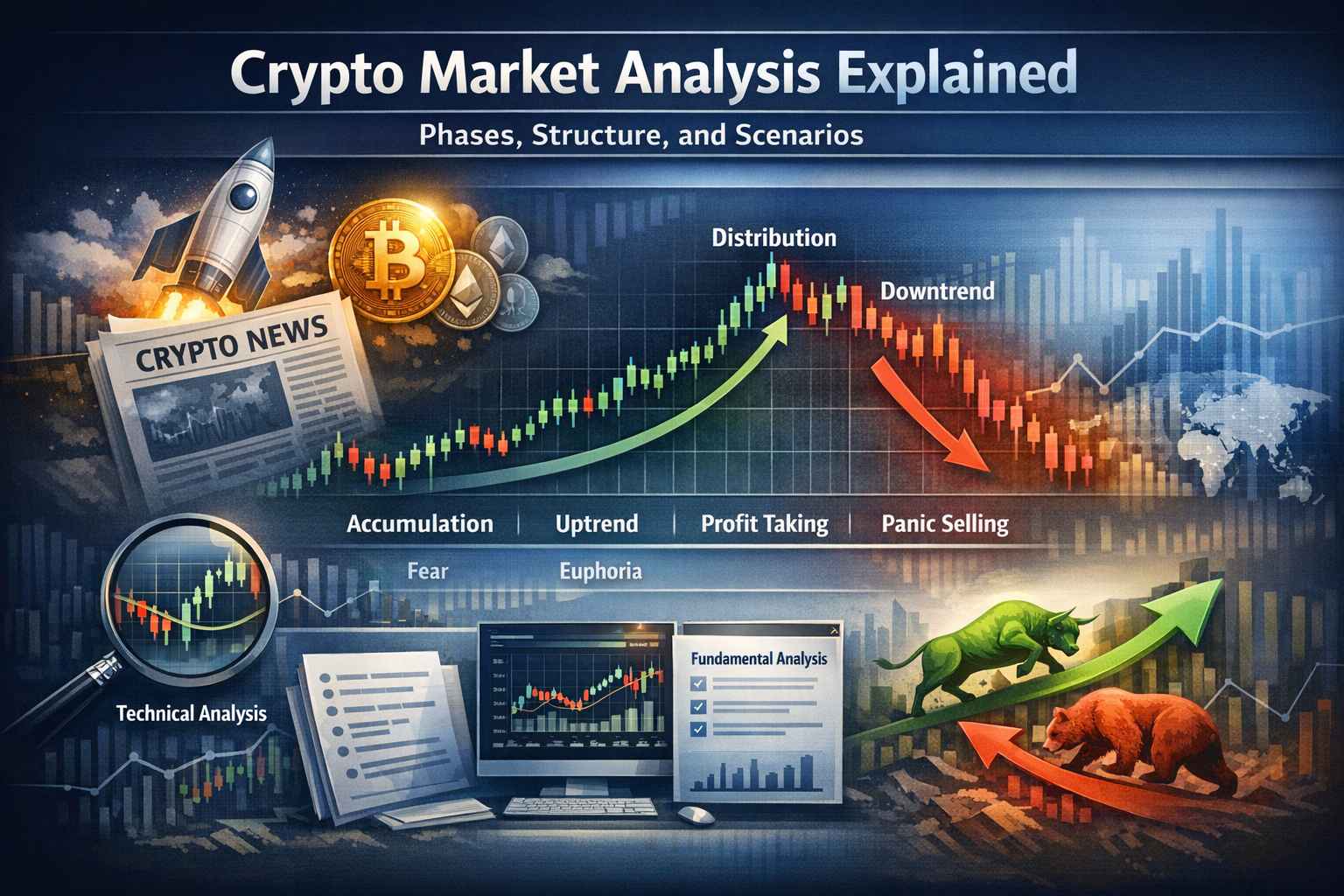
Why Every Market Moves in Cycles
One of the most important principles of market analysis is that markets rarely move in straight lines.
Instead, they progress through repeating cycles driven by changing supply, demand, liquidity and investor psychology.
These cycles develop because human behavior remains remarkably consistent over time.
Periods of fear gradually create opportunity.
Opportunity attracts buyers.
Optimism grows.
Eventually optimism becomes excessive.
Profit-taking begins.
Prices correct.
Fear returns.
The cycle starts again.
Although every market cycle differs slightly, understanding this repeating pattern helps investors interpret current conditions more objectively.
Rather than asking whether volatility is unusual, experienced investors ask where the market currently sits within its broader cycle.
Recognizing the current phase often proves far more valuable than attempting to predict the exact timing of the next major move.
How Crypto Cycles Shape Long-Term Opportunities
The Four Core Market Phases
Although every market cycle is unique, cryptocurrency markets typically progress through four recurring phases.
Understanding these phases helps investors focus on probabilities instead of predictions.
Each phase reflects changing relationships between liquidity, supply and demand, and investor psychology.
Recognizing the current phase often provides more valuable information than attempting to predict the exact price of Bitcoin or any other cryptocurrency.
Accumulation
Accumulation usually follows an extended market decline.
Prices stabilize after significant selling pressure.
Volatility decreases.
Media attention fades.
Investor sentiment remains pessimistic.
Many retail investors leave the market during this period.
Meanwhile, long-term investors and institutions may begin gradually building positions.
Characteristics of accumulation include:
- sideways price action
- lower trading volume
- declining volatility
- improving long-term fundamentals
- limited public interest
Although accumulation often feels uneventful, many major bull markets begin during these quiet periods.
Expansion
Expansion represents the beginning of a sustained uptrend.
Demand begins exceeding supply.
Higher highs and higher lows become increasingly common.
Volume gradually increases.
Positive news attracts new investors.
Confidence returns to the market.
Expansion is characterized by:
- improving market structure
- increasing liquidity
- stronger buying pressure
- rising trading volume
- growing institutional participation
This phase often generates the largest long-term gains.
However, emotions also begin influencing investor behavior more strongly.
Volume Analysis in Crypto: Market Participation, Trend Strength & Why Volume Matters
Distribution
Eventually, rapid price appreciation begins slowing.
Prices continue reaching new highs, but momentum weakens.
Early investors gradually reduce exposure while optimism remains widespread.
Characteristics include:
- slowing momentum
- increased volatility
- heavier profit-taking
- mixed market signals
- rising uncertainty
Distribution can last weeks or months.
Many investors mistake this phase for healthy consolidation.
Professional investors monitor liquidity and volume carefully during distribution because structural weakness often appears before major corrections begin.
Contraction
Contraction follows distribution.
Selling pressure begins exceeding buying pressure.
Liquidity decreases.
Investor confidence deteriorates.
Lower highs and lower lows become increasingly common.
Typical characteristics include:
- declining prices
- lower trading volume
- reduced risk appetite
- increased fear
- widespread pessimism
Although contraction can feel uncomfortable, it performs an important function.
It removes excessive leverage, resets valuations and prepares the foundation for the next accumulation phase.
Understanding this process helps long-term investors avoid emotional decision-making during market downturns.
Bull Markets and Bear Markets
Bull and bear markets represent broad directional trends rather than short-term price movements.
A bull market generally features:
- sustained higher highs
- higher lows
- improving liquidity
- increasing investor confidence
- expanding market participation
Bull markets often encourage excessive optimism.
Investors begin believing prices can only continue rising.
Bear markets display the opposite characteristics.
These include:
- lower highs
- lower lows
- declining liquidity
- falling investor confidence
- reduced participation
Bear markets frequently generate excessive pessimism.
Understanding these emotional extremes helps investors remain objective regardless of market direction.
Sideways Markets Are Normal
Not every market trends strongly upward or downward.
Extended periods of consolidation are common.
During these periods, prices fluctuate within relatively narrow ranges while buyers and sellers establish a new equilibrium.
Sideways markets serve several important purposes.
They allow markets to:
- absorb previous gains
- reduce excessive speculation
- rebuild liquidity
- establish new support and resistance levels
- prepare for future trends
Many inexperienced investors view consolidation as a sign that “nothing is happening.”
Professional investors often see it as a healthy stage within a larger market cycle.
Why Volume Matters
Price alone never tells the complete story.
Volume provides important confirmation.
Trading volume measures how actively market participants are buying and selling.
Strong trends often develop alongside increasing volume.
Weak trends may continue rising while participation gradually declines.
Professional investors therefore analyze both price and volume together.
For example:
Rising prices supported by increasing volume generally suggest stronger market conviction.
Rising prices accompanied by declining volume may indicate weakening momentum.
Although volume does not predict future prices, it provides valuable context for interpreting market strength.
Volatility and Momentum
Cryptocurrency markets are among the most volatile financial markets in the world.
Large daily price movements are common.
Volatility itself is neither positive nor negative.
Instead, it reflects uncertainty and changing expectations.
Momentum measures the strength of an existing trend.
Strong momentum often attracts additional buyers, creating self-reinforcing price movements.
Eventually, however, momentum slows.
Recognizing when momentum strengthens or weakens helps investors evaluate whether current trends remain healthy.
Rather than fearing volatility, experienced investors attempt to understand what it reveals about changing market conditions.
Market Sentiment
Markets are driven not only by facts but also by perception.
Investor sentiment influences buying and selling decisions every day.
Sentiment typically shifts through recurring emotional stages including:
- fear
- uncertainty
- optimism
- excitement
- greed
- euphoria
- panic
Extreme optimism often appears near major market tops.
Extreme pessimism frequently develops near significant market bottoms.
Professional investors monitor sentiment because emotional extremes often create opportunities that are overlooked by the broader market.
Macroeconomic Influences
Cryptocurrency markets do not operate independently from the global economy.
Macroeconomic conditions strongly influence capital flows.
Important factors include:
- interest rates
- inflation
- central bank policy
- money supply
- economic growth
- geopolitical uncertainty
- financial market liquidity
Periods of abundant liquidity generally support higher-risk assets such as cryptocurrencies.
Tighter monetary conditions often reduce investor risk appetite.
Understanding macroeconomic conditions helps investors place short-term market movements within a much broader context.
Looking Beyond the Charts
Professional investors rarely rely on charts alone.
They combine technical analysis with other forms of research.
These may include:
- on-chain analysis
- macroeconomic analysis
- liquidity analysis
- derivatives positioning
- blockchain fundamentals
- regulatory developments
Each analytical approach provides additional context.
Rather than searching for certainty, investors build probabilities based on multiple independent sources of information.
This comprehensive approach often produces more balanced investment decisions.
Scenario Planning Instead of Prediction
One of the biggest differences between experienced and inexperienced investors involves how they think.
Beginners often ask:
“Where will Bitcoin be next month?”
Professional investors ask:
“What scenarios are currently most likely?”
Common scenarios include:
- bullish continuation
- healthy correction
- prolonged consolidation
- trend reversal
- increased volatility following major news
Preparing for several possible outcomes reduces emotional decision-making and encourages disciplined risk management.
Markets remain uncertain.
Successful investors prepare rather than predict.
Conclusion
Crypto market analysis extends far beyond watching price charts.
Professional investors study market structure, liquidity, supply and demand, volume, sentiment and macroeconomic conditions to understand why markets move.
Rather than attempting to predict every short-term price fluctuation, they focus on identifying probabilities and managing risk.
Understanding the four market phases, recognizing structural changes and considering multiple possible scenarios allows investors to make more informed decisions throughout changing market conditions.
While no analytical framework guarantees success, developing a structured approach helps reduce emotional investing and improves long-term consistency.
Ultimately, successful market analysis is not about being right every time.
It is about understanding how markets function, adapting as conditions evolve and making decisions based on evidence rather than emotion.
RSI Explained in Crypto: How Investors Use the Relative Strength Index
Advanced Crypto Investing Strategies – Part 1: Portfolio Allocation & Diversification
Disclaimer: This article is for informational and educational purposes only and does not constitute financial or investment advice. Cryptocurrency markets are volatile, and readers should conduct their own research before making any financial decisions.
