
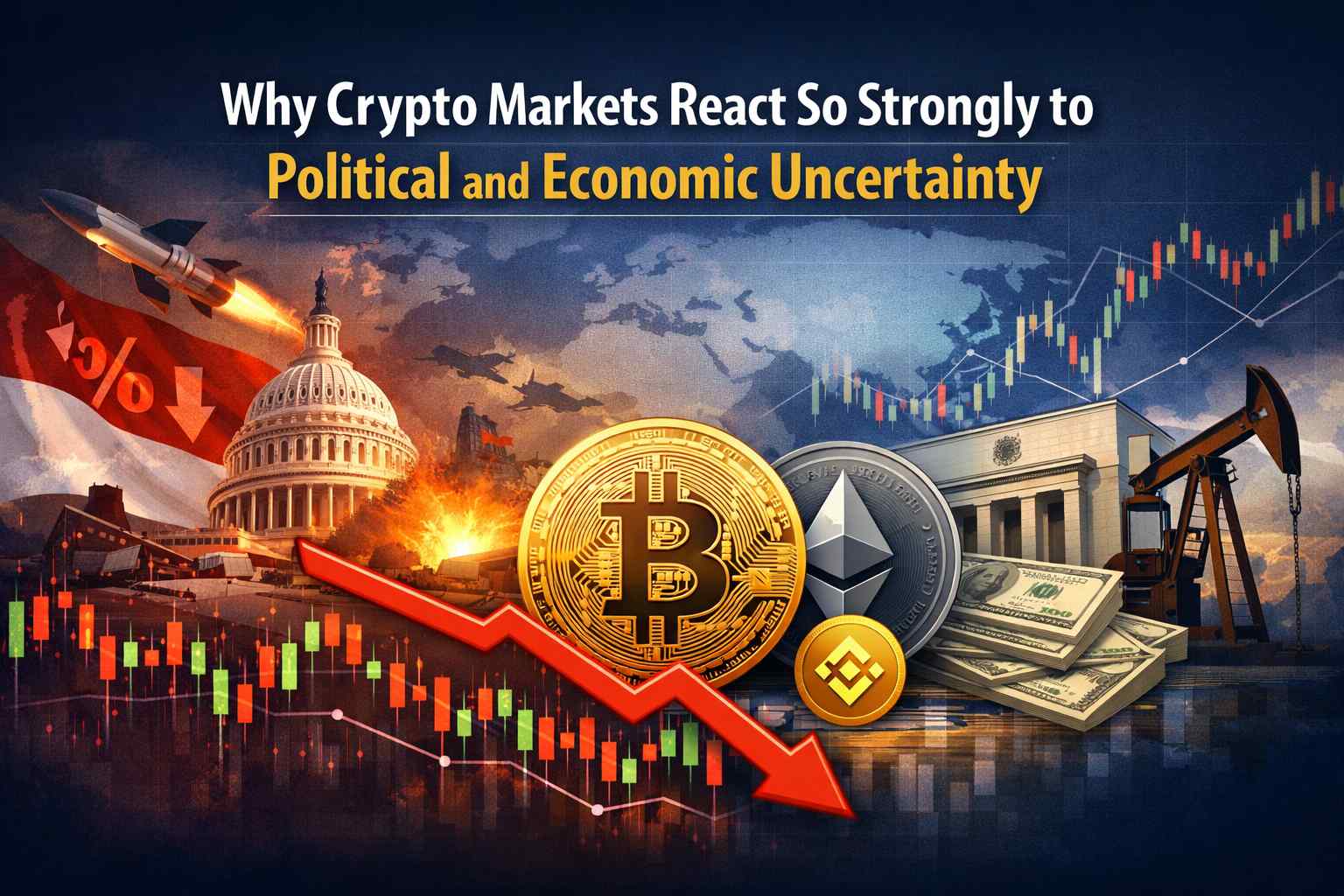
Cryptocurrency markets operate within a rapidly changing global financial environment.
Interest rate decisions.
Inflation reports.
Geopolitical conflicts.
Trade disputes.
Government regulation.
Economic recessions.
All of these events can trigger significant movements across Bitcoin, Ethereum and the broader digital asset market.
To many investors, these reactions appear unpredictable.
Prices may fall despite positive long-term adoption.
Markets may rally even while economic headlines remain negative.
However, beneath the daily volatility lies a logical relationship between uncertainty, liquidity, investor psychology and capital flows.
Unlike traditional financial markets, cryptocurrency markets trade continuously.
News is incorporated into prices within minutes rather than waiting for the next trading session.
As a result, crypto often reacts faster—and more aggressively—to changing economic and political conditions.
Professional investors understand that these short-term reactions rarely occur in isolation.
Instead, they analyze how macroeconomic developments influence liquidity, risk appetite and market structure before making investment decisions.
Understanding these relationships allows investors to view uncertainty not simply as a source of volatility, but as an important component of long-term market cycles.
Rather than reacting emotionally to every headline, disciplined investors seek to understand why markets behave the way they do.
In This Analysis, We’ll Explore:
- Why political and economic uncertainty influences financial markets
- Why cryptocurrency reacts more strongly than many traditional assets
- The relationship between liquidity and crypto prices
- How interest rates affect Bitcoin and altcoins
- Why inflation influences investor behavior
- How geopolitical events impact digital assets
- Why Bitcoin and altcoins often respond differently during uncertain periods
- The role of investor psychology during market uncertainty
- Common mistakes investors make during periods of economic uncertainty
- How long-term investors navigate uncertain market environments
What Is Political and Economic Uncertainty?
Political and economic uncertainty refers to periods when investors have limited confidence about future economic conditions or government policy.
Rather than responding to a single event, financial markets often react to uncertainty itself.
Examples include:
- Central bank policy changes
- Rising or falling interest rates
- Inflation reports
- Trade disputes between major economies
- Elections
- Military conflicts
- Banking instability
- New cryptocurrency regulation
- Government debt concerns
- Global recessions
Each of these developments can influence how investors allocate capital across different asset classes.
When confidence declines, investors generally become more cautious.
Riskier assets often experience greater volatility as capital moves toward investments perceived as safer.
Because cryptocurrencies remain relatively young and volatile compared to traditional financial assets, they frequently experience larger price swings during uncertain periods.
Why Financial Markets Dislike Uncertainty
Financial markets generally prefer predictable environments.
When investors understand economic conditions, they can estimate future corporate earnings, interest rates and investment returns with greater confidence.
Uncertainty makes those expectations more difficult.
As uncertainty increases, several market dynamics often develop simultaneously.
Reduced confidence
Investors become less willing to commit new capital until economic conditions become clearer.
Lower liquidity
Buying activity often slows.
With fewer participants willing to take risk, markets can become more volatile.
Greater volatility
Even relatively small pieces of news may trigger significant price movements as investors continuously reassess expectations.
Changing risk appetite
Capital frequently rotates away from higher-risk assets toward investments viewed as more stable during uncertain periods.
These reactions occur across nearly every financial market.
However, they tend to be amplified within cryptocurrency because of the market’s higher volatility and stronger sensitivity to changes in investor sentiment.
Why Crypto Reacts More Strongly Than Traditional Markets
Although political and economic events affect stocks, bonds and commodities, cryptocurrencies often experience larger and faster price movements.
Several structural characteristics explain this difference.
Twenty-four-hour trading
Unlike traditional stock exchanges, cryptocurrency markets never close.
News released during weekends, holidays or overnight trading hours is reflected in prices almost immediately.
Higher volatility
Cryptocurrencies have historically experienced larger percentage price movements than most traditional financial assets.
This naturally amplifies reactions during periods of uncertainty.
Greater retail participation
Retail investors represent a larger share of cryptocurrency trading than in many traditional markets.
Because retail sentiment can shift rapidly, price movements may become more emotional.
Leverage
Many cryptocurrency exchanges allow leveraged trading.
During periods of heightened volatility, liquidations can accelerate both upward and downward price movements.
Smaller market size
Although cryptocurrency adoption continues expanding, the overall market remains significantly smaller than global equity or bond markets.
As a result, relatively modest capital inflows or outflows can produce substantial price changes.
Together, these characteristics explain why cryptocurrency frequently reacts more dramatically to political announcements, economic reports and shifts in global market sentiment.
Liquidity: The Fuel Behind Crypto Markets
Liquidity is one of the most important drivers of cryptocurrency prices.
Simply put, liquidity refers to the amount of capital available to buy and sell financial assets.
When liquidity expands, investors generally have greater access to capital.
Risk appetite often increases.
Demand for growth-oriented assets, including cryptocurrencies, may strengthen.
Conversely, when liquidity contracts, investors typically become more selective.
Capital becomes more expensive.
Borrowing slows.Investment activity often declines.
This shift can reduce demand for speculative assets and contribute to increased market volatility.
Because cryptocurrencies are widely considered risk assets, changes in global liquidity frequently have a noticeable impact on market performance.
Rather than focusing solely on individual headlines, professional investors often monitor broader liquidity conditions to understand the environment in which digital assets are trading.
For many analysts, liquidity is not simply another economic indicator.
It is one of the primary forces influencing the direction of cryptocurrency markets over both the short and long term.
Liquidity in Crypto Markets: Why Capital Flows Move Prices
How Interest Rates Influence Cryptocurrency Prices
Interest rates are among the most closely watched economic indicators in global financial markets.
Central banks, such as the Federal Reserve and the European Central Bank, adjust interest rates to influence economic activity and control inflation.
Although cryptocurrencies are decentralized, they are not isolated from these decisions.
Higher interest rates generally make borrowing more expensive.
Consumers spend less.
Businesses invest more cautiously.
Institutional investors often reduce exposure to higher-risk assets in favor of investments that offer more predictable returns.
As liquidity contracts, cryptocurrencies may experience lower demand and increased volatility.
Lower interest rates often have the opposite effect.
Borrowing becomes cheaper.
Liquidity expands.
Investors are generally more willing to allocate capital toward growth-oriented assets, including cryptocurrencies.
While interest rates are only one factor influencing digital asset prices, they play an important role in shaping overall market sentiment and risk appetite.
Inflation and Crypto Markets
Inflation measures how quickly the prices of goods and services increase over time.
Periods of elevated inflation influence investment decisions across every financial market.
Some investors view Bitcoin as a potential long-term store of value because of its fixed maximum supply.
Others continue treating cryptocurrencies primarily as higher-risk growth assets.
As a result, crypto markets do not always respond to inflation in the same way.
Investor expectations often matter more than inflation itself.
If markets expect central banks to aggressively raise interest rates in response to inflation, cryptocurrencies may experience increased selling pressure.
If inflation begins slowing and investors anticipate easier monetary policy, confidence toward risk assets may gradually improve.
Understanding this relationship helps explain why cryptocurrency prices sometimes react sharply following inflation reports or central bank announcements.
Geopolitical Events and Market Reactions
Geopolitical events frequently increase uncertainty across global financial markets.
Examples include:
- Military conflicts
- Trade disputes
- International sanctions
- Elections
- Political instability
- Major regulatory announcements
These developments rarely affect cryptocurrencies directly.
Instead, they influence investor confidence.
During periods of heightened uncertainty, many investors reduce exposure to volatile assets while increasing allocations to investments they perceive as safer.
This shift in capital flows can generate significant volatility across cryptocurrency markets.
However, not every geopolitical event produces the same outcome.
Some developments create only temporary volatility.
Others influence market sentiment for months.
Professional investors therefore focus less on individual headlines and more on whether broader market conditions are changing.
Bitcoin vs Altcoins During Uncertainty
Not all cryptocurrencies react equally during uncertain market conditions.
Bitcoin is generally viewed as the most established digital asset.
Because of its larger market capitalization, greater liquidity and wider institutional adoption, it often experiences smaller percentage price movements than many alternative cryptocurrencies.
Altcoins, particularly smaller-cap projects, usually carry higher levels of risk.
When investor confidence declines, capital frequently exits these assets first.
During periods of uncertainty, capital often rotates in the following order:
- Smaller altcoins experience the largest declines.
- Mid-cap cryptocurrencies lose investor attention.
- Large-cap cryptocurrencies generally perform more defensively.
- Bitcoin often demonstrates greater relative resilience.
- Stablecoins may attract capital from investors seeking reduced volatility.
Although this pattern does not occur during every market correction, it has appeared repeatedly throughout previous cryptocurrency cycles.
Understanding these differences can help investors better evaluate portfolio risk during changing market conditions.
Investor Psychology During Uncertain Markets
Financial markets are driven not only by economic data but also by human behavior.
Periods of uncertainty often amplify emotional decision-making.
Negative headlines dominate news coverage.
Social media discussions become increasingly pessimistic.
Short-term price movements receive greater attention than long-term fundamentals.
As fear spreads, investors may begin making decisions based on emotion rather than analysis.
Common emotional reactions include:
- Panic selling after sharp declines.
- Chasing negative news.
- Attempting to predict every short-term market movement.
- Abandoning long-term investment strategies.
- Waiting indefinitely for the “perfect” entry point.
Professional investors recognize that uncertainty is a permanent feature of financial markets.
Rather than attempting to eliminate uncertainty, they develop investment strategies capable of functioning across different market environments.
Understanding investor psychology helps explain why markets often overreact in the short term before gradually returning to more balanced valuations.
Common Mistakes Investors Make During Periods of Uncertainty
Even experienced investors can make poor decisions when markets become unpredictable.
Political headlines, economic data and sudden price swings often trigger emotional reactions that override long-term investment plans.
Some of the most common mistakes include:
- Selling solely because prices are falling.
- Chasing every major news headline.
- Ignoring broader market structure.
- Overreacting to short-term volatility.
- Attempting to perfectly predict market bottoms.
- Taking excessive leverage during uncertain periods.
- Assuming every political event will permanently change the market.
- Abandoning long-term investment strategies after temporary setbacks.
Successful investors understand that uncertainty is a normal feature of financial markets.
Rather than reacting to every headline, they evaluate whether new information fundamentally changes the long-term outlook.
How Long-Term Investors Navigate Uncertain Markets
Long-term investors generally approach uncertainty differently from short-term traders.
Instead of viewing volatility as something to fear, they recognize that periods of uncertainty frequently create opportunities to accumulate quality assets at more attractive prices.
Several principles help investors remain disciplined during uncertain market environments.
Maintain a long-term perspective
Political events and economic announcements often dominate headlines for weeks or months.
However, long-term market trends frequently extend far beyond individual news events.
Experienced investors focus on structural adoption, technological development and long-term demand rather than daily market fluctuations.
Use Dollar-Cost Averaging (DCA)
Investing fixed amounts at regular intervals reduces the importance of perfect market timing.
Rather than attempting to predict when uncertainty will disappear, investors gradually build positions over time.
Manage portfolio risk
Diversification, realistic position sizing and maintaining adequate liquidity can help reduce the emotional pressure created by volatile markets.
Risk management allows investors to remain invested without exposing themselves to unnecessary losses.
Focus on fundamentals
Periods of uncertainty often separate fundamentally strong projects from speculative investments.
Professional investors continue evaluating network adoption, developer activity, institutional participation and long-term use cases regardless of short-term market sentiment.
Remain emotionally disciplined
Perhaps the greatest advantage long-term investors possess is patience.
Financial markets have experienced wars, recessions, inflation crises, banking instability and political uncertainty throughout history.
Despite these challenges, markets have repeatedly adapted over time.
Rather than attempting to predict every short-term movement, disciplined investors focus on building strategies capable of navigating changing economic conditions.
Strengths of Understanding Political and Economic Uncertainty
Understanding how uncertainty influences cryptocurrency markets offers several important advantages.
Key benefits include:
- Improving awareness of macroeconomic risks.
- Providing greater context for market volatility.
- Supporting better risk management decisions.
- Helping investors avoid emotional reactions.
- Explaining changes in liquidity and capital flows.
- Improving long-term portfolio planning.
- Strengthening market analysis beyond price charts alone.
- Encouraging more disciplined investment decisions.
Understanding uncertainty cannot eliminate market risk.
However, it can help investors interpret changing market conditions more objectively instead of reacting solely to headlines.
Limitations of Predicting Market Reactions
Although political and economic events influence cryptocurrency markets, predicting exactly how markets will respond remains extremely difficult.
Several limitations should be considered.
Markets often price in expectations before news is released.
By the time an announcement becomes public, investors may have already adjusted their positions.
Multiple factors influence prices simultaneously.
Interest rates, inflation, liquidity, investor sentiment, regulation and technical market structure frequently interact at the same time.
Isolating the impact of a single event is rarely possible.
Short-term reactions may differ from long-term trends.
Markets often react emotionally immediately after major news before gradually returning to longer-term fundamental trends.
For these reasons, uncertainty analysis should complement—not replace—technical analysis, fundamental research and sound risk management.
Conclusion
Political and economic uncertainty plays an increasingly important role in cryptocurrency markets.
Interest rate decisions, inflation, geopolitical developments, regulation and global liquidity all influence how investors allocate capital between risk assets and defensive investments.
Because cryptocurrency markets operate continuously and remain highly sensitive to changes in sentiment, they often react more rapidly than traditional financial markets.
Understanding these relationships helps investors place short-term volatility into a broader macroeconomic context.
Rather than reacting emotionally to every headline, disciplined investors focus on liquidity, market structure, investor psychology and long-term fundamentals.
Although uncertainty can never be eliminated, understanding how it influences cryptocurrency markets allows investors to make more informed decisions while remaining focused on long-term opportunities.
What Happened After the 2024 Bitcoin Halving? (First 90 Days Data & Historical Comparison)
Disclaimer: This article is for educational and informational purposes only and does not constitute financial or investment advice. Cryptocurrency markets are highly volatile and involve significant risk. Always conduct your own research and consider your financial circumstances before making investment decisions.