
A sharp Bitcoin rally can trigger several competing explanations.
Retail investors are chasing momentum. Institutions are accumulating. Whales are moving capital. Market makers are driving the price.
Each explanation might contain part of the story. But a price movement alone rarely reveals who was responsible.
Crypto markets bring together participants with different objectives, capital resources and trading methods. Their actions influence prices through a common mechanism: orders interact with the liquidity available at a particular moment.
A large investor can trade without moving the market substantially if sufficient liquidity is available. A much smaller order can produce a sharp price change when that liquidity is thin.
This distinction matters because understanding market participants is not the same as identifying the cause of every rally or correction.
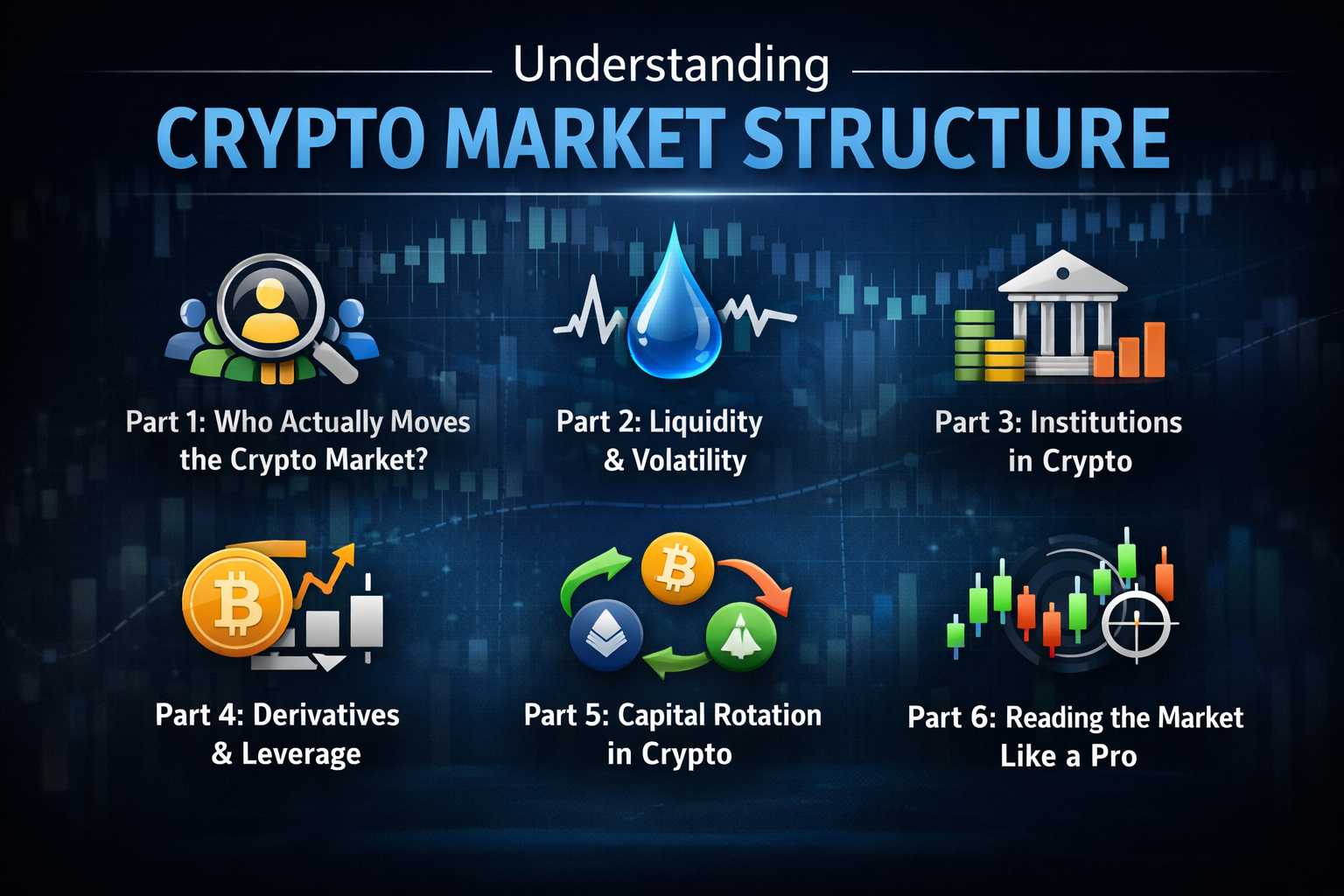
In Part 1 of ChainBitNews’ Understanding Crypto Market Structure series, we examine the roles of retail investors, institutions, market makers and large holders, how their activity interacts, and what their behavior can — and cannot — reveal about price movements.
The objective is to move beyond simple stories about who controls the market and toward a clearer understanding of how market participation becomes price action.
Retail Investors
Retail investors are individuals who participate in cryptocurrency markets using personal capital.
Their strategies vary considerably. Some hold assets for years, while others trade frequently, provide liquidity or react to short-term price movements.
Retail participation can become particularly visible during periods of strong public attention. Rising prices may attract new buyers, and widely shared narratives can reinforce demand.
However, describing retail investors as a single emotional group overlooks an important distinction: market impact depends on collective order behavior, not simply on whether the participants are individuals.
Thousands of smaller purchases can create meaningful buying pressure when they occur in the same direction. Conversely, retail selling may have limited price impact when sufficient demand is available to absorb it.
Retail activity can therefore contribute to momentum without necessarily initiating a broader trend.
The timing of retail participation also varies. Some individuals accumulate during weak markets, while others become active only after a substantial rally.
ChainBitNews explores the relationship between attention, sentiment and late-cycle participation in Why Retail Investors Always Arrive Late in Crypto Cycles.
For market structure, the essential point is that retail investors contribute to order flow. Their influence depends on how their transactions interact with the rest of the market.
Institutional Capital
Institutional capital includes professional investors and trading organizations such as asset managers, hedge funds, investment firms and proprietary trading desks.
These participants may control substantial amounts of capital, but their market behavior is not uniform.
An asset manager building long-term exposure has different objectives from a market-neutral trading firm. A hedge fund may increase risk during a rally, reduce exposure during market stress or maintain offsetting positions across spot and derivatives markets.
Institutions are therefore not automatically long-term buyers or stabilizing forces.
Their influence depends on what they are trying to accomplish and how their orders enter the market.
A large institution may execute purchases gradually to reduce market impact. Another participant may need to unwind a position quickly because of redemptions, leverage constraints or changing risk limits.
The same amount of capital can have very different consequences under those conditions.
Institutional activity can also involve trading on behalf of clients, hedging exposure or providing liquidity rather than making a directional investment in Bitcoin or another cryptocurrency.
This makes it difficult to infer institutional intent from price movements alone.
Part 3 of this series, The Role of Institutions in Crypto, examines institutional strategies, ETF-related activity and the broader consequences of professional capital entering crypto markets.
Here, the distinction is simpler: institutions can influence prices through substantial capital flows, but their size does not determine their trading direction, time horizon or market impact.
Market Makers
Market makers help trading venues function by placing orders to buy and sell assets.
By quoting prices on both sides of a market, they make it easier for other participants to execute transactions without waiting for an exact counterparty to appear.
Market makers may earn compensation through bid-ask spreads, exchange incentives or other trading arrangements. Their profitability also depends on inventory risk, hedging costs and the possibility of trading against better-informed participants.
Their role is not simply to keep prices stable.
A market maker may provide substantial liquidity under normal conditions and reduce its exposure when volatility rises. If several liquidity providers withdraw orders at the same time, the market can become much more sensitive to aggressive buying or selling.
Consider an order book with substantial sell orders available near the current price. A market buy order may execute with relatively little price movement.
If those sell orders disappear, a smaller purchase could consume the remaining offers and execute at progressively higher prices.
The difference is available liquidity, not necessarily the identity of the buyer.
Market makers can therefore reduce trading friction while also adjusting or withdrawing liquidity when the risks of providing it become too high.
That makes their behavior central to market structure, especially during periods when order-book conditions change rapidly.
Whales and Large Holders
Whales are individuals or organizations that control unusually large cryptocurrency holdings.
Their positions can give them the capacity to influence market prices, particularly in assets with limited liquidity. But owning a large amount of cryptocurrency is not the same as actively moving the market.
The distinction becomes important when interpreting on-chain activity.
A large transfer to an exchange may suggest that an asset is being positioned for trading. It does not establish that a sale will occur. Transfers can also reflect custody changes, internal exchange operations, collateral management or other activities unrelated to an immediate directional trade.
Even when a large holder does execute a transaction, the resulting price impact depends on how the order is handled.
A substantial position sold gradually into deep liquidity may produce less immediate disruption than a smaller position liquidated urgently into a thin market.
Whales can also participate as liquidity providers, institutional investors or long-term holders. These categories are not mutually exclusive.
This is why whale activity is better treated as potential evidence of changing market conditions than as a reliable explanation for price movements on its own.
ChainBitNews examines the interpretation and limitations of large-holder activity in Bitcoin Whales Explained.
For the broader market, the important variable is not simply how much cryptocurrency a whale owns. It is whether that capital becomes active trading pressure and how much liquidity is available to absorb it.
How These Participants Interact
The different groups participating in crypto markets do not operate independently.
A retail investor can place an order against liquidity supplied by a professional trading firm. An institution may use the same exchange as individual traders. A large holder may act as a market maker, while a hedge fund can simultaneously hold spot assets and hedge exposure through derivatives.
The categories describe participants and their possible roles. They do not establish who is buying, who is selling or which side is controlling the market at a particular moment.
Price movements emerge from the interaction between orders and available liquidity.
Consider a hypothetical Bitcoin market trading near $80,000.
Suppose the order book contains substantial sell liquidity immediately above that price. A market buy order worth $1 million may be absorbed across a relatively narrow range of prices.
Now imagine that market makers reduce their sell orders because volatility has increased. The same $1 million market buy order may need to execute against offers at progressively higher prices.
The buyer has not become larger. The available liquidity has changed.
This illustrates why market impact cannot be understood through capital size alone.
The urgency of an order matters, as does the amount of liquidity available at the prices where it can execute.
It also explains why every executed trade has both a buyer and a seller, yet prices can still rise or fall. When aggressive buyers consume the offers available at existing prices, subsequent transactions may occur at higher prices. Aggressive selling can similarly consume available bids and move transactions lower.
The market is not simply a contest between retail investors and institutions.
It is a continuous interaction between participants demanding immediate execution and participants willing to provide liquidity at particular prices.
Market makers, institutions, whales and retail traders can appear on either side of that interaction.
A strong rally may therefore reflect increasing demand, declining sell-side liquidity or a combination of both. A sharp decline may result from aggressive selling, disappearing bids or forced transactions occurring during market stress.
The price movement is observable. The precise identity and motivation of every participant usually are not.
Why Liquidity Connects Everything
Liquidity determines how easily market participants can execute transactions without causing substantial price changes.
It connects the different groups discussed in this article because their influence depends partly on the trading conditions they encounter.
An institution executing a large order may have limited immediate price impact in a deep market. A relatively small trader can contribute to a sharp movement when available liquidity is thin.
Liquidity is also dynamic.
Market makers may adjust their quotes, traders may cancel orders and volatility can change how much risk participants are willing to absorb.
During periods of stress, this can create a feedback effect: aggressive transactions move prices, liquidity providers become more cautious, and subsequent orders encounter even less available depth.
Forced liquidations can intensify the process by creating transactions that must be executed regardless of whether market conditions are favorable.
These mechanisms help explain why crypto prices can move sharply without an equivalent change in the underlying investment fundamentals.
Part 2 of this series, Liquidity and Why It Controls Volatility, examines these dynamics in greater detail.
For Part 1, the central relationship is that market participants influence prices through their orders, while liquidity determines how strongly those orders affect execution prices.
Why This Matters for Investors
Understanding market participants is useful because it changes how price movements are interpreted.
A rally is not automatically evidence of institutional accumulation. A sudden decline does not prove that whales are distributing their holdings. High trading volume demonstrates activity, but it does not identify the motives of everyone involved.
These distinctions matter when a convincing market narrative develops around a price movement.
Suppose Bitcoin rises sharply during a period of relatively low public attention. Commentators may describe the move as institutions accumulating before retail investors return.
That explanation is possible, but the price movement alone does not establish it.
The rally could reflect new spot demand, short positions being closed, changes in order-book liquidity or several mechanisms operating together.
Different explanations imply different things about the durability of the move.
A market driven by sustained buying demand may behave differently from one in which prices rise mainly because sell-side liquidity temporarily disappears.
Yet even when additional trading data is available, the identity and intentions of participants may remain uncertain.
The practical advantage of understanding market structure is therefore not the ability to identify a hidden buyer behind every candle.
It is the ability to distinguish what the market visibly demonstrates from what remains an interpretation.
That distinction provides a stronger foundation for the later parts of this series, where liquidity, institutional activity, derivatives and capital rotation are examined in greater depth.
Conclusion
Crypto markets are shaped by participants with different objectives, resources and trading strategies. But identifying those groups is only the beginning of understanding how prices move.
Retail investors, institutions, market makers and large holders can all influence trading conditions. Their impact depends on what they do, how urgently they trade and how much liquidity is available when their orders reach the market.
A large participant does not automatically create a large price movement. A smaller order does not automatically have an insignificant effect.
This also places an important limit on market interpretation.
Price action reveals the outcome of trading activity, not a complete record of the identities and motivations behind it. A convincing explanation of a rally or correction may still be only one of several plausible interpretations.
Understanding who participates in crypto markets is therefore most useful when combined with an understanding of how orders interact and why liquidity changes.
That relationship forms the foundation for the rest of this series.
The next step is to examine liquidity itself: why it can absorb substantial trading activity under some conditions and amplify relatively small transactions under others.
Part 2 Liquidity and Why It Controls Volatility – Understanding Crypto Market Structure
Part 1: Mindset – Think Like a Smart Crypto Investor
Part 1: Portfolio Allocation & Diversification – Advanced Crypto Investing Strategies
Disclaimer: This article is for informational purposes only and does not constitute financial advice. Cryptocurrency markets are volatile and involve significant risk. Always conduct your own research before making investment decisions.