
Crypto markets can move sharply even when there has been little change in the underlying value of an asset. One reason is that the amount of buying and selling interest available near the current price can change much faster than investors expect.
Liquidity influences how easily orders are absorbed. But the important question is not simply whether a market appears liquid during normal trading. It is whether that liquidity remains available when participants suddenly need to buy or sell.
A market can look stable while order books are deep and trading conditions are calm, then become highly sensitive to relatively modest orders as liquidity providers withdraw or leveraged positions are forced to close.
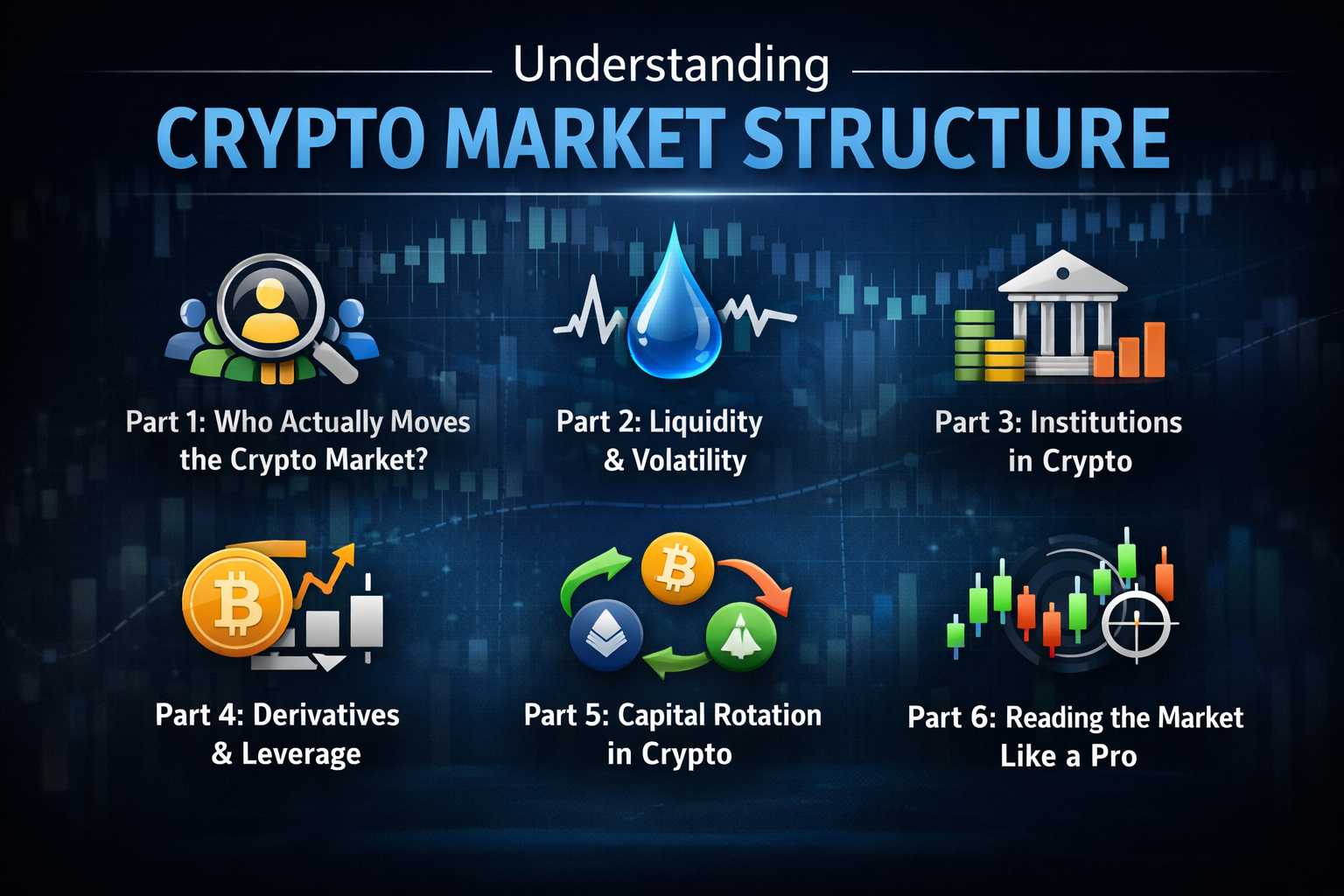
This second part of the Understanding Crypto Market Structure series examines how available liquidity, order imbalances and market stress interact to amplify volatility. The focus is on the mechanism behind price movements rather than on liquidity as a general investment metric.
What Is Liquidity?
Liquidity describes how easily an asset can be bought or sold without substantially changing its price.
For market structure analysis, the crucial factor is the amount of buying or selling interest available near the current market price. A deep order book can absorb relatively large transactions. A thin order book may require even moderate orders to execute across several price levels.
Liquidity should not be confused with trading volume. Volume records completed transactions, while available market depth indicates how much visible buying or selling interest is waiting to absorb new orders. The distinction becomes especially important during volatility.
For a broader explanation of order books, spreads, trading volume and execution costs, see our Crypto Liquidity Explained guide.
Why Low Liquidity Creates Volatility
Prices move when buying or selling pressure interacts with the orders available in the market. When those orders are concentrated close to the current price, a transaction may have relatively little impact. When fewer orders are available, the same transaction can move through several price levels.
Consider a hypothetical sell order worth $500,000. Under normal conditions, a deep order book might absorb most of it near the quoted price. If buyers withdraw their orders during a sudden market shock, the same sale could reach much lower bids before execution is complete.
The amount being sold has not changed. The market’s capacity to absorb it has.
This creates an important distinction between visible liquidity and resilient liquidity. Orders displayed during calm conditions are not guaranteed to remain available during stress. Market participants can cancel orders, widen their quotes or reduce exposure when volatility rises.
The relationship can become self-reinforcing:
Visible Depth → Liquidity Withdrawal → Order Imbalance → Price Impact → Volatility Amplification
This is a causal framework, not a prediction that every market decline will follow the same sequence. Unexpected news or a genuine change in asset valuation can initiate a price move. Liquidity conditions then help determine how strongly that move is transmitted through the market.
Slippage in Crypto Markets
Slippage is the difference between the expected execution price and the price actually received. It can increase sharply when an order consumes the limited liquidity available near the quoted price.
In volatile markets, slippage is therefore more than a trading inconvenience. It is observable evidence that the market is struggling to absorb orders at previously available prices.
Liquidity During Bull Markets
Bull markets can attract additional participants, trading activity and market-making capital. This may improve order-book depth and allow markets to absorb larger transactions more efficiently.
But higher trading volume does not guarantee deeper liquidity. Aggressive buying can consume available sell orders faster than new offers appear, causing prices to accelerate even in an active market.
A rally can therefore reflect both genuine demand and temporary imbalances between aggressive buyers and available sellers. Rising activity alone cannot establish which force is dominant.
Liquidity During Market Corrections
During market corrections, liquidity can deteriorate at the same time that selling pressure increases.
Buyers may lower their bids or withdraw orders while market makers reduce risk exposure. As a result, the market has fewer orders available to absorb selling near the previous price.
This combination matters more than selling pressure alone. A market facing heavy selling can remain relatively orderly if sufficient buyers are available. A smaller sell-off can become disorderly when available bids disappear.
Corrections do not always involve a liquidity crisis. But when falling prices, reduced market depth and forced selling occur together, volatility can intensify rapidly.
Liquidation Cascades Explained
Leveraged positions can add forced buying or selling to an already stressed market. When a long position is liquidated, its closure can generate additional selling pressure. If available bids are thin, those orders may push prices lower and trigger further liquidations.
The reverse can occur when short positions are forced to close during a rapid price increase.
For this article, the important point is that liquidation pressure and market depth interact. Liquidations increase the urgency of execution, while thin liquidity increases the price impact of those orders.
The mechanics of leverage, perpetual futures and liquidation cascades are covered in our dedicated Crypto Derivatives analysis.
The Role of Market Makers
Market makers help connect buyers and sellers by quoting prices on both sides of the market. Their activity can improve order-book depth, narrow bid-ask spreads and reduce the price impact of ordinary transactions.
However, market makers are not obligated to provide unlimited liquidity at unchanged prices. When volatility rises, they may widen spreads, reduce order sizes or temporarily withdraw quotes to manage inventory and execution risk.
This creates a structural tension. Liquidity providers can make markets more efficient under normal conditions, yet their need to control risk may contribute to thinner markets during periods of stress.
The presence of market makers is therefore not enough to establish that a market will remain liquid during a sharp correction.
Why Liquidity Matters for Investors
Liquidity influences the difference between an asset’s quoted market price and the price at which a meaningful position can actually be traded.
A market may appear stable because spreads are narrow and orders execute smoothly during ordinary conditions. That does not establish how it will behave when many participants attempt to exit simultaneously.
A useful liquidity assessment therefore considers more than trading volume. It examines available depth, execution costs, the concentration of liquidity across venues and whether those conditions remain reasonably stable when markets become stressed.
For investors, the analytical question is not simply whether an asset is liquid. It is how much confidence can reasonably be placed in that liquidity under different market conditions.
Liquidity and Emotional Volatility
Sudden price movements can create emotional pressure, particularly when market conditions change faster than investors expect.
Thin liquidity can amplify these movements, but it should not be confused with their underlying cause. A sharp decline may reflect new information, changing expectations, forced selling or a combination of these factors.
Recognizing the role of liquidity helps separate the size of a price movement from the information that movement actually contains.
Why Smaller Altcoins Are More Volatile
Smaller cryptocurrencies often have less market depth than major assets such as Bitcoin and Ethereum. Trading may also be concentrated on fewer exchanges, making prices more sensitive to changes in local buying and selling interest.
However, market capitalization alone does not determine liquidity. Two tokens with similar valuations can have very different order-book depth, trading activity and execution costs.
This distinction becomes especially important during speculative rallies. A thin market may rise rapidly when buyers compete for limited available supply, yet become difficult to exit when demand weakens.
The underlying vulnerability is not simply that an asset is small. It is that the amount of capital seeking execution can become large relative to the liquidity available to absorb it.
Conclusion
Liquidity does not determine every movement in cryptocurrency prices. New information, changing expectations, investor positioning and fundamental developments can all influence demand.
What liquidity determines is how effectively the market can absorb the orders that follow.
This distinction helps explain why similar amounts of buying or selling can produce very different price movements. Deep and resilient markets may absorb substantial pressure with relatively limited disruption. Markets that lose liquidity during stress can experience much larger price changes, especially when forced liquidations add to the imbalance.
The central lesson is that visible liquidity should not be mistaken for guaranteed liquidity. Order books can change, market makers can withdraw and execution conditions can deteriorate precisely when demand for liquidity becomes most urgent.
Understanding this mechanism makes volatility easier to interpret without assuming that every sharp move represents a comparable change in an asset’s underlying value.
The next part of the Understanding Crypto Market Structure series examines how institutional participants influence market activity and the broader structure of crypto markets.
Part 3 The Role of Institutions in Crypto – Understanding Crypto Market Structure
Part 1 — Who Actually Moves the Crypto Market? – Understanding Crypto Market Structure
Disclaimer: This article is for informational purposes only and does not constitute financial advice. Cryptocurrency markets are volatile and involve significant risk. Always conduct your own research before making investment decisions.