
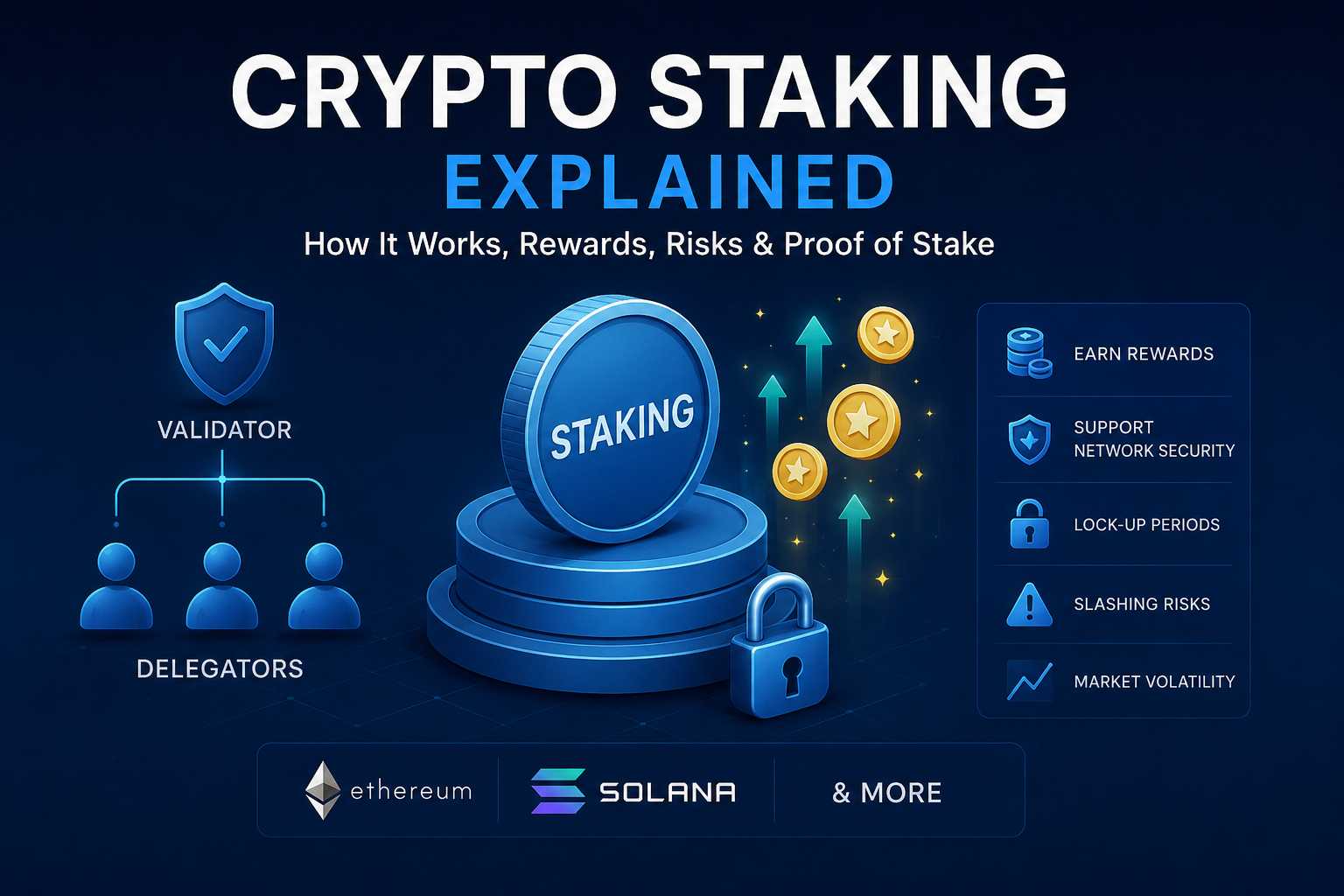
Crypto staking allows investors to earn rewards by participating in the operation and security of certain blockchain networks.
Instead of simply holding cryptocurrency in a wallet, holders can stake their tokens and potentially receive additional tokens over time.
This makes staking attractive to long-term investors.
If you already plan to hold an asset such as Ethereum or Solana, earning additional tokens may seem like an obvious advantage.
But staking rewards are not free money.
They exist for a reason.
Rewards can come from newly issued tokens, transaction fees, or a combination of both. Staking can involve lock-up periods, validator risk, smart-contract risk, platform risk and exposure to the underlying cryptocurrency’s price.
A token offering a 10% staking yield can still produce a substantial financial loss if the token itself falls 50%.
Understanding staking therefore requires looking beyond the advertised APY.
Investors need to understand where the yield comes from, what risks they are taking and whether staking actually improves the long-term economics of holding the asset.
In This Analysis, We’ll Explore:
- What crypto staking is
- Why staking exists
- Proof of Stake
- Validators and delegators
- Where staking rewards come from
- Staking rewards vs interest
- Token inflation
- Nominal yield vs real yield
- Native and delegated staking
- Exchange staking
- Staking pools
- Liquid staking
- Liquid staking tokens
- Lock-up and unstaking periods
- Slashing
- Staking risks
- Why high APY does not guarantee high returns
- Ethereum and Solana staking
- Staking vs lending and yield farming
- Staking and network security
- What investors should check before staking
What Is Crypto Staking?
Crypto staking is the process of committing cryptocurrency to a blockchain network that uses a Proof-of-Stake or related consensus mechanism.
In return, participants can receive staking rewards.
At a basic level, staking helps the blockchain determine who participates in validating transactions and maintaining the network.
Instead of relying on computational mining, as Bitcoin does with Proof of Work, Proof-of-Stake networks use cryptocurrency itself as part of the security mechanism.
The basic idea can be simplified as:
Hold eligible cryptocurrency → Stake tokens → Help support network operation → Potentially earn rewards
However, the exact process differs between blockchains.
Some investors run validators themselves.
Others delegate tokens to existing validators.
Some stake through centralized exchanges.
And liquid staking protocols introduce another layer by giving investors tradable tokens representing their staked assets.
These approaches can produce similar-looking rewards while carrying very different risks.
Why Does Crypto Staking Exist?
Staking is not simply a mechanism created to give token holders passive income.
Its primary purpose is to help secure Proof-of-Stake blockchain networks.
Blockchains need a method for reaching agreement about valid transactions and the current state of the network.
Bitcoin achieves this through mining.
Proof-of-Stake networks use economic incentives and penalties involving staked cryptocurrency.
Participants who behave correctly can receive rewards.
Participants who violate certain network rules may face penalties.
This creates an economic incentive to support the network honestly.
Staking rewards are therefore compensation for participating in the network’s security and consensus system.
Proof of Stake Explained
Proof of Stake is a blockchain consensus mechanism.
Rather than miners competing with computing power, validators participate by committing cryptocurrency to the network.
The exact validator-selection process varies between blockchains, but stake generally plays an important role.
Validators can help:
- Verify transactions.
- Propose or confirm blocks.
- Maintain agreement across the network.
- Protect the blockchain against dishonest behavior.
Because validators have economic value at stake, attacking the network can become expensive.
This is the fundamental logic behind Proof of Stake:
Participants have something valuable to lose if they behave dishonestly.
The blockchain can then use rewards to encourage correct participation and penalties to discourage certain forms of harmful behavior.
Validators and Delegators
Not everyone who stakes cryptocurrency needs to operate a validator.
This creates two important roles:
Validators
and
delegators.
Validators
Validators directly participate in the blockchain’s consensus process.
Operating a validator may require:
- Technical infrastructure.
- Reliable internet connectivity.
- Specific software.
- Minimum staking requirements.
- Ongoing maintenance.
Validators can receive rewards for successfully performing their responsibilities.
Delegators
Delegators commit or assign their staking power to an existing validator rather than operating one themselves.
This makes staking accessible to investors who do not want to maintain technical infrastructure.
The validator performs the operational work while rewards are distributed according to the network’s rules, usually after applicable validator commissions or fees.
Delegation simplifies staking.
But it also means choosing a validator becomes part of the investor’s risk assessment.
Where Do Staking Rewards Come From?
One of the most important questions investors should ask is:
Where does the yield actually come from?
Staking rewards can come from several sources.
These commonly include:
- Newly issued tokens.
- Transaction fees.
- Network incentives.
- A combination of these mechanisms.
This distinction matters.
Suppose a network pays a 10% staking reward entirely through newly created tokens.
Stakers receive more tokens.
But the total token supply is also expanding.
The investor therefore needs to look beyond the headline yield and consider what is happening to the entire supply.
A high staking APY does not automatically mean the network is creating equivalent new economic value.
Staking Rewards Are Not Traditional Interest
Staking rewards are sometimes compared with interest earned on a savings account.
The comparison can be misleading.
When money earns bank interest, the economic structure behind that return is fundamentally different from blockchain staking.
With staking, investors may receive additional units of a volatile cryptocurrency.
Those tokens can rise or fall significantly in value.
The reward may also partly come from token issuance.
So instead of thinking:
“This asset pays 8% interest.”
a more accurate question is:
“I may receive approximately 8% more tokens—but what will those tokens be worth, and how is the network funding those rewards?”
That distinction becomes crucial when evaluating staking as a long-term strategy.
Nominal Staking Yield vs Token Inflation
Imagine a cryptocurrency offers:
8% annual staking rewards
That sounds attractive.
But suppose the token supply expands by approximately:
6% per year
The investor receives more tokens, but the network is simultaneously creating additional supply.
This does not mean the staking return is worthless.
But the headline 8% does not tell the complete story.
Investors should consider:
Staking yield
alongside
Token issuance and inflation
and
Growth in network demand
If demand grows faster than supply, additional issuance may be absorbed relatively easily.
If supply expands rapidly while demand stagnates, token holders can face dilution pressure.
This connects staking directly with tokenomics.
A Simple Staking Reward Example
Suppose an investor owns:
1,000 tokens
The token price is:
$2
Initial position value:
$2,000
The investor stakes the tokens at an approximate annual reward rate of 8%.
After one year, ignoring compounding and changes in reward rates, the investor may have approximately:
1,080 tokens
If the token remains at $2:
1,080 × $2 = $2,160
The staking rewards increased the position value.
But now suppose the token price falls to $1.
The investor still has approximately:
1,080 tokens
but they are worth:
$1,080
The investor earned additional tokens while losing substantial value in dollar terms.
This demonstrates one of the most important staking principles:
Staking yield cannot protect an investor from underlying token price risk.
Why High Staking APY Can Be Misleading
Crypto investors are often attracted to high percentages.
5%, 10%, 20%.
Sometimes significantly more.
But higher yield should immediately create another question:
Why is the reward so high?
A high staking rate may exist because:
- Token issuance is high.
- The network needs stronger staking incentives.
- Relatively few tokens are currently staked.
- The asset carries substantial risk.
- The tokenomics intentionally distribute significant new supply.
A 20% staking APY attached to a token experiencing aggressive inflation and collapsing demand may be far less attractive than a lower yield attached to a stronger network.
Yield should never be analyzed independently from the underlying asset.
Native Staking
Native staking means participating through the blockchain’s own staking mechanism rather than through an external centralized service.
Depending on the network, this may involve:
- Operating a validator.
- Delegating to a validator.
- Using the network’s native staking functionality.
Native staking can reduce reliance on centralized intermediaries.
However, investors still need to understand the network’s specific rules.
These may include:
- Minimum staking amounts.
- Validator commissions.
- Unstaking periods.
- Reward schedules.
- Penalties.
- Technical requirements.
“Native” does not mean risk-free.
It simply means staking occurs more directly through the blockchain’s own infrastructure.
Delegated Staking
Delegated staking allows token holders to participate without running their own validator.
Instead, they delegate their stake to a validator.
The tokens generally remain associated with the holder while the validator receives additional staking weight.
Rewards are then distributed according to the protocol’s structure.
This makes staking much more accessible.
But validator selection matters.
Investors may want to consider factors such as:
- Validator reliability.
- Commission.
- Performance.
- Reputation.
- Uptime.
- Network concentration.
Delegating everything to the largest validators may be convenient, but excessive concentration can work against the decentralization of the network.
Staking Through a Crypto Exchange
Centralized crypto exchanges often make staking extremely simple.
An investor may only need to:
Hold the token → Select staking → Receive rewards
The exchange handles much of the technical process.
This can be convenient for beginners.
But convenience introduces counterparty risk.
The investor depends on the exchange to:
- Secure the assets.
- Operate the staking process correctly.
- Distribute rewards.
- Process withdrawals.
- Remain operational and solvent.
Exchange staking therefore combines:
staking risk
with
centralized platform risk.
Investors should understand that outsourcing complexity also means outsourcing control.
Staking Pools
Some networks have requirements that make individual staking more difficult.
Staking pools allow multiple participants to combine their assets.
This can lower the barrier to participation.
Instead of one investor meeting a large staking requirement alone, many investors contribute smaller amounts.
The pool then participates in staking and distributes rewards among participants.
This can improve accessibility.
However, investors should consider:
- Pool fees.
- Operator risk.
- Custody arrangements.
- Smart-contract risk where applicable.
- Withdrawal conditions.
Again, the advertised staking percentage is only one part of the decision.
What Is Liquid Staking?
Traditional staking can create a problem.
If tokens are locked or committed to staking, they may become less flexible.
The investor is earning rewards but may not be able to use the same capital elsewhere.
Liquid staking attempts to solve this.
An investor deposits or stakes cryptocurrency through a liquid staking protocol.
In return, they receive another token representing their staked position.
This is commonly called a Liquid Staking Token, or LST.
The simplified structure looks like:
Deposit crypto → Crypto is staked → Receive liquid staking token → Continue earning staking exposure
The liquid staking token can potentially be transferred, traded or used elsewhere in the crypto ecosystem.
This allows investors to retain greater capital flexibility while their underlying cryptocurrency remains staked.
What Are Liquid Staking Tokens?
A liquid staking token represents a claim or economic exposure to cryptocurrency that has been staked through a liquid staking system.
Suppose an investor stakes ETH through a liquid staking protocol.
Instead of the ETH simply becoming unavailable, the investor receives a token representing the staked position.
Depending on the protocol, the value or quantity of that token can reflect accumulated staking rewards over time.
This creates additional possibilities.
The investor may be able to use the liquid staking token within:
- DeFi.
- Lending protocols.
- Liquidity pools.
- Other blockchain applications.
But this additional flexibility introduces additional layers of risk.
The investor no longer has exposure only to ETH and Ethereum staking.
They may now also depend on:
- Smart contracts.
- The liquid staking protocol.
- The liquid staking token maintaining its expected relationship with the underlying asset.
- Other DeFi protocols where the token is used.
More flexibility can therefore mean more complexity.
Traditional Staking vs Liquid Staking
The basic trade-off can be summarized as:
Traditional Staking
Potential advantages:
- Simpler structure.
- Direct participation.
- Fewer additional protocol layers.
Potential disadvantages:
- Capital may be less liquid.
- Unstaking can take time.
- Fewer opportunities to use the staked capital elsewhere.
Liquid Staking
Potential advantages:
- Greater liquidity.
- Staking exposure remains active.
- Staked value can potentially be used elsewhere.
Potential disadvantages:
- Smart-contract risk.
- Protocol risk.
- Additional complexity.
- Liquid staking token price risk.
Liquid staking does not magically create additional risk-free return.
It creates a more flexible representation of staked capital while adding another layer to the investment structure.
And that leads to the most important part of staking analysis: the risks investors take in exchange for those rewards.
Lock-Up and Unstaking Periods
One of the practical disadvantages of staking is that cryptocurrency may not always be immediately available.
Some networks allow relatively flexible staking.
Others require investors to wait before staked assets become transferable again.
This is commonly known as an unstaking period.
Suppose an investor decides to sell a staked asset during a sudden market decline.
If unstaking requires several days, the investor may not be able to react immediately.
By the time the tokens become available, the market price could have changed substantially.
This creates liquidity risk.
Investors should therefore understand:
- Whether tokens are locked.
- How long unstaking takes.
- Whether rewards continue during unstaking.
- Whether withdrawal conditions can change.
- Whether immediate liquidity is available through another mechanism.
Staking rewards should always be considered alongside the flexibility investors give up to earn them.
What Is Slashing?
Proof-of-Stake networks need mechanisms to discourage validators from behaving incorrectly.
One possible mechanism is slashing.
Slashing means some of the cryptocurrency associated with a validator can be penalized when certain protocol rules are violated.
Depending on the blockchain, penalties may occur because of behavior such as:
- Signing conflicting blocks.
- Certain forms of malicious validation.
- Serious validator failures.
The exact rules vary significantly between networks.
For delegators, this means validator selection can matter.
Staking through an unreliable or malicious validator may expose investors to risks beyond normal token-price volatility.
Slashing is also a good example of why staking rewards exist.
Validators receive rewards for helping secure the network.
But they may also have something economically valuable at risk when they violate its rules.
The Main Risks of Crypto Staking
Staking is often presented as a simple way to earn passive income.
In reality, several risks can exist simultaneously.
The most important include:
Token Price Risk: The underlying cryptocurrency can decline significantly.
Validator Risk: Poor validator performance can reduce rewards or create penalties depending on the network.
Liquidity Risk: Staked tokens may not be immediately available.
Smart-Contract Risk: Liquid staking and other staking protocols may depend on smart contracts.
Counterparty Risk: Centralized staking services require trust in the provider.
Slashing Risk: Certain validator behavior can result in penalties.
Liquid Staking Token Risk: A liquid staking token may temporarily trade differently from the value investors expect relative to the underlying asset.
These risks vary depending on how staking is performed.
Native delegation and centralized exchange staking may both generate staking rewards, but their risk structures are not identical.
Why a 10% Staking Yield Can Still Lose Money
Consider an investor with:
$10,000 of a cryptocurrency
The asset offers approximately:
10% annual staking rewards
After one year, the investor has roughly 10% more tokens, ignoring compounding and changes in reward rates.
That sounds attractive.
But suppose the token price falls 40%.
The additional tokens do not compensate for the decline in the underlying asset.
This demonstrates why investors should separate:
Token return
from
Staking return
The total investment outcome depends on both.
A high staking yield attached to a weak cryptocurrency does not transform it into a strong investment.
The underlying asset remains the most important part of the equation.
Staking and Tokenomics
Staking should also be analyzed within the broader tokenomics of a cryptocurrency.
Suppose a network issues new tokens to reward validators.
Stakers receive part of that new supply.
Investors who do not stake may see their percentage ownership of the network diluted relative to those who do.
This creates an interesting dynamic.
In some Proof-of-Stake systems, staking is not simply about generating extra return.
It can also help offset the effects of token issuance.
This is why comparing staking yields without looking at supply growth can be misleading.
A token offering 3% staking rewards with limited issuance may have very different economics from a token offering 15% while supply expands rapidly.
The important questions are:
How many new tokens are being created?
Who receives them?
How quickly is total supply growing?
Is network demand growing enough to absorb that supply?
Staking yield and tokenomics should always be analyzed together.
Tokenomics in Crypto: Why Supply Design Determines Long-Term Value
Does Staking Create Passive Income?
Staking is frequently described as passive income.
That description is partly accurate.
Once tokens are staked, investors can potentially receive additional tokens without actively trading.
But staking rewards are not the same as guaranteed income.
The rewards themselves can:
- Change over time.
- Be paid in volatile tokens.
- Lose value.
- Be affected by validator performance.
- Be reduced by fees.
- Be accompanied by token inflation.
It may therefore be more accurate to think of staking as:
earning additional crypto exposure from assets already being held.
Whether that creates meaningful income depends on the value of those rewards over time.
Ethereum Staking
Ethereum is one of the most prominent Proof-of-Stake networks.
ETH can be staked to participate in Ethereum’s validator system and network security.
There are several ways investors can gain staking exposure.
These can include:
- Operating a validator.
- Using staking services.
- Participating through staking pools.
- Using centralized platforms.
- Using liquid staking protocols.
Each method changes the balance between:
Control, Convenience, Liquidity and Risk
Running a validator provides more direct participation but requires greater technical commitment and sufficient ETH.
Third-party services can make staking much easier but introduce additional dependencies.
Liquid staking can improve flexibility while adding smart-contract and protocol risk.
The underlying asset may be the same.
The staking method can still materially change the risk profile.
Ethereum (ETH) Analysis: Smart Contract Infrastructure, Layer-2 Scaling & Long-Term Positioning
Solana Staking
Solana also uses Proof-of-Stake mechanisms, with SOL holders able to delegate stake to validators.
Delegation makes participation relatively accessible because investors do not need to operate their own validator.
Validator selection still matters.
Factors such as performance, commission and reliability can influence the staking experience.
Solana also illustrates an important broader point:
Staking rules are blockchain-specific.
Ethereum staking should not be assumed to work exactly like Solana staking.
Different networks can have different:
- Reward mechanisms.
- Validator structures.
- Unstaking processes.
- Penalties.
- Inflation schedules.
Investors should therefore understand the specific staking mechanics of the asset they own rather than applying one universal model to every Proof-of-Stake cryptocurrency.
Solana (SOL) Analysis: High-Speed Infrastructure, Scalability & Long-Term Positioning
Staking vs Simply Holding Crypto
Suppose an investor already intends to hold a Proof-of-Stake cryptocurrency for several years.
Should they stake it?
Potentially, but the answer depends on the trade-offs.
Simply Holding
Advantages:
- Maximum simplicity.
- Assets may remain immediately accessible.
- No validator or staking-protocol exposure.
Disadvantages:
- No staking rewards.
- Potential dilution relative to participants if new tokens are distributed through staking.
Staking
Advantages:
- Additional tokens.
- Participation in network security.
- Potentially offsets some token issuance.
Disadvantages:
- Additional staking risks.
- Potential liquidity restrictions.
- Greater complexity depending on the method used.
For a long-term holder, staking can improve the economics of ownership.
But only if the additional reward justifies the additional risks.
Staking vs Crypto Lending
Staking and lending are frequently grouped together because both can generate yield.
But they are fundamentally different.
Staking supports the consensus and security mechanism of a Proof-of-Stake blockchain.
Lending involves making crypto assets available to borrowers through centralized or decentralized financial systems.
The source of the return is therefore different.
With staking, rewards can come from network issuance and transaction-related economics.
With lending, yield generally comes from borrowers paying for access to capital.
The risks are also different.
Lending can introduce:
- Borrower risk.
- Counterparty risk.
- Smart-contract risk.
- Collateral risk.
A platform advertising “earn” products should therefore not automatically be assumed to offer native staking.
Investors should understand what is actually happening to their cryptocurrency.
Staking vs Yield Farming
Yield farming goes another step further into decentralized finance.
Investors may provide liquidity, deposit assets into protocols or combine multiple DeFi strategies to generate returns.
Potential yields can be higher.
Complexity and risk can also increase substantially.
Yield farming may involve:
- Smart-contract risk.
- Impermanent loss.
- Protocol risk.
- Token incentive risk.
- Multiple interacting assets.
- Rapidly changing yields.
Staking is generally more directly connected to blockchain consensus.
Yield farming is primarily a DeFi activity.
Both can generate additional tokens.
That does not make them economically equivalent.
How Staking Helps Secure a Blockchain
Staking has a function beyond investor returns.
It helps create economic security for Proof-of-Stake networks.
Validators commit economic value to the system.
The network rewards correct participation and can impose penalties for certain harmful behavior.
As more economic value participates in staking, attacking the network can become more difficult or expensive.
This creates an alignment between:
Token holders
Validators
and
Network security
However, the distribution of stake also matters.
If too much staking power becomes concentrated among a small number of validators, exchanges or staking providers, concerns around centralization can increase.
The amount staked is therefore not the only relevant metric.
Who controls that stake also matters.
Does Staking Reduce Circulating Supply?
Staking can temporarily reduce the amount of cryptocurrency actively available for trading.
If a significant percentage of token holders stake their assets and those assets are less liquid, fewer tokens may be immediately available on exchanges.
In theory, lower liquid supply can influence market dynamics when demand increases.
But this relationship should not be oversimplified.
Staked tokens still exist.
Liquid staking can make staked value transferable.
Investors can eventually unstake.
And new token issuance may simultaneously increase supply.
Staking should therefore not automatically be interpreted as:
More staking = higher price
Price still depends on the broader interaction between supply, demand, liquidity and market conditions.
Common Crypto Staking Mistakes
Staking itself is relatively straightforward.
The mistakes often come from focusing exclusively on the reward percentage.
Common examples include:
- Choosing a token because it offers high APY.
- Ignoring token inflation.
- Ignoring the underlying asset’s fundamentals.
- Assuming staking rewards are guaranteed.
- Not checking unstaking conditions.
- Ignoring validator fees.
- Using unknown staking platforms for slightly higher yields.
- Treating liquid staking as risk-free.
- Ignoring smart-contract risk.
- Confusing staking with lending or yield farming.
- Forgetting that token price remains the largest source of volatility.
The biggest mistake is often:
Buying a weak cryptocurrency purely because the staking yield looks attractive.
Staking should improve the economics of an asset you already have a reason to own.
It should not create the investment thesis by itself.
What Investors Should Check Before Staking
Before staking a cryptocurrency, investors can use a simple framework.
1. Would I Own This Token Without the Staking Reward?
If the answer is no, the yield may be distracting from a weak investment thesis.
2. Where Do the Rewards Come From?
Understand whether rewards come from issuance, transaction fees or other mechanisms.
3. What Is the Token Inflation Rate?
A high nominal yield can look very different once supply growth is considered.
4. How Long Does Unstaking Take?
Liquidity matters, especially in volatile markets.
5. Am I Taking Additional Counterparty Risk?
Staking through an exchange or service introduces another party.
6. Is There Smart-Contract Risk?
This becomes especially relevant with liquid staking.
7. Is Slashing Possible?
Understand the rules of the specific blockchain.
8. What Fees Are Charged?
Validator, protocol or platform fees can reduce the actual reward.
9. How Strong Is the Underlying Network?
Staking cannot compensate indefinitely for weak adoption or deteriorating fundamentals.
This framework keeps attention on the complete investment rather than the headline APY.
Who Is Crypto Staking Most Suitable For?
Staking generally makes the most sense for investors who already have long-term conviction in a Proof-of-Stake asset.
If an investor plans to hold ETH, SOL or another eligible cryptocurrency regardless of short-term price movements, staking can potentially increase the number of tokens held over time.
It may be less suitable for investors who:
- Need immediate liquidity.
- Trade frequently.
- Do not understand the staking mechanism.
- Are buying solely because of the yield.
- Are uncomfortable with additional protocol or custody risks.
The decision should begin with the underlying cryptocurrency.
Not the reward percentage.
Conclusion
Crypto staking creates an interesting relationship between investing and blockchain infrastructure.
Token holders can potentially earn additional cryptocurrency while contributing to the operation and security of Proof-of-Stake networks.
But the word yield can make staking sound safer and simpler than it really is.
A 10% staking reward does not guarantee a 10% investment return.
Token prices can fall.Supply can inflate.
Validators can create additional risks.
Centralized platforms introduce counterparties.
Liquid staking introduces smart-contract and protocol exposure.
And high APYs can sometimes reflect aggressive token issuance rather than strong economic activity.
The most important question is therefore not:
“Which cryptocurrency has the highest staking yield?”
It is:
“Would I want to own this cryptocurrency even without staking?”
If the underlying investment thesis is strong, staking can potentially improve the economics of long-term ownership.
If the underlying asset is weak, a high staking yield may simply provide more tokens of an asset that continues losing value.
Staking rewards matter.
But the quality of the underlying asset, the source of the yield and the risks required to earn it matter more.
Crypto Security Explained: Wallets, Private Keys, Scams & How Investors Protect Digital Assets
Layer 1 vs Layer 2 vs Layer 3 Explained: Scalability, Blockchain Infrastructure & Why It Matters
Disclaimer: This article is for educational and informational purposes only and does not constitute financial or investment advice. Crypto staking and cryptocurrency investments involve significant risk, including token-price volatility, validator risk, smart-contract risk and potential loss of capital. Always conduct your own research before staking or investing in cryptocurrency.