
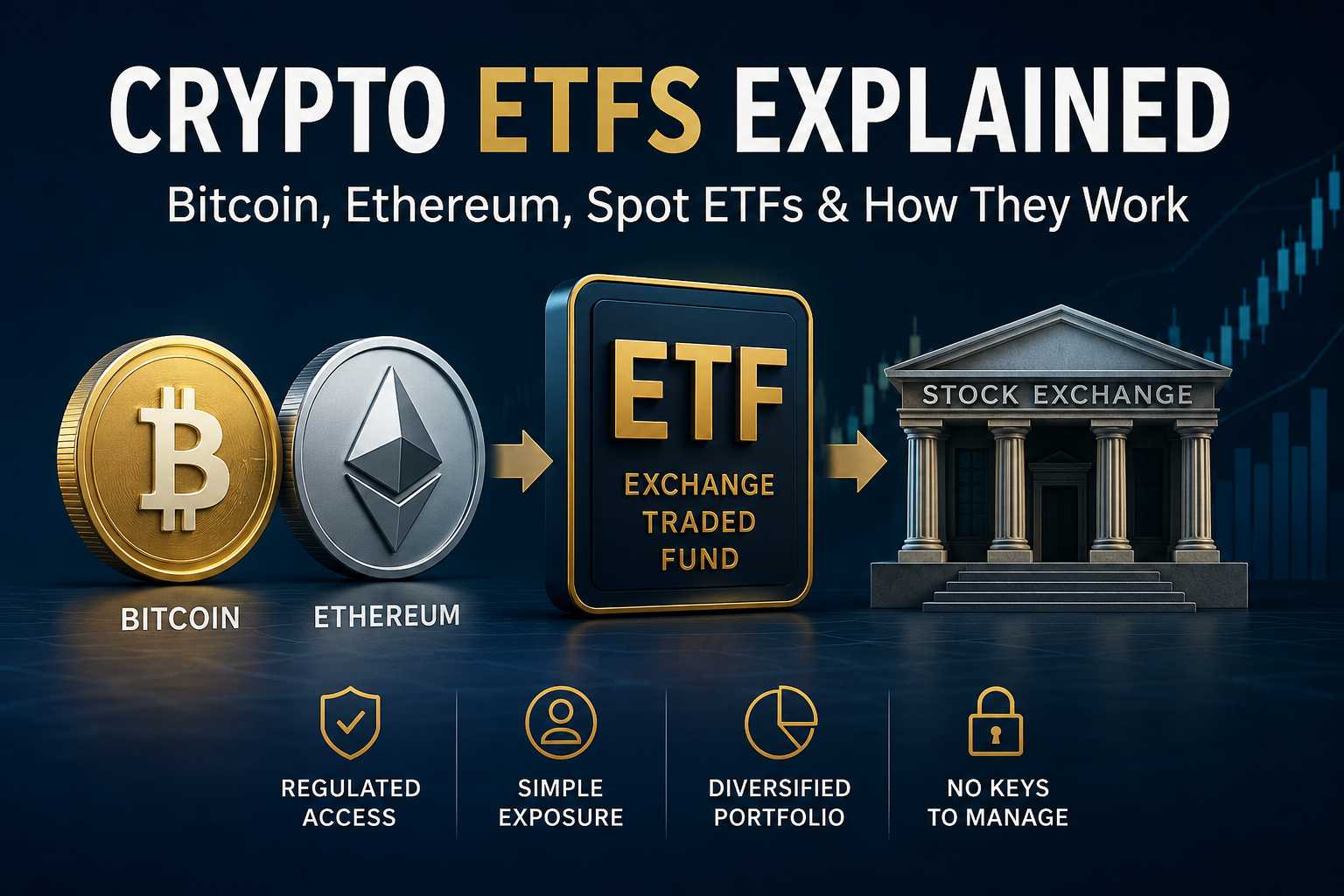
For years, investing in cryptocurrency meant entering the crypto market directly.
Investors had to use a cryptocurrency exchange, buy Bitcoin or another digital asset, and decide how that cryptocurrency should be stored.
Crypto ETFs offer a different route.
Instead of buying cryptocurrency directly, investors can gain exposure through an investment product traded on a traditional stock exchange.
This creates an important bridge between two markets:
Traditional finance
and
cryptocurrency.
For investors who already use brokerage accounts for stocks and ETFs, this can make crypto exposure significantly easier to access.
There is no need to manage private keys.
There is no need to transfer cryptocurrency between wallets.
And investors do not necessarily need a separate crypto exchange account.
But this convenience creates an important distinction.
Owning a crypto ETF is not the same as owning cryptocurrency directly.
An investor can gain exposure to the price of Bitcoin without personally owning Bitcoin that can be transferred, stored in self-custody or used on the network.
Understanding that difference—and the different types of crypto ETFs—is essential before deciding what role these products can play within the broader cryptocurrency market.
In This Analysis, We’ll Explore:
- What a crypto ETF is
- How crypto ETFs work
- Spot crypto ETFs
- Futures crypto ETFs
- Spot vs futures ETFs
- Bitcoin ETFs
- Ethereum ETFs
- Other crypto ETFs
- Why crypto ETFs matter for institutional adoption
- ETF inflows and outflows
- How ETF demand can influence crypto markets
- Whether crypto ETFs actually buy cryptocurrency
- How creation and redemption work
- Crypto ETFs vs buying crypto directly
- Crypto ETFs vs holding crypto on an exchange
- Crypto ETFs vs self-custody
- Advantages of crypto ETFs
- Risks and disadvantages
- Fees and tracking differences
- Custody risk
- Whether ETF investors actually own cryptocurrency
- Crypto ETFs and decentralization
- Long-term implications for crypto adoption
What Is a Crypto ETF?
ETF stands for Exchange-Traded Fund.
ETFs are investment products traded on stock exchanges in a similar way to individual stocks.
Traditional ETFs can provide exposure to:
- Stock markets.
- Bonds.
- Commodities.
- Specific industries.
- Investment themes.
Crypto ETFs apply the same general idea to cryptocurrency.
Instead of purchasing the underlying cryptocurrency directly, an investor buys shares of an investment product designed to provide exposure to that crypto asset.
For example, an investor who wants Bitcoin exposure may have two very different options:
Buy Bitcoin directly
or
Buy shares of a Bitcoin ETF
Both can provide exposure to changes in Bitcoin’s price.
But the ownership structure is completely different.
With direct Bitcoin ownership, the investor owns BTC.
With an ETF, the investor owns shares in a financial product providing Bitcoin exposure.
How Does a Crypto ETF Work?
The exact structure depends on the type of ETF.The two most important forms are:
Spot crypto ETFs
and
futures crypto ETFs.
A spot ETF gains exposure through the underlying cryptocurrency itself.
A futures ETF gains exposure through financial contracts linked to the cryptocurrency.
This distinction may sound technical, but the basic difference is straightforward:
Spot → exposure through the actual asset
Futures → exposure through contracts linked to the asset
Both can follow the general direction of the crypto market.
But they do not necessarily behave identically.
What Is a Spot Crypto ETF?
A spot crypto ETF is designed to track the market price of a cryptocurrency by holding the underlying asset.
For example, a spot Bitcoin ETF holds actual Bitcoin through its fund and custody structure.
Investors then purchase shares representing exposure to those holdings.
The basic structure can be simplified as:
Investors buy ETF shares → ETF holds Bitcoin → ETF shares track Bitcoin exposure
The investor does not personally receive the Bitcoin.
The cryptocurrency is held within the ETF’s custody structure.
This removes several responsibilities associated with direct crypto ownership.
Investors do not need to manage:
- Private keys.
- Seed phrases.
- Hardware wallets.
- Blockchain transfers.
- Personal crypto custody.
For investors who simply want price exposure, this can make accessing Bitcoin considerably easier.
What Is a Futures Crypto ETF?
A futures crypto ETF works differently.
Instead of holding the cryptocurrency directly, the fund uses futures contracts.
These are financial contracts linked to the price of an underlying asset.
A Bitcoin futures ETF can therefore provide exposure to Bitcoin price movements without holding Bitcoin itself.
This creates additional complexity.
Futures contracts expire.
The fund must regularly replace older contracts with newer ones.
This process can create differences between the performance of the ETF and the actual spot price of Bitcoin.
For investors, the most important distinction remains simple:
Spot Bitcoin ETF → underlying exposure comes from Bitcoin holdings
Bitcoin futures ETF → underlying exposure comes from futures contracts
Understanding which structure a product uses is therefore essential.
Spot vs Futures Crypto ETFs
Spot and futures products may both have “Bitcoin” or another cryptocurrency in their name.
But investors should not assume they provide identical exposure.
A spot product generally follows the underlying cryptocurrency more directly because actual crypto assets support the exposure.
A futures product depends partly on the behavior of the futures market.
This means performance can differ over time.
For long-term investors especially, understanding how an ETF creates its crypto exposure is more important than simply recognizing the asset in the product name.
Why Spot Crypto ETFs Matter
Spot crypto ETFs are important because they make cryptocurrency accessible through traditional investment infrastructure.
Before these products existed, an investor wanting direct Bitcoin exposure generally needed to enter the crypto ecosystem.
That meant learning how exchanges, wallets and crypto custody worked.
ETFs remove much of that operational complexity.
An investor can potentially hold crypto exposure alongside:
- Stocks.
- Traditional ETFs.
- Bonds.
- Other investments.
all within the same brokerage environment.
This significantly lowers the barrier between cryptocurrency and traditional financial markets.
It also opens crypto exposure to investors who may be interested in Bitcoin as an investment but have no interest in managing cryptocurrency themselves.
Bitcoin ETFs
Bitcoin is the clearest example of how crypto ETFs connect digital assets with traditional finance.
A spot Bitcoin ETF allows investors to gain exposure to Bitcoin’s price through a conventional investment account.
This can appeal to several types of investors.
Some may not trust themselves to manage private keys.
Others may prefer keeping all investments within one brokerage account.
Professional investors may need regulated investment structures that fit existing portfolio or custody requirements.
Bitcoin ETFs make this possible without changing Bitcoin itself.
The Bitcoin network continues operating independently.
Blocks continue being produced.
Bitcoin can still be transferred between wallets.
Self-custody remains possible.
The ETF simply creates another way to gain financial exposure to the asset.
Do Spot Bitcoin ETFs Actually Hold Bitcoin?
This is an important point.
A spot Bitcoin ETF holds actual Bitcoin as part of its underlying structure.
However, the individual ETF investor does not personally own those bitcoins.
Suppose an investor buys $5,000 worth of a Bitcoin ETF.
They now own approximately $5,000 worth of ETF shares.
They do not have $5,000 of Bitcoin sitting in a personal wallet.
They cannot send their ETF shares to another Bitcoin address.
They cannot withdraw the underlying BTC into self-custody.
They own a financial product providing exposure to Bitcoin.
This creates one of the fundamental differences between the two approaches:
Buying Bitcoin directly → ownership of BTC
Buying a Bitcoin ETF → ownership of ETF shares with Bitcoin exposure
For investors focused purely on price exposure, that distinction may not matter much.
For investors who value self-custody and direct control, it matters enormously.
Ethereum ETFs
Ethereum ETFs extend the same broad concept beyond Bitcoin.
Instead of purchasing ETH directly, investors can gain exposure through an exchange-traded investment product.
Again, this removes the need to personally manage cryptocurrency.
But Ethereum makes the difference between price exposure and crypto ownership even clearer.
ETH is not only an investment asset.
It is also used within the Ethereum ecosystem.
ETH can be used for:
- Transaction fees.
- Smart-contract interactions.
- DeFi.
- Blockchain applications.
- Other network activity.
Someone owning ETH directly can interact with that ecosystem.
Someone owning Ethereum ETF shares cannot.
The ETF provides investment exposure.
It does not provide direct access to the Ethereum network.
Bitcoin ETFs vs Ethereum ETFs
Bitcoin and Ethereum ETFs may look similar from the perspective of a brokerage account.
Both allow investors to gain cryptocurrency exposure without directly holding the underlying asset.
But the cryptocurrencies behind those products have very different investment cases.
Bitcoin is primarily associated with:
- Digital scarcity.
- Decentralized monetary infrastructure.
- Store-of-value characteristics.
- Global settlement.
- Long-term monetary adoption.
Ethereum is primarily associated with:
- Smart contracts.
- Decentralized applications.
- DeFi.
- Stablecoins.
- Tokenization.
- Programmable blockchain infrastructure.
The ETF does not change those fundamentals.
It simply changes the method investors use to gain exposure.
This is important because investors should evaluate the underlying cryptocurrency first and the ETF structure second.
An ETF wrapper does not make every crypto asset fundamentally equal.
Other Crypto ETFs
The concept of crypto ETFs can extend beyond Bitcoin and Ethereum.
Depending on the market and regulatory environment, exchange-traded crypto products can potentially provide exposure to:
- Individual altcoins.
- Multiple cryptocurrencies.
- Crypto indexes.
- Specific blockchain sectors.
- Futures strategies.
- Leveraged strategies.
- Inverse strategies.
This means the term crypto ETF can eventually cover a wide range of products.
And those products can carry very different risks.
A simple spot ETF holding one cryptocurrency is fundamentally different from a leveraged ETF attempting to multiply short-term daily price movements.
Likewise, a diversified crypto basket is different from an ETF concentrated entirely in one asset.
Investors should therefore always look beyond the name.
Ask:
What does the product actually hold?
How does it create exposure?
What cryptocurrency or strategy sits underneath it?
Is it designed for long-term exposure or short-term trading?
The ETF structure makes cryptocurrency easier to access.
It does not make the underlying investment simple or risk-free.
Why Crypto ETFs Matter for the Broader Market
Crypto ETFs represent more than another way for retail investors to buy Bitcoin or Ethereum.
They create a connection between cryptocurrency and enormous pools of capital already operating within traditional financial markets.
That can potentially increase:
- Accessibility.
- Institutional participation.
- Market liquidity.
- Professional custody.
- Portfolio integration.
- Long-term capital flows.
Instead of cryptocurrency existing largely as a separate investment category requiring specialized infrastructure, crypto exposure can increasingly sit alongside traditional assets.
That raises an important question:
What happens when Bitcoin, Ethereum and potentially other crypto assets become easier for traditional investors to include in normal investment portfolios?
The answer brings us to institutional adoption, ETF inflows and outflows, and how demand for ETF shares can ultimately affect the underlying cryptocurrency market.
Why Crypto ETFs Matter for Institutional Adoption
One of the biggest long-term effects of crypto ETFs is that they make digital assets easier to integrate into traditional investment portfolios.
Large financial institutions operate differently from individual crypto investors.
They often have strict requirements involving:
- Custody.
- Regulation.
- Risk management.
- Reporting.
- Liquidity.
- Investment mandates.
Buying cryptocurrency directly can create additional operational complexity.
An ETF provides a familiar structure.
Instead of creating completely new systems for buying, storing and managing cryptocurrency, institutions can potentially gain exposure through infrastructure they already use.
This lowers an important barrier to institutional participation.
It does not mean every institution will suddenly invest heavily in crypto.
But it expands the number of investors who can access the asset class.
And over time, greater accessibility can influence market liquidity and capital flows.
Understanding Crypto ETF Inflows and Outflows
Crypto investors increasingly encounter headlines discussing ETF inflows and outflows.
These numbers can provide useful information about demand through exchange-traded products.
An ETF inflow occurs when more capital enters the product.
An ETF outflow occurs when capital leaves.
For example:
$500 million net inflow
means more capital entered the ETF market than left during the measured period.
Meanwhile:
$500 million net outflow
means withdrawals exceeded new inflows.
These figures are particularly interesting for spot crypto ETFs because changes in investor demand can ultimately affect the amount of underlying cryptocurrency required within the ETF structure.
Why ETF Inflows Can Matter for Bitcoin
Bitcoin has a limited supply.
Only a certain amount of BTC is available for trading at any given time.
When significant new demand enters through spot Bitcoin ETFs, the ETF ecosystem may need additional Bitcoin exposure to support newly created shares.
This creates another source of demand within the broader Bitcoin market.
A simplified relationship looks like:
Investor demand → ETF share creation → additional Bitcoin demand
The opposite can occur when substantial capital leaves.
Large redemptions can reduce the amount of Bitcoin exposure required by the ETF structure.
However, investors should avoid interpreting every daily inflow or outflow as a direct price prediction.
Bitcoin’s price is influenced by many factors simultaneously:
- Global liquidity.
- Spot market demand.
- Derivatives positioning.
- Leverage.
- Long-term holders.
- Macroeconomic conditions.
- Market sentiment.
- Institutional flows.
ETF flows are therefore one part of the market—not the entire market.
ETF Flows vs Price
A common mistake is assuming:
Large ETF inflows = Bitcoin must rise
or
Large ETF outflows = Bitcoin must fall
Markets are more complicated.
Strong ETF buying can occur while other market participants are selling.
Likewise, ETF outflows can occur while demand elsewhere absorbs that supply.
This can create situations where Bitcoin barely moves despite large ETF flows.
It can also explain why price sometimes moves differently from what ETF headlines appear to suggest.
The better question is not:
“Were ETF flows positive today?”
but:
“How significant are ETF flows relative to the rest of the market?”
Persistent flows over longer periods generally provide more useful information than one unusually strong day.
How ETF Demand Can Influence Crypto Market Structure
Crypto ETFs do not change the fundamental mechanics of supply and demand.
They create another channel through which that demand can enter the market.
If substantial capital consistently enters spot crypto ETFs, demand for the underlying assets can increase.
If available liquid supply remains limited, that can contribute to upward price pressure.
This becomes particularly interesting when long-term holders are also reluctant to sell.
A market can then experience:
Increasing demand + limited available supply
That combination can create stronger price movements.
The opposite is also possible.
If institutional demand weakens while existing holders increase selling, the market may face greater supply relative to demand.
ETF flows should therefore be viewed within the broader market structure rather than as an isolated indicator.
Crypto Market Structure Explained: Higher Highs, Lower Lows, Trends & Structure Breaks
How ETF Creation and Redemption Work
The mechanics behind ETFs can become complicated, but investors do not need to understand every technical detail.
The basic concept is relatively simple.
When demand for an ETF increases significantly, additional shares can be created.
When demand decreases and shares are redeemed, the number of shares can decline.
Specialized financial institutions help manage this process.
Their role is important because it helps keep the market price of ETF shares relatively close to the value of the underlying assets.
Without this mechanism, an ETF could trade substantially above or below the value of what it represents.
For crypto investors, the important takeaway is:
ETF shares are not simply created without connection to the underlying exposure.
The creation and redemption process links the investment product with the assets or financial instruments behind it.
Crypto ETF vs Buying Crypto Directly
This is perhaps the most important comparison in the entire article.
Suppose two investors each want $10,000 of Bitcoin exposure.
Investor A: Buys $10,000 of Bitcoin directly.
Investor B: Buys $10,000 of a spot Bitcoin ETF.
Both investors now have approximately $10,000 of Bitcoin price exposure.
But what they actually own is different.
Investor A owns: Bitcoin
Investor B owns: ETF shares
This affects several important characteristics.
Direct Crypto Ownership
The investor can potentially:
- Transfer the cryptocurrency.
- Withdraw it from an exchange.
- Store it in a personal wallet.
- Use self-custody.
- Interact with blockchain applications where applicable.
- Control the private keys when self-custodied.
Crypto ETF Ownership
The investor can:
- Buy and sell through a traditional brokerage.
- Avoid managing private keys.
- Keep crypto exposure alongside traditional investments.
- Outsource custody responsibilities.
But cannot directly use the underlying cryptocurrency.
Neither approach is automatically better.
They solve different problems.
Crypto ETF vs Holding Crypto on an Exchange
There is another important middle ground.
Many crypto investors buy cryptocurrency directly but leave it on a centralized exchange.
In that situation, the investor owns a claim to cryptocurrency held through the exchange infrastructure.
They can generally withdraw the asset and transfer it to a personal wallet.
That possibility creates an important difference from an ETF.
With exchange-held Bitcoin:
You can potentially withdraw the BTC.
With a Bitcoin ETF:
You normally cannot withdraw the underlying BTC.
This distinction matters for investors who eventually want direct control over their cryptocurrency.
Crypto ETF vs Self-Custody
Self-custody represents the opposite end of the spectrum.
With self-custody, investors personally control the private keys required to access their cryptocurrency.
This removes dependence on an ETF provider or centralized exchange for custody.
But it also creates responsibility.
If private keys or recovery phrases are lost, access to the cryptocurrency can potentially be lost permanently.
There may be no customer-service department capable of restoring the assets.
The trade-off can therefore be summarized as:
ETF → convenience and outsourced custody
Self-custody → direct control and personal responsibility
This is one of the fundamental differences between traditional financial ownership and native cryptocurrency ownership.
Advantages of Crypto ETFs
Crypto ETFs can offer several advantages.
Accessibility: Investors can gain crypto exposure through traditional brokerage infrastructure.
Simplicity: There is no need to learn how wallets, private keys or blockchain transfers work.
Portfolio Integration: Crypto exposure can potentially sit alongside stocks, bonds and other ETFs within the same investment environment.
Professional Custody: The investor does not personally need to secure cryptocurrency.
Familiar Trading Experience: ETF shares can be bought and sold in much the same way as other exchange-traded investments.
For investors primarily interested in price exposure, these advantages can be significant.
Risks and Disadvantages of Crypto ETFs
Convenience does not remove risk.Crypto ETFs still expose investors to the extreme volatility of cryptocurrency markets.
If Bitcoin falls 50%, a spot Bitcoin ETF can experience a similarly severe decline.
The ETF wrapper does not make Bitcoin less volatile.
There are also additional considerations.
No Direct Crypto Ownership: Investors own ETF shares rather than the cryptocurrency itself.
Fees: ETF providers charge management expenses.
Direct cryptocurrency does not have an annual fund-management fee simply for existing in a wallet.
Custody Dependence: The product depends on professional custody infrastructure.
Tracking Differences: ETF performance may not perfectly match the underlying cryptocurrency.
Trading Hours: Cryptocurrency trades 24 hours a day, seven days a week.
Traditional ETFs generally trade during stock-market trading hours.
Bitcoin can therefore move significantly while the ETF market is closed.
When trading resumes, the ETF price may need to adjust quickly to reflect what happened in the crypto market.
Fees and Tracking Differences
Crypto ETF investors should understand that exposure comes at a cost.
ETF providers generally charge an annual expense ratio or management fee.
The percentage may appear small.
But over long investment periods, recurring fees compound.
There can also be slight differences between the return of the ETF and the return of the underlying cryptocurrency.
These differences may result from:
- Management fees.
- Operating expenses.
- Trading costs.
- Pricing mechanisms.
- Product structure.
A spot ETF is designed to follow the underlying asset closely.
But “closely” does not mean perfectly.
This becomes especially relevant when comparing long-term ETF ownership with directly holding cryptocurrency.
Custody and Counterparty Risk
Crypto ETFs remove personal custody responsibility.
But they do not eliminate custody risk.
They transfer that responsibility.
The underlying cryptocurrency may be held through professional institutional custody arrangements.
Investors therefore depend on several layers of infrastructure functioning correctly.
These can include:
- The ETF provider.
- Custodians.
- Brokers.
- Exchanges.
- Other financial intermediaries.
This differs fundamentally from self-custody.
Someone holding Bitcoin in their own wallet does not need an ETF provider to access the asset.
But they take full responsibility for securing it themselves.
Again, the trade-off is largely between:
Control
and
convenience.
Do Crypto ETF Investors Actually Own Cryptocurrency?
This deserves a clear answer.
No—not directly.
An investor buying shares of a crypto ETF owns shares in the investment product.
The ETF structure holds or obtains exposure to the underlying cryptocurrency.
This distinction matters because ETF investors cannot normally:
- Transfer the underlying cryptocurrency.
- Send it to another wallet.
- Use it for blockchain transactions.
- Interact with DeFi using it.
- Personally hold its private keys.
They receive financial exposure.
Not native blockchain ownership.
Crypto ETFs and Decentralization
Crypto ETFs create an interesting tension within the cryptocurrency ecosystem.
Bitcoin was designed to allow individuals to hold and transfer value without depending on traditional financial intermediaries.
ETFs do almost the opposite.
They allow investors to gain Bitcoin exposure through traditional financial intermediaries.
This does not make ETFs inherently good or bad.
But it creates two very different ways of interacting with the same asset.
One investor may view Bitcoin primarily as an investment.
For that person, an ETF can be extremely convenient.
Another may value:
- Self-custody.
- Permissionless transactions.
- Financial sovereignty.
- Direct network participation.
For that investor, holding Bitcoin directly may better reflect the original characteristics of the asset.
Crypto ETFs therefore expand accessibility while simultaneously moving ownership back toward traditional financial infrastructure.
Can Crypto ETFs Affect Decentralization?
Another long-term question is what happens if increasingly large amounts of cryptocurrency are held by institutional custodians.
The underlying blockchain can remain decentralized while ownership becomes more concentrated within large custody structures.
These are not exactly the same thing.
Bitcoin’s network decentralization depends on factors including:
- Nodes.
- Miners.
- Network rules.
- Distributed participation.
ETF ownership concentration relates more to who controls or custodies large quantities of the asset.
The two concepts should therefore not be confused.
But growing institutional custody is still worth watching because it changes how ownership is distributed across the market.
Who Are Crypto ETFs Most Useful For?
Crypto ETFs may be particularly useful for investors who:
- Want cryptocurrency price exposure.
- Already invest through traditional brokerage accounts.
- Do not want to manage wallets.
- Do not want responsibility for private keys.
- Prefer familiar financial products.
- Want to integrate crypto into a broader traditional portfolio.
Direct cryptocurrency ownership may be more appropriate for investors who value:
- Self-custody.
- Direct asset control.
- Blockchain participation.
- 24/7 access.
- Native crypto functionality.
The correct choice depends largely on why the investor wants cryptocurrency exposure in the first place.
Common Crypto ETF Misconceptions
Several misunderstandings frequently appear around crypto ETFs.
“Buying a Bitcoin ETF means I own Bitcoin.”
Not directly.
You own ETF shares providing Bitcoin exposure.
“A Bitcoin ETF is safer because it cannot fall as much as Bitcoin.”
Incorrect.
A spot Bitcoin ETF remains exposed to Bitcoin’s price volatility.
“Spot and futures ETFs are basically the same.”
They can provide similar market exposure, but their underlying structures are different.
“ETF inflows guarantee Bitcoin will rise.”
No.
ETF flows are only one component of broader supply and demand.
“Crypto ETFs replace direct cryptocurrency.”
They do not.
They provide an alternative way to gain exposure.
Direct crypto ownership and ETF ownership serve different purposes.
What Crypto ETFs Mean for Long-Term Adoption
Crypto ETFs represent an important stage in the integration of digital assets with traditional finance.
They reduce the operational barriers that once prevented many investors from gaining crypto exposure.
They can also make digital assets easier to incorporate into established investment portfolios.
This potentially expands the market from primarily:
crypto-native investors
toward a much broader group including:
retail investors + professional investors + financial institutions.
But ETFs do not replace the underlying blockchain networks.
Bitcoin still needs Bitcoin.
Ethereum still needs ETH.
Blockchains continue operating independently of the financial products built around them.
The ETF is simply another access layer.
And that distinction matters.
Conclusion
Crypto ETFs have changed how investors can access the cryptocurrency market.
Instead of requiring every investor to buy, transfer and secure digital assets directly, exchange-traded products allow crypto exposure to exist inside traditional investment infrastructure.
Spot ETFs provide relatively direct exposure by holding the underlying cryptocurrency.
Futures ETFs use financial contracts.
Bitcoin ETFs make Bitcoin accessible through brokerage accounts.
Ethereum ETFs extend the same concept to programmable blockchain infrastructure.
And additional crypto investment products can expand the range of available exposure even further.
But convenience should never be confused with direct ownership.
The fundamental distinction remains:
Crypto ETF → financial exposure
Direct crypto ownership → ownership of the digital asset
For some investors, financial exposure is exactly what they want.
For others, direct ownership, self-custody and the ability to interact with blockchain networks are essential parts of cryptocurrency.
Neither structure changes the underlying investment risk.
Bitcoin remains Bitcoin.
Ethereum remains Ethereum.
Volatility remains volatility.
What crypto ETFs change is how easily traditional capital can access that exposure.
And over the long term, that bridge between traditional finance and cryptocurrency may prove to be one of the most important consequences of the ETF era.
Crypto Security Explained: Wallets, Private Keys, Scams & How Investors Protect Digital Assets
Disclaimer: This article is for educational and informational purposes only and does not constitute financial or investment advice. Cryptocurrency and crypto-related investment products involve significant risk and volatility. Always conduct your own research before making investment decisions.