
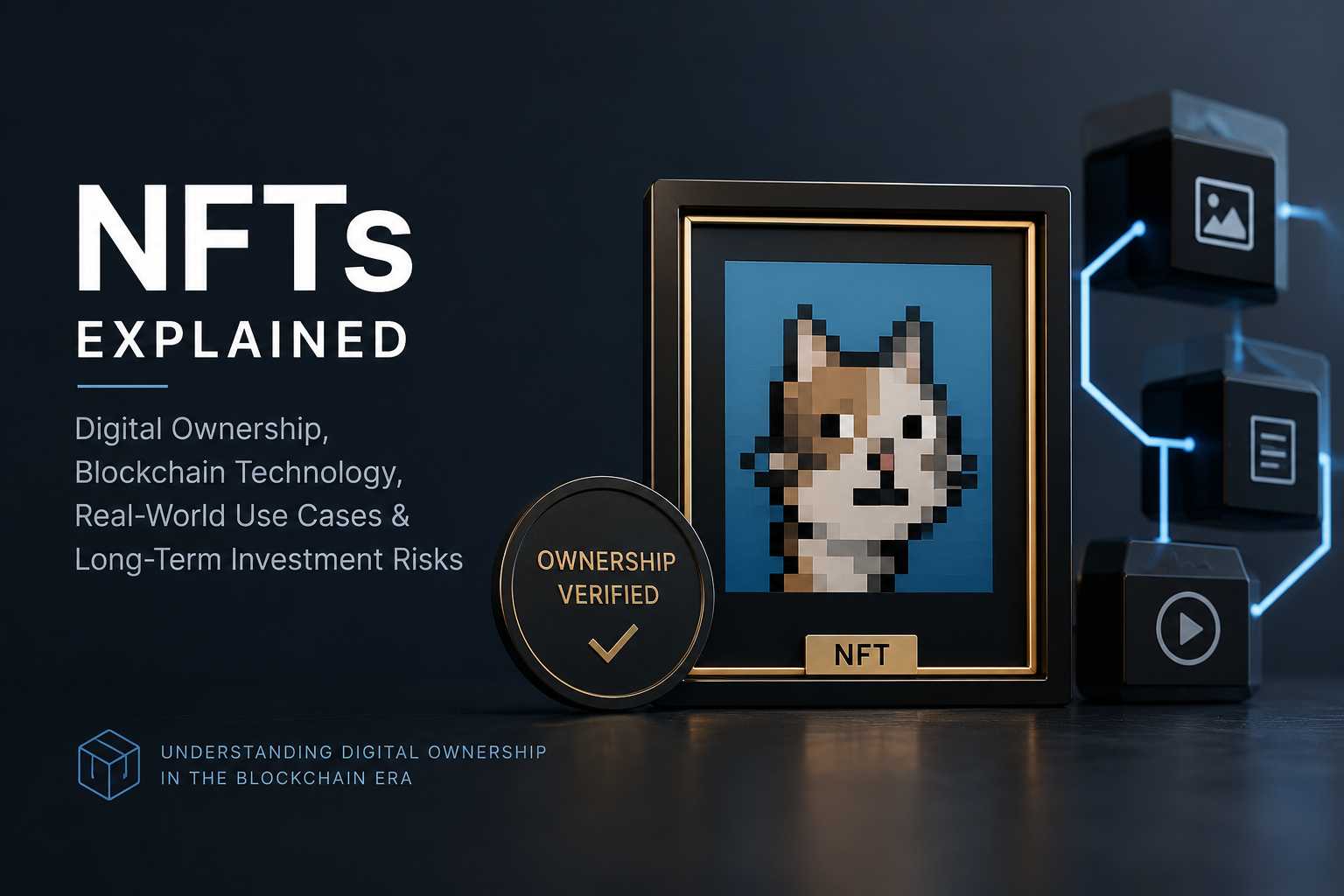
NFTs, or Non-Fungible Tokens, became one of the most discussed innovations in the cryptocurrency industry during the early 2020s.
Headlines about digital artwork selling for millions of dollars, celebrity collections and rapidly rising NFT prices introduced millions of people to the concept. At the same time, many critics dismissed NFTs as speculative bubbles with little practical value.
As a result, NFTs quickly became one of the most misunderstood technologies in the blockchain ecosystem.
In reality, NFTs represent far more than digital collectibles.
They introduce a new method of proving ownership, authenticity and uniqueness using blockchain technology.
While digital art remains one of the best-known applications, NFTs are increasingly being explored for gaming, ticketing, intellectual property, digital identity, supply chain verification and many other real-world use cases.
Like many blockchain innovations, the early hype surrounding NFTs often overshadowed the technology itself.
Understanding how NFTs actually work requires separating short-term speculation from their long-term potential as a digital ownership solution.
Rather than focusing solely on expensive JPEG images or volatile market prices, investors should understand the underlying technology, its strengths, its limitations and the industries that may benefit from NFT adoption in the years ahead.
In This Analysis, We’ll Explore:
- What NFTs are and why they were created
- What “non-fungible” actually means
- How NFTs work on blockchain networks
- Why NFTs differ from cryptocurrencies like Bitcoin and Ethereum
- The role of smart contracts in NFT ownership
- Why NFTs became so popular
- Real-world use cases beyond digital art
- NFT marketplaces and how they operate
- The opportunities and risks of NFT investing
- Common misconceptions about NFTs
- The future of NFTs and digital ownership
What Is an NFT?
An NFT, or Non-Fungible Token, is a unique digital asset recorded on a blockchain that represents ownership of a specific item, piece of content or digital certificate.
Unlike cryptocurrencies such as Bitcoin or Ethereum, every NFT is unique.
Each token contains its own identifying information that distinguishes it from every other NFT on the blockchain.
This uniqueness allows NFTs to represent ownership of assets that cannot simply be exchanged on a one-to-one basis.
An NFT may represent:
- Digital artwork
- Music
- Videos
- Collectibles
- Virtual land
- Gaming items
- Membership passes
- Event tickets
- Intellectual property
- Digital certificates
The blockchain records ownership, transfer history and authenticity without relying on a centralized authority.
Instead of trusting a company to verify ownership, users can independently verify NFT ownership through the blockchain itself.
This creates a transparent and tamper-resistant ownership record that can be viewed publicly.
What Does “Non-Fungible” Actually Mean?
To understand NFTs, it is first necessary to understand the difference between fungible and non-fungible assets.
A fungible asset is interchangeable with another identical asset.
For example:
- One Bitcoin is equal to another Bitcoin.
- One US dollar has the same value as another US dollar.
- One ounce of pure gold is interchangeable with another ounce of equal purity.
These assets can be exchanged without changing their value.
Non-fungible assets are different.
Each asset possesses unique characteristics that distinguish it from every other asset.
Examples include:
- Original paintings
- Houses
- Concert tickets with assigned seats
- Rare collectibles
- Vintage sports cards
- Signed memorabilia
Even if two items appear similar, they are not identical.
NFTs bring this concept of uniqueness into the digital world.
Rather than allowing unlimited identical copies to function as ownership records, each NFT represents a specific digital asset with its own unique identity recorded on the blockchain.
How NFTs Work
NFTs are created through smart contracts on blockchain networks.
A smart contract defines the NFT’s characteristics, ownership rules and transfer conditions.
When an NFT is created—a process commonly called minting—its information is permanently recorded on the blockchain.
Depending on the blockchain, this information may include:
- A unique token ID
- The creator’s wallet address
- Ownership history
- Metadata
- Links to associated digital files
- Royalty rules for future sales
The digital file itself is often stored separately from the blockchain because images, videos and other media files are too large to store efficiently on-chain.
Instead, the blockchain stores a secure reference connecting the NFT to its associated content.
Ownership changes occur whenever the NFT is transferred between blockchain wallets.
Every transfer becomes part of the blockchain’s permanent transaction history, creating a transparent record that anyone can verify.
Because blockchain records are extremely difficult to alter, NFTs provide a reliable method of demonstrating ownership and authenticity without requiring centralized databases.
This combination of transparency, security and decentralization is one of the main reasons NFTs have attracted attention across multiple industries.
NFTs vs Cryptocurrencies
Although NFTs and cryptocurrencies both exist on blockchain networks, they serve very different purposes.
Traditional cryptocurrencies such as Bitcoin, Ethereum and many other digital coins are fungible.
This means each unit is interchangeable with another identical unit.
If you send someone one Bitcoin, it makes no difference which specific Bitcoin is transferred.
Every Bitcoin has the same value and function within the network.
NFTs operate differently.
Each NFT has its own identity, making every token unique.
Even if two NFTs belong to the same collection, they still possess different token IDs and ownership histories.
This uniqueness allows NFTs to represent assets that cannot simply be exchanged one-for-one.
Some of the key differences include:
Cryptocurrencies
- Designed primarily as digital money or utility tokens.
- Each unit is interchangeable.
- Used for payments, trading and decentralized applications.
- Value is generally determined by market supply and demand.
NFTs
- Represent ownership of unique digital or physical assets.
- Every token is distinct.
- Often linked to artwork, collectibles, gaming assets or digital certificates.
- Value depends on rarity, demand, utility and authenticity.
Although NFTs and cryptocurrencies perform different functions, they often work together.
For example, most NFT purchases are completed using cryptocurrencies such as Ethereum or Solana, depending on the blockchain where the NFT was created.
The Role of Smart Contracts
Smart contracts are one of the most important technologies behind NFTs.
A smart contract is a self-executing program stored on a blockchain.
Instead of relying on lawyers, brokers or centralized companies to enforce ownership rules, smart contracts automatically execute predefined instructions whenever certain conditions are met.
For NFTs, smart contracts manage many important functions.
These include:
- Creating new NFTs through minting.
- Recording ownership.
- Verifying transfers.
- Enforcing royalty payments.
- Managing collection rules.
- Controlling supply limits.
One of the most innovative features introduced by NFT smart contracts is programmable royalties.
An artist may specify that every future resale automatically sends a percentage of the sale price back to the original creator.
Traditionally, artists rarely benefit when collectors resell their work.
With NFTs, royalty payments can be automated directly through blockchain technology, depending on the marketplace and blockchain standards being used.
Smart contracts also improve transparency.
Because the contract code is recorded on the blockchain, users can often inspect how an NFT collection operates before purchasing.
Smart Contracts Explained: How Blockchain Automation Works & Why It Matters for Investors
Why NFTs Became So Popular
NFTs experienced explosive growth during 2021 and 2022.
Several factors contributed to this rapid expansion.
First, digital art attracted enormous public attention.
Artists suddenly gained the ability to sell verified digital originals directly to collectors without relying entirely on traditional galleries or auction houses.
Second, celebrity involvement generated mainstream awareness.
Musicians, athletes, actors and major brands launched NFT collections, introducing millions of new users to the technology.
Third, cryptocurrency markets were experiencing a strong bull cycle.
Higher cryptocurrency prices increased investor confidence and encouraged speculation across many blockchain sectors, including NFTs.
Communities also played an important role.
Many NFT collections offered exclusive membership benefits, online communities, early product access or participation in future ecosystem developments.
For some buyers, owning an NFT became more than purchasing digital artwork.
It represented membership in a particular community or project.
However, rapid growth also attracted excessive speculation.
Many buyers entered the market hoping for quick profits rather than understanding the underlying technology.
As market conditions changed, numerous NFT collections lost significant value.
This demonstrated an important lesson.
The speculative excitement surrounding NFTs should not be confused with the long-term potential of the technology itself.
Like many innovations within the blockchain industry, periods of excessive hype are often followed by more realistic adoption focused on practical use cases rather than speculation alone.
Real-World Use Cases for NFTs
Although digital art introduced NFTs to a global audience, it represents only one application of the technology.
Many developers, businesses and institutions are exploring NFTs as a way to prove ownership, authenticity and access in both digital and physical environments.
As blockchain technology continues evolving, NFTs may become part of many everyday services without users even realizing they are interacting with blockchain.
Some of the most promising use cases include:
Gaming
Gaming is widely considered one of the strongest long-term applications for NFTs.
Players spend billions of dollars each year on virtual items such as character skins, weapons and collectibles.
Traditionally, these items remain locked inside a single game and ultimately belong to the game developer.
NFTs introduce the possibility of true digital ownership.
Instead of simply licensing an in-game item, players may own it directly through their blockchain wallet.
Depending on how games are designed, NFT assets could potentially be traded, sold or even used across multiple compatible gaming ecosystems.
Although this vision is still developing, blockchain gaming continues attracting significant investment.
Digital Art
Digital art remains the most recognizable NFT application.
Artists can tokenize original works, allowing collectors to purchase verified digital originals rather than simply downloading identical image files.
While anyone may still view or copy the artwork itself, blockchain ownership identifies who owns the authentic NFT associated with that artwork.
For creators, NFTs may provide additional opportunities through automated royalties and direct relationships with collectors.
Event Tickets
Counterfeit tickets remain a major challenge for concerts, sporting events and festivals.
NFTs could reduce ticket fraud by providing transparent ownership records that are difficult to duplicate or manipulate.
Event organizers may also use NFT tickets to provide additional benefits such as:
- VIP access
- Exclusive merchandise
- Future event discounts
- Community memberships
- Digital collectibles
After an event, the NFT may also remain as a permanent digital souvenir.
Memberships and Digital Communities
Many blockchain projects use NFTs as digital membership cards.
Rather than simply purchasing access through a subscription, users may own an NFT that grants entry to exclusive communities, educational content, conferences or online services.
Because ownership can be verified instantly through blockchain wallets, access management becomes more transparent and secure.
Identity Verification
Digital identity is another area where NFTs may play an important role.
Instead of repeatedly submitting documents to multiple organizations, individuals could potentially use blockchain-based credentials that verify specific information without revealing unnecessary personal data.
Examples include:
- Educational certificates
- Professional licenses
- Employment credentials
- Medical certifications
- Membership verification
Although privacy and regulatory challenges remain, decentralized identity solutions continue receiving increasing attention.
Intellectual Property and Licensing
NFTs may also simplify how intellectual property rights are managed.
Musicians, photographers, writers and software developers could use NFTs to represent ownership licenses or distribution rights.
Smart contracts may automate royalty payments whenever licensed content is sold or transferred, reducing administrative complexity while improving transparency.
NFT Marketplaces
NFTs are typically bought and sold through specialized online marketplaces.
These platforms allow users to mint, list, purchase and transfer NFTs using supported blockchain networks.
Some marketplaces focus on digital art.
Others specialize in gaming assets, collectibles or broader blockchain ecosystems.
Some of the best-known NFT marketplaces include:
- OpenSea
- Magic Eden
- Blur
- Foundation
- Rarible
Each marketplace supports different blockchain networks, fee structures and collection standards.
Before purchasing an NFT, users should verify:
- Which blockchain the NFT uses.
- Marketplace transaction fees.
- Creator authenticity.
- Collection reputation.
- Trading volume and liquidity.
- Smart contract verification.
As the NFT ecosystem continues maturing, marketplaces are increasingly emphasizing creator verification, security and fraud prevention to improve user confidence.
Opportunities and Risks of NFT Investing
Like many emerging technologies, NFTs present both opportunities and significant risks.
Some NFT collections have generated substantial returns for early buyers, while countless others have lost much of their value over time.
For this reason, understanding what drives an NFT’s value is far more important than simply following market trends.
Unlike cryptocurrencies, NFTs are not valued solely by supply and demand.
Several additional factors influence their long-term potential.
These include:
- Utility
- Scarcity
- Community strength
- Creator reputation
- Brand recognition
- Liquidity
- Long-term development
- Real-world applications
For example, an NFT that grants access to exclusive events or services may retain value differently than a purely collectible digital image.
Similarly, projects supported by active development teams and sustainable ecosystems often demonstrate greater resilience than collections created purely for speculation.
However, NFT investing also carries considerable risks.
Liquidity can become a major challenge.
Unlike Bitcoin, which can usually be bought or sold almost instantly, NFTs often require finding a specific buyer willing to pay the asking price.
This means an NFT may remain unsold for long periods, particularly during weaker market conditions.
Investors should also understand that rarity alone does not guarantee value.
An NFT may be unique, but if there is little demand, its market value may remain very limited.
Successful NFT investing therefore requires careful research rather than speculation.
Common Misconceptions About NFTs
The rapid rise of NFTs created numerous misconceptions that continue to influence public perception today.
Understanding these misunderstandings helps investors evaluate the technology more objectively.
“NFTs Are Just Expensive JPEGs”
This is perhaps the most common misconception.
While many early NFT collections consisted of digital artwork, an NFT is not the image itself.
The NFT is the blockchain record that verifies ownership of a specific digital asset.
The underlying technology can be applied to many different forms of digital ownership far beyond artwork.
“Anyone Can Screenshot an NFT”
It is true that anyone can copy or save an image associated with an NFT.
However, copying a file is not the same as owning the authenticated blockchain record.
This is similar to photographing a famous painting.
The photograph may look identical, but it does not grant ownership of the original artwork.
NFT ownership is verified through blockchain records rather than possession of the image file itself.
“NFTs Have No Real Utility”
Although some NFT projects were purely speculative, many others provide practical benefits.
Examples include:
- Digital memberships
- Event access
- Gaming assets
- Loyalty programs
- Identity verification
- Intellectual property management
As blockchain adoption expands, utility-driven NFTs may become increasingly common.
“All NFTs Are Good Investments”
Like cryptocurrencies, NFTs vary enormously in quality.
Thousands of NFT collections have little long-term value.
Many projects disappear shortly after launch.
Others never build active communities or useful applications.
Investors should evaluate each project individually rather than assuming every NFT represents a worthwhile investment.
Understanding the underlying technology, development team and intended use case is often more important than following short-term market excitement.
The Future of NFTs
Although NFT activity has declined significantly since the peak of the 2021 bull market, many experts believe the technology itself is still in its early stages.
This pattern is not unusual.
Many emerging technologies experience an initial wave of excitement followed by a period of slower, more practical development.
Today, much of the focus has shifted away from speculation and toward real-world utility.
Rather than asking whether NFTs will return to previous price levels, developers are increasingly asking how blockchain-based ownership can solve real problems.
Several trends may shape the future of NFTs.
Tokenized Real-World Assets
One of the fastest-growing areas is the tokenization of physical assets.
Future NFTs could represent ownership of:
- Real estate
- Luxury goods
- Fine art
- Vehicles
- Business assets
- Collectibles
Blockchain records may improve transparency, simplify ownership transfers and reduce administrative costs.
Digital Identity
Digital identity continues to attract growing attention from both governments and private organizations.
Instead of maintaining multiple usernames, passwords and identity documents, individuals may eventually use blockchain-based credentials to verify their identity while retaining greater control over personal information.
NFT technology could play an important role in this evolution.
Gaming and the Metaverse
Blockchain gaming remains one of the largest areas of NFT development.
Rather than treating in-game purchases as temporary licenses controlled entirely by developers, NFT technology may allow players to own digital assets directly.
Whether or not the broader concept of the metaverse develops as originally envisioned, digital ownership within online environments is likely to remain an important area of innovation.
Brand Loyalty and Membership Programs
Major companies are increasingly exploring blockchain technology for customer engagement.
NFTs may eventually replace traditional loyalty cards by providing customers with transferable digital memberships, rewards and exclusive experiences.
Instead of simply collecting reward points, users could own digital assets that evolve over time or unlock additional benefits.
Enterprise Adoption
Businesses may also use NFTs behind the scenes for purposes that consumers never directly notice.
Potential applications include:
- Supply chain verification
- Product authentication
- Digital documentation
- Intellectual property management
- Certification systems
In many cases, users may interact with NFT-based systems without even realizing blockchain technology is involved.
As with the internet itself, widespread adoption may eventually make the underlying technology largely invisible.
Strengths of NFTs
NFTs offer several advantages that extend beyond digital collectibles.
Some of the technology’s greatest strengths include:
- Verifiable digital ownership.
- Transparent transaction history.
- Global accessibility.
- Programmable smart contracts.
- Automated royalty payments for creators.
- Reduced dependence on centralized intermediaries.
- New business models for artists, developers and content creators.
- Expanding applications across multiple industries.
These characteristics make NFTs one of the more versatile innovations within the broader blockchain ecosystem.
Limitations and Risks of NFTs
Despite their potential, NFTs also face important limitations.
Some challenges are technological, while others relate to adoption, regulation and market behavior.
Key risks include:
- Highly speculative market prices.
- Low liquidity compared with major cryptocurrencies.
- Copyright and intellectual property disputes.
- Marketplace security risks.
- Scam projects and counterfeit collections.
- Regulatory uncertainty.
- Long-term adoption remains uncertain.
- Many NFT projects may ultimately fail.
Investors should also recognize that owning an NFT does not automatically grant copyright or commercial rights to the associated content.
The specific rights attached to an NFT depend on the project’s terms and licensing agreement.
As with any emerging technology, careful research remains essential before making investment decisions.
Conclusion
NFTs are often associated with digital artwork and speculative market bubbles, but the technology represents something much broader.
At their core, NFTs provide a blockchain-based method of proving ownership, authenticity and uniqueness in the digital world.
While the early NFT market was driven largely by speculation, ongoing development increasingly focuses on practical applications such as gaming, digital identity, ticketing, intellectual property and tokenized real-world assets.
Whether NFTs ultimately become a mainstream technology will depend on their ability to solve real problems rather than generate short-term excitement.
For investors, understanding this distinction is essential.
Instead of evaluating NFTs solely through the lens of market prices, it is often more valuable to consider how digital ownership may evolve as blockchain adoption continues expanding.
Like many innovations within the cryptocurrency ecosystem, NFTs remain a developing technology with both significant opportunities and meaningful risks.
A balanced understanding of both is likely to prove far more valuable than following market hype alone.
Crypto Security Explained: Wallets, Private Keys, Scams & How Investors Protect Digital Assets
Layer 1 vs Layer 2 vs Layer 3 Explained: Scalability, Blockchain Infrastructure & Why It Matters
Disclaimer: This article is for educational and informational purposes only and does not constitute financial or investment advice. NFTs and cryptocurrencies are highly volatile and involve significant risk. Always conduct your own research before buying, selling or investing in any digital asset.