
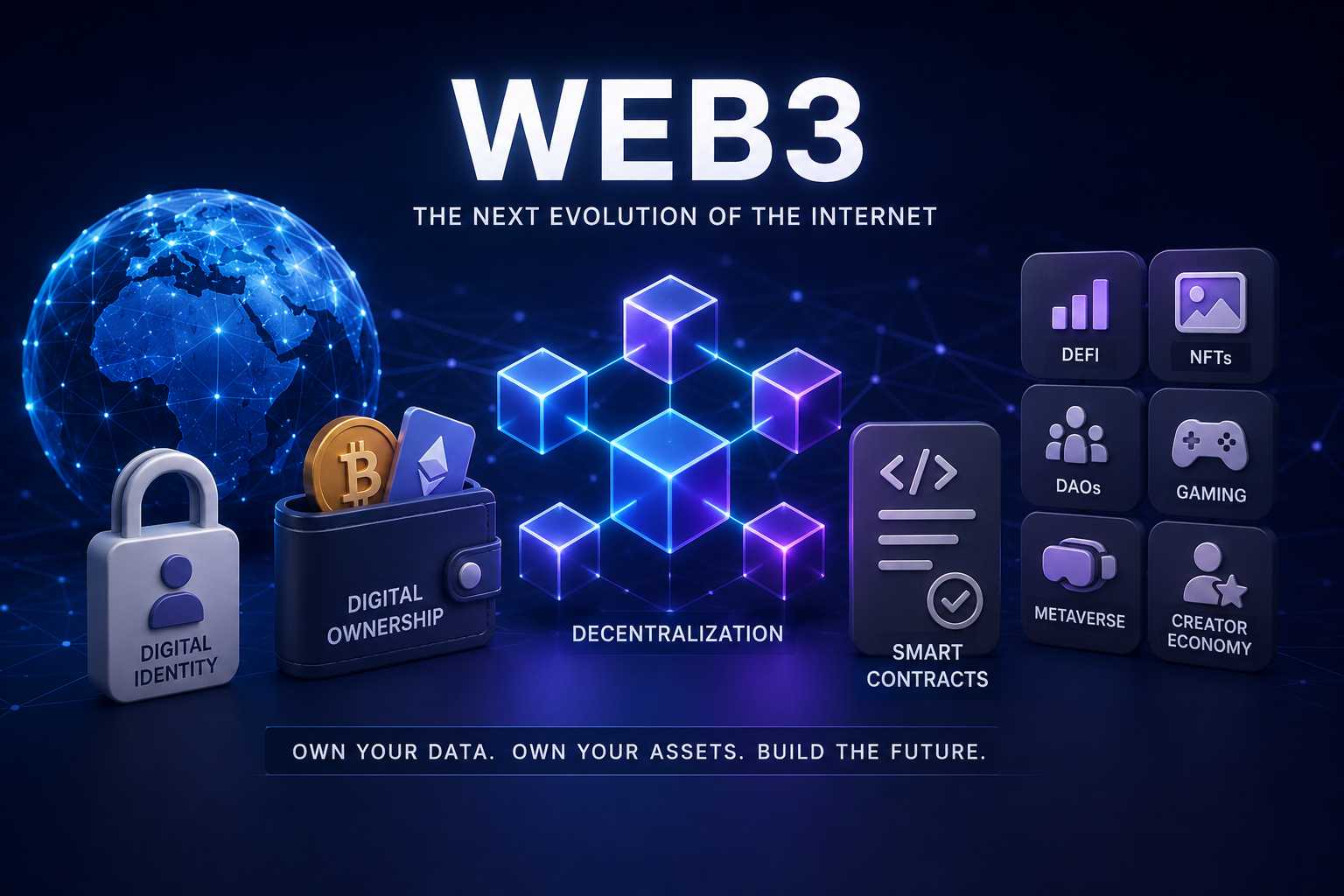
The internet has transformed nearly every aspect of modern life.
People communicate instantly across continents.
Businesses operate entirely online.
Financial transactions occur within seconds.
Entertainment is streamed globally.
Social media connects billions of users every day.
Yet despite its enormous success, today’s internet also faces growing criticism.
A small number of technology companies control much of the world’s digital infrastructure.
Users often surrender ownership of their personal data.
Creators depend on centralized platforms.
Digital identities remain fragmented across countless services.
These challenges have led developers to propose a new vision for the internet:
Web3.
Rather than relying primarily on centralized platforms, Web3 seeks to create an internet where users own their digital assets, control their identities, and interact through decentralized blockchain networks.
Supporters believe Web3 represents the next major evolution of the internet, enabling greater transparency, digital ownership and financial inclusion.
Critics argue that Web3 remains technically complex, fragmented and still far from mainstream adoption.
Regardless of perspective, Web3 has become one of the most influential concepts shaping the future of blockchain technology.
Understanding Web3 can help investors better evaluate cryptocurrencies, blockchain infrastructure and the long-term evolution of the digital economy.
In This Analysis, We’ll Explore:
- what Web3 is
- Web1 vs Web2 vs Web3
- why Web3 was created
- decentralization explained
- digital ownership
- blockchain technology
- smart contracts
- decentralized applications (dApps)
- wallets and digital identity
- DeFi
- NFTs
- DAOs
- tokenization
- the creator economy
- gaming and the metaverse
- AI and Web3
- institutional adoption
- common misconceptions
- strengths and limitations
- long-term investment outlook
- why investors should care
What Is Web3?
Web3 refers to a new generation of internet applications built on blockchain technology.
Instead of relying on centralized servers owned by large technology companies, Web3 applications operate through decentralized networks.
Users maintain greater control over:
- digital assets
- online identities
- financial transactions
- personal data
- digital ownership
Rather than asking permission from a central platform, users interact directly with blockchain-based applications.
This creates a more open and programmable internet where ownership can be verified without relying on intermediaries.
Although Web3 is still evolving, its core objective remains simple:
To give users greater control over their digital lives.
Why Was Web3 Created?
The modern internet offers incredible convenience.
However, it also concentrates significant power within a relatively small number of companies.
Many online services rely on centralized platforms that control:
- user accounts
- personal data
- payment systems
- content distribution
- advertising revenue
- platform rules
As these platforms expanded, concerns grew regarding:
- privacy
- censorship
- platform dependence
- data ownership
- creator compensation
Web3 emerged as an attempt to address these challenges.
Instead of trusting centralized companies, users interact with decentralized blockchain networks governed by transparent protocols.
Understanding Web1, Web2 and Web3
To understand Web3, it helps to understand how the internet has evolved.
Web1
Often called the Read-Only Internet, Web1 dominated the early years of the internet.
Most websites provided static information.
Users primarily consumed content rather than creating it.
Examples included:
- news websites
- company websites
- online directories
- personal webpages
Interaction remained limited.
Web2
Web2 introduced user-generated content.
Instead of simply reading information, users began creating it.
Platforms including:
- social media
- video streaming
- blogs
- online marketplaces
- cloud services
transformed the internet into an interactive environment.
While Web2 dramatically improved usability, it also concentrated enormous amounts of user data within centralized companies.
Web3
Web3 builds upon previous generations while introducing blockchain technology.
Rather than platforms owning digital assets, users may own them directly.
Rather than centralized databases, blockchain networks verify transactions.
Rather than isolated applications, programmable blockchain infrastructure enables entirely new forms of digital interaction.
Web3 does not replace the internet.
It expands how ownership and value function within it.
Decentralization Explained
Decentralization is one of Web3’s defining principles.
Traditional internet services typically rely on centralized servers.
A single company controls:
- infrastructure
- databases
- user accounts
- policies
- updates
Web3 distributes these responsibilities across decentralized blockchain networks.
Instead of one organization maintaining control, thousands of independent participants validate transactions according to shared rules.
This reduces reliance on individual companies while increasing transparency.
Although decentralization introduces technical complexity, many supporters believe it creates more resilient digital infrastructure.
Digital Ownership
One of Web3’s biggest innovations is digital ownership.
In today’s internet, users often purchase digital content without truly owning it.
Examples include:
- in-game items
- digital music
- online subscriptions
- platform accounts
Access usually depends on centralized providers.
If a platform changes its policies, users may lose access.
Web3 introduces blockchain-based ownership.
Digital assets become cryptographically verifiable.
Examples include:
- cryptocurrencies
- NFTs
- tokenized assets
- blockchain identities
Ownership exists independently of any single company.
This represents one of Web3’s most significant conceptual shifts.
Blockchain Technology
Blockchain technology provides the foundation for Web3.
Rather than storing information within centralized databases, blockchain networks maintain distributed ledgers verified by thousands of independent computers.
These ledgers record:
- transactions
- ownership
- smart contract activity
- digital identities
- token transfers
Because blockchain data is transparent and difficult to alter, users can verify information independently.
This trustless verification model enables many Web3 applications.
Smart Contracts
Web3 applications rely heavily on smart contracts.
Smart contracts automatically execute predefined rules without requiring centralized intermediaries.
They power:
- decentralized finance
- NFT marketplaces
- gaming
- digital identity
- tokenization
- governance systems
Rather than relying on manual approval, blockchain code performs transactions automatically.
This automation enables entirely new forms of internet applications.
Smart Contracts Explained: How Blockchain Automation Works & Why It Matters for Investors
Decentralized Applications (dApps)
Many Web3 services operate through decentralized applications, commonly known as dApps.
Unlike traditional applications, dApps rely on blockchain infrastructure rather than centralized servers.
Examples include:
- decentralized exchanges
- lending platforms
- NFT marketplaces
- blockchain games
- prediction markets
- decentralized social media
Although users interact with familiar interfaces, the underlying transactions occur directly on blockchain networks.
This reduces reliance on centralized operators.
Wallets and Digital Identity
Instead of logging into websites using usernames and passwords, Web3 often uses cryptocurrency wallets.
Wallets function as digital identities.
They allow users to:
- access decentralized applications
- store cryptocurrencies
- manage NFTs
- sign blockchain transactions
- verify ownership
Rather than creating separate accounts for every platform, users increasingly interact with Web3 services through a single blockchain wallet.
This creates greater portability across applications.
Crypto Security Explained: Wallets, Private Keys, Scams & How Investors Protect Digital Assets
Why Ethereum Became the Foundation of Web3
Although many blockchain networks now support Web3 applications, Ethereum played the largest role in popularizing the concept.
Ethereum introduced programmable smart contracts capable of supporting decentralized applications.
This allowed developers to build:
- decentralized finance protocols
- NFT marketplaces
- DAOs
- blockchain games
- tokenized assets
As developer activity accelerated, Ethereum became the largest Web3 ecosystem.
Although competitors have since emerged, Ethereum continues serving as one of the industry’s most important development platforms.
Ethereum (ETH) Analysis: Smart Contract Infrastructure, Layer-2 Scaling & Long-Term Positioning
Major Web3 Ecosystems
Today, Web3 extends far beyond Ethereum.
Leading ecosystems include:
Each ecosystem offers different advantages regarding:
- scalability
- transaction costs
- developer activity
- security
- user experience
Competition between these ecosystems continues driving innovation across the Web3 industry.
Why Investors Should Care
Many investors focus primarily on cryptocurrency prices.
Professional investors often examine the infrastructure supporting long-term adoption.
Web3 represents far more than another technological trend.
It combines blockchain, smart contracts, digital ownership and decentralized applications into a new framework for internet services.
Understanding Web3 helps investors better evaluate:
- blockchain adoption
- smart contract ecosystems
- digital ownership
- decentralized infrastructure
- network utility
- long-term technology trends
Rather than viewing Web3 as a marketing buzzword, many analysts consider it one of the most important long-term developments in blockchain technology.
DeFi: Financial Services Without Banks
One of the most successful applications of Web3 is Decentralized Finance (DeFi).
Instead of relying on banks or financial institutions, DeFi allows users to access financial services directly through blockchain-based smart contracts.
Common DeFi services include:
- lending
- borrowing
- decentralized exchanges (DEXs)
- staking
- yield farming
- stablecoins
- derivatives
- liquidity pools
Users retain custody of their assets while interacting directly with blockchain protocols.
Billions of dollars already flow through DeFi applications every day.
For many supporters, DeFi demonstrates that blockchain technology can support financial systems operating continuously without centralized intermediaries.
NFTs and Digital Ownership
Web3 also introduced a new concept:
Digital ownership.
Non-Fungible Tokens (NFTs) allow ownership of unique digital assets to be recorded permanently on a blockchain.
Although NFTs first became popular through digital art, their potential extends much further.
Possible applications include:
- gaming assets
- event tickets
- music rights
- intellectual property
- digital identity
- memberships
- real estate documentation
- collectibles
Unlike traditional digital files that can be copied indefinitely, NFTs establish verifiable ownership.
This innovation allows creators to monetize digital content in entirely new ways.
DAOs and Decentralized Governance
Another important Web3 innovation is the Decentralized Autonomous Organization (DAO).
Instead of relying on executives or centralized management, DAOs allow communities to govern projects collectively.
Token holders may vote on issues such as:
- protocol upgrades
- treasury spending
- ecosystem grants
- governance rules
- development priorities
Smart contracts automatically execute approved proposals.
This creates transparent governance where every decision remains permanently visible on the blockchain.
Although DAOs continue evolving, they represent one of Web3’s most innovative organizational models.
Tokenization
Many analysts believe tokenization could become one of Web3’s largest long-term opportunities.
Tokenization converts ownership rights into blockchain-based digital tokens.
Assets that may be tokenized include:
- stocks
- bonds
- real estate
- commodities
- artwork
- private equity
- carbon credits
- intellectual property
Instead of transferring paper certificates through multiple intermediaries, ownership transfers through blockchain transactions.
Potential advantages include:
- faster settlement
- improved transparency
- lower costs
- increased accessibility
- fractional ownership
- improved liquidity
Many global financial institutions are actively exploring tokenization as blockchain infrastructure continues to mature.
The Creator Economy
Web3 may fundamentally change how creators earn income online.
Today’s internet often relies on centralized platforms that control:
- advertising revenue
- content distribution
- platform rules
- creator monetization
Web3 introduces alternative models.
Creators may receive payments directly through blockchain networks while maintaining greater ownership over their content.
Examples include:
- NFTs
- token-gated communities
- decentralized social media
- creator tokens
- blockchain subscriptions
Supporters believe this model may reduce dependence on centralized technology companies.
Gaming and the Metaverse
Gaming represents another rapidly growing Web3 sector.
Traditional games generally keep all virtual assets under centralized control.
Players rarely own the items they purchase.
Web3 gaming changes this model.
Players may own blockchain-based:
- characters
- skins
- weapons
- land
- collectibles
- currencies
These assets can potentially move between marketplaces or ecosystems.
Although large-scale adoption remains in its early stages, many developers continue investing heavily in blockchain gaming infrastructure.
Crypto Gaming Explained: Blockchain Gaming, Digital Ownership & Why Investors Still Watch the Sector
AI and Web3
Artificial Intelligence and Web3 are increasingly becoming interconnected.
AI can automate decision-making.
Web3 can verify ownership and transactions.
Together they may support applications involving:
- decentralized AI marketplaces
- AI-generated digital ownership
- autonomous financial systems
- decentralized computing
- machine-to-machine payments
- blockchain identity verification
Although this field remains relatively new, many analysts expect AI and Web3 to become increasingly interconnected during the coming decade.
How to Use AI in Crypto Investing — Opportunities, Risks, and the Reality Behind AI-Driven Decisions
Institutional Adoption
Institutional interest in Web3 has expanded significantly.
Major financial institutions continue researching blockchain infrastructure involving:
- tokenization
- stablecoins
- digital identity
- cross-border payments
- settlement systems
- asset management
Technology companies are also exploring decentralized infrastructure for cloud computing, payments and digital ownership.
Although widespread adoption remains gradual, institutional participation continues increasing.
Common Misconceptions
Web3 is often misunderstood.
Common misconceptions include:
- Web3 only means cryptocurrency.
- Every blockchain project is Web3.
- Web3 replaces the entire internet.
- Decentralization eliminates every risk.
- NFTs only represent digital pictures.
- Web3 has already reached mainstream adoption.
- Blockchain automatically improves every application.
Reality is far more nuanced.
Web3 represents an evolving technological framework rather than a single product or blockchain.
Strengths of Web3
Web3 offers several potential advantages.
These include:
- greater digital ownership
- decentralized infrastructure
- programmable smart contracts
- transparent transactions
- reduced reliance on intermediaries
- global accessibility
- financial inclusion
- creator monetization
- interoperability
- programmable digital assets
These strengths explain why many developers view Web3 as the next evolution of the internet.
Limitations of Web3
Despite its potential, Web3 also faces important challenges.
These include:
- technical complexity
- scalability limitations
- regulatory uncertainty
- fragmented user experience
- security risks
- wallet management challenges
- slower mainstream adoption
- evolving infrastructure
- interoperability issues
Many of these limitations are gradually improving as blockchain technology matures.
Long-Term Outlook
Predicting the future of Web3 remains impossible.
However, several long-term trends continue emerging.
These include:
- expanding blockchain adoption
- improving Layer-2 scalability
- institutional participation
- tokenization of real-world assets
- growing developer ecosystems
- decentralized identity solutions
- AI integration
- broader Web3 infrastructure
Whether Web3 ultimately transforms the internet as dramatically as its supporters expect remains uncertain.
What appears increasingly likely is that blockchain-based applications will continue becoming a larger part of the global digital economy.
Conclusion
Web3 represents one of the most ambitious technological developments since the creation of the modern internet.
By combining blockchain technology, smart contracts, decentralized applications and digital ownership, Web3 introduces new ways for people to interact online without relying exclusively on centralized platforms.
Understanding:
- Web3
- decentralization
- blockchain technology
- smart contracts
- decentralized applications
- DeFi
- NFTs
- DAOs
- tokenization
- creator economy
- gaming
- AI integration
- institutional adoption
helps investors better understand where blockchain technology may be heading over the coming decades.
Successful investing involves more than following token prices.
It requires understanding the infrastructure supporting future adoption.
For long-term investors, Web3 represents not merely another cryptocurrency narrative, but a broader transformation in how ownership, finance and digital interaction may evolve as blockchain technology continues maturing.
Layer 1 vs Layer 2 vs Layer 3 Explained: Scalability, Blockchain Infrastructure & Why It Matters
Bitcoin (BTC) Analysis: Liquidity, Market Dominance, Institutional Adoption & Long-Term Positioning
On-Chain Analysis in Crypto: How to Read Blockchain Data
Disclaimer: This article is for educational and informational purposes only and does not constitute financial or investment advice. Cryptocurrency markets and Web3 technologies continue to evolve rapidly and involve significant risk. Always conduct your own research before making investment decisions.