
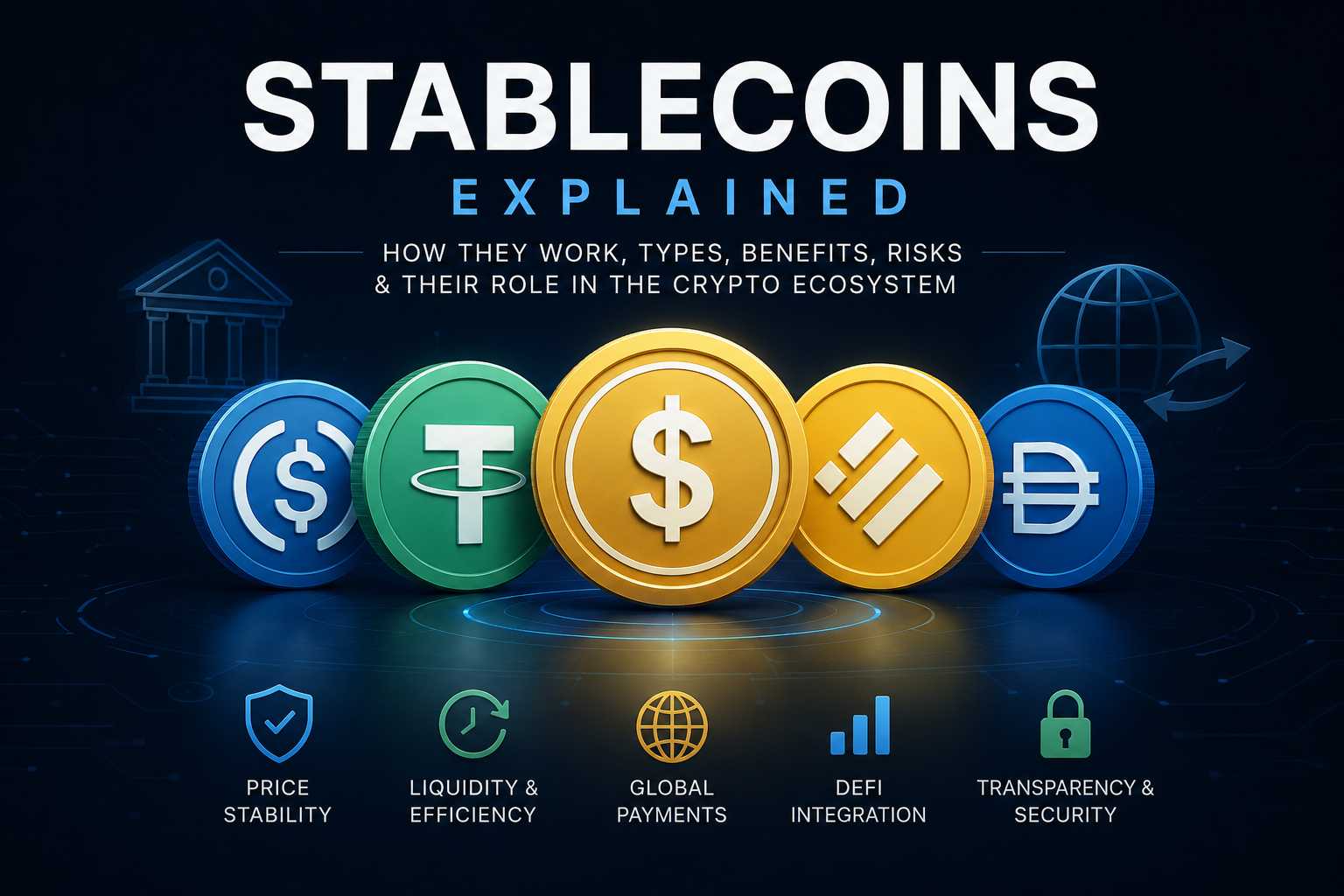
Cryptocurrency markets are known for their volatility.
Prices of assets such as Bitcoin, Ethereum and many altcoins can rise or fall significantly within a short period, creating both opportunities and risks for investors.
While this volatility is one of the defining characteristics of the crypto market, it also creates challenges for trading, payments and everyday financial transactions.
Stablecoins were developed to address this problem.
Unlike most cryptocurrencies, stablecoins are designed to maintain a relatively stable value by linking their price to another asset, most commonly the US dollar.
This combination of blockchain technology and price stability has made stablecoins one of the most important components of the modern cryptocurrency ecosystem.
Today, stablecoins play a central role in cryptocurrency trading, decentralized finance (DeFi), international payments and digital asset management.
They allow investors to move funds between exchanges without relying on traditional banking systems, provide liquidity for decentralized applications and offer a way to reduce exposure to market volatility without leaving the blockchain ecosystem.
However, not all stablecoins operate in the same way.
Some are backed by traditional financial reserves, while others rely on cryptocurrencies or algorithmic mechanisms to maintain their value.
Understanding these differences is essential for anyone investing in or using digital assets.
Rather than viewing stablecoins simply as “digital dollars,” investors should understand how they function, why they matter and the benefits and risks they introduce to the broader cryptocurrency market.
In This Analysis, We’ll Explore:
- What stablecoins are
- Why stablecoins were created
- How stablecoins maintain their value
- The different types of stablecoins
- Fiat-backed stablecoins
- Crypto-backed stablecoins
- Algorithmic stablecoins
- Stablecoins versus traditional currencies
- Real-world use cases
- Benefits and risks of stablecoins
- Regulation and the future of stablecoins
What Is a Stablecoin?
A stablecoin is a cryptocurrency designed to maintain a relatively stable value by being linked, or pegged, to another asset.
In most cases, that asset is a major fiat currency such as the US dollar.
For example, one US dollar-pegged stablecoin is intended to maintain a value of approximately $1.
Unlike Bitcoin or Ethereum, whose prices fluctuate according to market supply and demand, stablecoins aim to minimize price volatility.
This makes them more suitable for transactions, savings, trading and decentralized financial applications.
Stablecoins exist on blockchain networks just like other cryptocurrencies.
This means they can be transferred quickly across the world without relying on traditional banking infrastructure.
Depending on the blockchain, transactions may settle within seconds or minutes while remaining transparent and verifiable.
Some of the largest stablecoins in the cryptocurrency market include:
- Tether (USDT)
- USD Coin (USDC)
- Dai (DAI)
- First Digital USD (FDUSD)
Although these stablecoins all seek to maintain a stable value, they achieve this goal through different mechanisms.
Understanding these differences is one of the most important aspects of evaluating stablecoin risk.
Why Stablecoins Were Created
The original purpose of stablecoins was simple:
To combine the efficiency of blockchain technology with the price stability of traditional currencies.
As cryptocurrency adoption expanded, investors needed a digital asset that could move across blockchain networks without experiencing the extreme price swings associated with Bitcoin and many altcoins.
Stablecoins emerged as a practical solution.
Today, they serve several important functions.
Reducing Volatility
One of the biggest challenges in cryptocurrency investing is managing price fluctuations.
An investor who sells Bitcoin may not want to immediately convert funds back into a traditional bank account.
Instead, they can temporarily move into stablecoins while remaining within the crypto ecosystem.
This allows investors to reduce exposure to market volatility without leaving blockchain networks.
Supporting Cryptocurrency Trading
Stablecoins have become one of the primary trading pairs on cryptocurrency exchanges.
Instead of buying Bitcoin directly with traditional currencies, many traders first acquire stablecoins before exchanging them for other digital assets.
Because stablecoins maintain relatively stable values, they simplify trading and portfolio management.
Faster Global Payments
Traditional international bank transfers can be expensive and may require several business days to settle.
Stablecoins allow users to transfer value across borders much more quickly.
Depending on the blockchain network being used, transfers can often be completed within minutes while avoiding many of the delays associated with conventional payment systems.
Building Decentralized Finance
Stablecoins also became essential building blocks for decentralized finance (DeFi).
Many lending platforms, decentralized exchanges and liquidity protocols rely on stablecoins because they provide a predictable unit of value.
Without relatively stable digital assets, many decentralized financial applications would become significantly more difficult to operate.
As a result, stablecoins now represent one of the most important sources of liquidity throughout the broader cryptocurrency ecosystem.
How Stablecoins Maintain Their Value
Maintaining a stable price is one of the defining characteristics of every stablecoin.
However, keeping a cryptocurrency consistently close to one dollar is more complex than it may initially appear.
Different stablecoins use different methods to maintain their peg.
Some rely on traditional financial reserves.
Others use cryptocurrencies as collateral.
Some attempt to maintain stability through algorithmic mechanisms.
Regardless of the approach, the objective remains the same:
To keep the stablecoin’s market value as close as possible to its target price.
Several mechanisms help achieve this.
Asset Reserves
Many stablecoins maintain reserves consisting of cash, short-term government securities or other highly liquid assets.
These reserves are intended to support the stablecoin’s value by providing assets that can back the tokens in circulation.
The size, quality and transparency of these reserves are among the most important factors investors evaluate when assessing stablecoin reliability.
Minting and Redemption
Many fiat-backed stablecoins allow authorized institutions to create new tokens when additional reserves are deposited.
Likewise, tokens can often be redeemed for the underlying asset and removed from circulation.
This process helps balance supply and demand while supporting the stablecoin’s target price.
Market Arbitrage
Arbitrage also plays an important role in maintaining stability.
If a stablecoin trades slightly above its target price, traders may create additional tokens and sell them into the market.
If it trades below its intended value, traders may purchase discounted tokens and redeem them for the underlying assets where redemption mechanisms exist.
These market incentives help push prices back toward their intended peg.
Although no stablecoin can guarantee a perfectly stable price under all market conditions, these mechanisms are designed to minimize significant deviations and maintain confidence in the asset’s long-term stability.
Types of Stablecoins
Although all stablecoins aim to maintain a stable value, they do not all achieve this in the same way.
Understanding the different types of stablecoins helps investors better evaluate their strengths, limitations and potential risks.
The three primary categories are:
- Fiat-backed stablecoins
- Crypto-backed stablecoins
- Algorithmic stablecoins
Each approach attempts to solve the same problem—price stability—but uses a different mechanism.
Fiat-Backed Stablecoins
Fiat-backed stablecoins are the most widely used type of stablecoin.
They maintain their value by holding reserves of traditional financial assets, typically US dollars or highly liquid equivalents.
In theory, every stablecoin issued is supported by reserves of approximately equal value.
If one million stablecoins are circulating, the issuer should hold roughly one million dollars (or equivalent reserve assets) backing those tokens.
Some of the largest fiat-backed stablecoins include:
- Tether (USDT)
- USD Coin (USDC)
- First Digital USD (FDUSD)
These stablecoins have become essential components of cryptocurrency trading because they generally maintain relatively stable prices while remaining easy to transfer across blockchain networks.
Advantages
- High liquidity.
- Broad exchange support.
- Relatively stable value.
- Widely accepted across the crypto ecosystem.
- Fast global transfers.
Risks
Fiat-backed stablecoins also rely on trust.
Investors must have confidence that the issuing company actually holds sufficient reserves to support every token in circulation.
For this reason, transparency, independent audits and reserve reporting are important considerations when evaluating these stablecoins.
Crypto-Backed Stablecoins
Instead of relying on traditional financial assets, crypto-backed stablecoins use cryptocurrencies as collateral.
Because cryptocurrencies themselves are volatile, these stablecoins are typically overcollateralized.
This means the value of the collateral exceeds the value of the stablecoins issued.
For example, a user might deposit $150 worth of Ethereum to create $100 worth of stablecoins.
The additional collateral helps absorb normal market volatility.
One of the best-known examples is:
- Dai (DAI)
Unlike many fiat-backed stablecoins, DAI operates through decentralized smart contracts rather than a centralized company managing traditional reserves.
Advantages
- Greater decentralization.
- Transparent blockchain collateral.
- Reduced dependence on centralized financial institutions.
- Integration with decentralized finance (DeFi).
Risks
Because the collateral consists of volatile cryptocurrencies, significant market declines may trigger automatic liquidations designed to protect the system.
Although these mechanisms help maintain stability, they also introduce additional complexity compared with fiat-backed stablecoins.
Algorithmic Stablecoins
Algorithmic stablecoins attempt to maintain their value without relying entirely on traditional reserves or overcollateralized crypto assets.
Instead, they use software algorithms and economic incentives to balance supply and demand.
For example, if the stablecoin trades above its target price, additional tokens may be created to increase supply.
If the price falls below its target, the protocol may reduce supply or use other incentive mechanisms to restore the peg.
While this approach appears innovative in theory, it has also proven to be the riskiest.
TerraUSD (UST): An Important Lesson
Perhaps the most well-known example of an algorithmic stablecoin was TerraUSD (UST).
UST attempted to maintain its one-dollar peg through an algorithmic relationship with another cryptocurrency called LUNA.
For a period, the system appeared successful.
However, during severe market stress, confidence deteriorated rapidly.
As investors rushed to exit, the stabilization mechanism failed.
UST lost its dollar peg, triggering one of the largest collapses in cryptocurrency history.
The event highlighted an important lesson:
A stablecoin’s long-term success depends not only on its design but also on market confidence, liquidity and the system’s ability to withstand extreme conditions.
Since then, investors have become significantly more cautious when evaluating algorithmic stablecoins.
Stablecoins vs Traditional Money
Although stablecoins are often described as “digital dollars,” they are not the same as traditional fiat currencies held in a bank account.
Traditional money is issued and managed by central banks and governments.
Stablecoins, by contrast, exist on blockchain networks and are typically issued by private companies or decentralized protocols.
Some important differences include:
Traditional Money
- Issued by governments.
- Stored in banks.
- Payments may require financial intermediaries.
- International transfers can take several days.
Stablecoins
- Issued on blockchain networks.
- Stored in digital wallets.
- Can often be transferred globally within minutes.
- Frequently integrated into decentralized financial applications.
Although stablecoins offer greater flexibility within the cryptocurrency ecosystem, they generally do not replace traditional banking services.
Instead, they serve as a bridge between conventional finance and blockchain-based digital assets, allowing users to move value more efficiently across global cryptocurrency networks.
How Stablecoins Are Used
Stablecoins have become one of the most widely used assets within the cryptocurrency ecosystem.
Although they are often viewed simply as digital versions of traditional currencies, their applications extend far beyond basic payments.
Today, stablecoins support trading, decentralized finance, international transfers and many other blockchain-based services.
Cryptocurrency Trading
One of the primary uses of stablecoins is cryptocurrency trading.
Rather than converting profits into traditional bank accounts after selling Bitcoin or other digital assets, many investors temporarily move into stablecoins.
This allows them to:
- Reduce exposure to market volatility.
- Preserve purchasing power within the crypto ecosystem.
- Quickly re-enter the market when opportunities arise.
- Transfer funds between exchanges efficiently.
Because stablecoins maintain relatively stable values, they serve as convenient trading pairs for thousands of cryptocurrencies.
Decentralized Finance (DeFi)
Stablecoins are a cornerstone of decentralized finance.
Many DeFi platforms use stablecoins because predictable prices simplify lending, borrowing and other financial activities.
Common DeFi applications include:
- Lending digital assets.
- Borrowing against cryptocurrency collateral.
- Providing liquidity to decentralized exchanges.
- Earning yield through approved DeFi protocols.
- Automated market making (AMMs)
Without relatively stable digital assets, many decentralized financial services would be significantly more volatile and difficult to use.
Cross-Border Payments
International money transfers have traditionally been expensive and time-consuming.
Banks often rely on multiple intermediaries before funds reach their destination.
Stablecoins offer an alternative.
Because they operate on blockchain networks, users can transfer value globally without depending entirely on traditional banking infrastructure.
Potential advantages include:
- Faster settlement.
- Lower transaction costs.
- 24/7 availability.
- Global accessibility.
- Greater transparency.
Although regulations continue evolving, stablecoins are increasingly being explored for international business payments and remittances.
Preserving Value During Market Volatility
Many investors use stablecoins as temporary safe havens during periods of market uncertainty.
Rather than selling cryptocurrency and withdrawing funds to a traditional bank account, they may convert assets into stablecoins while remaining active within the blockchain ecosystem.
This flexibility allows investors to respond quickly if market conditions improve without waiting for traditional banking transfers.
Business Payments
An increasing number of businesses are experimenting with stablecoins for commercial transactions.
Because payments can often settle within minutes regardless of geographical location, stablecoins may reduce costs associated with international commerce.
Potential business applications include:
While adoption remains relatively early compared with traditional payment systems, stablecoins continue gaining attention from both fintech companies and global financial institutions.
Benefits of Stablecoins
Stablecoins offer several advantages that have contributed to their rapid adoption across the cryptocurrency industry.
Some of the most important benefits include:
- Reduced price volatility compared with most cryptocurrencies.
- Fast global transfers.
- Continuous availability without traditional banking hours.
- High liquidity across major cryptocurrency exchanges.
- Essential infrastructure for decentralized finance.
- Easier portfolio management during volatile market conditions.
- Lower barriers to international transactions.
- Improved efficiency for digital payments.
These advantages have made stablecoins one of the most important sources of liquidity within the broader digital asset ecosystem.
Risks of Stablecoins
Despite their relatively stable prices, stablecoins are not risk-free.
Understanding these risks is essential before using them for trading, investing or payments.
De-Pegging Risk
Although stablecoins are designed to maintain stable values, they can temporarily lose their peg under extreme market conditions.
This phenomenon, known as de-pegging, may occur if investor confidence declines or liquidity becomes insufficient.
Most de-pegging events are relatively small and temporary.
However, history has shown that severe failures are possible.
Counterparty Risk
Fiat-backed stablecoins depend on centralized organizations that manage reserve assets.
Users must trust that these organizations maintain sufficient reserves and operate responsibly.
Questions surrounding reserve quality or transparency can affect investor confidence.
Regulatory Risk
Stablecoins continue attracting increasing attention from regulators worldwide.
Future regulations could influence:
- Reserve requirements.
- Licensing standards.
- Reporting obligations.
- Issuer operations.
- Cross-border availability.
Although clearer regulations may improve confidence, changing legal frameworks remain an important consideration.
Smart Contract Risk
Crypto-backed and decentralized stablecoins often rely on smart contracts.
Like any software, smart contracts may contain vulnerabilities or coding errors.
Although many protocols undergo extensive security audits, no blockchain application can eliminate technical risk entirely.
Understanding these potential risks helps investors evaluate stablecoins more realistically rather than assuming that price stability automatically means complete safety.
Smart Contracts Explained: How Blockchain Automation Works & Why It Matters for Investors
The Future of Stablecoins
Stablecoins have already become an essential part of the cryptocurrency ecosystem, but many analysts believe their role will continue expanding as blockchain technology matures.
Rather than serving only cryptocurrency traders, stablecoins are increasingly being explored by financial institutions, payment providers and governments as efficient tools for transferring value.
As adoption grows, stablecoins may become an increasingly important bridge between traditional finance and decentralized financial systems.
Several trends are likely to shape their future.
Institutional Adoption
Large financial institutions have shown growing interest in stablecoins.
Banks, payment processors and asset managers are exploring how blockchain-based digital dollars can improve settlement times, reduce costs and increase operational efficiency.
Rather than replacing traditional financial systems overnight, stablecoins may gradually become integrated into existing payment infrastructure.
Tokenized Finance
The tokenization of real-world assets is another rapidly developing area.
As more financial assets move onto blockchain networks, stablecoins are expected to play an important role as the primary settlement currency.
Potential applications include:
- Tokenized stocks.
- Government bonds.
- Real estate.
- Investment funds.
- Business assets.
Stablecoins may allow these assets to be traded more efficiently while reducing settlement delays associated with traditional financial markets.
Global Payments
International payments remain one of the most promising long-term applications.
Millions of people continue facing high fees and long settlement times when transferring money across borders.
Stablecoins offer the possibility of near-instant global transfers operating around the clock.
As payment infrastructure improves, businesses and consumers may increasingly adopt blockchain-based payments without needing to understand the underlying technology.
Central Bank Digital Currencies (CBDCs)
Many governments are also researching Central Bank Digital Currencies (CBDCs).
Although CBDCs are not stablecoins in the traditional sense, both concepts seek to combine digital payments with relatively stable values.
Unlike privately issued stablecoins, CBDCs would be issued directly by central banks.
Whether CBDCs and private stablecoins eventually compete or complement one another remains uncertain, but both are likely to influence the future of digital finance.
Strengths of Stablecoins
Stablecoins provide several important advantages that have contributed to their rapid growth.
Some of their greatest strengths include:
- Relatively stable prices.
- Fast blockchain transactions.
- Global accessibility.
- High liquidity.
- Essential infrastructure for cryptocurrency trading.
- Foundation for decentralized finance.
- Lower costs for many international transfers.
- Continuous availability without traditional banking hours.
These characteristics have made stablecoins one of the most widely used digital assets within the blockchain ecosystem.
Limitations of Stablecoins
Despite their advantages, stablecoins also face several limitations.
Some challenges relate to technology, while others involve regulation, transparency and market confidence.
Key limitations include:
- Dependence on reserve management.
- Potential de-pegging during market stress.
- Regulatory uncertainty.
- Counterparty risk for centralized issuers.
- Smart contract vulnerabilities for decentralized protocols.
- Limited decentralization in some stablecoin models.
- Ongoing trust requirements for reserve-backed systems.
Understanding these limitations allows investors to evaluate stablecoins more realistically and recognize that stability does not eliminate risk.
Conclusion
Stablecoins have become one of the most important innovations within the cryptocurrency ecosystem by combining the efficiency of blockchain technology with the relative stability of traditional currencies.
They support cryptocurrency trading, decentralized finance, international payments and a growing number of real-world financial applications.
However, not all stablecoins operate in the same way.
Fiat-backed, crypto-backed and algorithmic stablecoins each offer different advantages and risks, making it important for investors to understand how individual projects maintain their value.
As blockchain adoption continues expanding, stablecoins are likely to play an increasingly significant role in global finance.
Whether facilitating cross-border payments, supporting decentralized applications or enabling tokenized financial markets, stablecoins represent a key building block in the ongoing evolution of digital assets.
For investors, understanding how stablecoins work—and the opportunities and limitations they present—is essential for navigating the modern cryptocurrency ecosystem.
Crypto Security Explained: Wallets, Private Keys, Scams & How Investors Protect Digital Assets

Disclaimer: This article is for educational and informational purposes only and does not constitute financial or investment advice. Stablecoins and other digital assets involve risks, including regulatory, market and technological risks. Always conduct your own research before using or investing in any cryptocurrency.