
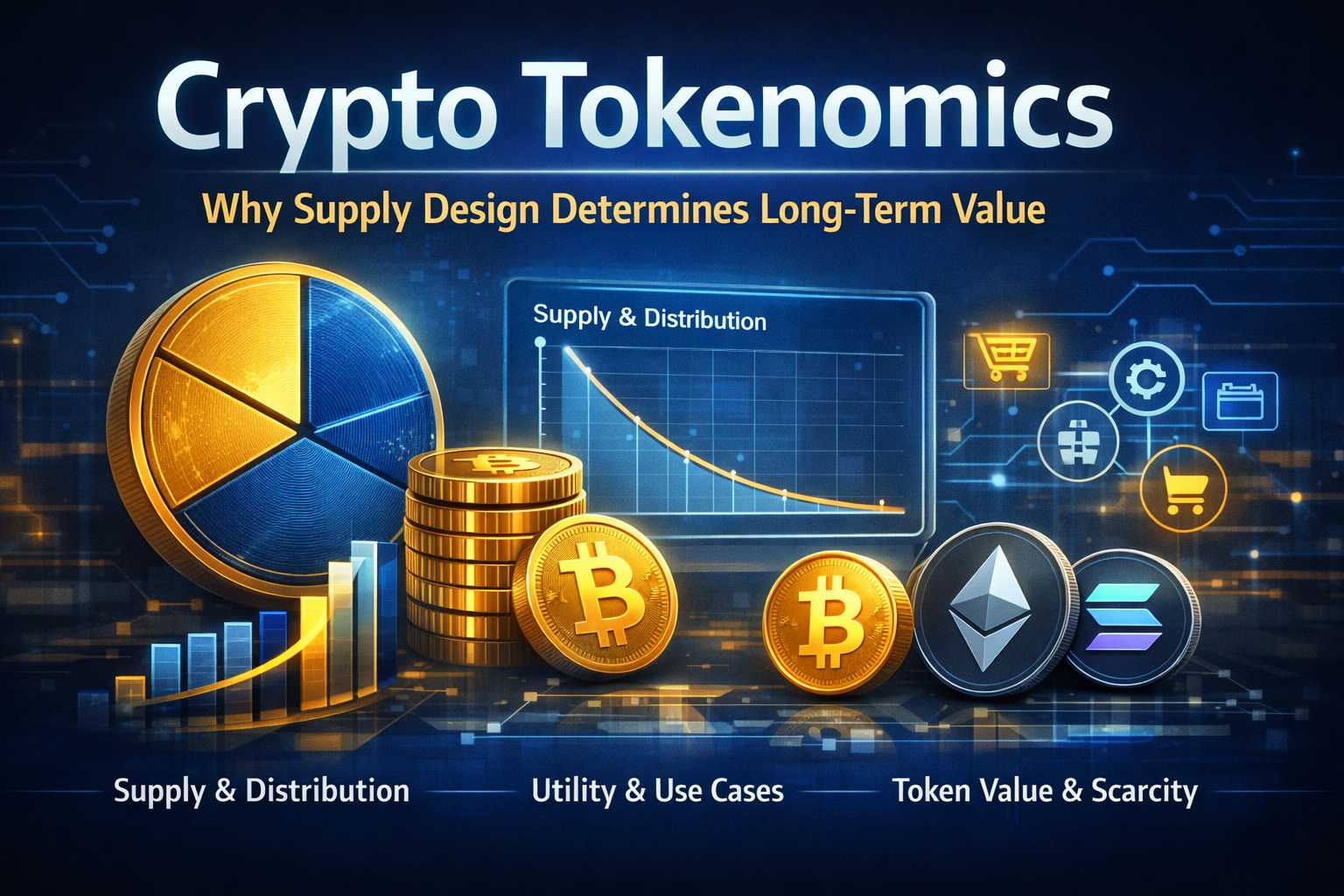
Price movements often dominate discussions in the cryptocurrency market.
However, behind every digital asset lies a deeper structure that influences its long-term value: tokenomics.
Tokenomics refers to the economic design of a cryptocurrency, including how tokens are created, distributed and used within a network. Understanding these mechanisms helps investors evaluate whether a project has sustainable long-term potential or relies primarily on short-term speculation.
For anyone analyzing digital assets beyond price charts, tokenomics is a critical foundation.
What Is Tokenomics?
Tokenomics combines the words token and economics.
It describes the economic framework governing a cryptocurrency. This includes factors such as:
- token supply
- distribution mechanisms
- incentives for participants
- token utility within the ecosystem
- long-term inflation or scarcity
Strong tokenomics can encourage network participation and sustainable growth. Weak tokenomics, on the other hand, can lead to excessive inflation or poor incentive alignment.
Supply Models: Inflationary vs Deflationary
One of the most important aspects of tokenomics is how supply evolves over time.
Some cryptocurrencies use inflationary models, where new tokens are continuously created. This approach is common in networks that rely on staking rewards or mining incentives.
Other projects aim for deflationary models, where token supply is limited or gradually reduced through mechanisms such as token burns.
Both models have advantages and trade-offs. Inflationary systems can support network security and participation, while deflationary structures may encourage long-term scarcity.
Understanding how supply changes over time is essential when evaluating potential value dynamics.
Circulating Supply vs Total Supply
Token supply is often divided into multiple categories.
Circulating supply refers to the tokens currently available on the market.
Total supply includes all tokens that have been created, including those that may still be locked, reserved or scheduled for release.
Maximum supply represents the total number of tokens that will ever exist.
A project with a large amount of locked tokens scheduled for future release may face significant selling pressure when those tokens eventually enter circulation.
For investors, analyzing supply schedules can reveal potential dilution risks.
Token Utility and Demand
Supply alone does not determine value.
Demand must also exist within the ecosystem.
Token utility refers to the role a token plays within its network. Common uses include:
- paying transaction fees
- governance participation
- staking and network security
- accessing platform services
- collateral in decentralized finance applications
Projects where tokens have meaningful utility often create stronger demand dynamics compared to purely speculative assets.
Incentive Structures
Effective tokenomics also depend on well-designed incentives.
Blockchain networks rely on participants such as validators, developers and users. Incentive mechanisms encourage these participants to contribute to the network’s growth and security.
Examples of incentives include:
- staking rewards
- governance voting power
- liquidity incentives
- ecosystem grants
When incentives are aligned with long-term network health, ecosystems tend to grow more sustainably.
Risks of Poor Tokenomics
Weak tokenomics can create structural problems for a project.
Some common risks include:
- excessive token inflation
- large early allocations to insiders
- lack of real token utility
- poorly designed reward mechanisms
- unsustainable emission schedules
Projects with flawed economic structures may struggle to maintain long-term value even if their technology appears promising.
Why Tokenomics Matters for Investors
For investors, understanding tokenomics is essential when evaluating the long-term potential of a cryptocurrency project.
Price movements in crypto can often be driven by hype, news, or short-term speculation.
However, tokenomics determines the underlying economic structure that supports a project over time.
One of the most important aspects investors should examine is the relationship between supply and demand. If a token has a very large or constantly increasing supply, strong demand is required to maintain or grow its price. Without sufficient demand, inflation can put downward pressure on the market.
Another key factor is circulating supply versus total supply. Some projects appear attractive because of a relatively low circulating supply, but large portions of the total supply may still be locked and scheduled to enter the market later. When these tokens unlock, they can significantly increase selling pressure.
Token distribution also plays an important role. When a large percentage of tokens is controlled by founders, venture capital funds, or early investors, the risk of concentrated selling increases. A more balanced distribution among community members, developers, and long-term holders generally supports a healthier ecosystem.
Utility is another major consideration. Tokens that play an active role within their ecosystem — such as being used for transaction fees, governance voting, staking rewards, or access to services — tend to maintain stronger demand over time compared to tokens that exist mainly for speculation.
Finally, investors should pay attention to incentive structures within a project. Well-designed tokenomics align the interests of developers, users, and investors. When participants are rewarded for contributing to the ecosystem, it encourages long-term growth and stability.
Conclusion
Tokenomics is one of the most important yet often overlooked aspects of cryptocurrency investing.
While price charts and market sentiment receive most of the attention, the underlying economic design of a token ultimately determines how sustainable a project can be over time.
By analyzing supply dynamics, distribution models, token utility, and incentive structures, investors can gain a deeper understanding of a project’s long-term potential.
Projects with strong tokenomics are more likely to build lasting ecosystems, maintain investor confidence, and navigate market cycles more successfully.
For anyone serious about crypto investing, learning how to evaluate tokenomics is a powerful skill that can help separate promising projects from those built on short-term hype. Also Read ->
Crypto Market Analysis Explained: Phases, Structure, and Scenarios
Part 3: Reading On-Chain Data & Indicators – Advanced Crypto Investing Strategies
Disclaimer: This article is for informational purposes only and should not be considered financial advice. Cryptocurrency investments carry risk, and investors should always conduct their own research before making financial decisions.