
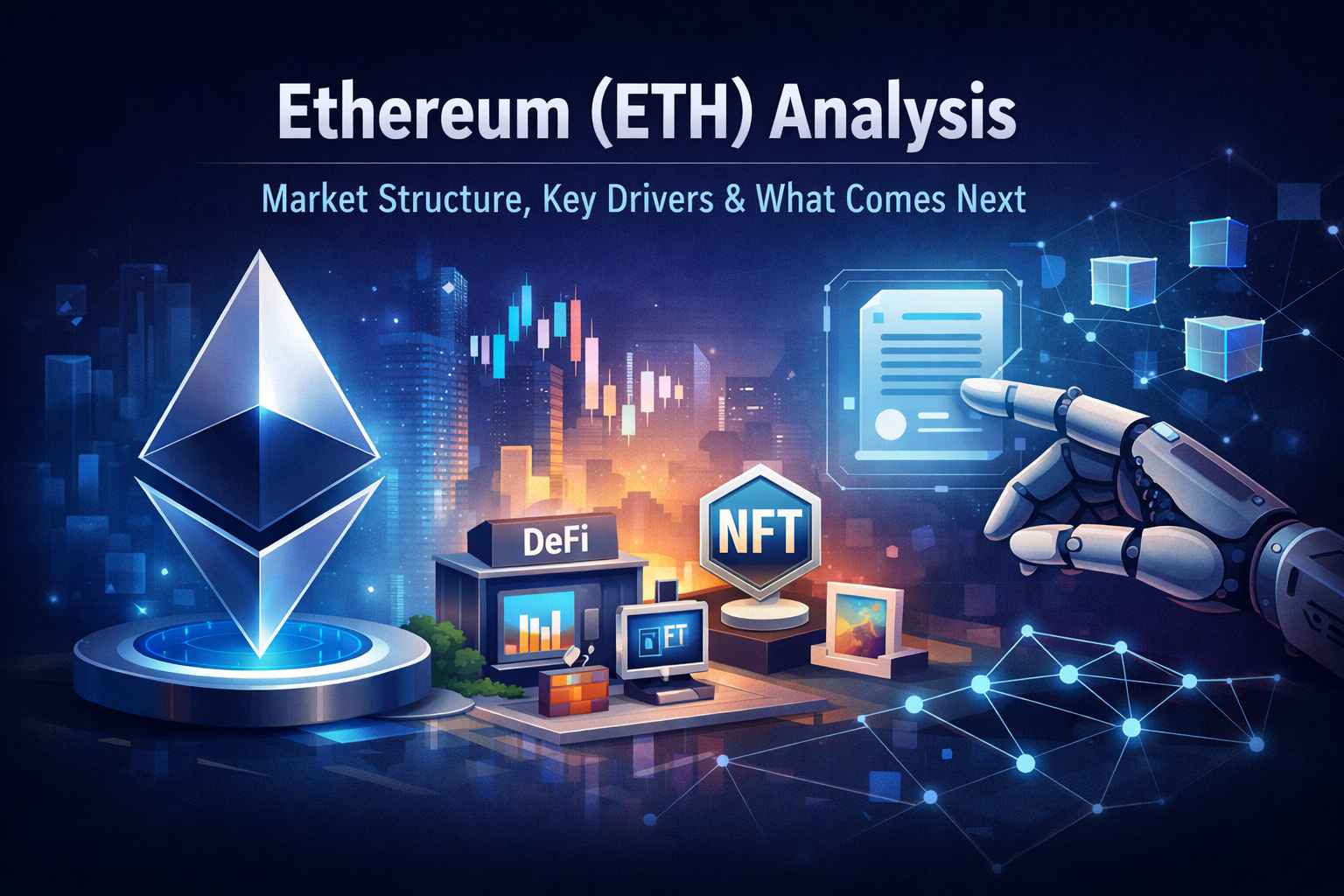
Ethereum analysis often focuses on price targets and short-term narratives, but Ethereum’s real importance lies deeper in its market structure, network usage, and role within the broader crypto ecosystem. As the backbone of smart contracts, DeFi, and NFTs, Ethereum occupies a unique position that goes far beyond speculation.
To understand ETH properly, emotion and hype need to be stripped away. What matters is structure, incentives, and how Ethereum continues to evolve in response to scaling challenges and competition.
Ethereum Analysis: Market Structure Explained
Ethereum operates at the center of the crypto market’s activity layer. While Bitcoin functions primarily as a monetary asset, Ethereum acts as infrastructure — a settlement and execution layer for decentralized applications.
ETH demand is driven by:
- Network usage (transactions, smart contracts)
- Gas fees paid in ETH
- Staking and supply reduction mechanisms
- Growth of Layer 2 solutions built on top of Ethereum
This creates a dual dynamic: Ethereum is both an investment asset and a productive network. That combination introduces complexity, but also resilience during different market phases.
Key Drivers Behind Ethereum’s Long-Term Value
Ethereum’s long-term relevance is not dependent on a single trend. Instead, it rests on several structural drivers:
Smart contract dominance: Ethereum remains the most widely adopted smart contract platform, with the largest developer ecosystem.
DeFi infrastructure: Most decentralized finance protocols are either built directly on Ethereum or rely on it as a settlement layer.
Layer 2 scaling solutions: Rollups like Optimism, Arbitrum, and zk-based solutions reduce congestion while reinforcing Ethereum’s base layer role.
ETH staking & supply dynamics: Staking locks up ETH, while fee burning mechanisms reduce net issuance during periods of high activity.
Together, these factors shift Ethereum from a purely inflationary asset toward a more usage-driven model.
Ethereum vs Other Layer 1 Blockchains
Ethereum faces competition from faster and cheaper Layer 1 networks, but its advantage lies in network effects rather than raw performance.
Key differences:
- Ethereum prioritizes decentralization and security
- Competing chains often optimize for speed and cost
- Most Layer 1 alternatives still rely on Ethereum liquidity or tooling
Rather than “winning” outright, Ethereum increasingly positions itself as the base layer, with scalability pushed outward to Layer 2 ecosystems.
Risks, Weaknesses, and Common Misconceptions
Ethereum is not without challenges:
Complex user experience: Wallets, bridges, and gas mechanics remain confusing for newcomers.
Fee volatility during high demand:Despite improvements, congestion can still drive costs up.
Narrative confusion: ETH is often misunderstood as “just another altcoin,” ignoring its infrastructure role.
A common misconception is that faster chains automatically replace Ethereum. In reality, market adoption tends to favor security, liquidity, and developer depth over pure speed.
What Comes Next for Ethereum (Without Predictions)
Ethereum’s future does not hinge on short-term price movements. Instead, its trajectory depends on:
- Continued Layer 2 adoption
- Sustainable staking participation
- Developer retention
- Regulatory clarity around staking and DeFi
Rather than making price forecasts, smart investors evaluate whether Ethereum continues to function as critical infrastructure within crypto. As long as applications, liquidity, and innovation flow through its ecosystem, ETH maintains strategic relevance.
Final takeaway
Ethereum is not just a trade — it is a structural component of the crypto market. Understanding ETH means understanding how decentralized systems scale, coordinate, and create value over time.
Also Read -> XRP Analysis: Market Structure, Key Drivers & What Comes Next
Avalanche (AVAX) Analysis: Architecture, Use Cases and Long-Term Positioning
Arbitrum (ARB) Analysis: Architecture, Use Cases and Long-Term Positioning
Also Read -> Bitcoin (BTC) Analysis: Market Structure, Key Drivers & What Comes Next
Disclaimer: This article is for educational and informational purposes only and does not constitute financial advice. Cryptocurrency trading and investing carry significant risk, and individuals should do their own research before making financial decisions.