
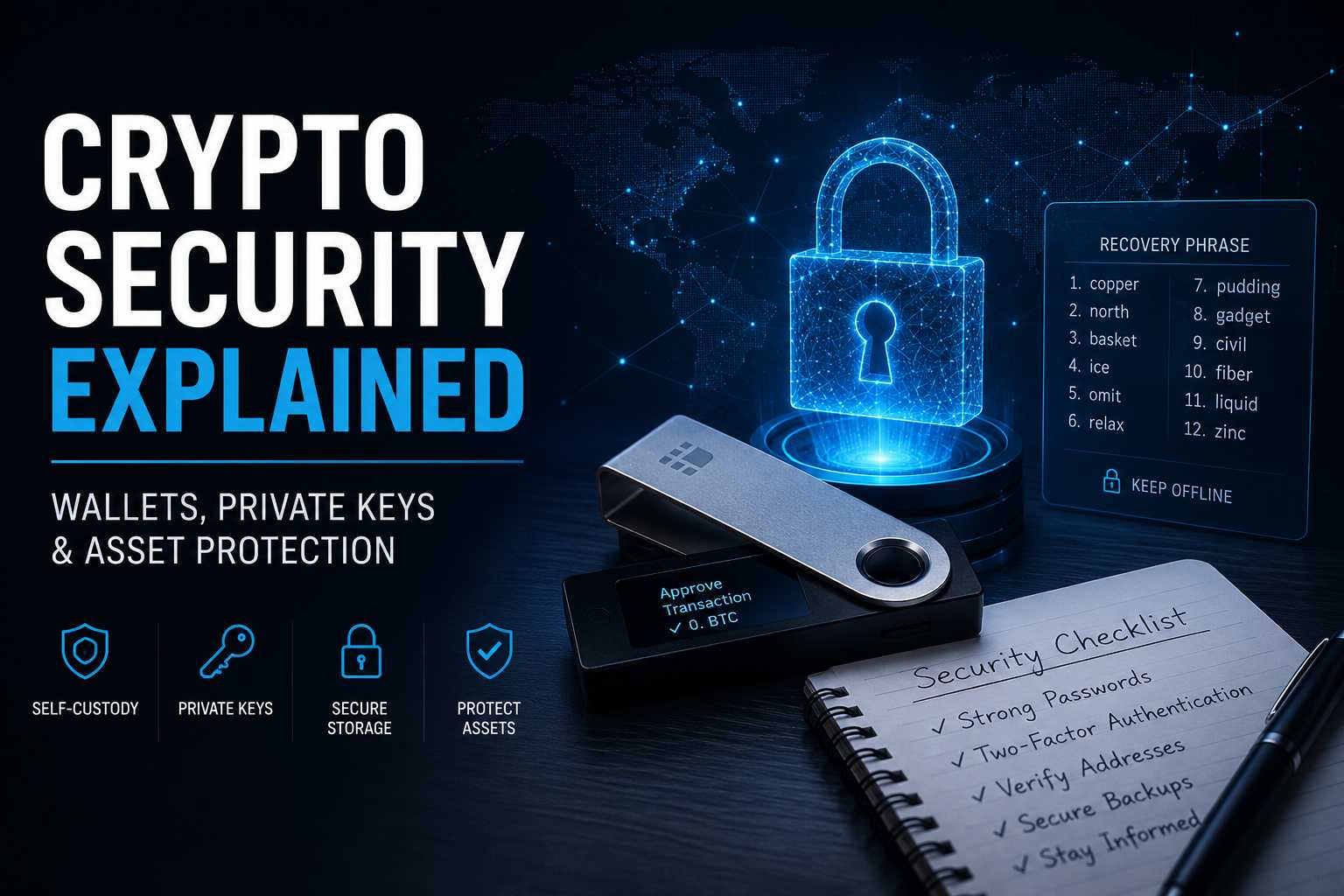
Crypto security remains one of the most important yet misunderstood aspects of cryptocurrency investing.
Unlike traditional banking systems, cryptocurrency allows investors to hold and control assets directly without relying on a central authority.
This creates significant advantages involving:
- financial sovereignty
- self-custody
- global accessibility
- censorship resistance
However, it also creates a unique responsibility.
In traditional finance, fraudulent transactions can sometimes be reversed and accounts can often be recovered through customer support.
In crypto, mistakes are frequently permanent.
Lost private keys, compromised wallets, phishing attacks, and security failures can result in irreversible losses.
Because of this, understanding crypto security is just as important as understanding blockchain technology, investing strategies, or market analysis.
In this analysis, we’ll explore:
- why crypto security matters
- private keys and seed phrases
- hot wallets vs cold wallets
- exchange security
- phishing attacks and scams
- social engineering threats
- hardware wallets
- common security mistakes
- best practices for long-term investors
- the strengths and limitations of crypto self-custody
Why Crypto Security Matters
Cryptocurrency operates differently from traditional financial systems.
Ownership is determined through cryptographic keys rather than identity verification.
This creates a fundamentally different security model.
In crypto markets:
- transactions are generally irreversible
- accounts cannot easily be recovered
- investors become responsible for asset protection
- attackers constantly target digital assets
- security mistakes can lead to permanent losses
As cryptocurrency adoption grows, cybercriminals increasingly target:
- investors
- exchanges
- wallets
- decentralized applications
- blockchain infrastructure
Understanding security is therefore essential for anyone participating in the digital asset ecosystem.
Private Keys Explained
Private keys are the foundation of cryptocurrency ownership.
A private key is a cryptographic code that grants control over blockchain assets.
Whoever controls the private key controls the cryptocurrency.
Private keys allow users to:
- access wallets
- authorize transactions
- transfer assets
- verify ownership
Without a private key, assets cannot be accessed.
This leads to one of the most important principles in crypto:
Not your keys, not your crypto.
When assets are stored on an exchange, the exchange controls the private keys.
When assets are held in self-custody wallets, the investor controls the private keys directly.
Understanding this distinction is critical.
Seed Phrases Explained
Most crypto wallets generate a recovery phrase, often called a seed phrase.
A seed phrase is typically a sequence of 12 to 24 words used to recover wallet access.
If a device is lost, damaged, or replaced, the seed phrase can restore access to the wallet.
Because of this, seed phrases represent the ultimate backup mechanism.
Anyone who gains access to a seed phrase can potentially access the associated cryptocurrency.
This makes seed phrase protection one of the most important aspects of crypto security.
Common security practices include:
- storing seed phrases offline
- avoiding cloud storage
- avoiding screenshots
- preventing unauthorized access
- maintaining multiple secure backups
Hot Wallets vs Cold Wallets
Crypto wallets generally fall into two categories:
- hot wallets
- cold wallets
Understanding the differences helps investors manage security and convenience.
Hot Wallets
Hot wallets remain connected to the internet.
Examples include:
- MetaMask
- Trust Wallet
- Phantom
- mobile wallets
- browser wallets
Advantages include:
- convenience
- quick access
- easy interaction with decentralized applications
Risks include:
- phishing attacks
- malware
- wallet drainers
- compromised devices
Hot wallets are generally considered suitable for active use but involve higher security risk.
Cold Wallets
Cold wallets store private keys offline.
Examples include:
- hardware wallets
- air-gapped storage systems
Advantages include:
- stronger security
- offline protection
- reduced attack surface
Risks include:
- physical loss
- improper backup procedures
- user error
Cold storage is often preferred by long-term investors holding significant amounts of cryptocurrency.
Exchange Security
Many investors store assets on cryptocurrency exchanges.
This approach offers convenience but introduces custodial risk.
When assets remain on an exchange:
- the exchange controls the private keys
- users rely on platform security
- withdrawals may depend on platform policies
- insolvency risks may exist
Major exchanges typically invest heavily in:
- cybersecurity
- cold storage
- insurance mechanisms
- compliance frameworks
However, history has shown that exchanges can still experience:
- hacks
- operational failures
- insolvency events
- regulatory disruptions
This is why many investors choose to balance convenience with self-custody strategies.
Phishing Attacks
Phishing remains one of the most common threats in cryptocurrency markets.
Attackers attempt to trick users into revealing sensitive information or signing malicious transactions.
Common phishing methods include:
- fake websites
- fraudulent wallet interfaces
- fake exchange login pages
- malicious email campaigns
- fake customer support accounts
Modern phishing attacks can appear highly convincing.
Many successful attacks rely on creating urgency and exploiting emotional reactions.
Investors should always verify:
- website URLs
- wallet permissions
- transaction details
- communication sources
before interacting with crypto platforms.
Social Engineering Threats
Many crypto losses occur without any technical hacking.
Instead, attackers manipulate human behavior.
This is known as social engineering.
Common examples include:
- fake giveaways
- impersonation scams
- investment fraud
- romance scams
- fake influencers
- fraudulent support agents
Social engineering attacks exploit:
- trust
- fear
- greed
- urgency
- confusion
Because of this, psychological awareness remains an important component of crypto security.
Hardware Wallets Explained
Hardware wallets are physical devices designed to store private keys offline.
Rather than exposing keys to internet-connected devices, hardware wallets isolate sensitive information.
Benefits include:
- offline key storage
- stronger protection against malware
- reduced exposure to phishing attacks
- improved long-term security
Many investors use hardware wallets as part of broader self-custody strategies.
However, hardware wallets are not immune to mistakes.
Security still depends on:
- seed phrase protection
- proper setup procedures
- avoiding fraudulent devices
- secure physical storage
Technology alone cannot eliminate human error.
Common Crypto Security Mistakes
Many crypto losses occur because of avoidable mistakes.
Common examples include:
- sharing seed phrases
- storing recovery phrases online
- clicking suspicious links
- downloading fake applications
- using weak passwords
- failing to enable two-factor authentication
- signing transactions without verification
- trusting unknown individuals online
Understanding these risks can significantly reduce the likelihood of security incidents.
Best Practices for Long-Term Investors
Experienced investors often follow several core security principles.
These include:
- using strong and unique passwords
- enabling two-factor authentication
- storing backups securely
- verifying websites carefully
- keeping software updated
- limiting unnecessary wallet permissions
- separating long-term holdings from active trading funds
- maintaining security awareness
No system is perfectly secure.
However, consistent security habits can dramatically reduce risk exposure.
Risks and Limitations of Self-Custody
While self-custody provides greater control, it also introduces responsibility.
Potential risks include:
- lost seed phrases
- forgotten passwords
- physical theft
- device damage
- operational mistakes
- inheritance complications
Many new investors underestimate the complexity of managing digital assets independently.
The goal is not simply maximizing security.
The goal is balancing:
- security
- accessibility
- usability
- risk management
in a way that matches individual needs.
Two-Factor Authentication (2FA)
Two-factor authentication remains one of the simplest and most effective security measures available to crypto investors.
Most major exchanges support 2FA through:
- authenticator apps
- hardware security keys
- backup recovery codes
Benefits include:
- stronger account protection
- reduced risk of unauthorized access
- additional security beyond passwords
Many successful exchange hacks occur because users rely solely on passwords.
For long-term investors, enabling 2FA should be considered a basic security requirement rather than an optional feature.
Conclusion
Crypto security remains one of the most important foundations of successful cryptocurrency investing.
Unlike traditional financial systems, digital assets place responsibility directly in the hands of the owner.
Understanding:
- private keys
- seed phrases
- wallet security
- phishing attacks
- exchange risk
- self-custody principles
can significantly reduce the likelihood of costly mistakes.
While blockchain technology continues evolving, one reality remains unchanged:
protecting digital assets is just as important as selecting the right investments.
Successful crypto investors focus not only on portfolio growth but also on preserving capital through strong security practices.
In cryptocurrency markets, protecting assets is often the first step toward long-term success.
How to Do Your Own Research (DYOR) in Crypto
Advanced Crypto Investing Strategies – Part 5: Advanced Risk Management
How to Evaluate a Cryptocurrency Project: A Fundamental Analysis Guide
Disclaimer: This article is for educational and informational purposes only and does not constitute financial or investment advice. Cryptocurrency markets are highly volatile and involve substantial risk. Always conduct your own research before making investment decisions.