
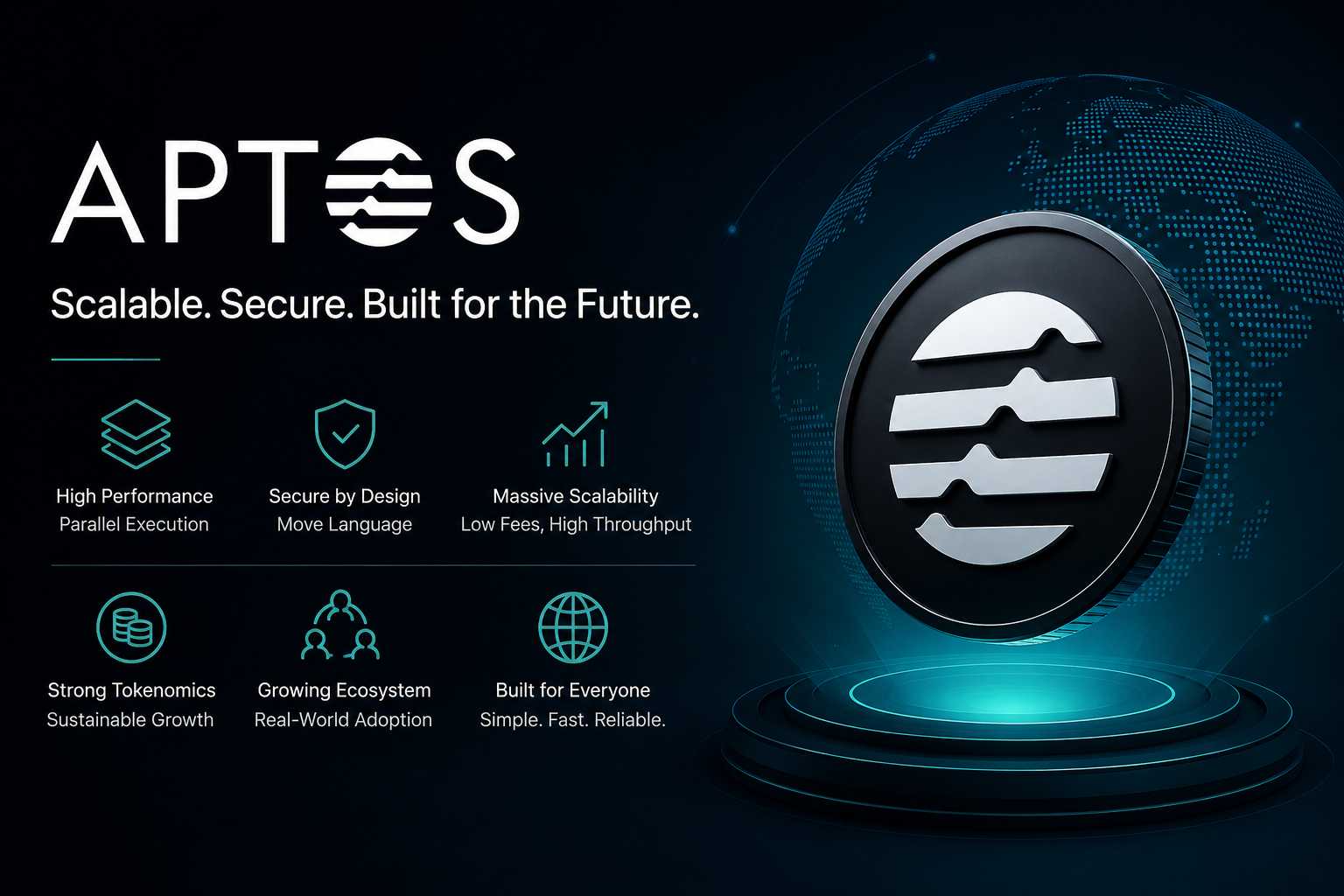
As blockchain adoption continues expanding, scalability, user experience, and network performance remain among the biggest challenges facing the cryptocurrency industry.
Many blockchain networks struggle with:
- network congestion
- limited throughput
- high transaction fees
- complex user experiences
- scalability bottlenecks
As a result, a new generation of blockchain infrastructure projects has emerged seeking to improve performance without sacrificing security.
Among the most notable is Aptos.
Originally developed by engineers who previously worked on Meta’s Diem blockchain initiative, Aptos was designed to provide a high-performance Layer-1 blockchain focused on scalability, reliability, and mainstream adoption.
Supporters view Aptos as one of the most technically advanced blockchain ecosystems in the market.
Critics argue that competition among Layer-1 networks remains intense and long-term adoption is far from guaranteed.
Regardless of perspective, Aptos has become one of the most closely watched blockchain ecosystems in the crypto industry.
In This Analysis, We’ll Explore:
- what Aptos is
- the origins of Aptos
- Aptos architecture
- the Move programming language
- parallel execution technology
- scalability and throughput
- security model
- Aptos ecosystem development
- Aptos tokenomics
- staking and network participation
- risks and criticisms
- long-term positioning
- the strengths and limitations of Aptos
What Is Aptos?
Aptos is a Layer-1 blockchain designed to support:
- decentralized applications (dApps)
- smart contracts
- digital assets
- decentralized finance (DeFi)
- gaming applications
- Web3 infrastructure
The project focuses heavily on:
- scalability
- reliability
- security
- user experience
Unlike many blockchain networks that evolved gradually over time, Aptos was built from the ground up using lessons learned from earlier blockchain architectures.
Its primary objective is creating infrastructure capable of supporting large-scale adoption without compromising performance.
The Origins of Aptos
The Aptos project originated from former members of Meta’s Diem blockchain initiative.
Diem was originally developed as a global payment and digital currency project.
Although Diem was ultimately discontinued, much of the underlying research and engineering expertise survived.
Former Diem engineers later launched Aptos Labs.
The goal was to continue developing many of the innovations originally created for Diem while adapting them for a decentralized blockchain ecosystem.
This heritage remains one of Aptos’ most distinctive characteristics.
Few blockchain projects entered the market with comparable engineering resources and experience.
Aptos Architecture Explained
Aptos was designed around several core principles:
- scalability
- modularity
- upgradeability
- security
- efficiency
The architecture separates various blockchain functions in ways intended to improve overall network performance.
This design helps Aptos process transactions more efficiently while maintaining security and network reliability.
Rather than focusing exclusively on transaction speed, Aptos attempts to optimize the entire blockchain stack.
The Move Programming Language
One of Aptos’ most important innovations is the Move programming language.
Move was originally developed for Meta’s Diem project and later adapted for Aptos.
Move was specifically designed for digital assets and smart contracts.
Its objectives include:
- improved security
- resource management
- asset ownership verification
- reduced smart contract vulnerabilities
Unlike many traditional programming languages, Move treats digital assets as first-class resources.
This approach helps reduce common errors that can lead to:
- exploits
- asset duplication
- smart contract vulnerabilities
- unintended behavior
Supporters believe Move offers significant advantages for blockchain development.
Parallel Execution Technology
Most blockchain networks process transactions sequentially.
This means transactions are executed one after another.
Aptos uses a parallel execution engine known as Block-STM.
This technology allows many transactions to be processed simultaneously.
Potential advantages include:
- increased throughput
- reduced congestion
- improved scalability
- greater efficiency
By executing independent transactions in parallel, Aptos aims to improve network performance without sacrificing security.
Parallel execution remains one of Aptos’ most important technological differentiators.
Scalability and Throughput
Scalability remains one of the most important challenges in blockchain infrastructure.
Aptos was designed with scalability as a primary objective.
The network aims to support:
- high transaction throughput
- low latency
- rapid finality
- large-scale application growth
Supporters believe these characteristics make Aptos suitable for:
- gaming
- payments
- decentralized finance
- social applications
- enterprise infrastructure
Whether blockchain adoption ultimately reaches these levels remains uncertain, but Aptos was designed with long-term scalability in mind.
Security Model
Security remains critical for any blockchain ecosystem.
Aptos uses a Proof-of-Stake consensus mechanism.
Validators help secure the network by:
- processing transactions
- validating blocks
- maintaining network integrity
The combination of:
- Proof-of-Stake
- Move programming
- formal verification techniques
aims to reduce several common blockchain risks.
Security remains a major focus because network adoption ultimately depends on trust and reliability.
Crypto Security Explained: Wallets, Private Keys, Scams & How Investors Protect Digital Assets
The Aptos Ecosystem
The success of a blockchain depends on more than technology alone.
Ecosystem growth is equally important.
The Aptos ecosystem includes:
- decentralized exchanges
- lending protocols
- NFT platforms
- gaming applications
- infrastructure providers
- developer tools
Like many Layer-1 projects, Aptos faces a critical challenge:
attracting developers and users.
Strong technology alone does not guarantee adoption.
Network effects often determine long-term success.
Aptos Tokenomics
APT serves as the native asset of the Aptos network.
The token performs several functions:
- staking
- transaction fees
- governance participation
- network security
Tokenomics remain important because they influence:
- decentralization
- validator incentives
- long-term sustainability
- ecosystem growth
Investors often monitor token distribution carefully because concentrated ownership can create future risks.
Staking and Network Participation
Aptos uses staking as part of its Proof-of-Stake security model.
Token holders can participate by:
- staking APT
- supporting validators
- contributing to network security
Potential benefits include:
- staking rewards
- network participation
- long-term ecosystem alignment
Like all staking systems, rewards and participation levels can evolve over time.
Aptos vs Solana
Aptos and Solana are frequently compared because both emphasize performance and scalability.
Solana focuses heavily on:
- high throughput
- low fees
- ecosystem growth
Aptos focuses heavily on:
- Move-based development
- parallel execution
- security-oriented architecture
Both ecosystems seek to become major blockchain infrastructure platforms.
However, they pursue this objective using different technological approaches.
Aptos vs Sui
Comparisons between Aptos and Sui are also common.
Both projects:
- utilize Move-based technology
- prioritize scalability
- focus on user experience
- emerged from similar engineering backgrounds
Key differences exist in:
- architecture
- execution models
- ecosystem development
- strategic direction
Because of these similarities, investors often evaluate Aptos and Sui as competing ecosystems.
Adoption Challenges
Despite its technological strengths, Aptos faces several challenges.
These include:
- intense Layer-1 competition
- user acquisition difficulties
- ecosystem development requirements
- token unlock concerns
- market cycle dependence
The blockchain industry remains highly competitive.
Numerous projects compete for:
- developers
- liquidity
- applications
- users
Technology alone does not guarantee long-term success.
Risks and Criticisms
Several criticisms are frequently directed toward Aptos.
These include:
- competition from established networks
- concerns regarding token distribution
- ecosystem maturity
- adoption uncertainty
- long-term sustainability questions
Investors should understand that strong technology does not automatically translate into market dominance.
Many technically impressive projects have struggled to achieve meaningful adoption.
Strengths of Aptos
Potential strengths include:
- experienced engineering team
- Move programming language
- parallel execution technology
- strong scalability focus
- growing ecosystem
- high-performance infrastructure
- institutional interest
These characteristics explain why Aptos continues attracting attention from investors and developers.
Limitations of Aptos
Potential limitations include:
- fierce Layer-1 competition
- uncertain adoption trajectory
- ecosystem development challenges
- tokenomics concerns
- dependence on continued growth
Like all blockchain projects, Aptos faces execution risk.
Long-term success ultimately depends on adoption rather than technology alone.
Long-Term Positioning
Aptos represents one of the most ambitious next-generation Layer-1 blockchain ecosystems.
Its focus on:
- scalability
- user experience
- security
- parallel execution
- Move-based development
positions it as a serious competitor within the blockchain infrastructure sector.
Whether Aptos becomes a dominant blockchain platform remains uncertain.
However, its technological foundation and engineering pedigree ensure it remains an important project to monitor.
Conclusion
Aptos has emerged as one of the most technically advanced Layer-1 blockchain ecosystems in the cryptocurrency market.
Built by former Meta engineers and powered by innovations such as Move and parallel execution, the network seeks to solve many of the scalability and usability challenges facing blockchain adoption.
Understanding:
- Aptos architecture
- Move programming
- scalability design
- tokenomics
- staking
- ecosystem growth
- competitive positioning
can help investors evaluate Aptos more effectively.
While long-term success is not guaranteed, Aptos remains one of the most important infrastructure-focused blockchain projects in the evolving digital asset ecosystem.
For investors seeking exposure to next-generation blockchain technology, Aptos remains a project worth following closely.
XRP Analysis: Cross-Border Liquidity, Institutional Adoption & Long-Term Positioning
Disclaimer: This article is for educational and informational purposes only and does not constitute financial or investment advice. Cryptocurrency markets are highly volatile and involve substantial risk. Always conduct your own research before making investment decisions.