
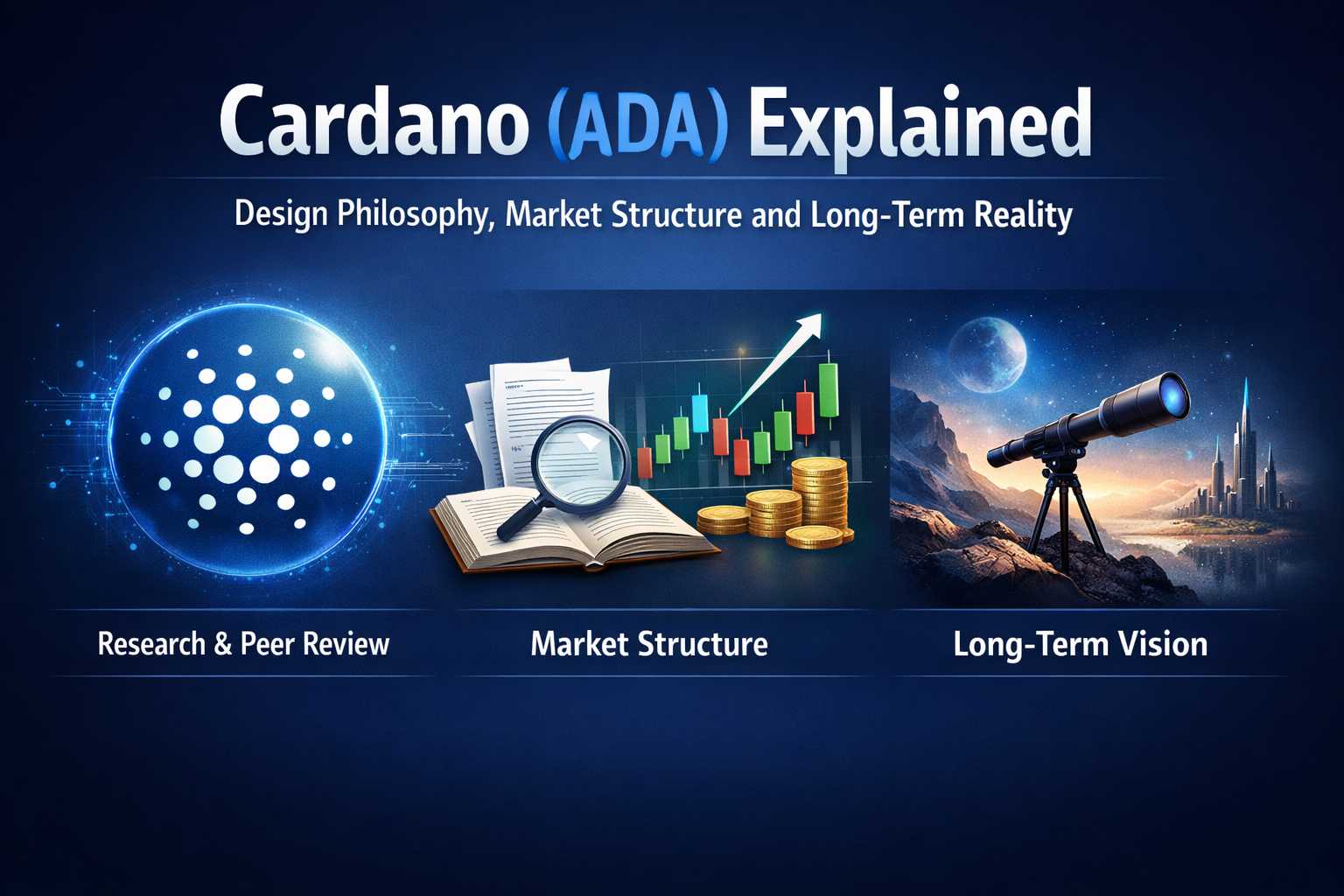
Cardano (ADA) occupies an unusual position among major smart-contract blockchains.
Its development philosophy places unusual emphasis on academic research, formal methods and deliberate protocol engineering. That approach has helped Cardano build a reputation around security, decentralization and long-term infrastructure design rather than rapid experimentation.
But careful engineering is not the same as economic adoption.
Cardano still has to compete for developers, applications, liquidity and users against ecosystems that often move faster. And even if the network becomes more widely used, a second question remains: how strongly does that activity translate into economic relevance for ADA itself?
This creates the central tension in the Cardano thesis.
A research-driven architecture can strengthen the foundations of a blockchain, but long-term relevance ultimately depends on whether those foundations support useful applications, durable economic activity and a meaningful role for the native asset.
This analysis examines Cardano’s architecture, Ouroboros consensus, smart-contract model, governance, scaling strategy, ecosystem development, ADA economics and the factors that could strengthen or weaken its competitive position over time.
What Makes Cardano Different?
Cardano’s defining characteristic is not a single performance metric. It is the way the protocol has been designed and developed.
The project emerged from a research-first philosophy that places substantial emphasis on peer-reviewed work, formal methods and deliberate protocol design. Ouroboros, Cardano’s Proof-of-Stake consensus family, is one example: its development has been closely connected to academic research into blockchain security and consensus.
That philosophy creates a real trade-off.
Formal research and careful implementation can strengthen confidence in protocol design, but blockchain ecosystems do not compete on engineering rigor alone. Developers also care about tooling, users care about applications and usability, and economic activity tends to concentrate where liquidity, infrastructure and distribution already exist.
Cardano’s long-term position therefore depends on whether research quality becomes an operational advantage rather than remaining primarily a design advantage.
The distinction is important: a blockchain can be carefully engineered without becoming the environment developers and users choose most often.
Cardano’s Proof-of-Stake Architecture
Cardano uses Ouroboros, a Proof-of-Stake consensus protocol in which stake pools participate in block production and ADA holders can delegate their stake to those pools.
Delegation is particularly relevant to Cardano’s design because ADA does not need to be transferred to a stake pool for the holder to delegate its staking rights. The underlying ADA remains under the holder’s control.
This connects ADA directly to network security. Stake determines participation in block production, while rewards provide an economic incentive for stake pool operators and delegators to support the network.
For Cardano analysis, however, staking should not be treated simply as a source of token rewards. Its more important structural role is that ADA functions as economic weight inside the consensus system.
That creates a long-term dependency: Cardano needs enough distributed participation and economic value securing the network while maintaining incentives capable of supporting stake-pool infrastructure as reserve-based issuance gradually declines.
ADA Staking and Tokenomics
ADA has several protocol-level roles within Cardano. It is used for transaction fees, staking, network security and on-chain governance.
Its supply is capped at 45 billion ADA. Staking rewards are funded through a combination of transaction fees and ADA released gradually from the remaining reserve, while part of the reward pot supports the Cardano treasury.
This creates an important long-term economic relationship.
Reserve-funded rewards decline as the remaining reserve becomes smaller. Over time, sustainable network economics therefore become increasingly connected to actual transaction-fee generation rather than relying indefinitely on the release of previously uncirculated ADA.
That does not mean Cardano requires high fees per transaction. A low-cost network can generate meaningful aggregate fees through sufficient economic activity. But it does mean that staking, network usage and monetary sustainability should be analyzed together rather than treating staking yield as an isolated benefit of holding ADA.
Smart Contracts and Ecosystem Development
Cardano added smart-contract functionality through the Alonzo upgrade in 2021, enabling decentralized applications and programmable financial infrastructure.
Its application architecture differs from account-based systems such as Ethereum because Cardano uses an Extended Unspent Transaction Output model, or EUTXO. Instead of maintaining application state through the same account model used by Ethereum, transactions consume and create outputs that can contain scripts and additional data.
This can make transaction behavior more predictable because validation depends on the transaction and the specific inputs it consumes. It also requires developers to design applications around a different programming and state-management model.
Architecture alone, however, does not determine ecosystem success.
Cardano still needs developers to convert its technical properties into applications that attract durable users, liquidity and economic activity. This is where the distinction between engineering quality and ecosystem adoption becomes especially important.
A technically differentiated execution model can be valuable. It becomes strategically important only when developers can use it to build applications that users repeatedly choose over available alternatives.
Cardano vs Ethereum and Solana
Ethereum and Solana provide useful comparisons because the three ecosystems approach blockchain infrastructure from different starting points.
Ethereum’s competitive strength is closely connected to its established developer ecosystem, liquidity and increasingly modular scaling architecture. More execution can occur through Layer-2 networks while Ethereum provides underlying settlement, data availability and security.
Solana places much greater emphasis on high-capacity execution within an integrated Layer-1 environment. Its long-term challenge is to combine performance and low costs with reliability, decentralization and durable economic activity.
Cardano follows a different path. Its architecture emphasizes formal research, Ouroboros consensus, the EUTXO model and deliberately staged protocol development.
None of these approaches is inherently superior across every use case.
Ethereum must manage the complexity and economic consequences of a modular ecosystem. Solana must sustain high performance without allowing infrastructure requirements or reliability trade-offs to undermine its advantages. Cardano must demonstrate that deliberate engineering can translate into competitive developer adoption and economic activity quickly enough to remain relevant.
That last condition is critical. Research quality can differentiate Cardano’s infrastructure, but it does not protect the network from competition if developers, liquidity and users increasingly concentrate elsewhere.
Scalability and Future Infrastructure
Cardano’s scaling strategy is developing across more than one layer.
Hydra provides Layer-2 scaling through off-chain Hydra Heads, where groups of participants can process activity outside the main ledger while retaining a connection to Cardano’s underlying security model.
At the base-layer level, Ouroboros Leios represents a different scaling direction. Leios is designed to increase Cardano’s transaction-processing capacity by allowing more work to occur in parallel while preserving the security properties of the underlying consensus system.
These approaches address different parts of the scaling problem.
Hydra can provide specialized off-chain capacity for applications that benefit from fast repeated interactions. Leios is intended to increase the capacity of the underlying Layer-1 itself.
For Cardano’s long-term position, however, theoretical capacity is not the final objective.
Scaling creates economic value only when additional capacity is used. The stronger test is whether improved infrastructure enables applications, users and economic activity that would otherwise be constrained — without materially weakening decentralization, reliability or security.
Cardano’s On-Chain Governance
Cardano’s governance architecture has become a more important part of the network itself.
The Chang and Plomin upgrades implemented the governance framework defined through CIP-1694. ADA holders can participate in governance directly or delegate voting power to delegated representatives, known as DReps, while stake pool operators and the Constitutional Committee also perform defined governance roles.
Governance can cover decisions such as protocol changes and treasury withdrawals, meaning ADA now has a role that extends beyond transaction fees and network security.
This creates both an opportunity and a new analytical risk.
Decentralized governance can reduce dependence on a small group of founding organizations and give the wider ecosystem greater influence over protocol development and treasury capital. But putting governance on-chain does not guarantee that authority is distributed effectively.
Participation, voting-power concentration, delegate quality and the ability to convert governance decisions into effective execution remain important.
Cardano’s governance model should therefore be evaluated by what it produces, not simply by whether decisions occur on-chain. The stronger long-term outcome is a system that can allocate capital, coordinate upgrades and resolve disagreements without creating governance capture or operational paralysis.
Institutional and Real-World Adoption
Cardano has long pursued use cases beyond crypto-native trading, including identity, financial infrastructure, education and other forms of real-world blockchain deployment.
These initiatives can broaden the network’s potential addressable market, but partnerships and pilot programs should not be treated as equivalent to adoption.
The stronger evidence appears when an initiative produces recurring use of Cardano infrastructure: transactions, applications, assets, users or other economic activity that continues after the initial announcement.
This distinction matters because institutional narratives can create attention long before they create meaningful network demand.
For Cardano, real-world adoption strengthens the long-term case when external organizations do more than associate with the ecosystem — they repeatedly use infrastructure in ways that create durable economic activity on or connected to the network.
How Cardano Network Growth Connects to ADA
A successful Cardano ecosystem does not automatically imply proportional economic value for ADA.
ADA has several structural roles. It pays transaction fees, participates in Proof-of-Stake security, carries governance rights and forms part of the network’s reward and treasury system.
The relevant question is therefore not simply whether Cardano attracts more activity.
It is whether that activity strengthens demand for the functions ADA performs.
CHAINBITNEWS CARDANO VALUE-CAPTURE TEST:
Research & Engineering → Reliable Infrastructure → Useful Applications → Durable Economic Activity → ADA Utility → Potential ADA Value Capture
Every link matters.
Research can improve infrastructure without guaranteeing developer adoption. Developers can build applications without attracting durable users. Users can create activity that is economically small or temporary. And network activity can grow without producing an equally strong economic effect for the native asset.
The Cardano thesis becomes stronger when these links reinforce one another: technical improvements support applications people repeatedly use, that usage creates meaningful network activity, and ADA remains necessary for security, fees and governance as the ecosystem expands.
It becomes weaker when progress remains concentrated near the beginning of the chain — more research, more protocol capacity and more technical development — without comparable progress in applications, economic activity and ADA utility.
This is why Cardano should not be evaluated solely by whether its technology works as designed.
The deeper question is whether good engineering compounds into an ecosystem whose economic activity makes the network — and ADA’s role within it — increasingly difficult to replace.
Risks and Criticism
Cardano’s main risks follow directly from the strengths on which its long-term case is built.
A deliberate development process can improve confidence in protocol design, but it can also become a competitive disadvantage if important infrastructure reaches users too slowly. Blockchain ecosystems exhibit network effects: developers, applications, users and liquidity can reinforce one another once activity reaches sufficient scale.
Cardano therefore faces execution risk as well as adoption risk.
Scaling technologies such as Hydra and Leios can expand capacity, but unused capacity does not create economic value. Governance can distribute decision-making, but poor participation or concentrated influence can weaken its practical decentralization. A growing application ecosystem can improve network relevance, but that growth matters less to ADA if the token’s economic role does not strengthen alongside it.
Competition intensifies each of these risks.
Ethereum already benefits from substantial liquidity and developer infrastructure, while Solana has built its position around fast, inexpensive execution and active consumer-facing applications. Other Layer-1 networks continue competing for the same developers and users.
Cardano therefore does not need to fail technically for its long-term position to weaken.
The more important risk is relative: the network can continue improving while competing ecosystems improve faster, attract more economically valuable activity or create stronger network effects.
Conclusion
Cardano’s long-term case cannot be reduced to whether its technology is academically rigorous or whether its protocol continues to improve.
Those characteristics matter because they shape the quality of the infrastructure. They do not determine what ultimately happens on top of it.
Cardano now combines a research-driven protocol, Ouroboros Proof of Stake, an EUTXO smart-contract architecture, on-chain governance and a scaling roadmap that includes both Hydra and Ouroboros Leios. Together, these give the ecosystem a technically distinctive foundation.
The harder test begins after that foundation is built.
Research & Engineering → Reliable Infrastructure → Useful Applications → Durable Economic Activity → ADA Utility → Potential ADA Value Capture
No step in that sequence is automatic.
Better infrastructure can exist without enough developers choosing it. Developers can build without creating applications that attract persistent demand. Greater network activity can emerge without producing equally strong economics for ADA.
Cardano’s slower development philosophy is therefore neither automatically a strength nor automatically a weakness. It becomes an advantage if deliberate engineering produces infrastructure that remains reliable while supporting increasingly valuable applications. It becomes a disadvantage if the ecosystem improves technically while developers, users and liquidity compound faster elsewhere.
Governance introduces the same kind of test. Moving decision-making on-chain can make Cardano less dependent on its founding organizations, but the quality of decentralization ultimately depends on participation, authority distribution and whether collective decisions can be executed effectively.
The strongest long-term evidence for Cardano would therefore not be another technical milestone in isolation.
It would be the convergence of technical progress, developer adoption, useful applications, recurring economic activity and a durable economic role for ADA.
That is the point at which Cardano’s research-first philosophy stops being primarily a design distinction and becomes an economic advantage.
Arbitrum (ARB) Analysis: Architecture, Use Cases and Long-Term Positioning
Polygon (MATIC) Analysis: Architecture, Use Cases and Long-Term Positioning
Disclaimer: This article is for educational and informational purposes only and does not constitute financial advice. Cryptocurrency trading and investing carry significant risk, and individuals should do their own research before making financial decisions.