
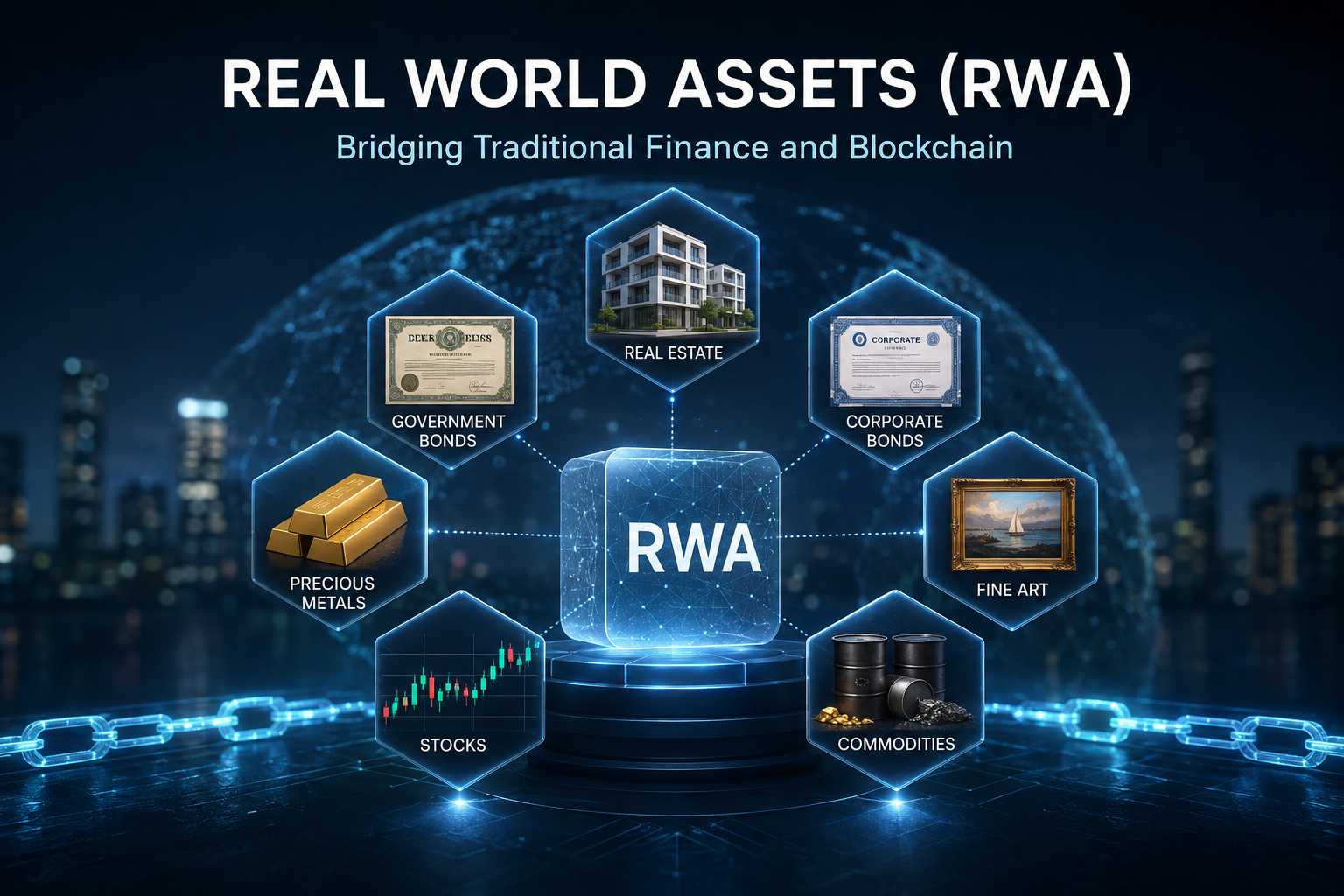
Blockchain technology has evolved far beyond cryptocurrencies.
While Bitcoin introduced decentralized digital money and Ethereum enabled smart contracts, a new trend is rapidly gaining attention among financial institutions, governments and blockchain developers:
Real World Assets (RWAs).
Rather than creating entirely digital assets, RWAs bring existing physical and financial assets onto blockchain networks through a process known as tokenization.
Real estate.
Government bonds.
Corporate debt.
Gold.
Stocks.
Private credit.
Even fine art.
All of these assets can potentially be represented digitally on a blockchain, allowing ownership to be transferred more efficiently while opening new opportunities for investors around the world.
Many analysts believe Real World Assets could become one of the largest long-term growth sectors within the cryptocurrency industry.
Instead of replacing traditional finance, RWAs seek to connect conventional financial markets with blockchain technology.
This integration has already attracted significant interest from major financial institutions, which are actively exploring tokenized investment products and blockchain-based settlement systems.
Understanding how Real World Assets work—and how they differ from cryptocurrencies—is becoming increasingly important for investors seeking to understand the future of digital finance.
In This Analysis, We’ll Explore:
- What Real World Assets (RWAs) are
- Why tokenization matters
- How RWAs work on the blockchain
- The different types of tokenized assets
- Real estate
- Government bonds
- Corporate bonds
- Stocks
- Commodities
- Precious metals
- Stablecoins as Real World Assets
- RWA versus traditional investing
- RWA versus cryptocurrencies
- Benefits and risks
- Institutional adoption
- The future of tokenized finance
What Are Real World Assets (RWAs)?
A Real World Asset (RWA) is a physical or traditional financial asset that is represented digitally on a blockchain.
Rather than existing solely as paper records or within traditional financial databases, ownership rights can be recorded and transferred using blockchain technology.
The underlying asset remains real.
Only its representation changes.
For example, instead of purchasing an entire building, investors may own blockchain-based tokens representing fractional ownership of that property.
Similarly, government bonds or money market funds can be tokenized, allowing investors to buy and transfer digital ownership more efficiently.
Common examples of Real World Assets include:
- Real estate.
- Government bonds.
- Corporate bonds.
- Stocks.
- Gold and precious metals.
- Commodities.
- Private credit.
- Money market funds.
Although these assets already exist within traditional finance, blockchain technology introduces new methods for recording ownership, transferring value and improving market accessibility.
Why Tokenization Matters
Tokenization is the process of converting ownership rights into blockchain-based digital tokens.
Each token represents a claim on an underlying real-world asset.
Instead of relying entirely on traditional financial intermediaries, blockchain networks record ownership transparently while enabling transfers through smart contracts.
This creates several potential improvements compared with traditional financial systems.
Greater Accessibility
Many traditional investments require significant amounts of capital.
Tokenization allows assets to be divided into much smaller units.
For example, instead of purchasing an entire commercial property, investors may eventually own a small percentage through blockchain-based tokens.
This concept is known as fractional ownership.
Faster Settlement
Traditional financial transactions often require multiple intermediaries and several business days to settle.
Blockchain transactions can often settle much faster, reducing administrative delays and improving operational efficiency.
Improved Transparency
Blockchain records are designed to be transparent and verifiable.
Ownership records can be viewed and verified without relying entirely on centralized databases.
Although legal ownership frameworks still depend on local regulations, blockchain technology can improve transparency throughout the transfer process.
Global Participation
Tokenized assets may eventually become accessible to investors across multiple jurisdictions, depending on regulatory requirements.
Rather than limiting investment opportunities to local financial markets, blockchain technology has the potential to support broader global participation.
How RWAs Work
Although Real World Assets involve physical or traditional financial assets, blockchain technology manages their digital representation.
Several components work together to make this possible.
Asset Verification
Before an asset can be tokenized, ownership and legal rights must first be verified.
Depending on the asset, this process may involve financial institutions, custodians, legal agreements or regulated service providers.
The blockchain itself does not verify whether an asset exists.
Instead, trusted entities confirm ownership before digital tokens are issued.
Token Creation
Once verification is complete, digital tokens are created on a blockchain.
These tokens represent ownership, participation rights or financial claims connected to the underlying asset.
The exact legal structure varies depending on local regulations and the type of asset being tokenized.
Smart Contracts
Smart contracts automate many administrative processes associated with tokenized assets.
These may include:
- Ownership transfers.
- Dividend distributions.
- Interest payments.
- Compliance requirements.
- Settlement procedures.
Because smart contracts execute predefined rules automatically, they can reduce administrative complexity while improving operational efficiency.
Smart Contracts Explained: How Blockchain Automation Works & Why It Matters for Investors
Fractional Ownership
One of the most significant advantages of tokenization is fractional ownership.
Traditionally, many investments require large amounts of capital.
Blockchain technology allows assets to be divided into many smaller digital units.
This enables investors to gain exposure to assets that might otherwise remain inaccessible due to high purchase prices.
Fractional ownership has become one of the primary reasons why many analysts believe Real World Assets could significantly expand participation in global financial markets.
Types of Real World Assets
The concept of Real World Assets extends across many sectors of the global economy.
Although real estate often receives the most attention, tokenization can apply to a wide variety of physical and financial assets.
Each category offers different opportunities and challenges.
Real Estate
Real estate is one of the largest potential markets for tokenization.
Traditionally, investing in commercial buildings or residential property requires substantial capital and involves lengthy legal processes.
Tokenization allows ownership to be divided into smaller digital units.
Instead of purchasing an entire property, investors may own fractional interests represented by blockchain tokens.
Potential benefits include:
- Lower investment barriers.
- Fractional ownership.
- Faster transfers.
- Greater liquidity.
- Broader investor participation.
Although legal ownership structures vary by jurisdiction, tokenized real estate continues attracting growing interest from both startups and institutional investors.
Government Bonds
Government bonds have become one of the fastest-growing areas within the RWA sector.
Rather than issuing entirely new financial products, institutions tokenize existing government securities and make them available through blockchain infrastructure.
Potential advantages include:
- Faster settlement.
- Improved transparency.
- More efficient transfers.
- Programmable ownership through smart contracts.
Several tokenized treasury products have already attracted billions of dollars in assets, demonstrating growing institutional demand for blockchain-based financial infrastructure.
Corporate Bonds
Corporate debt can also be represented on blockchain networks.
Instead of relying solely on traditional settlement systems, companies may issue tokenized bonds that allow interest payments and ownership transfers to be managed more efficiently.
Potential benefits include:
- Reduced administrative costs.
- Faster settlement.
- Greater transparency.
- Improved accessibility.
While adoption remains relatively early, many financial institutions continue exploring tokenized bond markets.
Stocks
Equities represent another major opportunity for tokenization.
Instead of traditional brokerage systems, blockchain-based tokens may eventually represent ownership of publicly traded companies.
Potential benefits include:
- Fractional ownership.
- Faster settlement.
- Continuous trading infrastructure.
- Improved accessibility for global investors.
However, securities regulations remain one of the largest factors influencing how tokenized stocks develop.
Commodities and Precious Metals
Physical commodities can also be tokenized.
Examples include:
- Gold.
- Silver.
- Oil.
- Agricultural products.
Gold has become one of the most widely adopted examples.
Rather than physically storing gold themselves, investors may purchase blockchain tokens representing ownership of gold held in secure vaults.
This combines the stability of physical assets with the transfer efficiency of blockchain technology.
Stablecoins as Real World Assets
Many investors do not immediately think of stablecoins as Real World Assets.
However, many fiat-backed stablecoins are effectively tokenized representations of traditional financial assets.
For example, US dollar-backed stablecoins are typically supported by reserves such as:
- Cash.
- Short-term government securities.
- Money market instruments.
Because these reserves exist in the traditional financial system while the tokens circulate on blockchain networks, stablecoins represent one of the earliest and most successful examples of Real World Asset tokenization.
Their rapid growth has demonstrated how traditional finance and blockchain technology can work together rather than compete directly.
RWA vs Traditional Investing
At first glance, investing in tokenized assets may appear similar to traditional investing.
Both involve ownership of real financial or physical assets.
However, blockchain technology introduces several important differences.
Traditional investing typically relies on centralized institutions such as:
- Banks.
- Brokers.
- Custodians.
- Clearing houses.
Transactions often require multiple intermediaries and settlement may take several business days.
Tokenized assets aim to streamline many of these processes.
Blockchain technology can provide:
- Faster settlement.
- Greater transparency.
- Programmable ownership.
- Improved accessibility.
- Fractional investment opportunities.
Despite these advantages, tokenized assets do not eliminate legal requirements or regulatory oversight.
In many cases, traditional financial institutions continue playing important roles behind the scenes while blockchain improves the efficiency of ownership records and settlement procedures.
RWA vs Cryptocurrencies
Although Real World Assets and cryptocurrencies both operate on blockchain networks, they represent fundamentally different concepts.
Understanding this distinction helps investors better appreciate the role each plays within the digital asset ecosystem.
Cryptocurrencies such as Bitcoin and Ethereum are native blockchain assets.
They exist entirely on blockchain networks and do not represent ownership of external physical assets.
Their value is determined primarily by market supply and demand, network adoption and investor expectations.
Real World Assets, by contrast, derive their value from assets that already exist outside the blockchain.
The blockchain simply records digital ownership or financial claims linked to those assets.
Bitcoin
Bitcoin was created as a decentralized digital currency and store of value.
It is not backed by physical assets or government reserves.
Its value depends on scarcity, network security, adoption and market demand.
Ethereum
Ethereum serves as a programmable blockchain platform supporting smart contracts and decentralized applications.
Many Real World Assets are expected to operate on Ethereum or similar smart contract platforms because these networks allow ownership rights to be automated and transferred efficiently.
Stablecoins
Stablecoins occupy an interesting position between cryptocurrencies and Real World Assets.
Many fiat-backed stablecoins are effectively tokenized representations of traditional financial reserves.
For this reason, they are often considered among the earliest large-scale examples of Real World Asset tokenization.
Utility Tokens
Utility tokens provide access to blockchain applications or decentralized services.
Unlike RWAs, they generally do not represent ownership of physical assets or traditional financial instruments.
Instead, their value is often linked to the usefulness and adoption of a particular blockchain ecosystem.
Benefits of Real World Assets
Real World Assets have attracted growing interest because they combine traditional investments with blockchain technology.
Several potential advantages stand out.
Improved Liquidity
Many traditional assets are relatively illiquid.
Selling commercial real estate or private investments may take weeks or even months.
Tokenization may eventually improve liquidity by allowing ownership interests to be traded more efficiently.
Fractional Ownership
Tokenization allows expensive assets to be divided into many smaller units.
Instead of requiring millions of dollars to invest in commercial real estate or private credit, investors may eventually purchase much smaller ownership stakes.
This lowers barriers to entry and broadens market participation.
Faster Settlement
Blockchain technology enables ownership transfers to occur far more quickly than many traditional settlement systems.
Rather than waiting several business days, certain transactions may settle within minutes, depending on the underlying blockchain infrastructure.
Greater Transparency
Blockchain ledgers provide transparent records of token ownership and transaction history.
Although legal ownership still depends on applicable regulations, blockchain technology can improve transparency throughout the settlement process.
Increased Efficiency
Smart contracts can automate many administrative processes that traditionally require manual intervention.
Examples include:
- Dividend distributions.
- Interest payments.
- Ownership transfers.
- Compliance procedures.
- Settlement instructions.
This automation may reduce operational costs while improving overall efficiency.
Risks of Real World Assets
Despite their potential, Real World Assets also introduce several important risks.
Investors should understand these limitations before assuming tokenization automatically improves every aspect of traditional investing.
Regulatory Risk
Real World Assets exist at the intersection of blockchain technology and traditional financial regulation.
Because regulations continue evolving worldwide, future legal frameworks may significantly influence how tokenized assets are issued, traded and managed.
Custody Risk
Although blockchain records digital ownership, the underlying physical assets must still be securely managed.
Investors often depend on custodians, trustees or regulated institutions to safeguard the assets represented by blockchain tokens.
Counterparty Risk
Many tokenized assets rely on third parties responsible for asset verification, reserve management or legal enforcement.
If these organizations fail to perform their obligations, investors could face additional risks despite the blockchain operating correctly.
Liquidity Risk
Not every tokenized asset enjoys active secondary markets.
Some Real World Assets may remain relatively illiquid, making it difficult to buy or sell ownership interests quickly at fair market prices.
Smart Contract Risk
Many tokenized assets rely on smart contracts to automate ownership transfers and financial operations.
Although these contracts improve efficiency, coding errors or security vulnerabilities remain possible.
Understanding these risks allows investors to evaluate Real World Assets more objectively while recognizing that blockchain technology improves many processes but does not eliminate every source of investment risk.
Institutional Adoption of RWAs
Real World Assets have become one of the fastest-growing sectors within blockchain technology largely because institutional investors have begun embracing tokenization.
Unlike many earlier crypto trends that were driven primarily by retail investors, the RWA sector is increasingly being developed by some of the world’s largest financial institutions.
Rather than attempting to replace traditional finance, these organizations are exploring how blockchain can improve existing financial infrastructure.
Several developments are driving institutional interest.
Tokenized Treasury Products
One of the fastest-growing RWA markets involves tokenized government securities.
Instead of purchasing government bonds through traditional settlement systems, investors can gain exposure through blockchain-based tokens representing those same assets.
These products combine the stability of traditional fixed-income investments with the efficiency of blockchain settlement.
Asset Management
Large asset managers are exploring tokenization as a way to modernize investment products.
Potential applications include:
- Money market funds.
- Bond funds.
- Private credit.
- Alternative investments.
- Institutional liquidity management.
Blockchain infrastructure may reduce administrative costs while improving settlement efficiency and transparency.
Banking Sector
Major banks are also investing heavily in blockchain technology.
Rather than replacing banking entirely, many institutions are researching how tokenization can improve:
- Securities settlement.
- Cross-border payments.
- Collateral management.
- Trade finance.
- Digital asset custody.
This demonstrates that blockchain is increasingly being viewed as complementary to traditional finance rather than purely disruptive.
Why RWAs Could Become One of Crypto’s Largest Markets
Many analysts believe Real World Assets could eventually represent one of the largest sectors within the blockchain industry.
The reason is relatively straightforward.
The total value of traditional financial assets—including bonds, real estate, equities and private markets—is measured in hundreds of trillions of dollars.
Even if only a small percentage of these assets becomes tokenized over the coming decades, the market could become significantly larger than many existing cryptocurrency sectors.
Several long-term trends support this possibility.
- Growing institutional participation.
- Increasing regulatory clarity.
- Expansion of blockchain infrastructure.
- Rising demand for tokenized financial products.
- Continued development of smart contracts.
- Greater global accessibility.
Rather than competing directly with cryptocurrencies such as Bitcoin or Ethereum, RWAs may significantly expand the overall blockchain ecosystem by bringing traditional capital onto blockchain networks.
Strengths of Real World Assets
Real World Assets offer several important advantages.
These include:
- Connecting traditional finance with blockchain technology.
- Improving settlement efficiency.
- Supporting fractional ownership.
- Increasing investment accessibility.
- Enhancing transparency.
- Expanding global participation.
- Supporting programmable financial products.
- Creating new sources of blockchain liquidity.
- Encouraging institutional adoption.
These strengths explain why many investors view RWAs as one of the most promising long-term developments within digital finance.
Limitations of Real World Assets
Despite their potential, Real World Assets should not be viewed as a complete replacement for traditional financial systems.
Several limitations remain.
These include:
- Evolving regulatory frameworks.
- Dependence on custodians and legal institutions.
- Counterparty risk.
- Smart contract vulnerabilities.
- Uneven global adoption.
- Limited liquidity for some tokenized assets.
- Technical complexity.
- Legal differences between jurisdictions.
As the sector continues maturing, many of these challenges may gradually improve.
However, investors should recognize that tokenization remains an evolving technology rather than a fully mature financial system.
Conclusion
Real World Assets represent one of the most significant developments in the evolution of blockchain technology.
By bringing traditional financial and physical assets onto blockchain networks, tokenization has the potential to improve settlement efficiency, increase transparency, expand investment accessibility and connect global capital markets.
Unlike cryptocurrencies such as Bitcoin, which exist entirely on blockchain networks, RWAs derive their value from assets in the real world.
This allows blockchain technology to support a much broader range of financial products, including real estate, government bonds, corporate debt, commodities and private credit.
Although regulatory, legal and technical challenges remain, institutional adoption continues accelerating.
As more financial institutions explore tokenization, Real World Assets may become a fundamental bridge between traditional finance and decentralized technologies.
For investors, understanding how RWAs work—and how they differ from cryptocurrencies—provides valuable insight into one of the fastest-growing sectors shaping the future of digital finance.
Tokenomics in Crypto: Why Supply Design Determines Long-Term Value
Crypto Security Explained: Wallets, Private Keys, Scams & How Investors Protect Digital Assets
Disclaimer: This article is for educational and informational purposes only and does not constitute financial or investment advice. Real World Assets and tokenized investments involve market, regulatory, technological and counterparty risks. Always conduct your own research before making investment decisions.