
Blockchains are designed to operate without relying on a central authority.
Transactions can be verified by distributed networks, smart contracts can execute automatically, and data recorded on a blockchain can be independently checked by participants across the network.
But blockchains have an important limitation.
They cannot automatically know what is happening outside their own network.
A smart contract may need to know the current price of Bitcoin, whether a payment has occurred, the result of an event or information from another external system.
That information exists outside the blockchain.
This creates a fundamental problem:
How can a smart contract reliably use external data without sacrificing the security and trust assumptions that make blockchains valuable in the first place?
Blockchain oracles are designed to solve this problem.
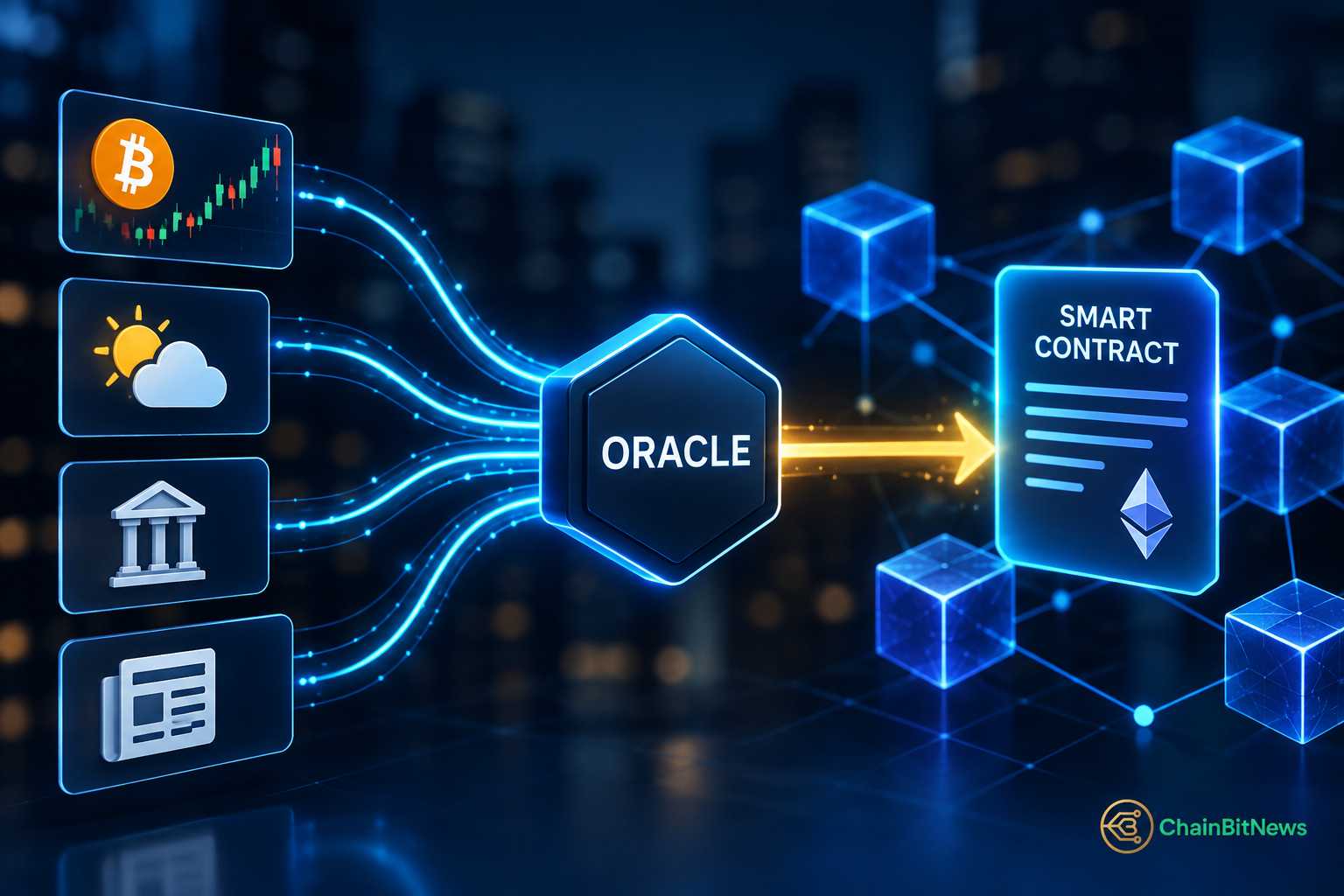
Oracles connect blockchains with external information, allowing smart contracts to react to data that does not originate directly on-chain.
They have become particularly important in decentralized finance, where billions of dollars in smart contracts can depend on accurate and timely market data.
Understanding oracles therefore means understanding one of the most important connections between blockchain networks and the world outside them.
In This Analysis, We’ll Explore:
- What blockchain oracles are
- Why smart contracts need external data
- The oracle problem
- How blockchain oracles work
- The difference between centralized and decentralized oracles
- Why oracle security matters
- How oracles are used in DeFi
- Price feeds, lending and liquidations
- Oracle manipulation and data risks
- Chainlink as a major oracle example
- Other uses beyond decentralized finance
- Why oracles matter for broader blockchain adoption
What Is a Blockchain Oracle?
A blockchain oracle is a system that provides smart contracts with information they cannot obtain directly from the blockchain.
This information can include:
- Cryptocurrency prices
- Exchange rates
- Commodity prices
- Interest rates
- Weather information
- Sports results
- Financial market data
- Information from external APIs
- Data from other systems
The oracle acts as a bridge between blockchain applications and external information.
Importantly, an oracle is not necessarily the original source of the information.
For example, an oracle network providing an ETH/USD price may collect information from multiple exchanges or professional data providers.
The oracle’s job is to obtain, verify and deliver that information in a form a smart contract can use.
This creates a basic information flow:
External Data → Oracle → Smart Contract → On-Chain Action
In decentralized oracle networks, additional steps may be used to collect information from multiple sources and compare or aggregate the results before the final value reaches the smart contract.
That additional verification is important because smart contracts may automatically execute based on the information they receive.
Why Smart Contracts Need Oracles
Smart contracts are programs running on blockchain networks.
They execute according to predefined rules.
A simple example might be:
If condition X occurs, execute action Y.
The smart contract itself can verify information already available on its blockchain.
It can determine whether an address owns a particular token, whether a transaction occurred or how much cryptocurrency is stored inside a contract.
But many useful applications depend on information that does not exist on-chain.
Imagine a decentralized lending protocol.
A user deposits ETH worth $10,000 as collateral and borrows $5,000 in stablecoins.
The protocol needs to continuously determine the value of that ETH.
If the collateral value falls too far, the loan may need to be liquidated.
But the blockchain does not inherently know the dollar price of ETH.
Someone — or something — must provide that information.
That is the oracle.
Without reliable external price information, the lending protocol cannot accurately determine whether the collateral remains sufficient.
The same principle applies across many blockchain applications.
A derivatives contract may need an asset price.
An insurance application may need weather data.
A prediction market may need the verified result of an event.
Smart contracts provide the execution logic.
Oracles provide information about the outside world that can trigger that logic.
Smart Contracts Explained: How Blockchain Automation Works & Why It Matters for Investors
The Oracle Problem Explained
Oracles solve one problem but introduce another.
Blockchains are designed so participants do not need to trust one central party to determine what is true.
But what happens if a decentralized smart contract depends on information supplied by a single external source?
The blockchain may be decentralized.
The smart contract may execute exactly as programmed.
But the external data could still be wrong.
This is known as the oracle problem.
Consider a lending protocol that uses one source for the price of ETH.
The source incorrectly reports:
ETH = $1,000
when the broader market price is actually:
ETH = $2,500
The smart contract does not automatically understand that the data is wrong.
It simply receives the value and executes its programmed rules.
Borrowers who were safely collateralized could potentially appear undercollateralized.
That could trigger incorrect liquidations.
The smart contract itself has not failed.
It has executed exactly as intended.
The failure occurred in the information supplied to it.
This leads to an important principle:
A smart contract can only make reliable decisions when the data it receives is reliable.
This is why oracle design is such an important part of blockchain infrastructure.
How Blockchain Oracles Work
Oracle systems can be designed in different ways, but the general process is relatively straightforward.
Suppose a DeFi application needs the current price of ETH in US dollars.
First, market data is obtained from external sources.
These might include multiple cryptocurrency exchanges or specialized data providers.
The oracle system then processes the information.
Rather than automatically trusting one price, a decentralized oracle network can compare data from multiple sources.
The information may then be aggregated into a final value.
That value is delivered on-chain, where the smart contract can use it.
The process can be summarized as:
Data Sources → Oracle Network → Validation/Aggregation → Blockchain → Smart Contract
This separation is important.
The blockchain provides consensus about what happens inside the blockchain.
The oracle system provides information about what happens outside it.
The two systems then interact.
On-Chain and Off-Chain Data
Understanding oracles becomes easier when distinguishing between on-chain and off-chain information.
On-chain data already exists within a blockchain.
Examples include:
- Wallet balances
- Transactions
- Token transfers
- Smart contract activity
- Blockchain state
A smart contract can work directly with this information because the network itself verifies it.
Off-chain data originates outside the blockchain.
Examples include:
- Asset prices
- Weather conditions
- Real-world payment information
- Sports results
- Traditional financial data
Blockchains cannot independently verify most of these facts.
They need a mechanism for bringing that information on-chain.
Oracles provide that mechanism.
This is why calling an oracle simply a “data source” can be misleading.
The important challenge is not only obtaining information.
It is obtaining external information in a way that remains reliable enough for decentralized applications to act upon it.
Centralized vs Decentralized Oracles
One of the most important differences between oracle systems is how they obtain and verify data.
Centralized Oracles
A centralized oracle relies on a single provider or source.
This approach can be simple and efficient.
But it creates a major weakness:
a single point of failure.
If that provider experiences an outage, reports incorrect information or is manipulated, the smart contract depending on it may receive unreliable data.
This can undermine the benefits of using decentralized blockchain infrastructure.
Imagine building a decentralized lending protocol worth hundreds of millions of dollars but allowing one server to determine the asset prices used for liquidations.
The smart contracts may be decentralized, but one critical part of the system remains dependent on a central party.
Decentralized Oracles
Decentralized oracle networks attempt to reduce this dependency.
Instead of trusting one source, they can use:
- Multiple data sources
- Multiple independent oracle operators
- Data aggregation
- Economic incentives
- Verification mechanisms
If several independent sources report similar values, the system has greater confidence that the resulting information reflects the broader market.
For example, instead of obtaining the Bitcoin price from one exchange, an oracle network might combine information from numerous sources.
An abnormal price from one venue would then have less influence over the final result.
The goal is not to make external data magically trustless.
The goal is to reduce dependence on any single source or participant.
Why Decentralization Matters for Oracle Security
Oracle decentralization matters because the security of a smart contract can depend on the weakest part of the system surrounding it.
A blockchain might have thousands of validators.
Its smart contracts may be carefully audited.
Its applications may be transparent.
But if a critical application relies on one easily manipulated external data source, much of that security can be undermined.
Decentralized oracle networks try to reduce several risks.
Data Source Risk
A single exchange or provider can report inaccurate information.
Using multiple independent sources reduces dependence on one source.
Oracle Operator Risk
Even if the underlying information is correct, the entity delivering it could fail or behave incorrectly.
Multiple independent operators reduce this dependency.
Manipulation Risk
Attackers may attempt to manipulate a market or data source used by a smart contract.
Aggregating data from deeper and more diverse markets can make manipulation more difficult.
Availability Risk
A data provider may temporarily become unavailable.
Using multiple sources and operators can improve reliability when individual components fail.
However, decentralization does not automatically make an oracle secure.
The quality of the underlying data still matters.
Ten oracle operators using the same unreliable source do not provide the same protection as genuinely independent data sources.
Likewise, poorly designed incentives or weak aggregation methods can introduce additional vulnerabilities.
Oracle security therefore depends on more than simply counting the number of participants.
It depends on the entire data pipeline.
Why Oracle Security Matters So Much in DeFi
The importance of oracle security becomes especially clear in decentralized finance.
DeFi protocols can automatically execute financial transactions without traditional intermediaries.
That automation is powerful.
But it also means incorrect data can have immediate financial consequences.
Consider again a lending protocol.
The protocol uses an oracle to determine the value of collateral.
If the oracle reports an inaccurate price, the protocol may:
- Liquidate positions incorrectly
- Allow users to borrow too much
- Miscalculate collateral ratios
- Create losses for lenders or borrowers
Similar risks exist in decentralized derivatives, synthetic assets and other applications that depend on external market prices.
The smart contract does not stop and ask whether the data “looks reasonable.”
It follows its programmed rules.
This is why reliable oracle infrastructure is not simply an additional feature for many DeFi applications.
It is part of their security model.
As blockchain applications become more connected to external markets and real-world information, this dependency becomes even more important.
How Oracles Are Used in DeFi
Decentralized finance is one of the clearest examples of why blockchain oracles are important.
DeFi protocols can execute lending, borrowing, trading and other financial activities through smart contracts. But many of these applications depend on market information that does not originate on the blockchain itself.
A lending protocol needs to know the value of collateral.
A derivatives platform may need the current price of the asset underlying a contract.
A stablecoin system may need external market prices to determine whether collateral remains sufficient.
Oracles provide this information.
This makes them an important connection between decentralized financial applications and the markets those applications represent.
Price Feeds, Lending and Liquidations
Price feeds are among the most important oracle applications in DeFi.
Consider a user who deposits ETH as collateral to borrow stablecoins.
The lending protocol needs to continuously compare:
Value of Collateral → Value of Debt
If the value of ETH falls significantly, the collateral may no longer be sufficient to safely support the loan.
The position can then become eligible for liquidation.
But the smart contract cannot independently determine the market price of ETH. It relies on an oracle price feed.
The same principle applies across many DeFi applications.
Price feeds can help protocols determine:
- Collateral values
- Liquidation thresholds
- Asset exchange rates
- Derivatives settlement
- Synthetic asset values
- Risk parameters
Accurate pricing therefore becomes part of the financial infrastructure supporting these protocols.
Oracle Manipulation and Data Risks
Because smart contracts automatically respond to oracle data, attackers may attempt to manipulate the information they receive.
One possible attack involves manipulating the price of an asset in a market used as an oracle source.
This risk can be particularly significant when an asset has low liquidity.
Imagine a protocol determines a token’s value using the price from one small decentralized exchange.
An attacker might temporarily move that market price through large trades.
If the oracle reports the manipulated price to a smart contract, the attacker could potentially exploit the difference before the market returns to normal.
Oracle failures do not always require malicious attacks.
Problems can also result from:
- Exchange outages
- Incorrect data
- Extreme volatility
- Delayed updates
- Low-liquidity markets
- Technical failures
- Abnormal prices on individual exchanges
This is why oracle design needs to consider not only whether data is available, but whether that data is sufficiently reliable and representative.
How Decentralized Oracle Networks Reduce Risk
Decentralized oracle networks attempt to reduce these vulnerabilities by avoiding dependence on a single source.
Instead of asking one provider:
“What is the price of ETH?”
a decentralized oracle system can collect information from multiple independent sources.
Those values can then be compared and aggregated before the result is delivered to a smart contract.
A simplified structure looks like this:
Multiple Data Sources → Oracle Network → Aggregated Result → Smart Contract
This creates several layers of protection.
If one exchange reports an abnormal price, other sources can reduce its influence on the final value.
If one oracle operator becomes unavailable, other operators may continue providing information.
And if an attacker wants to manipulate the final result, influencing a single source may no longer be enough.
However, decentralization does not automatically eliminate oracle risk.
The underlying data still needs to be reliable, and the sources need to be sufficiently independent.
Chainlink as a Real-World Example
Chainlink is one of the best-known examples of decentralized oracle infrastructure.
Its oracle networks allow blockchain applications to access external information while reducing dependence on individual data sources or operators.
For market price feeds, information can be collected from multiple sources and processed through decentralized oracle networks before becoming available to smart contracts.
This approach is particularly important for DeFi applications where incorrect market prices could affect lending, borrowing and liquidations.
Chainlink also demonstrates that oracle infrastructure can extend beyond cryptocurrency prices.
The broader purpose is to allow blockchain applications to interact with information and systems that exist outside their native networks.
The important principle is therefore larger than any individual oracle provider:
Smart contracts need a reliable way to connect decentralized execution with external information.
Other Uses Beyond DeFi
Although DeFi is one of the most important oracle use cases, external data can support many other types of blockchain applications.
Insurance
Blockchain-based insurance contracts may depend on real-world events.
For example, an agricultural insurance application could use weather information to determine whether predefined conditions occurred.
An oracle can provide the external data needed for the smart contract to execute.
Prediction Markets
Prediction markets need reliable information about real-world outcomes.
An oracle could provide the verified result of an event so the smart contract can settle the market.
Supply Chains
Blockchain applications used in supply chains may require information about shipments, delivery status or physical conditions.
External systems and sensors can provide information that is then connected to blockchain applications.
Traditional Financial Markets
Smart contracts may also require data involving:
- Stocks
- Bonds
- Interest rates
- Foreign exchange rates
- Commodities
Connecting this information to blockchains can expand the range of financial applications that smart contracts can support.
These examples all share the same requirement:
The smart contract needs information that the blockchain cannot verify by itself.
Oracles and Real-World Assets
The development of tokenized real-world assets makes external data particularly important.
If a blockchain token represents or tracks something outside the blockchain, applications may need reliable information about that underlying asset.
Tokenized financial assets, for example, could require market prices, interest rates or other financial information.
This highlights a broader challenge.
Blockchains are extremely effective at verifying their own state.
But as blockchain applications become connected to real-world assets, they increasingly depend on facts that exist outside their networks.
Oracles help bridge that gap.
The greater the connection between blockchain applications and the external economy becomes, the more important reliable data infrastructure becomes as well.
Why Data Freshness Matters
Oracle security is not only about whether information is correct.
It also matters when that information was correct.
Cryptocurrency prices can move rapidly.
A price that accurately represented the market several minutes ago may no longer be appropriate during extreme volatility.
For applications involving collateral and liquidations, outdated information can create additional risk.
Oracle systems therefore need to balance:
- Accuracy
- Update frequency
- Reliability
- Cost
Updating information more frequently can improve responsiveness, but delivering data on-chain also has costs.
Different oracle systems approach this trade-off differently.
The important principle is straightforward:
Reliable oracle data needs to be both accurate and sufficiently current for the application using it.
How to Evaluate an Oracle Network
Investors do not need to understand every technical detail of an oracle protocol to evaluate its basic structure.
Several questions can provide useful insight.
Where Does the Data Come From?
The quality of an oracle ultimately depends partly on the quality of its underlying information.
For price feeds, reliance on one thinly traded market can create additional risk.
Are Multiple Independent Sources Used?
Using several sources can reduce dependence on one provider.
But the sources should also be genuinely independent.
Ten sources ultimately relying on the same underlying information may provide less diversification than they appear to.
Who Operates the Oracle Network?
Independent operators can reduce the risk that one participant controls the information delivered to smart contracts.
How Is Data Aggregated?
Oracle networks need mechanisms for combining information and limiting the influence of abnormal values.
How Frequently Is Data Updated?
Different applications require different levels of data freshness.
A lending protocol exposed to volatile cryptocurrency prices may require more frequent updates than an application using slower-moving information.
What Happens When Something Fails?
A robust oracle design should account for outages, abnormal market conditions and unreliable data sources.
Oracle security is ultimately about the resilience of the complete system, not one individual component.
Why Oracles Matter for Blockchain Adoption
Smart contracts become significantly more useful when they can interact with information beyond their own blockchain.
Without oracles, smart contracts are largely limited to information already available on-chain.
With reliable oracle infrastructure, they can potentially respond to:
market prices, financial data, real-world events, external systems and other off-chain information.
This dramatically expands what blockchain applications can do.
A blockchain can provide secure execution and consensus.
A smart contract can define the rules.
An oracle can provide the external information required to apply those rules to events beyond the blockchain.
But this connection also creates dependency.
A blockchain cannot guarantee that external information is true simply because that information has been recorded on-chain.
The information needs to be reliable before the smart contract acts on it.
Conclusion
Blockchain oracles solve one of the fundamental limitations of smart contracts.
Blockchains can independently verify what happens within their own networks.
They cannot automatically know what is happening outside them.
Oracles provide that connection.
They allow smart contracts to use cryptocurrency prices, financial information, real-world events and other external data.
But connecting blockchains to the outside world introduces a new trust problem.
If the data is wrong, a smart contract can execute the wrong outcome perfectly.
That is the essence of the oracle problem.
Decentralized oracle networks attempt to reduce this risk by combining multiple data sources, independent operators and aggregation mechanisms rather than relying entirely on one provider.
This has made oracle infrastructure particularly important in DeFi, where lending positions, liquidations and other financial transactions can depend directly on external market data.
Its importance may extend much further.
As blockchain applications increasingly interact with traditional finance, real-world assets and external systems, reliable data becomes a fundamental part of the infrastructure connecting those worlds.
Smart contracts provide automated execution.
Blockchains provide verification and consensus.
Oracles provide the information that allows those systems to understand and respond to events beyond the blockchain itself.
Why Retail Investors Always Arrive Late in Crypto Cycles
Disclaimer: This article is for educational and informational purposes only and does not constitute financial or investment advice. Cryptocurrency, blockchain and decentralized finance applications involve significant technical and financial risks. Always conduct your own research before using blockchain protocols or making investment decisions.