
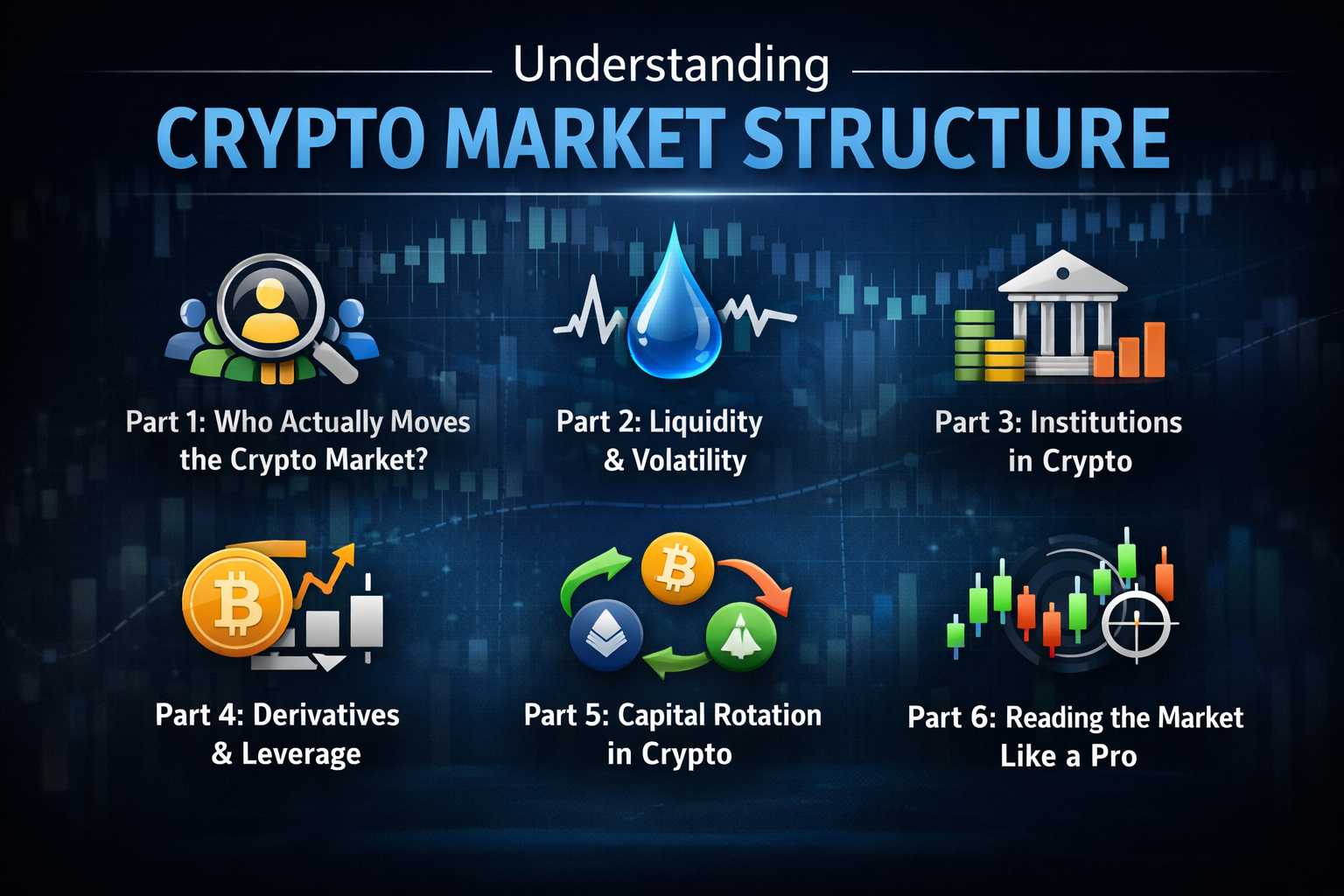
Cryptocurrency markets rarely move in a uniform way across all assets.
Instead, capital often rotates between different segments of the market over time. Investors may shift funds from one category of assets to another as sentiment, risk appetite and market momentum evolve.
Understanding how this capital rotation works can help investors interpret broader market trends and recognize why certain assets outperform others during different phases of the market cycle.
Rather than moving randomly, capital in crypto markets often follows recognizable patterns.
Capital rotation is one of the core mechanisms driving crypto market cycles.
Different phases of the market often attract different types of investors, narratives, and risk appetite. As liquidity and confidence expand, capital tends to move gradually from lower-risk assets such as Bitcoin toward higher-risk and more speculative parts of the market.
Understanding these rotation patterns helps investors better interpret:
- market cycle transitions
- altcoin strength and weakness
- Bitcoin dominance shifts
- changes in investor risk appetite
- why some sectors suddenly outperform others
In many cases, crypto market cycles are not driven by isolated assets moving independently, but by capital continuously rotating throughout the ecosystem.
What Is Capital Rotation?
Capital rotation refers to the movement of investment funds between different assets or sectors within a market.
In cryptocurrency markets, this typically involves capital shifting between:
- Bitcoin
- Ethereum
- large-cap altcoins
- smaller or more speculative altcoins
These shifts often occur as investors adjust their risk exposure based on market conditions and perceived opportunities.
When one part of the market becomes less attractive or reaches extended valuations, capital may move into other assets that investors believe offer stronger potential.
Why Capital Rotation Happens
Capital rotation happens because investor behavior changes throughout market cycles.
During uncertain conditions, investors often prioritize assets perceived as safer or more established, such as Bitcoin.
As confidence grows and volatility becomes more attractive, investors gradually increase exposure to higher-risk assets in search of larger returns.
Several factors influence capital rotation, including:
- market sentiment
- liquidity conditions
- risk appetite
- Bitcoin momentum
- macroeconomic conditions
- social media narratives
- speculative behavior
This process creates repeating patterns where leadership rotates between different sectors of the crypto market.
Bitcoin as the Starting Point
Bitcoin typically acts as the primary entry point for capital entering the crypto market.
Many investors view Bitcoin as the most established and relatively stable digital asset. As a result, new capital entering the market often flows into Bitcoin first.
During early phases of market expansion, Bitcoin frequently leads the overall market as confidence begins to grow.
When Bitcoin experiences strong upward momentum, it can attract significant attention and capital inflows.
Rotation Into Ethereum
As markets mature during a bullish phase, capital often begins rotating into Ethereum.
Ethereum plays a unique role within the crypto ecosystem because of its extensive smart contract infrastructure and large developer community.
When Bitcoin stabilizes after an initial rally, investors may start seeking higher potential returns in assets like Ethereum.
This shift can lead to periods where Ethereum outperforms Bitcoin in percentage terms.
Ethereum often acts as a bridge between Bitcoin dominance and broader altcoin speculation.
Because Ethereum sits at the center of decentralized finance, Layer-2 ecosystems, smart contracts, and on-chain activity, it frequently becomes the next major destination for capital after Bitcoin rallies begin stabilizing.
This transition is important because strong Ethereum performance historically increases broader confidence across the altcoin market.
The Altcoin Phase
Later in market cycles, capital may begin rotating further into altcoins.
These assets often include:
- large-cap alternative cryptocurrencies
- ecosystem tokens
- smaller speculative projects
Altcoins can experience significant price movements during these phases as investors pursue higher-risk opportunities with potentially larger upside.
However, these phases can also involve increased volatility and risk.
How Altseason Develops
Altseason typically develops when investors become increasingly comfortable taking higher levels of risk.
After Bitcoin and Ethereum perform strongly, speculative capital often begins rotating into:
- smaller altcoins
- emerging ecosystems
- meme coins
- low-cap speculative assets
During these phases, volatility increases dramatically because liquidity spreads across a wider range of cryptocurrencies.
Altseason periods are often driven heavily by:
- social media hype
- rapid narrative shifts
- speculation
- fear of missing out (FOMO)
However, altseason environments also tend to carry significantly higher downside risk once liquidity begins leaving speculative assets again.
Altcoins vs Memecoins vs Hype Coins: What’s the Difference and Why It Matters
Bitcoin Dominance
One indicator often used to track capital rotation is Bitcoin dominance.
Bitcoin dominance measures Bitcoin’s share of the total cryptocurrency market capitalization.
When Bitcoin dominance rises, it suggests that capital is flowing primarily into Bitcoin relative to other assets.
When Bitcoin dominance declines, it can indicate that capital is rotating into altcoins.
Although dominance trends do not guarantee market direction, they can provide useful insight into broader capital flows within the crypto ecosystem.
How Investors Interpret Bitcoin Dominance
Many investors monitor Bitcoin dominance closely because it can provide insight into changing market leadership.
Rising Bitcoin dominance often appears during:
- market uncertainty
- early bull market phases
- risk-off environments
Declining Bitcoin dominance may suggest:
- growing altcoin participation
- higher speculative activity
- expanding investor risk appetite
However, Bitcoin dominance should always be interpreted alongside broader market conditions rather than used as a standalone predictive indicator.
The Risks of Chasing Capital Rotation
Many investors attempt to aggressively chase capital rotation by constantly moving between trending assets.
However, this strategy can become dangerous because rotation phases are often highly emotional and difficult to time consistently.
Common mistakes include:
- buying altcoins after large rallies
- rotating too late into speculative sectors
- overexposure during euphoric phases
- panic selling during sharp reversals
Because crypto market cycles move quickly, emotional decision-making can significantly increase risk.
Experienced investors often focus more on structured positioning and risk management than on perfectly timing every phase of capital rotation.
Why Capital Rotation Matters
For investors, understanding capital rotation helps explain why different assets perform well at different times.
Rather than assuming that all cryptocurrencies move together, investors can recognize that market leadership often shifts during various phases of the cycle.
By observing these patterns, investors may gain better perspective on market trends and risk dynamics.
Capital rotation also highlights the importance of diversification and strategic positioning within the broader crypto market.
Conclusion
Capital rotation is one of the most important forces shaping cryptocurrency market cycles.
Rather than moving uniformly across all assets, liquidity continuously shifts between Bitcoin, Ethereum, large-cap altcoins, and highly speculative sectors as investor sentiment, confidence, and risk appetite evolve.
Understanding these rotation patterns helps explain:
- why Bitcoin often leads early market phases
- why Ethereum frequently strengthens after Bitcoin rallies stabilize
- why altcoins can suddenly outperform aggressively
- why speculative phases often create extreme volatility
Capital rotation is closely connected to:
- liquidity conditions
- market psychology
- narratives
- institutional positioning
- speculative behavior
- Bitcoin dominance trends
As market confidence expands, investors typically move gradually further out on the risk curve in search of higher returns.
However, these same rotation cycles can reverse quickly once liquidity weakens or market sentiment deteriorates.
For investors, understanding capital rotation provides valuable insight into:
- market cycle transitions
- risk dynamics
- sector leadership
- altseason behavior
- changing investor psychology
Rather than viewing crypto markets as random price movement, investors can begin recognizing how liquidity and capital flows shape the structure of the entire ecosystem.
In the next part of the Understanding Crypto Market Structure series, we’ll explore how professional investors interpret market conditions, liquidity, sentiment, and positioning to better understand crypto market behavior.
Part 6 How to Read the Crypto Market Like a Professional – Understanding Crypto Market Structure
Part 4 Derivatives, Leverage and Liquidations – Understanding Crypto Market Structure
Position Sizing in Crypto: How to Allocate Capital Without Destroying Your Portfolio
How to Protect Your Capital in Crypto: A Survival Guide for Long-Term Investors
Disclaimer: This article is for informational purposes only and does not constitute financial advice. Cryptocurrency markets are volatile and involve significant risk. Always conduct your own research before making investment decisions.