
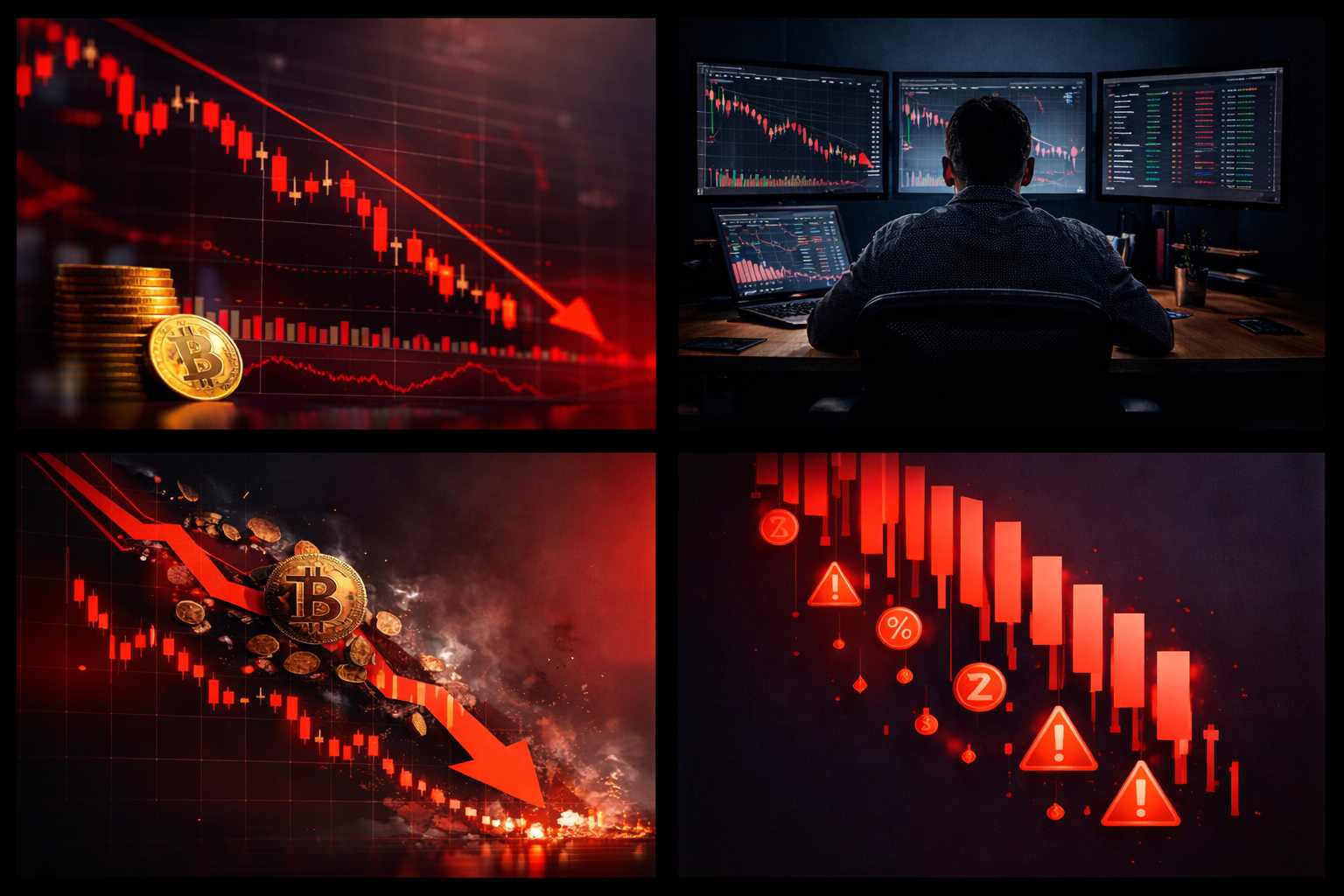
Crypto day trading attracts traders because cryptocurrency markets move quickly.
Bitcoin and major altcoins can experience significant price swings within hours, while smaller cryptocurrencies can move even more aggressively.
These movements create opportunities for short-term traders attempting to profit from relatively small changes in price.
But volatility does not automatically create profitability.
Every trade involves uncertainty, and frequent trading introduces additional challenges such as fees, slippage, leverage, liquidation risk and emotional decision-making.
A trader can correctly predict market direction and still lose money through poor position sizing or execution.
Understanding crypto day trading therefore requires more than learning chart patterns or technical indicators.
Not every market participant operates on the same time horizon. Swing traders may hold positions for days or weeks, while long-term investors can remain invested for months or years. Each approach creates different demands in terms of time commitment, risk management, market timing and emotional discipline.
It requires understanding how short-term trading actually works and where its risks come from.
In This Analysis, We’ll Explore:
- What crypto day trading is
- How day trading works
- Why crypto attracts day traders
- Spot vs perpetual futures trading
- Leverage and liquidation risk
- Liquidity, spreads and slippage
- Trading fees and funding costs
- Risk/reward and trading expectancy
- Position sizing and stop-losses
- Trading psychology
- Common day trading mistakes
- Whether crypto day trading can be profitable
- Day trading vs swing trading vs long-term investing
- When swing trading may make more sense than day trading
- Time commitment and screen time
- Trading frequency and costs
- Which strategy fits different investor profiles
What Is Crypto Day Trading?
Crypto day trading is a short-term strategy where traders attempt to profit from price movements over relatively short periods.
Positions may remain open for minutes or hours rather than months or years.
For example, a trader might buy Bitcoin at:
$80,000
and sell at:
$80,800
The price increased only 1%, but the trader attempts to capture that short-term movement.
Traders can also take short positions through derivatives and attempt to profit when cryptocurrency prices decline.
The objective is therefore very different from long-term investing.
A long-term investor asks:
“Will this asset become more valuable over the next several years?”
A day trader asks:
“Where is price likely to move next?”
Those questions require very different strategies.
How Crypto Day Trading Works
Day traders use short-term market information to identify potential trading opportunities.
This may include:
Before entering a trade, a structured trader typically considers three important levels:
Entry: Where should the position be opened?
Invalidation: At what price is the trading idea no longer valid?
Target: Where could profits reasonably be taken?
This creates a predefined structure before capital is committed.
Without one, traders can easily change their decisions after price begins moving.
A small loss becomes a position they “will hold until it recovers.”
A profitable trade remains open because the trader wants more.
Short-term trading therefore depends heavily on discipline.
Day Trading vs Swing Trading vs Long-Term Investing
Day trading, swing trading and long-term investing all provide exposure to cryptocurrency markets, but they operate on very different time horizons.
The differences go far beyond how long a position remains open.
Trading frequency, transaction costs, screen time, market timing and psychological pressure can all change depending on the strategy.
Day Trading
Day traders attempt to capture short-term price movements, with positions often remaining open for minutes or hours.
The strategy places significant emphasis on:
- Short-term market structure
- Execution
- Liquidity
- Volatility
- Risk management
- Precise entries and exits
Because trades occur frequently, fees, spread and slippage can have a larger impact on performance.
Day trading also requires considerable attention. Crypto markets operate continuously, meaning traders must create their own boundaries around when they trade and when they stop.
Swing Trading
Swing trading operates on a longer timeframe.
Instead of attempting to capture intraday movements, swing traders generally hold positions for several days or weeks while trying to benefit from broader market trends.
This reduces the need to monitor every short-term price movement.
Swing traders may focus on:
- Broader market structure
- Support and resistance
- Momentum
- Trend development
- Higher timeframes
- Risk/reward
Trading frequency is generally lower than with day trading, which can reduce the impact of repeated transaction costs.
However, holding positions longer introduces different risks.
Crypto trades 24/7, so swing traders remain exposed to sudden price movements overnight and during weekends. News, liquidations or broader market events can significantly change a position before the trader reacts.
Long-Term Investing
Long-term investors approach the market differently.
Rather than attempting to profit from individual price swings, they generally hold assets for months or years based on a broader investment thesis.
Analysis may focus more heavily on:
- Adoption
- Tokenomics
- Network activity
- Development
- Competitive positioning
- Long-term market cycles
Short-term execution becomes less important, while the quality of the underlying asset becomes more important.
A long-term investor can tolerate many short-term price movements if the original investment thesis remains intact.
However, long-term investing introduces its own risk:
The investment thesis itself can be wrong.
Holding an asset for longer does not automatically make it a good investment.
Typical Time Horizon
Day Trading: Minutes to hours
Swing Trading: Days to weeks
Long-Term Investing: Months to years
Trading Frequency
Day Trading: High
Swing Trading: Moderate
Long-Term Investing: Low
Screen Time
Day Trading: High
Swing Trading: Moderate
Long-Term Investing: Low
Transaction Cost Impact
Day Trading: High
Swing Trading: Moderate
Long-Term Investing: Low
Market Timing Importance
Day Trading: Very high
Swing Trading: High
Long-Term Investing: Lower
Main Focus
Day Trading: Short-term price action
Swing Trading: Broader trends
Long-Term Investing: Fundamentals and adoption
Leverage
Day Trading: Often used
Swing Trading: Sometimes used
Long-Term Investing: Usually unnecessary
Main Risk
Day Trading: Execution and repeated losses
Swing Trading: Trend reversals and extended exposure
Long-Term Investing: Long-term thesis failure
When Swing Trading May Make More Sense Than Day Trading
Swing trading can offer a middle ground between active day trading and long-term investing.
A trader can still attempt to benefit from market trends without needing to react to every intraday movement.
This may be attractive to traders who:
- Cannot monitor crypto markets continuously
- Prefer fewer, higher-conviction setups
- Want to reduce trading frequency
- Focus on broader technical structure
- Are comfortable holding positions through short-term volatility
Lower trading frequency can also reduce the cumulative impact of fees, spreads and slippage.
But swing trading is not simply an easier version of day trading.
Holding positions for longer means accepting greater exposure to unexpected market developments. A position may remain open while the trader sleeps, while major news breaks or while derivatives markets experience sudden liquidation events.
Swing trading therefore exchanges some of the execution pressure of day trading for greater exposure to market developments over time.
Time Commitment and Trading Frequency
The amount of time required can differ substantially between strategies.
Day trading generally requires the greatest level of active involvement because short-term setups can develop and disappear quickly.
Swing traders can operate on higher timeframes and may not need to monitor every market movement.
Long-term investors generally make fewer decisions because individual intraday movements have much less influence on the investment thesis.
This creates an important distinction:
More market activity does not automatically create higher returns.
Higher trading frequency creates more opportunities, but it also creates more decisions, more transaction costs and more opportunities to make mistakes.
The appropriate level of activity depends on the strategy being used.
Volatility Is Not the Same as Opportunity
Day traders need price movement.Without volatility, there would be fewer short-term opportunities.
But a large price movement is useful only if the trader can capture it with acceptable risk.
Suppose an altcoin regularly moves 10% per day.
That sounds attractive.
But if those movements are unpredictable and accompanied by poor liquidity, large spreads and sudden reversals, trading the asset may be extremely difficult.
This creates an important distinction:
Volatility creates movement.
A trading edge creates opportunity.
An edge is a repeatable advantage that produces positive results over many trades.
Simply trading the most volatile cryptocurrency does not create one.
Spot Trading vs Perpetual Futures
Crypto day traders can operate in different markets.
Spot Trading
In spot markets, traders buy or sell the cryptocurrency itself.
Suppose a trader buys $1,000 of Bitcoin.
If Bitcoin falls 5%, the position loses approximately 5% in value.
The trader still owns the Bitcoin.
Perpetual Futures
Perpetual futures allow traders to gain exposure to crypto prices without necessarily owning the underlying asset.
They also make it possible to:
- Take short positions
- Use leverage
- Trade with margin
These features make perpetual futures popular among day traders.
But they also introduce additional risks.
How Leverage Changes Risk
Leverage allows a trader to control a larger position using a smaller amount of capital.
Suppose a trader has:
$1,000
Using 5x leverage could create approximately:
$5,000 of market exposure
A 2% move in the underlying asset now represents approximately $100 on the $5,000 position before costs.
Relative to the trader’s original $1,000, that is a 10% change.
This works in both directions.
Leverage amplifies profitable movements.
It also amplifies mistakes.
Importantly:
Leverage does not make a trading strategy better.
It only magnifies the financial consequences of its results.
Liquidation Risk
Leveraged trading also introduces liquidation risk.
When losses become too large relative to the collateral supporting a position, the exchange may automatically close that position.
The exact liquidation level depends on factors such as:
- Leverage
- Entry price
- Available collateral
- Maintenance margin
- Exchange rules
Higher leverage generally means the trader has less room for price to move against the position.
This can create a frustrating situation.
A trader may correctly predict the broader direction of Bitcoin but still be liquidated during a temporary move in the opposite direction.
The market later moves exactly as expected.
The trader no longer has the position.
This is why leverage increases the importance of short-term volatility.
Liquidity, Spreads and Slippage
Price on a chart is not always the exact price a trader receives.
Markets contain buyers and sellers at different prices.
The difference between the highest available buying price and lowest selling price is the spread.
When liquidity is deep, this spread is generally smaller.
When liquidity is poor, spreads can become wider.
Slippage occurs when a trade executes at a different average price than expected.
For example, a trader attempts to buy a token around:
$10.00
but receives an average execution price of:
$10.05
For an investor making occasional long-term purchases, a small difference may not be particularly important.
For a trader executing hundreds of transactions, these differences accumulate.
This is one reason why smaller altcoins can be more difficult to day trade despite their greater volatility.
Trading Fees and Funding Costs
Every trade needs to overcome trading costs before becoming profitable.
Depending on the market, these can include:
- Entry and exit fees
- Spread
- Slippage
- Perpetual futures funding
Suppose a trader repeatedly attempts to capture gains of around 0.5%.
If total trading friction consumes 0.1% or 0.2%, a significant percentage of the potential profit disappears before losses are even considered.
This effect becomes more important as trading frequency increases.
A strategy can therefore appear profitable on a chart but perform poorly once real execution costs are included.
Perpetual futures can also involve funding payments, where one side of the market periodically pays the other depending on market conditions.
For very short trades this may not always be significant, but it remains another potential cost that traders need to understand.
Why Frequent Trading Can Erode Capital
Small trading costs appear insignificant individually.
Repeated continuously, they become meaningful.
Consider a trader who enters many positions each week.
Every completed trade may involve:
fees + spread + possible slippage
Winning trades must overcome those costs.
Losing trades pay those costs as well.
Increasing the number of trades therefore increases both:
potential opportunities
and
the amount of friction the strategy must overcome.
This is why more activity does not automatically produce more profit.
Sometimes the best trading decision is simply not to trade.
And costs are only one side of the equation.
Even after fees, a trader can have a high percentage of winning trades and still lose money.
Win Rate vs Risk/Reward
Many traders focus heavily on win rate.
A strategy that wins 70% of the time sounds better than one that wins only 40%.
But win rate alone does not determine profitability.
Consider two traders.
Trader A
Wins 70% of trades.
Average winner:
+$50
Average loser:
-$150
Across ten trades:
7 wins × $50 = +$350
3 losses × $150 = -$450
Result before trading costs:
-$100
Trader A was correct 70% of the time and still lost money.
Trader B
Wins only 40% of trades.
Average winner:
+$150
Average loser:
-$75
Across ten trades:
4 wins × $150 = +$600
6 losses × $75 = -$450
Result before costs:
+$150
Trader B loses more trades than they win but has a better relationship between risk and reward.
This is why professional trading analysis focuses on more than being right.
Trading Expectancy Explained
Trading expectancy estimates how much a strategy can theoretically make or lose on average across many trades.
A simplified formula is:
Expectancy = (Win Rate × Average Win) − (Loss Rate × Average Loss)
Suppose a strategy has:
Win rate: 50%
Average win: $120
Average loss: $80
The expectancy is:
(0.50 × $120) − (0.50 × $80)
$60 − $40 = +$20
The theoretical expectancy is therefore positive before trading costs.
This does not mean every trade earns $20.
Individual outcomes can vary dramatically.
Expectancy becomes meaningful across a sufficiently large number of trades.
And once again, fees, spread, slippage and funding need to be included when evaluating real results.
A small theoretical edge can disappear completely after costs.
Position Sizing Matters More Than One Trade
Even a profitable trading strategy will experience losses.
The important question is how much damage those losses cause.
Suppose two traders use the same strategy.
One risks 1% of their capital per trade.
The other risks 20%.
Several consecutive losses may be manageable for the first trader.
For the second, the same sequence can severely damage the account.
This is why position sizing is fundamental to day trading.
No trader knows with certainty whether the next setup will succeed.
Risk should therefore be determined before the outcome is known.
A trader who repeatedly places too much capital behind individual predictions can eventually encounter a losing sequence large enough to cause serious damage.
Position Sizing in Crypto: How to Allocate Capital Without Destroying Your Portfolio
The Mathematics of Drawdowns
Large losses create another problem: recovering them requires increasingly large percentage gains.
If a portfolio loses: 10%
it requires approximately: 11.1% to recover.
After a: 25% loss
approximately: 33.3% is needed.
After a: 50% loss
the required recovery is: 100%.
This is why protecting trading capital matters.
The objective is not simply to maximize profits when trades work.
It is also to prevent losing periods from becoming so severe that recovery becomes increasingly difficult.
Stop-Losses and Their Limitations
A stop-loss is an instruction designed to exit a position when price reaches a predetermined level.
It can help traders define risk before entering.
For example:
Entry: $100
Stop: $97
Target: $106
The trader is risking approximately $3 per unit for a potential $6 gain per unit.
That creates a theoretical:
1:2 risk/reward ratio
But stop-losses are not perfect protection.
During rapid volatility, price can move through a stop level before the order is fully executed.
Slippage can result in a larger loss than expected.
Very tight stops can also be triggered by normal crypto volatility before price moves in the anticipated direction.
A stop-loss is therefore a risk-management tool.
It does not eliminate market risk.
Overtrading and Revenge Trading
The 24/7 nature of crypto creates constant temptation to act.
After closing a losing trade, another setup is immediately available.
Then another.
This can lead to overtrading.
Instead of waiting for conditions that match a strategy, traders begin taking increasingly weak setups simply because the market is moving.
Losses can create an even more dangerous response:
revenge trading.
A trader loses $200 and immediately wants to recover it.
Position size increases.
Standards fall.
Risk limits disappear.
The next trade is no longer based entirely on market conditions.It is based on the emotional need to erase the previous loss.
This is one of the ways a relatively small trading loss can develop into serious capital erosion.
FOMO and Trading Psychology
Fear of missing out affects traders differently from long-term investors.
A breakout begins.
Price accelerates.
The trader hesitates.
Then price moves higher again.
Eventually, the trader enters because they cannot tolerate watching the move continue without them.
The original setup may already be gone.
The entry price is worse.
The risk/reward has changed.
And the trade is now driven partly by emotion.
Short-term trading repeatedly exposes participants to:
- Fear
- Greed
- Impatience
- FOMO
- Frustration
- Overconfidence
A trading strategy can be logically sound on paper but fail when the trader repeatedly abandons its rules under pressure.
Psychology is therefore not separate from risk management.
It is part of it.
Advanced Crypto Investing Strategies – Part 4: Managing Emotions & Avoiding FOMO
Technical Indicators Do Not Automatically Create an Edge
RSI, MACD, moving averages, Stochastic RSI and other indicators can help traders interpret market conditions.
But indicators do not predict the future with certainty.
Most are calculated from information already contained in price or volume.
They can help identify:
- Momentum
- Trend
- Volatility
- Potential extremes
- Changes in market behavior
But a single indicator saying “oversold” does not guarantee price will rise.
Likewise, an “overbought” reading does not guarantee a decline.
Indicators become more useful when interpreted within broader context such as:
market structure + liquidity + timeframe + risk/reward
rather than being treated as automatic buy and sell signals.
Why Backtesting Can Look Better Than Reality
A trading strategy may appear highly profitable when tested on historical charts.
Real trading can be more difficult.
A backtest may not perfectly reproduce:
- Slippage
- Spread changes
- Trading fees
- Funding
- Liquidity conditions
- Execution delays
- Emotional decision-making
There is also a risk of designing a strategy that works extremely well on historical data simply because its rules were adjusted until they fit the past.
Future markets may behave differently.
Backtesting can still be valuable.
But strong historical results should not be confused with guaranteed future profitability.
Day Trading Bitcoin vs Altcoins
Not all cryptocurrencies create the same trading environment.
Bitcoin
Bitcoin generally benefits from deeper liquidity and substantial trading activity.
This can make execution more efficient than in many smaller assets.
However, Bitcoin is still highly volatile and difficult to predict over short periods.
Major Altcoins
Large altcoins can provide greater volatility while still maintaining significant liquidity.
This can create more aggressive short-term opportunities and risks.
Small-Cap Altcoins
Smaller tokens can move dramatically.
But traders may also encounter:
- Thin liquidity
- Larger spreads
- Greater slippage
- Sudden price spikes
- Greater manipulation risk
- Difficulty exiting positions
The asset with the largest percentage movements is therefore not necessarily the best asset to trade.
Execution quality matters.
Can Day Trading and Swing Trading Be Profitable?
Yes, crypto day trading can be profitable.
But profitability requires more than occasionally predicting market direction correctly.
A sustainable strategy needs to overcome:
- Losing trades
- Trading fees
- Spread
- Slippage
- Funding where applicable
- Emotional mistakes
It also needs positive expectancy over a meaningful number of trades.
This means the important question is not:
“Can someone make money day trading crypto?”
Clearly, some traders can.
The more useful question is:
“Does this trader have a repeatable edge that remains profitable after costs and can be executed consistently?”
That is a much higher standard.
A few successful trades prove very little.
Long-term trading performance matters more.
The same principle applies to swing trading. Lower trading frequency can reduce some of the friction associated with day trading, but it does not automatically create a profitable strategy.
Swing traders still need a repeatable process for identifying opportunities, managing position size and determining when a trade is no longer valid.
The timeframe changes. The requirement for positive expectancy does not.
Common Day Trading and Swing Trading Mistakes
Many trading losses come from recurring behavioral and structural mistakes rather than one catastrophic prediction.
Common mistakes include:
- Trading without predefined risk
- Using excessive leverage
- Chasing sudden price movements
- Focusing only on win rate
- Ignoring fees and slippage
- Trading illiquid altcoins
- Increasing position size after losses
- Moving stop-losses to avoid accepting a loss
- Taking too many low-quality setups
- Treating indicators as guaranteed signals
- Trading while tired or emotional
- Confusing a few successful trades with a proven strategy
- Entering swing trades against the broader market trend
- Holding failed swing setups because there is more time for them to “recover”
- Turning a losing swing trade into a long-term investment to avoid accepting the loss
The common theme is lack of structure.
Short-term markets move too quickly to build a risk framework after something has already gone wrong.
A Simple Framework Before Entering a Day Trade
Before opening a position, a trader should be able to answer several basic questions.
Why am I entering?
There should be a specific setup rather than a feeling that price will rise or fall.
Where is the trade invalidated?
Know what market behavior would prove the original idea wrong.
How much am I risking?
The potential loss should be understood before entering.
What is the potential reward?
A high win rate cannot compensate indefinitely for consistently poor risk/reward.
How liquid is the market?
Execution matters, particularly in smaller cryptocurrencies.
What costs will I pay?
Fees, spread, slippage and potentially funding affect real performance.
Am I following my strategy or reacting emotionally?
Sometimes this is the most important question.
Which Strategy Fits Which Type of Investor?
There is no single trading or investing approach that fits every market participant.
Day trading may be more suitable for traders who have significant time available, understand short-term market structure and can consistently follow strict execution and risk-management rules.
Swing trading may be more suitable for those who want active exposure to market trends without monitoring every intraday movement. It requires patience and the ability to tolerate short-term volatility while a setup develops.
Long-term investing may be more suitable for participants who prefer lower trading frequency and want to focus primarily on fundamentals, adoption, tokenomics and long-term market development.
The important distinction is not which strategy sounds most profitable.
It is whether the strategy’s time horizon, risk profile and decision-making requirements match the person attempting to execute it.
Conclusion
Crypto markets allow participants to operate across very different time horizons.
Day traders attempt to capture short-term price movements and depend heavily on execution, liquidity, risk management and trading discipline.
Swing traders step back from intraday noise and attempt to capture broader moves developing over days or weeks.
Long-term investors take an even wider perspective, focusing more heavily on fundamentals, adoption, tokenomics and the long-term development of an asset.
Each approach creates different risks.
Day trading faces significant trading friction and psychological pressure.
Swing trading reduces trading frequency but increases exposure to unexpected market movements while positions remain open.
Long-term investing reduces the importance of short-term execution but creates greater dependence on the underlying investment thesis being correct.
None of these approaches eliminates uncertainty.
And more activity does not automatically produce better returns.
The most important question is therefore not:
“Which strategy can make the most money?”
It is:
“Which strategy has a risk structure, time horizon and decision-making process that can be executed consistently?”
Day trading requires speed and execution.
Swing trading requires patience and intermediate-term market awareness.
Long-term investing requires conviction supported by fundamentals.
Understanding those differences is more valuable than assuming one strategy is automatically superior to the others.
Understanding Crypto Market Structure – Part 6 How to Read the Crypto Market Like a Professional
Think Like a Smart Crypto Investor Part 1: Why Mindset Matters More Than Price
Disclaimer: This article is for educational purposes only and does not constitute financial advice. Cryptocurrency trading involves significant risk, including the potential loss of capital. Always conduct independent research and consider your risk tolerance before trading.