
TRON has become an important blockchain for transferring stablecoins, particularly USDT. Its appeal is straightforward: users can move dollar-denominated tokens through an established network with broad exchange support and a resource system designed for repeated transactions.
For payment services, that combination matters. Reliable settlement, available liquidity and manageable transaction costs can be more important than the technological complexity behind a blockchain.
But TRON’s success as payment infrastructure raises a separate question.
Does growing stablecoin activity create lasting economic value for TRX, the network’s native token?
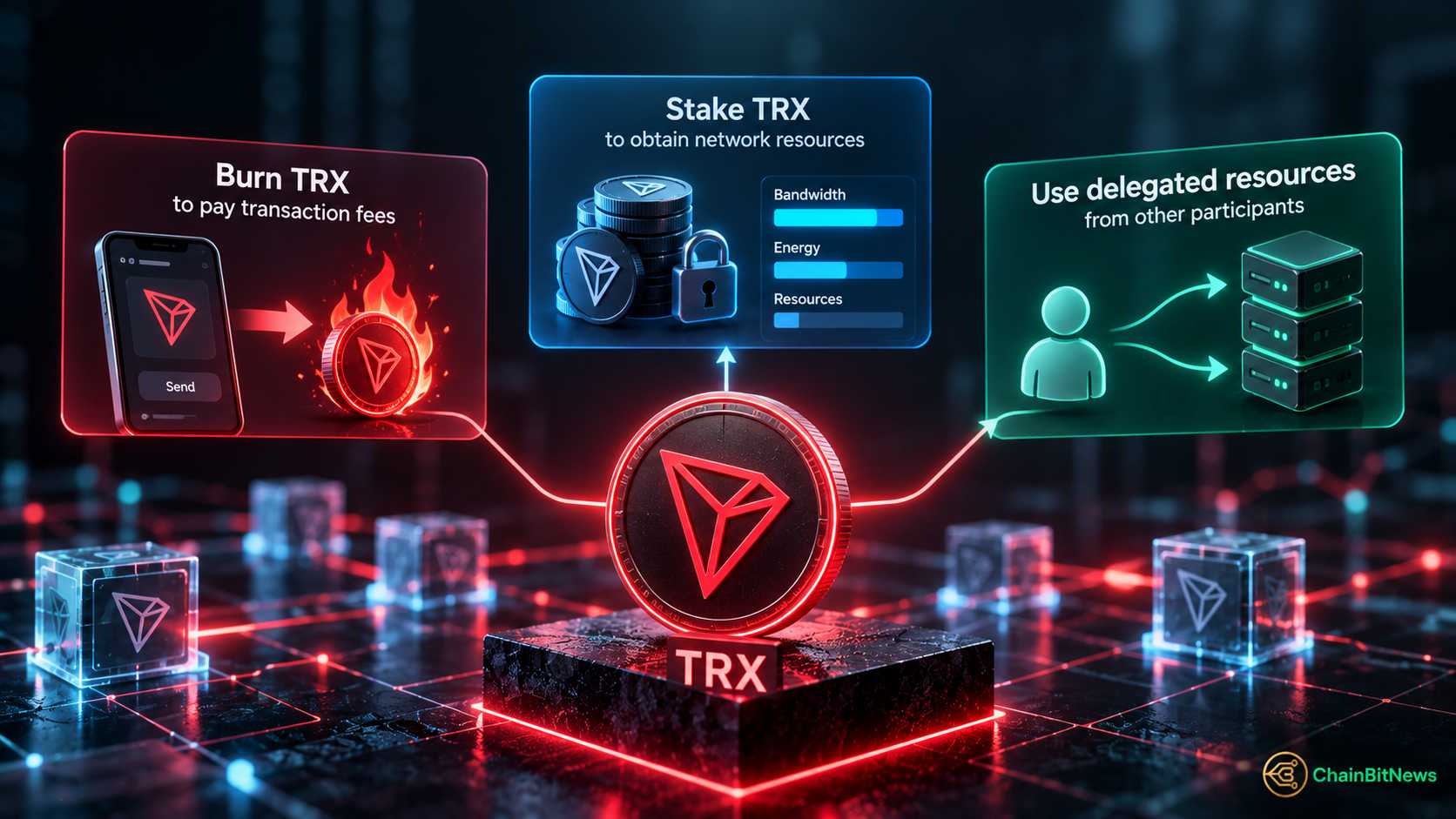
The connection is less direct than transaction volumes suggest. TRON allows users to pay transaction costs by burning TRX, obtain network resources through staking, or use resources delegated by other participants.
Each arrangement supports network activity, but its economic consequences for TRX differ.
Understanding those differences is essential to evaluating TRON beyond its adoption statistics.
Why Stablecoin Activity Matters to TRON
TRON’s economic position is closely connected to USDT, the dollar-pegged stablecoin issued by Tether. Although USDT operates across multiple blockchains, TRON has developed an established infrastructure for transferring it between wallets, exchanges and payment services.
The scale is significant. TRON DAO’s Q1 2026 report recorded approximately $86 billion in stablecoin supply on the network and reported trillions of dollars in quarterly stablecoin activity.
These figures demonstrate substantial usage, but they require careful interpretation.
A stablecoin transfer does not necessarily represent a commercial payment. Funds may move between exchanges, custodians, trading accounts or automated systems. The same capital can circulate repeatedly.
High transfer volume therefore establishes that a network processes economic activity, not how much of that activity represents independent payments or new demand.
TRON’s stronger competitive argument is its established combination of stablecoin liquidity, infrastructure support and practical transaction processing.
For businesses, switching networks involves more than comparing fees. Wallet compatibility, exchange support and available counterparties also matter.
This gives TRON an established position in stablecoin transfers, although that position remains exposed to competing networks and changes in user behavior.
How TRON’s Resource Model Changes the Economics
Consider a payment service processing hundreds of USDT transfers every day.
It could pay transaction costs directly using TRX. Alternatively, it could stake TRX to obtain resources or receive those resources from another provider.
TRON uses two principal resources: Bandwidth for transaction data and Energy for smart contract execution. USDT transfers generally require both.
When available resources are insufficient, the network can burn TRX to cover the required costs. Staking or delegation can reduce the need for direct burning.
This creates an important economic distinction.
A business paying transaction fees directly contributes to TRX destruction. A business staking TRX instead commits capital to obtain reusable resources. A business purchasing delegated Energy may rely on another participant to maintain the underlying TRX stake.
All three can generate similar transaction activity without producing the same amount of token burning.
As usage increases, infrastructure providers may accumulate or stake additional TRX to supply resources. But they may also meet demand using existing capacity or more efficient allocation.
Transaction growth therefore does not translate mechanically into equivalent growth in TRX demand or burning.
The resource system helps make TRON practical for recurring payments. At the same time, it complicates the relationship between network adoption and native-token economics.
How Stablecoin Adoption Connects to TRX Value
TRX has several economic functions. It pays transaction costs when resources are insufficient, provides access to resources through staking and supports participation in network governance.
But growing network activity does not guarantee a shrinking token supply.
TRON issues new TRX through network rewards while burning TRX through certain transaction costs. The balance determines whether supply expands or contracts.
Net TRX supply change = TRX issued − TRX burned
TRON DAO’s Q1 2026 report illustrates the distinction. Approximately 352.3 million TRX was issued while 281.8 million TRX was burned, resulting in roughly 70.5 million TRX in net issuance.
The report also attributed a declining burn ratio partly to increased use of staking to reduce transaction costs.
That does not necessarily indicate weaker network economics. Staking can create demand for TRX even when users avoid direct fee burning.
However, the mechanisms should not be confused.
Burning permanently removes tokens from supply. Staking commits tokens to network participation but remains reversible. Delegated resources can also allow businesses to transact without holding significant amounts of TRX themselves.
The result is a variable relationship between adoption and token economics.
A network can process more stablecoin transfers while burning proportionally less TRX. Conversely, sustained resource demand could encourage greater staking participation even without a comparable increase in burns.
The key is whether growing network activity creates additional, durable economic demand for TRX rather than merely increasing transaction counts.
TRON’s Competitive Position and Structural Risks
TRON’s payment infrastructure benefits from established USDT liquidity, exchange integrations and a resource model that can make recurring transfers economical.
However, those advantages are not exclusive.
Ethereum and its layer-2 ecosystem support extensive stablecoin activity, while Solana offers another environment for fast, low-cost transfers. Both compete for payment providers, liquidity and long-term user adoption.
TRON’s position therefore depends on more than maintaining attractive fees. It must remain convenient for businesses whose customers and counterparties operate across different networks.
Its reliance on USDT introduces another dependency. Tether controls the issuance and administration of the stablecoin, including address-freezing capabilities. TRON cannot independently guarantee that USDT-related activity will remain on its network.
Governance also deserves attention. TRON uses an elected Super Representative system for block production, making voting concentration and stakeholder influence relevant to its decentralization profile.
These risks do not eliminate TRON’s established utility. They limit how confidently current adoption can be extrapolated into a permanent competitive advantage.
The strongest long-term evidence would be sustained stablecoin activity, resilient liquidity and recurring demand for TRON’s resources even as competing networks improve.
Conclusion
TRON has established a meaningful role in stablecoin infrastructure. Its combination of USDT liquidity, network integrations and flexible resource management gives businesses practical reasons to use it.
Yet the economic consequences for TRX are more complicated than adoption figures suggest.
Stablecoin transfers can generate token burns, encourage staking or increase demand for delegated resources. The balance depends on how participants obtain network capacity, while ongoing TRX issuance affects the supply outcome.
This creates TRON’s central trade-off: making transactions more efficient can strengthen its competitiveness without necessarily increasing direct token burning.
For TRX, the strongest long-term case is therefore not simply that more USDT moves across TRON. It is that recurring economic activity continues to require meaningful TRX participation, even as resource efficiency improves and alternative networks compete for users.
TRON’s network utility is observable. The degree to which that utility creates durable value for TRX remains the essential analytical question.
Disclaimer: This article is for informational and educational purposes only and does not constitute financial advice. Cryptocurrency investments involve substantial risk, and network adoption does not guarantee investment returns.