
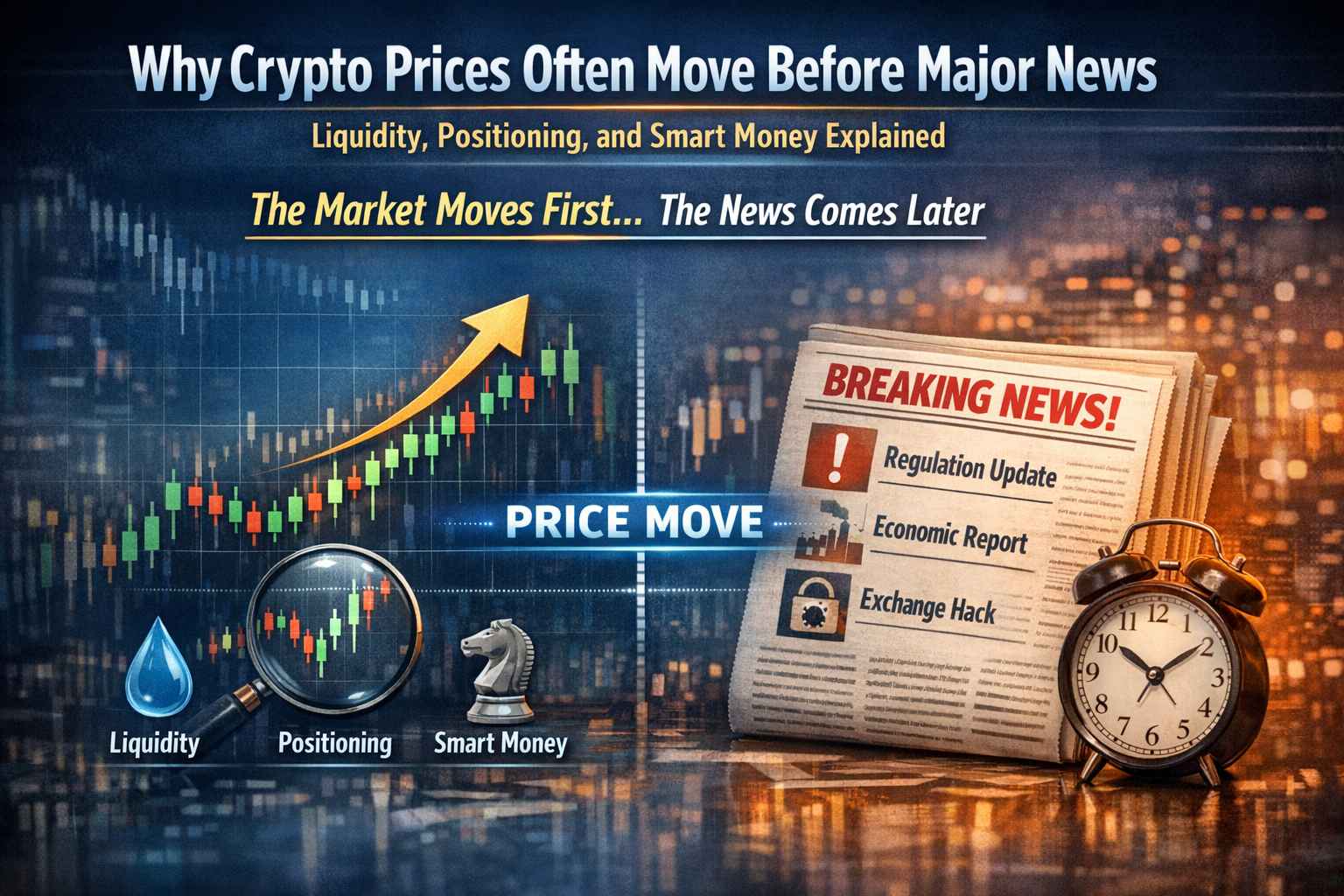
Cryptocurrency markets often appear to react instantly to major news.
A Bitcoin ETF receives approval.
Inflation data surprises investors.
A central bank changes interest rates.
A major exchange announces a new listing.
Prices suddenly move.
For many investors, the conclusion seems obvious:
“The news caused the move.”
Yet experienced investors frequently reach a very different conclusion.
In many cases, the market began moving hours, days, or even weeks before the headline became public.
By the time the news reaches financial media, much of the move has already occurred.
This phenomenon confuses many newer investors.
How can prices react before everyone knows the news?
The answer lies in understanding how financial markets actually function.
Markets are not driven primarily by headlines.
They are driven by expectations, positioning, liquidity, probability, and the continuous process of price discovery.
News often accelerates an existing trend rather than creating one from nothing.
Understanding this distinction can dramatically improve the way investors interpret market behavior.
Instead of chasing headlines after prices have already moved, investors begin focusing on the structural forces that influence markets long before breaking news appears.
This shift in perspective represents one of the biggest differences between inexperienced market participants and professional investors.
In This Analysis, We’ll Explore:
- why crypto prices often move before news
- how price discovery works
- the Efficient Market Hypothesis explained
- expectations versus reality
- institutional positioning
- smart money behavior
- liquidity before major news
- market makers and order flow
- derivatives and leverage
- Buy the Rumor, Sell the News
- Bitcoin examples
- common investor mistakes
- how professional investors analyze news
- strengths and limitations of news analysis
- why market structure matters more than headlines
Why Markets Move Before News
One of the biggest misconceptions in investing is believing that prices react only after information becomes public.
In reality, markets continuously attempt to estimate future outcomes.
Every buyer and seller enters the market with expectations about what may happen next.
Some expect stronger economic growth.
Others expect weaker inflation.
Some believe Bitcoin adoption will accelerate.
Others expect tighter financial conditions.
These differing opinions are reflected in every trade.
As new information gradually becomes available, investors adjust their positions.
Price begins moving long before certainty exists.
This process explains why markets frequently appear to “predict” future events.
They are not predicting the future perfectly.
They are continuously updating probabilities.
The more investors believe a particular outcome is likely, the more prices gradually adjust before confirmation arrives.
Markets Price Expectations — Not Headlines
One of the biggest misconceptions among newer investors is believing that prices move because news is published.
In reality, markets are constantly trying to estimate what is most likely to happen next.
Every trade reflects someone’s expectation about the future.
Some investors believe interest rates will fall.
Others expect ETF inflows to increase.
Some anticipate stronger blockchain adoption.Others prepare for regulatory changes.
Each of these expectations influences buying and selling decisions before any official announcement is made.
Professional investors continuously evaluate information such as:
- Economic data
- Inflation reports
- Central bank policy
- Corporate announcements
- ETF inflows and outflows
- On-chain metrics
- Liquidity conditions
- Stablecoin supply
- Investor sentiment
- Global risk appetite
As these probabilities change, market participants gradually adjust their positions.
Prices therefore begin moving long before financial media publishes a headline explaining why.
Why Professional Investors Position Early
Institutional investors manage portfolios worth millions—or even billions—of dollars.
Unlike retail traders, they cannot simply buy or sell their entire position in a single transaction without significantly affecting market prices.
Instead, they gradually build or reduce positions over time.
Large investors rarely wait until uncertainty disappears.
By the time an event becomes obvious, much of the opportunity has often disappeared as well.
Rather than seeking certainty, professionals focus on probabilities.
Research teams continuously combine information from multiple sources, including:
- Macroeconomic trends
- Regulatory developments
- Exchange reserves
- ETF flows
- Derivatives positioning
- On-chain analytics
- Liquidity conditions
- Corporate treasury activity
- Market sentiment
None of these factors predicts the future with certainty.
Together, however, they provide valuable clues about how market expectations are changing.
This allows institutions to position themselves before the broader market reacts.
Price Reflects Collective Market Knowledge
Financial markets function as massive information-processing systems.
Every participant contributes a different perspective.
Some traders analyze technical charts.
Others study blockchain data.
Institutions monitor economic indicators.
Algorithmic trading systems process thousands of data points every second.
At any given moment, price reflects the balance between buyers and sellers acting on all of this information.
For that reason, prices often begin adjusting before journalists, influencers or financial media explain what is happening.
The market itself is usually faster than the news.
Headlines typically describe a move that has already begun rather than causing it.
MACD Indicator in Crypto: Understanding Momentum, Trend Strength & Market Reversals
News Often Explains Price—It Doesn’t Always Create It
When a major announcement is finally released, investors often assume it caused the price movement.
In many cases, the opposite is true.
Professional investors may have been positioning for weeks.
Liquidity may already have shifted.
Market expectations may already have changed.
By the time the announcement reaches the public, much of the information has already been reflected in the market.
This explains why seemingly positive news sometimes produces little reaction—or even triggers a decline.
The market is not responding to the news itself.
It is responding to the difference between expectation and reality.
If reality merely matches expectations, there may be little reason for prices to continue rising.
That principle forms the foundation of one of Wall Street’s oldest expressions:
“Buy the rumor, sell the news.”
Liquidity Comes Before Headlines
One of the most overlooked concepts in financial markets is liquidity.
News may attract attention, but liquidity is what allows markets to move.
Large institutions cannot simply buy billions of dollars worth of Bitcoin at market price.
Doing so would immediately push prices sharply higher.
Instead, they need willing sellers.
Likewise, institutions looking to reduce exposure require sufficient buyers.
This is why professional investors often focus on liquidity long before a major announcement becomes public.
Rather than reacting to headlines, they position themselves while markets remain relatively quiet.
Periods of low volatility often provide:
- Better execution
- Lower slippage
- Greater available liquidity
- Less competition from retail investors
- More efficient portfolio positioning
By the time headlines attract widespread attention, much of this positioning has already taken place.
Why Bitcoin Volatility Scares Retail Investors — But Attracts Smart Money
Why Markets Often Move Before the Announcement
Many investors imagine that news creates price movement.
In reality, markets frequently move because expectations change before the official announcement.
Consider a hypothetical Bitcoin ETF approval.
Weeks beforehand, investors begin estimating the probability of approval.
As confidence gradually increases:
- Institutions accumulate positions.
- Market makers adjust inventories.
- Traders reduce short exposure.
- Options markets reprice volatility.
- Analysts revise forecasts.
Price gradually reflects these changing expectations.
When the announcement finally arrives, there may be surprisingly little buying pressure remaining.
The market has already anticipated much of the event.
The “Buy the Rumor, Sell the News” Phenomenon
One of the oldest principles in financial markets is:
Buy the rumor. Sell the news.
Although simplified, this phrase captures an important psychological pattern.
The strongest price movements often occur while uncertainty still exists.
Once certainty arrives, many early buyers begin taking profits.
A typical sequence looks like this:
- Rumors begin circulating.
- Expectations improve.
- Institutions quietly accumulate.
- Price gradually rises.
- Media attention increases.
- The official announcement is released.
- Early investors lock in profits.
- Price consolidates or temporarily declines.
This pattern has appeared repeatedly across Bitcoin ETF approvals, protocol upgrades, exchange listings and macroeconomic events.
It is not a rule.
But it is common enough that professional investors pay close attention to it.
How Market Makers Influence Short-Term Price Action
Market makers play a very different role than most retail investors realize.
Their objective is not to predict whether Bitcoin will rise or fall.
Instead, they seek to provide liquidity while managing inventory risk.
Before major news events, market makers often observe:
- Higher uncertainty
- Wider bid-ask spreads
- Increased options activity
- Changing order flow
- Larger institutional orders
To manage this risk, they may adjust pricing, hedge positions or rebalance inventories.
These adjustments can influence short-term price movements even before any public announcement occurs.
Understanding this helps explain why markets sometimes move despite an apparent lack of news.
What Actually Moves Crypto Prices? Understanding the Real Market Forces
Why Derivatives Often Move First
Spot markets represent only one part of the cryptocurrency ecosystem.
Professional investors also monitor derivatives markets, including:
- Futures
- Perpetual contracts
- Options
- Open interest
- Funding rates
These markets frequently react before headlines appear.
For example, rising open interest combined with improving funding rates may indicate that traders are positioning for increased volatility.
Likewise, unusually large options activity may signal that institutional investors expect an important event.
While derivatives do not predict the future, they often reveal changing market expectations earlier than traditional news sources.
Bitcoin vs Altcoin Reactions
Not all cryptocurrencies respond to news in the same way.
Bitcoin
Bitcoin generally reacts more efficiently because it benefits from:
- Deep liquidity
- Strong institutional participation
- Global trading activity
- Extensive derivatives markets
- Continuous price discovery
As a result, major news is often priced into Bitcoin relatively quickly.
Altcoins
Altcoins behave differently.
Many have:
- Lower liquidity
- Smaller market capitalizations
- Greater retail participation
- Higher volatility
- Stronger narrative dependence
Because of these characteristics, altcoins may experience much larger price swings before or after important announcements.
They often react more emotionally than Bitcoin.
Why Retail Investors Often Feel Late
Many investors believe they consistently “miss the move.”
This feeling usually comes from reacting to headlines rather than market structure.
A common sequence looks like this:
- Price begins moving quietly.
- Institutions gradually accumulate.
- Retail investors remain skeptical.
- Financial media notices the rally.
- Social media becomes optimistic.
- New investors enter aggressively.
- Early buyers begin taking profits.
By the time many retail investors finally feel confident enough to buy, much of the initial move has already occurred.
Understanding this sequence helps explain why patience often outperforms emotional decision-making.
Why Retail Investors Always Arrive Late in Crypto Cycles
Common Investor Mistakes
Many investors misunderstand the relationship between price and news.
Common mistakes include:
- Waiting for confirmation before investing.
- Assuming headlines always create price movements.
- Ignoring liquidity conditions.
- Following social media instead of market structure.
- Confusing expectations with reality.
- Reacting emotionally to breaking news.
- Assuming every price move is caused by manipulation.
These mistakes frequently lead investors to buy after optimism has already peaked or sell after fear has already become widespread.
How Professional Investors Interpret News
Professional investors rarely ask:
“What happened today?”
Instead, they ask:
- Was this event already expected?
- How was the market positioned beforehand?
- Did liquidity support the move?
- Are derivatives confirming the trend?
- Does on-chain activity support the price action?
- Is this changing long-term fundamentals or only short-term sentiment?
Only after answering these questions do they evaluate whether the news genuinely changes the investment outlook.
This approach focuses on probability rather than emotion.
Strengths of News-Based Analysis
Studying news remains valuable.
It helps investors understand:
- Market narratives
- Regulatory developments
- Institutional adoption
- Macroeconomic trends
- Technological progress
- Investor sentiment
Combined with technical, on-chain and liquidity analysis, news provides important context for understanding market behavior.
Limitations of News-Based Analysis
News should never be viewed in isolation.
Several important limitations exist:
- Headlines often lag behind price.
- Markets frequently price expectations in advance.
- Media coverage can exaggerate short-term events.
- Unexpected macroeconomic developments may override individual news stories.
- Social media can amplify misinformation.
- Not every headline changes long-term fundamentals.
Successful investors therefore combine news with broader market analysis rather than relying on headlines alone.
Conclusion
One of the most important lessons in cryptocurrency investing is that markets are forward-looking.
Prices rarely wait for headlines because professional investors continuously evaluate probabilities, adjust positions and manage liquidity long before information reaches the broader public.
Understanding:
- Market expectations
- Liquidity
- Institutional positioning
- Derivatives activity
- Investor psychology
- Market structure
- Information flow
- Risk management
helps investors interpret price movements more objectively.
Successful investing is not about reacting to every headline.
It is about understanding why prices move before the news, recognizing how expectations become reflected in market prices, and distinguishing genuine structural changes from short-term media narratives.
For long-term investors, learning to focus on positioning rather than headlines can provide a significant advantage in understanding how cryptocurrency markets truly operate.
Understanding Crypto Market Structure – Part 3: The Role of Institutions in Crypto
Crypto Market Structure Explained: Higher Highs, Lower Lows & Trend Basics
Disclaimer: This article is for informational and educational purposes only and does not constitute financial advice. Cryptocurrency markets are highly volatile. Always do your own research before making any investment decisions.
