
Cryptocurrency markets are not driven solely by spot trading where investors buy and sell actual tokens.
A large portion of trading activity now occurs in derivatives markets, where traders speculate on price movements using financial instruments such as futures and perpetual contracts.
These instruments allow traders to use leverage, meaning they can control larger positions than their actual capital would normally allow.
While derivatives increase market liquidity and trading opportunities, they also introduce additional volatility, particularly during periods of strong market momentum.
Understanding how derivatives, leverage and liquidations work is essential for interpreting many of the rapid price movements seen in crypto markets.
Today, derivatives markets often generate more trading volume than spot markets themselves.
This means short-term crypto price movements are increasingly influenced not only by real buying and selling demand, but also by leveraged positioning, liquidation pressure, funding imbalances, and speculative market sentiment.
Understanding how derivatives interact with liquidity and market psychology is essential for interpreting modern crypto volatility.
What Are Crypto Derivatives?
Derivatives are financial contracts whose value is based on the price of an underlying asset.
In crypto markets, the most common derivatives include:
- Futures contracts
- Perpetual futures (perpetual swaps)
- Options contracts
These instruments allow traders to speculate on price movements without directly owning the underlying cryptocurrency.
For example, a trader can take a long position if they expect prices to rise or a short position if they expect prices to fall.
Because derivatives often involve leverage, they can significantly increase both potential gains and potential losses.
Why Perpetual Futures Dominate Crypto Markets
Perpetual futures — often called perpetual swaps — have become the dominant derivative instrument in crypto markets.
Unlike traditional futures contracts, perpetual futures do not expire.
Instead, they use a funding rate mechanism to keep contract prices relatively aligned with spot market prices.
Perpetual contracts are popular because they allow traders to:
- use leverage easily
- open long or short positions quickly
- trade continuously without expiration dates
- gain large market exposure with relatively small capital
Because perpetual futures are highly accessible, they contribute significantly to crypto market volatility and speculative trading behavior.
What Is Leverage?
Leverage allows traders to open positions larger than the capital they actually hold.
For example, with 10x leverage, a trader can control a $10,000 position with only $1,000 of capital.
While leverage can amplify profits if the market moves in the expected direction, it also increases risk. Even relatively small price movements can lead to large losses when leverage is involved.
This dynamic makes leveraged markets much more sensitive to sudden price changes.
Crypto Day Trading: Structural Risks and Capital Erosion
Why High Leverage Amplifies Crypto Volatility
Leverage magnifies both profits and losses, which makes crypto markets extremely sensitive to sudden price movement.
In highly leveraged environments:
- small market moves can trigger forced liquidations
- traders become more vulnerable to volatility
- market sentiment shifts accelerate rapidly
- short-term momentum becomes exaggerated
This is one reason crypto markets often experience sudden spikes in volatility even without major fundamental news.
When too many traders become positioned in one direction, the market becomes structurally unstable.
How Liquidations Occur
When a leveraged position loses too much value, exchanges automatically close the position to prevent further losses. This process is known as liquidation.
Liquidations occur when the market moves against a trader’s position and their collateral is no longer sufficient to support the trade.
For example:
- If a highly leveraged long position faces a sudden price drop, it may be liquidated.
- If a leveraged short position faces a sharp price increase, it may also be liquidated.
These forced closures add additional buy or sell pressure to the market.
Crypto Swing Trading: Strategy, Risk and Market Structure Explained
Liquidation Cascades
One of the most dramatic effects of leveraged trading is the possibility of liquidation cascades.
When a large number of leveraged positions are liquidated at the same time, the resulting forced buying or selling can trigger further liquidations.
This chain reaction can accelerate price movements in a short period of time.
In extreme cases, liquidation cascades can temporarily disconnect price action from underlying fundamentals.
Markets may move violently simply because leveraged positions are forced to close automatically.
This explains why crypto markets sometimes experience:
- rapid crashes without major news
- aggressive short squeezes
- sudden volatility spikes
- large wicks on price charts
These events are often linked more to derivatives market mechanics than to fundamental news.
Why Derivatives Influence Volatility
Derivatives markets have grown significantly in recent years and now represent a large portion of overall crypto trading volume.
Because leveraged positions can amplify both buying and selling pressure, derivatives trading often magnifies existing trends.
This is one reason derivatives markets often amplify short-term volatility far beyond what spot market activity alone would normally produce.
During strong rallies, leveraged long positions can accelerate upward momentum. During market corrections, forced liquidations can intensify downward movements.
As a result, derivatives markets frequently play a major role in shaping short-term volatility across the crypto ecosystem.
How Derivatives Influence Market Psychology
Derivatives markets do not only affect price movement — they also strongly influence investor psychology. Highly leveraged environments often increase:
- fear-driven reactions
- short-term speculation
- emotional trading behavior
- panic during corrections
- euphoria during rallies
When traders use excessive leverage, market sentiment can shift extremely quickly.
This is one reason crypto markets sometimes experience emotional volatility far beyond what fundamentals alone would justify.
Understanding derivatives helps investors recognize when volatility may be driven more by positioning and leverage than by structural changes in adoption or long-term value.
Funding Rates and Open Interest
Two important metrics in crypto derivatives markets are funding rates and open interest.
Funding rates measure the cost of holding leveraged long or short positions in perpetual futures markets.
When funding rates become extremely positive, it often signals excessive bullish positioning.
When funding rates become heavily negative, it may indicate extreme bearish sentiment.
Open interest measures the total value of active derivatives contracts currently open in the market.
Rising open interest combined with aggressive price movement can sometimes signal increasing leverage and growing volatility risk.
Many experienced investors monitor these metrics to better understand market positioning and speculative conditions.
What Investors Should Understand
For long-term investors, understanding derivatives activity can provide useful context for sudden price movements.
Many dramatic price swings are not always the result of fundamental developments. Instead, they may be driven by the mechanics of leveraged trading.
Monitoring factors such as funding rates, open interest and liquidation levels can offer insight into how leveraged traders are positioned.
Recognizing these dynamics helps investors avoid reacting emotionally to short-term volatility.
Experienced investors often focus less on predicting every short-term move and more on understanding when leverage conditions may create unstable market environments.
Why Derivatives Matter for Long-Term Investors
Even long-term investors benefit from understanding derivatives markets.
Many major crypto price movements are heavily influenced by leverage, liquidations, and speculative positioning rather than purely by long-term fundamentals.
Understanding derivatives helps investors:
- interpret sudden volatility more rationally
- avoid emotional reactions during liquidation events
- recognize overheated market conditions
- better understand market sentiment
- improve risk management during extreme conditions
In modern crypto markets, derivatives activity often shapes short-term price behavior even when long-term adoption trends remain unchanged.
Bitcoin Liquidity Sweeps Explained: Why Price Drops Before Major Moves
Conclusion
Derivatives markets have become one of the most important forces shaping short-term cryptocurrency price behavior.
Through futures contracts, perpetual swaps, leverage, and liquidation mechanics, derivatives trading can significantly amplify both bullish and bearish market movements.
Understanding concepts such as:
- leverage
- liquidations
- funding rates
- open interest
- liquidation cascades
- market positioning
helps investors better interpret why crypto markets sometimes experience sudden and extreme volatility.
Importantly, many major price swings are not always driven purely by fundamental developments. In many cases, they are accelerated by leveraged positioning and forced liquidations inside derivatives markets.
For investors, understanding derivatives activity provides valuable insight into:
- market sentiment
- speculative excess
- volatility risk
- liquidity conditions
- short-term market structure
As derivatives markets continue growing, leverage increasingly plays a central role in shaping crypto volatility across the broader digital asset ecosystem.
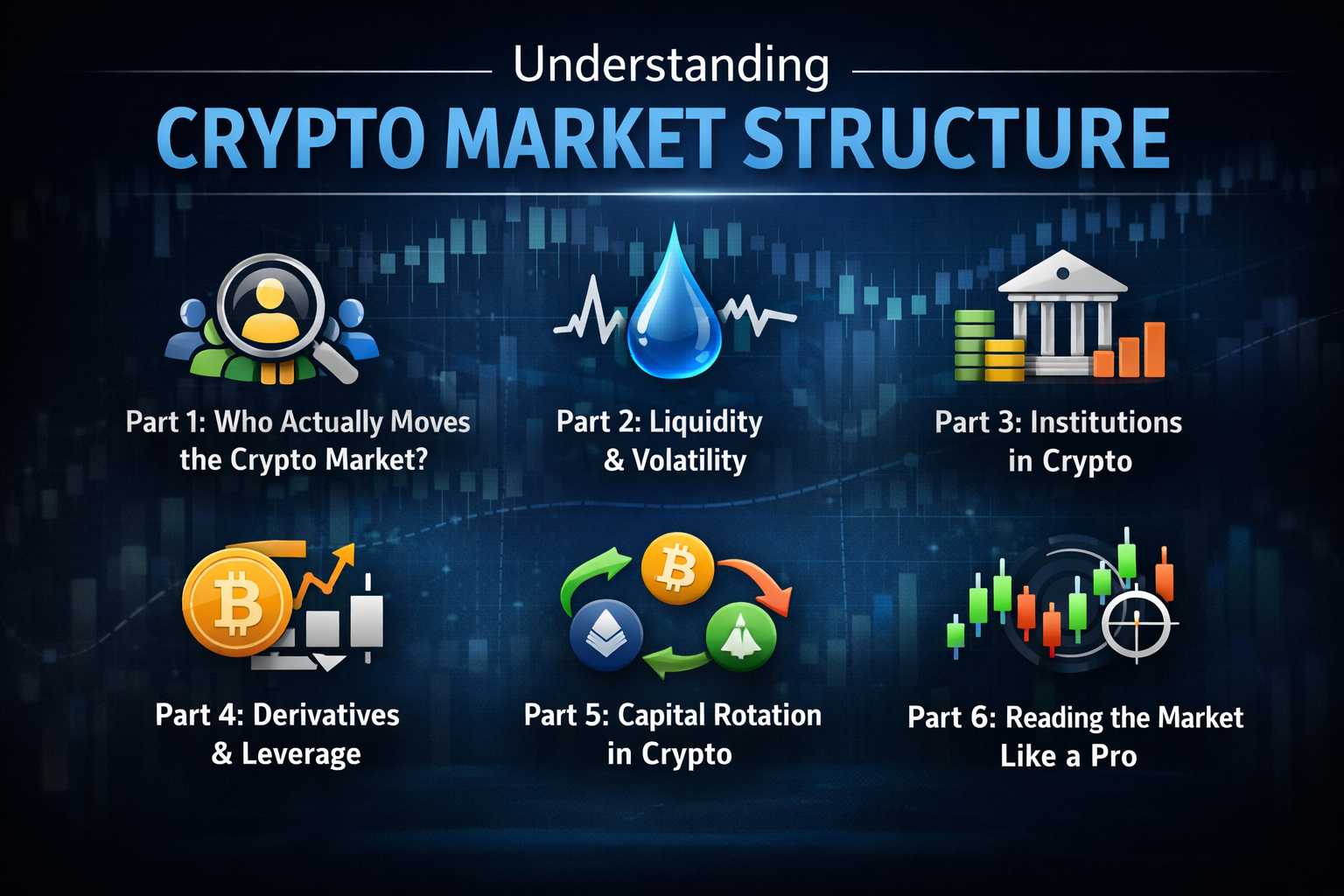
In the next part of the Understanding Crypto Market Structure series, we’ll explore how capital rotates between Bitcoin, Ethereum, and altcoins throughout different phases of the crypto market cycle.
Part 5 Capital Rotation in Crypto Markets – Understanding Crypto Market Structure
Crypto Narratives: How Trends Drive Market Cycles and Capital Flows
Liquidity in Crypto Markets: Why Capital Flows Move Prices
Disclaimer: This article is for informational purposes only and does not constitute financial advice. Cryptocurrency markets are volatile and involve significant risk. Always conduct your own research before making investment decisions.