
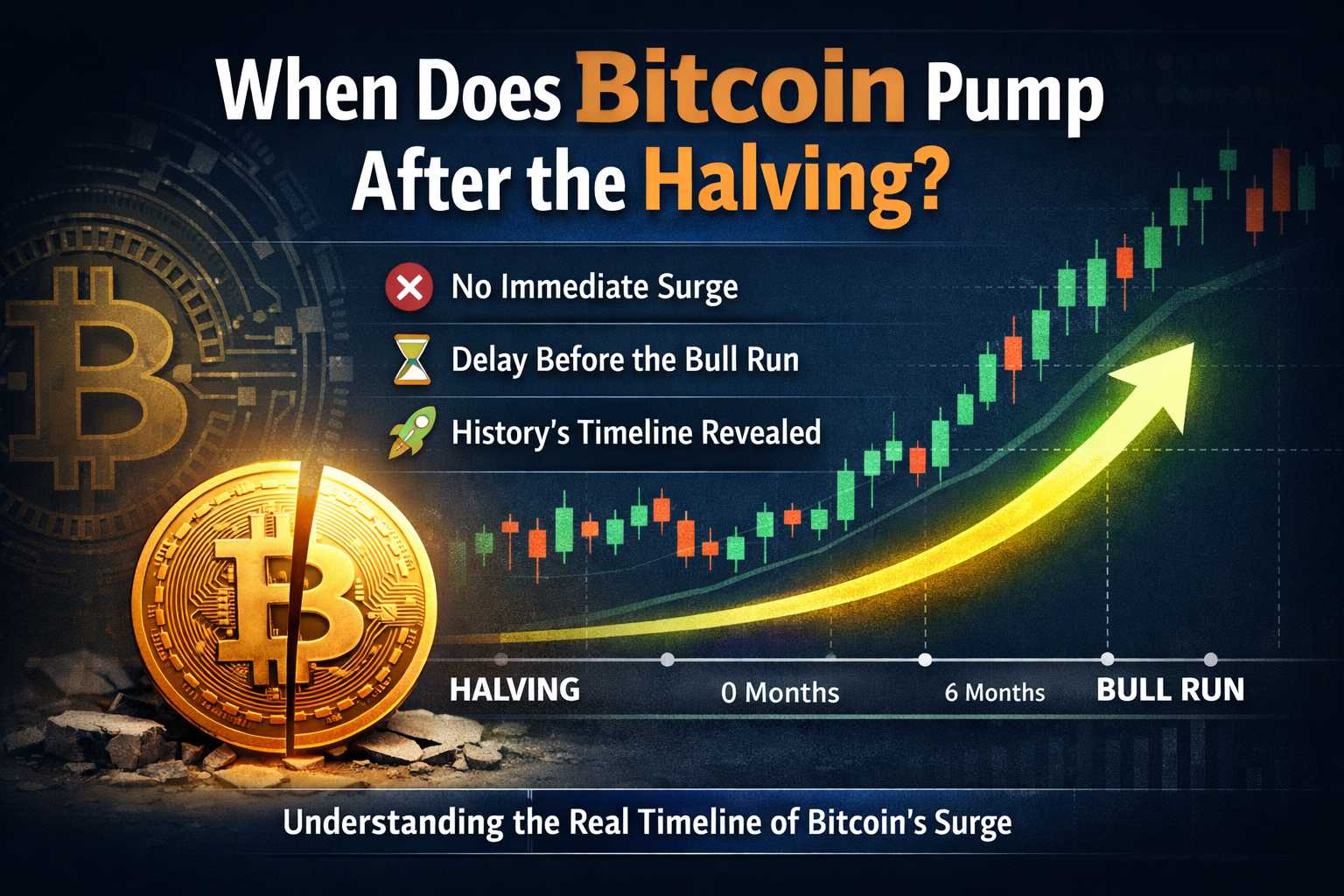
Bitcoin halvings are among the most closely watched events in the cryptocurrency market.
Approximately every four years, the reward Bitcoin miners receive for adding new blocks to the network is reduced by half.
This reduces the amount of new Bitcoin entering circulation.
Because major Bitcoin bull markets have historically developed around halving cycles, many investors assume there is a predictable pattern:
Halving → Supply Reduction → Bull Market
The reality is more complicated.
Bitcoin has not followed exactly the same timeline after every halving. Some rallies developed months after the event, while the 2024 cycle showed that major price movements can begin before the halving itself.
The halving matters.
But it is only one part of the Bitcoin market cycle.
In This Analysis, We’ll Explore:
- What the Bitcoin halving changes
- Why Bitcoin does not automatically rally after a halving
- What happened around previous Bitcoin halvings
- Why the 2024 cycle was different
- What historical halving cycles actually tell us
- Why demand and liquidity matter
- How institutional participation can change the cycle
- Why future halvings may behave differently
What Is the Bitcoin Halving?
Bitcoin has a predetermined supply mechanism.
Miners receive newly created Bitcoin as part of the reward for processing blocks. After approximately every 210,000 blocks, that reward is reduced by 50%.
Historically, the block reward has changed as follows:
2012: 50 BTC → 25 BTC
2016: 25 BTC → 12.5 BTC
2020: 12.5 BTC → 6.25 BTC
2024: 6.25 BTC → 3.125 BTC
The important point is that a halving does not remove Bitcoin from the existing supply.
Instead, it reduces the rate at which new Bitcoin is created.
Over time, this gradually slows Bitcoin’s supply growth as it moves toward its maximum supply of 21 million BTC.
Why Bitcoin Does Not Immediately Rally After a Halving
A lower supply of newly created Bitcoin can affect the market, but it does not automatically create higher prices.
Price still depends on both sides of the market:
Supply and Demand
If new Bitcoin issuance falls while demand increases, competition for the available supply can become stronger.
But if demand weakens, the reduction in new supply may have a much smaller immediate effect.
This explains why the halving itself does not need to produce a sudden price movement.
The market also knows when the halving will occur.
It is built into Bitcoin’s protocol and can be anticipated years in advance.
Investors can therefore adjust their positioning before the actual event.
The halving is better understood as a structural change in Bitcoin’s supply than as a specific date when a bull market should begin.
The 2012 Bitcoin Halving
Bitcoin’s first halving occurred in November 2012.
The block reward fell from:
50 BTC → 25 BTC
Bitcoin was still a very small market at the time.
Liquidity was limited, cryptocurrency exchanges were relatively undeveloped and institutional participation was almost nonexistent.
During 2013, Bitcoin experienced an enormous expansion in both price and public attention.
The first halving therefore became closely associated with Bitcoin’s emerging market cycle.
However, the Bitcoin market of 2012 was fundamentally different from the market today.
Because Bitcoin was much smaller, relatively limited capital flows could have a much larger effect on price.
The 2016 Bitcoin Halving
The second halving occurred in July 2016.
The block reward fell from:
25 BTC → 12.5 BTC
Bitcoin did not suddenly enter its strongest rally immediately after the event.
Instead, the larger market expansion developed over the following months and eventually became the major 2017 bull market.
By then, the cryptocurrency ecosystem was also growing.
More exchanges existed, Bitcoin awareness was increasing and a much larger group of investors could participate.
This cycle reinforced the idea that the effect of a halving may develop gradually rather than appearing immediately.
It also demonstrated why demand matters.
Reducing new supply becomes much more significant when the number of potential buyers is also increasing.
The 2020 Bitcoin Halving
The third halving occurred in May 2020.
The mining reward fell from:
12.5 BTC → 6.25 BTC
Bitcoin later entered another major bull market.
Strong momentum developed during the second half of 2020, and Bitcoin eventually moved beyond its previous cycle high.
But the halving was not the only force influencing the market.
The global financial environment had changed dramatically.
Liquidity conditions, growing institutional interest and increasing mainstream awareness all contributed to a very different market environment.
This is an important lesson when studying halving cycles.
A major Bitcoin rally occurring after a halving does not mean the halving alone caused the entire move.
Several forces can reinforce each other during a bull market.
Why the 2024 Halving Was Different
The fourth Bitcoin halving occurred in April 2024.
The block reward declined from:
6.25 BTC → 3.125 BTC
But this cycle produced an important difference.
Bitcoin had already reached a new all-time high before the halving occurred.
That had not happened in previous halving cycles.
One important change was the arrival of spot Bitcoin ETFs in the United States.
These products created another route for capital to gain exposure to Bitcoin, contributing to strong demand before the halving.
The traditional sequence had changed.
Instead of:
Halving → Bullish Expansion → New All-Time High
the market had already entered a major expansion before Bitcoin’s new supply reduction took place.
This showed why investors should be careful with fixed halving-cycle models.
The market can anticipate events.
And new sources of demand can change the timing.
What Previous Bitcoin Halvings Actually Tell Us
Bitcoin’s historical halvings reveal an interesting pattern.
Major market expansions have repeatedly developed around halving cycles.
But the timing has not been identical.
That means statements such as:
“Bitcoin always starts its bull run six months after the halving.”
or:
“Bitcoin always peaks 12 to 18 months later.”
are too precise.
Bitcoin has only experienced a small number of halvings, and the market surrounding each event has been different.
Bitcoin itself has also changed.
The asset now has:
- Deeper global liquidity
- Larger institutional participation
- More developed derivatives markets
- Regulated investment products
- Greater mainstream awareness
Future cycles therefore do not have to reproduce previous ones exactly.
A more useful way to think about the halving is:
The halving changes Bitcoin’s supply structure. Demand determines how strongly the market responds.
That gives us a much stronger foundation for understanding the Bitcoin halving cycle than simply counting the number of months since the last halving.
Why the Halving Effect Takes Time
A Bitcoin halving changes new supply immediately, but its effect on the broader market can develop gradually.
Miners receive fewer new Bitcoin after the halving, reducing the amount of newly created BTC that can potentially enter the market.
But Bitcoin already has a large circulating supply.
Existing holders, traders, institutions and long-term investors can all provide Bitcoin to the market.
This means the halving does not suddenly create a supply shortage.
Instead, it changes the balance gradually.
If demand remains strong while new supply continues entering the market at a slower rate, the effect can become more noticeable over time.
Demand Matters More Than the Halving Alone
The halving only affects one side of the equation.
The other side is demand.
Bitcoin can experience lower new issuance without experiencing a major rally if investor demand is weak.
Likewise, strong demand can push Bitcoin higher even before a halving occurs.
The 2024 cycle demonstrated this clearly.
This gives us a simple framework:
Lower New Supply + Rising Demand → Stronger Market Conditions
But:
Lower New Supply + Weak Demand → Limited Price Impact
This is why analyzing Bitcoin purely through the halving schedule can miss an important part of the market.
Liquidity Can Change the Cycle
Bitcoin does not trade in isolation from the wider financial system.
The amount of capital available for investment can influence crypto markets significantly.
When financial conditions encourage investors to take more risk, additional capital can move into Bitcoin and other cryptocurrencies.
When liquidity becomes tighter and investors become more defensive, demand for risk assets can weaken.
This helps explain why two Bitcoin halvings can produce very different market environments.
The supply mechanism may be predictable.
Global liquidity is not.
A halving can therefore create favorable supply conditions while the broader financial environment determines whether enough demand develops to take advantage of them.
Crypto Liquidity Explained: Market Depth, Capital Flows, Slippage & Why Prices Move
The Growing Role of Institutional Investors
Bitcoin’s investor base has changed significantly since the early halving cycles.
The market once consisted largely of miners, early adopters, retail investors and crypto-focused traders.
Today, Bitcoin also attracts:
- Institutional investors
- Investment funds
- Public companies
- Professional trading firms
- ETF investors
This matters because larger and more sophisticated market participants can change how Bitcoin responds to predictable events.
The halving is known years in advance.
Investors do not need to wait until the exact day of the event before positioning themselves.
As Bitcoin markets become more developed, expectations surrounding the halving may increasingly influence price before the event itself.
Understanding Crypto Market Structure – Part 3: The Role of Institutions in Crypto
Bitcoin ETFs Can Change Demand
Spot Bitcoin ETFs introduced another important factor into the halving cycle.
They provide investors with Bitcoin exposure through traditional financial markets without requiring direct ownership through a crypto exchange or wallet.
This created an additional source of demand.
The effect became visible during the 2024 cycle, when strong Bitcoin demand developed before the halving.
This does not mean ETFs permanently guarantee higher prices.
ETF flows can move in both directions.
Their importance is that Bitcoin now has another major channel through which capital can enter or leave the market.
Future halving cycles therefore need to consider more than miner supply.
Investor flows can become equally important.
Crypto ETFs Explained: Bitcoin, Ethereum, Spot ETFs & How They Work
Are Bitcoin Halving Returns Getting Smaller?
Another pattern worth considering is that Bitcoin has become much larger over time.
During Bitcoin’s early years, relatively small amounts of capital could produce enormous percentage price movements.
As market capitalization grows, achieving the same percentage gains requires increasingly larger capital flows.
This does not mean Bitcoin cannot experience powerful bull markets.
It means investors should be careful about assuming that percentage returns from early cycles will automatically repeat.
The structure of the market has changed.
Bitcoin is larger, liquidity is deeper and institutional participation is greater.
Historical cycles can provide context without providing a guaranteed return model.
Why Counting Months After the Halving Can Be Misleading
One of the most popular ways to analyze Bitcoin cycles is to count the number of months since the latest halving.
This can provide historical context.
But it becomes dangerous when treated as a prediction.
For example:
“Bitcoin is 12 months past the halving, therefore the cycle must be close to its peak.”
The conclusion assumes that future cycles must follow previous timing.
They do not.
A cycle can accelerate because demand arrives earlier.
It can develop more slowly because liquidity is weak.
It can also be affected by regulation, macroeconomic conditions, institutional flows or unexpected market events.
Time since the halving is therefore one piece of information.
It should not become the entire investment thesis.
What Should Investors Watch Instead?
Rather than relying only on the halving calendar, investors can examine the broader market environment.
Important areas include:
- Bitcoin market structure
- Demand and capital flows
- Trading volume and liquidity
- Institutional participation
- ETF flows
- Macroeconomic conditions
- Investor sentiment
- Leverage in derivatives markets
The halving provides the supply backdrop.
These factors help show what the market is actually doing within that backdrop.
For example, sustained higher highs and higher lows can provide more direct evidence of an expanding market than simply knowing how many months have passed since a halving.
Likewise, weakening demand and excessive speculation may deserve attention even if a historical cycle model suggests more upside should remain.
Will the Bitcoin Halving Cycle Continue?
Bitcoin’s halving mechanism will continue reducing new issuance.
But that does not guarantee that future market cycles will follow the same pattern as previous ones.
The relative impact of each halving also changes.
Going from 50 BTC to 25 BTC per block represented a much larger reduction in absolute new supply than going from 3.125 BTC to 1.5625 BTC.
Meanwhile, other forces influencing Bitcoin continue to grow.
Institutional participation, global liquidity, ETFs, derivatives and macroeconomic conditions can all affect demand.
The halving cycle may therefore remain relevant without remaining dominant.
Future Bitcoin cycles could become less predictable around one specific event.
Conclusion
Bitcoin halvings have historically occurred around some of the most important market cycles in Bitcoin’s history.
But history does not show a fixed rule for when Bitcoin must rally after a halving.
The 2012, 2016 and 2020 cycles each developed under different market conditions, while 2024 demonstrated that a major expansion can begin before the halving itself.
The halving changes something real:
the rate at which new Bitcoin enters circulation.
What happens to price depends on much more.
Demand, liquidity, institutional participation, market structure and the broader financial environment all influence how Bitcoin responds.
The most useful lesson from previous cycles is therefore not that Bitcoin always rallies a certain number of months after a halving.
It is that scarcer new supply becomes most important when it meets strong and sustained demand.
The halving can help shape a Bitcoin cycle.
It does not determine the entire cycle.
Crypto Market Structure Explained: Higher Highs, Lower Lows, Trends & Structure Breaks
Disclaimer: This article is for informational purposes only and does not constitute financial advice. Cryptocurrency markets are highly volatile. Always do your own research before making investment decisions.