
As blockchain adoption continues to expand, scalability and user experience remain two of the biggest challenges facing the crypto industry.
Many networks struggle with:
- network congestion
- high transaction fees
- slow execution speeds
- fragmented user experiences
- limited scalability under heavy demand
While early blockchains focused primarily on decentralization and security, newer blockchain ecosystems increasingly prioritize scalability, efficiency, and usability for mainstream adoption.
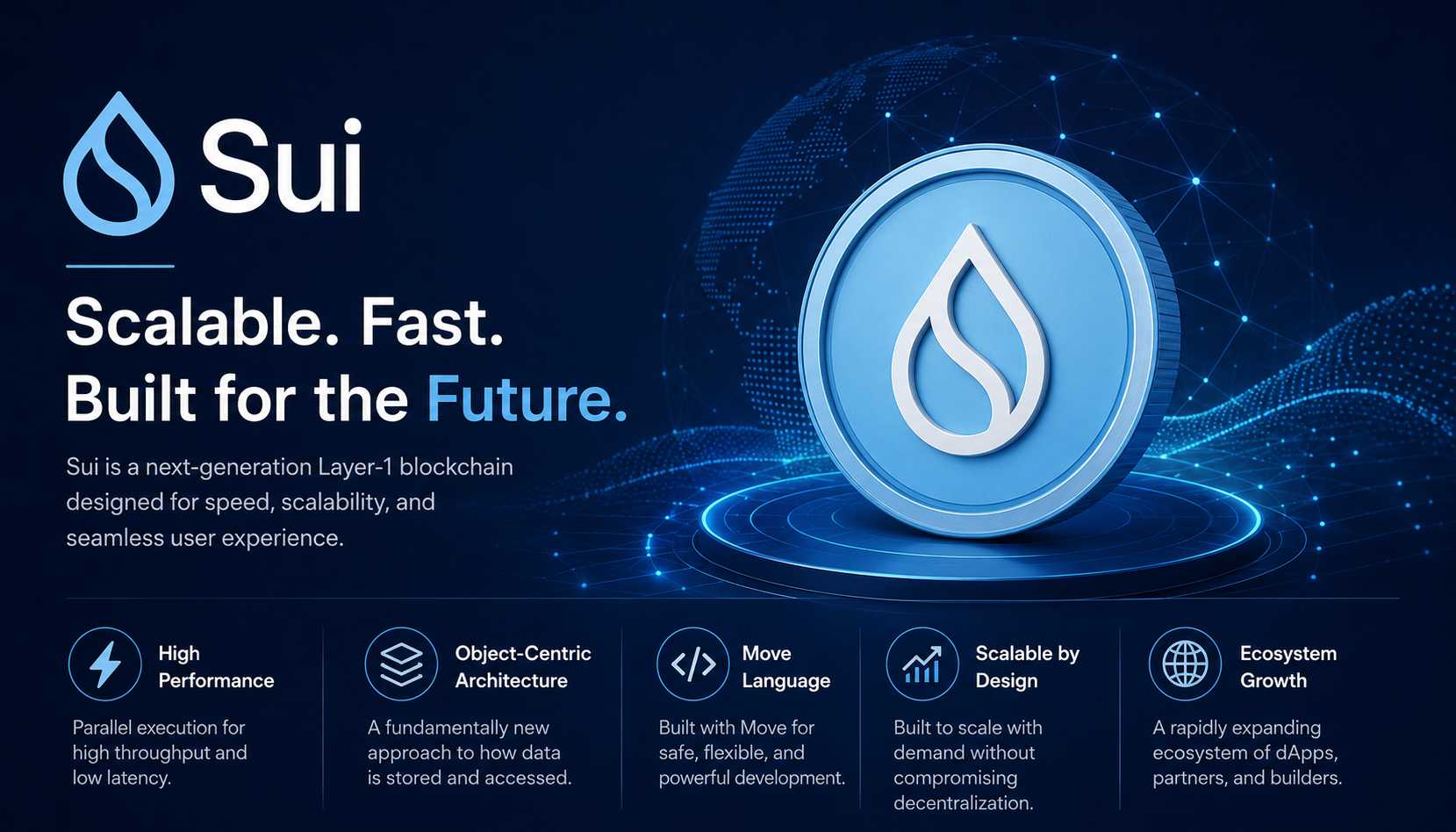
Sui (SUI) is one of the newer Layer-1 blockchain networks attempting to solve these structural limitations through a fundamentally different architectural approach.
Unlike many traditional blockchain networks, Sui focuses heavily on:
- parallel transaction execution
- object-based data architecture
- scalability optimization
- low-latency processing
- improved user experience
- developer flexibility
Since its launch, Sui has attracted growing attention within crypto markets because of its technical design, ecosystem expansion, and positioning within the next generation of high-performance blockchain infrastructure.
However, like all emerging blockchain ecosystems, Sui also faces important questions regarding:
- decentralization
- long-term adoption
- tokenomics
- ecosystem competition
- market sustainability
In this analysis, we’ll explore:
- how Sui works
- why its architecture differs from traditional blockchains
- the role of the Move programming language
- scalability and transaction processing
- SUI tokenomics
- ecosystem growth
- long-term positioning within the crypto market
What Is Sui?
Sui is a Layer-1 blockchain designed to optimize scalability, speed, and user experience.
The network was developed by Mysten Labs, a team founded by former Meta (Facebook) engineers who previously worked on the Diem blockchain initiative.
Sui aims to support:
- decentralized applications (dApps)
- gaming ecosystems
- digital asset ownership
- scalable smart contracts
- high-throughput blockchain infrastructure
Unlike older blockchain models that process transactions sequentially, Sui introduces an object-centric architecture that allows many transactions to execute in parallel.
This design attempts to improve:
- scalability
- transaction efficiency
- network responsiveness
- throughput capacity
The native asset of the network is the SUI token, which is used for:
- transaction fees
- staking
- validator participation
- governance-related functionality
- ecosystem incentives
Why Sui Was Created
Many existing blockchain networks face structural scalability limitations.
For example:
- Ethereum prioritizes decentralization but can experience congestion and high fees
- Bitcoin prioritizes security and simplicity over programmability
- some high-speed chains sacrifice decentralization for performance
Sui was designed to improve blockchain scalability without relying entirely on traditional scaling methods such as rollups or secondary layers.
The network focuses heavily on:
- transaction parallelization
- efficient state management
- low-latency execution
- scalable infrastructure
- simplified onboarding experiences
The goal is to create a blockchain environment capable of supporting large-scale applications while maintaining fast and efficient execution.
The Move Programming Language
One of the defining aspects of Sui is its use of the Move programming language.
Move was originally developed for Meta’s Diem project and focuses heavily on:
- security
- asset ownership
- resource management
- predictable smart contract behavior
Unlike some traditional smart contract languages, Move was specifically designed for digital assets and blockchain environments.
This structure helps reduce certain categories of smart contract vulnerabilities while improving control over asset management.
Move also enables developers to build more flexible blockchain applications with stronger ownership models.
Because of this, Move is increasingly viewed as an important part of Sui’s long-term infrastructure positioning.
Object-Based Architecture Explained
Sui’s architecture differs significantly from many traditional blockchain networks.
Instead of treating blockchain state primarily as account balances, Sui organizes network activity around programmable objects.
This object-based structure allows the network to process many independent transactions simultaneously rather than forcing every transaction into a single sequential pipeline.
This creates several potential advantages:
- improved scalability
- lower latency
- more efficient transaction processing
- reduced congestion
- faster execution speeds
Parallel transaction execution is one of the main reasons Sui attracts attention as a high-performance blockchain.
Rather than requiring all validators to process unrelated transactions in sequence, many operations can occur concurrently.
This architectural design attempts to improve scalability without relying entirely on off-chain solutions.
Scalability and Transaction Speed
Scalability remains one of the central narratives surrounding Sui.
The network was specifically engineered to support:
- high transaction throughput
- rapid settlement
- low transaction costs
- responsive application performance
In blockchain markets, scalability matters because user demand often increases dramatically during periods of strong adoption.
Networks unable to scale efficiently may experience:
- congestion
- slower execution
- rising fees
- reduced usability
Sui attempts to minimize these issues through parallel execution and optimized state management.
Supporters argue that this design makes Sui particularly attractive for:
- blockchain gaming
- high-frequency applications
- real-time interactions
- consumer-focused decentralized applications
However, long-term scalability claims must still be tested under sustained real-world adoption conditions.
Sui is often compared to networks such as:
Each network approaches scalability differently.
Ethereum relies heavily on Layer-2 scaling solutions and prioritizes decentralization and ecosystem maturity.
Solana focuses on high throughput and low fees through an optimized monolithic architecture.
Sui differentiates itself primarily through:
- object-based execution
- parallel transaction processing
- Move-based smart contracts
- user experience optimization
While these technical differences are important, long-term success depends on more than architecture alone.
Blockchain ecosystems also compete on:
- developer adoption
- liquidity
- ecosystem growth
- institutional interest
- network effects
- community strength
Technology alone does not guarantee dominance within crypto markets.
The Role of SUI Tokenomics
Tokenomics play an important role in evaluating long-term blockchain sustainability.
The SUI token is used across the ecosystem for:
- transaction fees
- staking
- validator incentives
- network participation
Like many emerging blockchain ecosystems, investors also monitor:
- token unlock schedules
- circulating supply growth
- inflation dynamics
- ecosystem incentives
- long-term supply pressure
Aggressive token unlocks can sometimes create additional selling pressure during weaker market conditions.
Because of this, understanding token distribution and emission schedules remains important for long-term investors.
Strong technology does not automatically eliminate tokenomic risk.
Ecosystem Growth and Adoption
Long-term blockchain success depends heavily on ecosystem adoption.
This includes:
- developer activity
- decentralized applications
- liquidity growth
- user participation
- infrastructure expansion
- ecosystem funding
Sui has increasingly attracted projects focused on:
- gaming
- NFTs
- decentralized finance (DeFi)
- infrastructure tools
- consumer applications
However, blockchain ecosystems remain highly competitive.
Many networks compete aggressively for:
- developers
- liquidity
- market attention
- institutional partnerships
As a result, ecosystem growth is often one of the most important long-term indicators for blockchain sustainability.
Risks and Criticism
Despite strong technical narratives, Sui still faces important risks and criticisms.
Common concerns include:
- competition from other scalable Layer-1 networks
- token unlock pressure
- ecosystem maturity
- long-term decentralization questions
- reliance on continued adoption growth
- speculative market behavior
Like many newer blockchain ecosystems, Sui must prove that strong technical architecture can translate into durable real-world adoption.
Crypto markets are highly narrative-driven, and investor sentiment can shift rapidly.
This means long-term sustainability depends not only on technology, but also on execution, adoption, liquidity, and ecosystem development over time.
Long-Term Positioning
Sui is positioning itself as part of the next generation of scalable blockchain infrastructure.
Its focus on:
- scalability
- parallel execution
- user experience
- efficient architecture
- developer flexibility
gives it a distinct position within the broader Layer-1 blockchain landscape.
However, the long-term success of Sui will likely depend on whether the network can:
- attract sustained developer activity
- grow ecosystem usage
- maintain liquidity growth
- compete against larger blockchain ecosystems
- survive multiple market cycles
In crypto markets, long-term winners are rarely determined by technology alone.
Adoption, liquidity, ecosystem strength, and market positioning all play critical roles in determining which blockchain networks remain relevant over time.
Conclusion
Sui represents one of the more technically ambitious Layer-1 blockchain projects in the modern crypto ecosystem.
Its architecture focuses heavily on scalability, parallel transaction execution, low-latency processing, and user experience optimization — areas increasingly important for broader blockchain adoption.
By utilizing:
- object-based architecture
- the Move programming language
- parallel execution
- scalable infrastructure design
Sui attempts to position itself as a high-performance blockchain capable of supporting large-scale decentralized applications and consumer-focused ecosystems.
However, like all emerging blockchain networks, Sui still faces significant long-term challenges related to:
- ecosystem competition
- tokenomics
- decentralization
- adoption growth
- market sustainability
For investors, understanding Sui requires looking beyond short-term price movements and focusing instead on architecture, ecosystem development, liquidity, adoption trends, and long-term positioning within the broader crypto market structure. Also Read ->
Chainlink Explained: Why LINK Keeps Showing Up in Serious Crypto Infrastructure
Polygon (MATIC) Analysis: Architecture, Use Cases and Long-Term Positioning
Understanding Crypto Market Structure – Part 1 Who Actually Moves the Crypto Market?
Disclaimer: This article is for informational purposes only and does not constitute financial advice. Cryptocurrency markets are volatile and involve significant risk. Always conduct your own research before making investment decisions.