
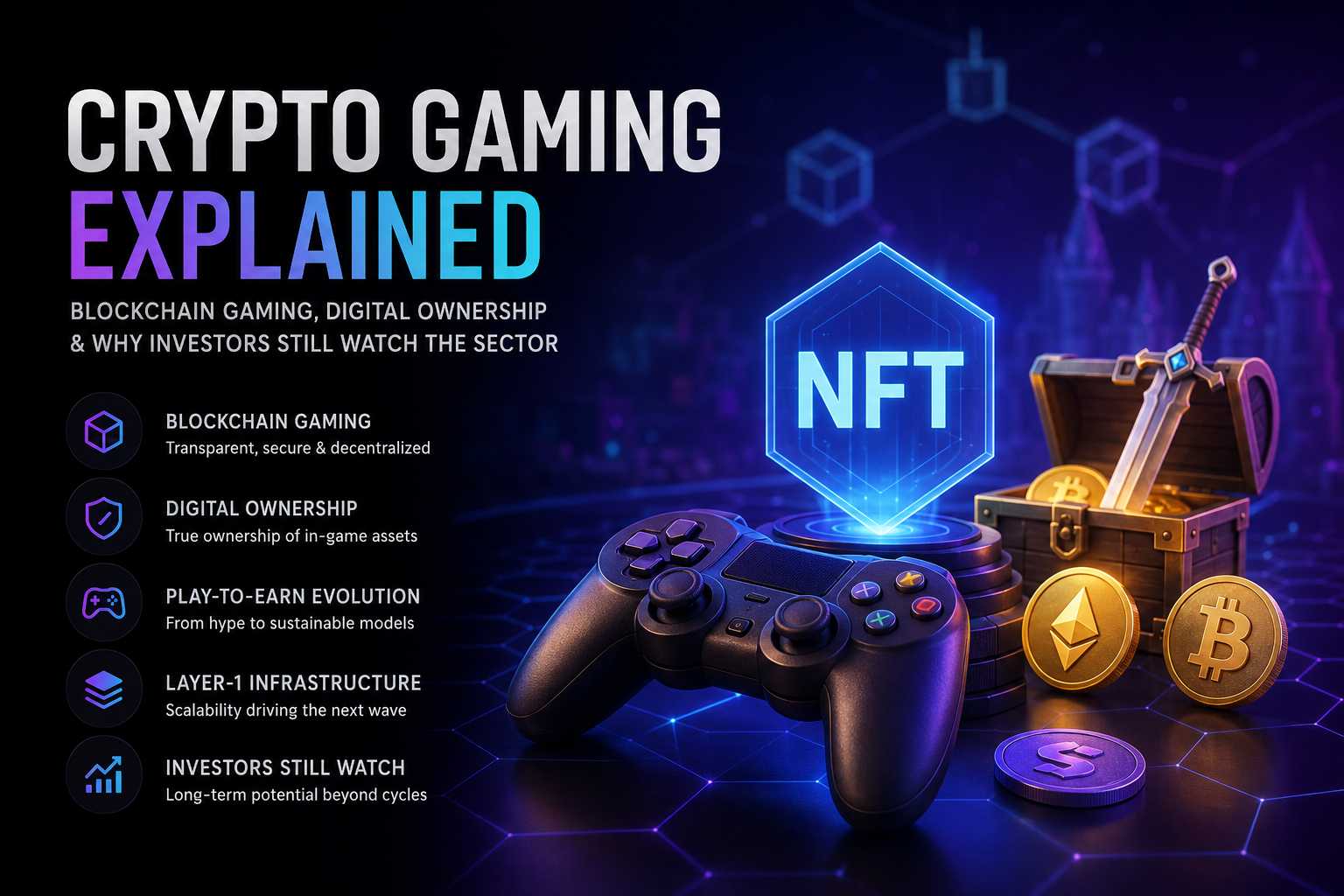
Crypto gaming remains one of the most controversial and misunderstood sectors within the cryptocurrency market.
Supporters believe blockchain gaming could fundamentally change:
- digital ownership
- in-game economies
- player incentives
- virtual assets
- online gaming infrastructure
Critics argue that most crypto games remain speculative, unsustainable, or technologically immature.
Despite multiple hype cycles, sharp collapses, and skepticism surrounding play-to-earn models, blockchain gaming continues attracting:
- developers
- infrastructure investment
- Layer-1 competition
- venture capital
- institutional attention
Understanding crypto gaming requires separating short-term speculation from long-term infrastructure development.
Because beneath the hype cycles, blockchain gaming represents a broader idea:
bringing digital ownership and decentralized economies into online gaming ecosystems.
In this analysis, we’ll explore:
- what crypto gaming actually is
- how blockchain games work
- NFTs and digital ownership
- why gaming became important for crypto adoption
- why many early crypto games failed
- scalability and Layer-1 competition
- play-to-earn vs sustainable gaming economies
- institutional and developer interest
- the biggest risks and criticisms surrounding blockchain gaming
- how investors often view the crypto gaming sector
What Is Crypto Gaming?
Crypto gaming refers to video games that integrate blockchain technology into gameplay, economies, or digital asset ownership.
Unlike traditional online games where publishers control all in-game assets and economies, blockchain games allow players to interact with assets stored on decentralized networks.
These assets may include:
- characters
- skins
- currencies
- weapons
- land
- collectibles
- governance tokens
In many blockchain games, players can theoretically:
- own assets directly
- trade items externally
- transfer assets between ecosystems
- participate in decentralized economies
This concept became one of the biggest narratives during earlier crypto market cycles.
Why Blockchain Gaming Became Popular
Traditional gaming already contains massive digital economies.
Players spend billions annually on:
- cosmetic items
- virtual currencies
- skins
- in-game upgrades
- collectibles
However, in most traditional games:
players do not truly own these assets.
Publishers maintain complete control over:
- item access
- marketplaces
- account systems
- game economies
Blockchain gaming introduced the idea of:
digital ownership.
This became one of crypto gaming’s most important narratives.
Supporters argued blockchain infrastructure could allow players to:
- own assets independently
- trade items freely
- move assets across ecosystems
- participate in player-driven economies
This narrative attracted major attention during NFT and metaverse expansion cycles.
NFTs and Digital Ownership
NFTs became heavily connected to blockchain gaming because they allow unique digital assets to exist on-chain.
Within gaming ecosystems, NFTs may represent:
- characters
- weapons
- land
- cosmetics
- collectibles
- account progression
- rare items
Unlike traditional in-game purchases locked within centralized platforms, blockchain-based assets can theoretically remain independently transferable.
Supporters believe this creates:
- stronger player ownership
- open economies
- creator monetization opportunities
- interoperable digital ecosystems
Critics argue most NFT gaming implementations remain speculative and fail to improve gameplay quality meaningfully.
This debate continues shaping the future of blockchain gaming development.
Why Most Early Crypto Games Failed
One of the biggest misconceptions surrounding crypto gaming is the assumption that earlier hype cycles represented true mainstream adoption.
In reality, many early blockchain games struggled because they focused more heavily on:
- speculation
- token rewards
- unsustainable incentives
- financial extraction
rather than gameplay quality.Many play-to-earn ecosystems depended on constant inflows of new participants.
This created fragile economic systems vulnerable to collapse once growth slowed.
Common problems included:
- inflationary tokenomics
- weak gameplay
- unsustainable reward systems
- excessive speculation
- poor player retention
- low production quality
As a result, many early crypto gaming ecosystems collapsed during broader market downturns.
This significantly damaged the sector’s reputation.
Play-to-Earn vs Sustainable Gaming Economies
The distinction between speculative gaming economies and sustainable gaming infrastructure became increasingly important after earlier market collapses.
Play-to-Earn Models
Early crypto gaming often focused heavily on earning potential.
Players were incentivized primarily through:
- token rewards
- NFT appreciation
- yield mechanisms
- speculative growth
This attracted short-term participation but often weakened long-term sustainability.
Sustainable Gaming Models
Newer blockchain gaming projects increasingly focus on:
- gameplay quality
- scalable infrastructure
- balanced economies
- optional blockchain integration
- user experience
Rather than forcing financialization into every aspect of gameplay, many developers now prioritize creating games players actually want to play.
Supporters argue this represents a healthier long-term direction for the sector.
Why Scalability Matters for Crypto Gaming
Gaming requires extremely efficient infrastructure.
Unlike slower financial systems, games often demand:
- rapid execution
- low latency
- high transaction throughput
- low fees
- smooth user experience
This creates major scalability challenges for blockchain infrastructure.
High transaction fees or slow execution can make blockchain gaming impractical.
Because of this, gaming ecosystems often rely on:
- Layer-2 scaling solutions
- high-performance Layer-1 blockchains
- specialized gaming infrastructure
Scalability became one of the biggest infrastructure bottlenecks for blockchain gaming adoption.
Layer 1 vs Layer 2 vs Layer 3 Explained: Scalability, Blockchain Infrastructure & Why It Matters
Why Solana and Avalanche Often Appear in Gaming Discussions
Several blockchain ecosystems positioned themselves aggressively around gaming infrastructure.
Solana
Solana focuses heavily on:
- high throughput
- low transaction costs
- fast execution
- consumer-scale applications
Supporters believe these characteristics make Solana attractive for blockchain gaming ecosystems.
Avalanche
Avalanche emphasizes:
- subnet architecture
- customizable blockchain environments
- gaming infrastructure flexibility
Gaming developers may theoretically launch dedicated gaming subnets with independent execution environments.
Immutable and Gaming-Focused Infrastructure
Some ecosystems focus almost entirely on blockchain gaming infrastructure.
These systems prioritize:
- NFT scaling
- gaming transactions
- marketplace infrastructure
- developer tooling
This specialization may become increasingly important if blockchain gaming adoption expands.
Crypto Gaming and Metaverse Narratives
Crypto gaming became closely connected to metaverse narratives during earlier market cycles.
Supporters envisioned:
- interconnected digital worlds
- blockchain-based economies
- virtual land ownership
- interoperable digital identities
However, many early metaverse projects struggled because expectations expanded far beyond current technological reality.
Despite this, broader themes involving:
- digital identity
- virtual ownership
- online economies
continue attracting long-term infrastructure interest.
Institutional and Developer Interest
Despite market skepticism, blockchain gaming still attracts significant:
- venture capital
- developer activity
- infrastructure investment
Many large gaming companies continue exploring blockchain integration cautiously.
Areas attracting ongoing experimentation include:
- digital collectibles
- marketplace systems
- tokenized assets
- player economies
- creator monetization
However, mainstream gaming adoption remains highly uncertain.
Traditional gaming communities often remain skeptical toward blockchain integration because of concerns surrounding:
- monetization
- speculation
- NFTs
- pay-to-win systems
This remains one of the sector’s largest adoption challenges.
Risks and Criticism
Crypto gaming still faces major long-term risks and criticisms.
These include:
- unsustainable token economies
- weak gameplay quality
- speculative behavior
- low player retention
- scalability limitations
- regulatory uncertainty
- NFT backlash
- infrastructure complexity
- poor user experience
Critics argue many blockchain games prioritize financial speculation over entertainment value.
Others question whether players actually want blockchain integration inside games.
In addition, gaming development itself remains highly competitive and unpredictable — even outside crypto markets.
How Investors Often View Crypto Gaming
Within crypto markets, blockchain gaming is often viewed as high-risk infrastructure and adoption exposure.
For many investors, crypto gaming represents potential exposure to:
- digital ownership systems
- consumer blockchain adoption
- NFT ecosystems
- gaming infrastructure
- virtual economies
- scalable blockchain networks
However, the sector also remains extremely speculative and highly sensitive to market sentiment.
Because of this, many investors treat crypto gaming as:
- higher-risk growth exposure
- emerging infrastructure experimentation
- long-term adoption speculation
rather than stable infrastructure investment.
Conclusion
Crypto gaming remains one of the most ambitious and controversial sectors within cryptocurrency markets.
At its core, blockchain gaming attempts to introduce:
- digital ownership
- decentralized economies
- tokenized assets
- interoperable virtual systems
into online gaming environments.
While earlier hype cycles exposed major weaknesses involving:
- speculation
- unsustainable tokenomics
- poor gameplay quality
the broader infrastructure narrative surrounding blockchain gaming continues evolving.
Scalability, low transaction costs, NFT infrastructure, and consumer blockchain usability remain central challenges for the sector.
Because of this, blockchain ecosystems involving:
- Solana
- Avalanche
- Layer-2 networks
- gaming-focused infrastructure systems
continue competing aggressively for future gaming adoption.
At the same time, blockchain gaming still faces significant uncertainty involving:
- mainstream adoption
- regulation
- player acceptance
- economic sustainability
- technological maturity
For investors, crypto gaming is often viewed less as a guaranteed growth sector and more as a long-term speculative infrastructure thesis tied to digital ownership and consumer blockchain adoption.
Whether blockchain gaming ultimately becomes a major part of the gaming industry will depend heavily on one critical factor:
whether developers can create games people genuinely want to play — not just ecosystems people want to speculate on.
How Smart Crypto Investors Navigate Uncertainty Without Predicting the Market
On-Chain Analysis in Crypto: How to Read Blockchain Data
Understanding Crypto Market Structure – Part 1 Who Actually Moves the Crypto Market?
Disclaimer: This article is for educational and informational purposes only and does not constitute financial or investment advice. Cryptocurrency markets are highly volatile and involve substantial risk. Always conduct your own research before making investment decisions.