
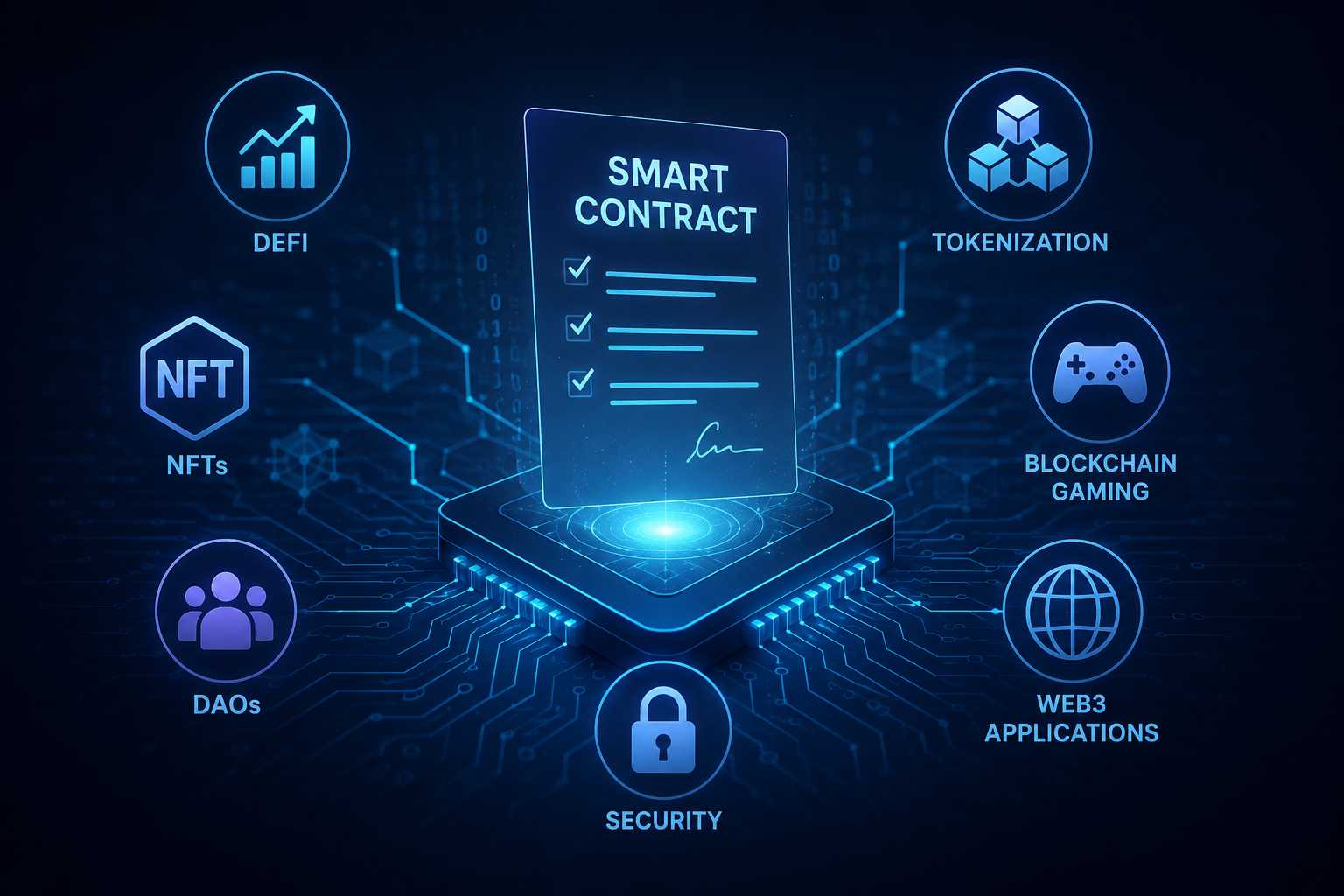
Blockchain technology has transformed the way people think about money.
Bitcoin introduced decentralized digital payments.
Ethereum expanded that vision by introducing something even more powerful:
Smart contracts.
Today, smart contracts power much of the cryptocurrency ecosystem.
Every day, they facilitate billions of dollars in transactions across:
- decentralized finance (DeFi)
- NFT marketplaces
- blockchain gaming
- tokenized real-world assets
- decentralized autonomous organizations (DAOs)
- Layer-2 networks
- Web3 applications
Without smart contracts, much of today’s blockchain economy simply would not exist.
Supporters believe smart contracts represent one of the most significant technological innovations since the internet itself.
Critics argue they remain complex, vulnerable to software bugs, and still face legal and regulatory uncertainty.
Regardless of perspective, understanding smart contracts has become essential for anyone seeking to understand cryptocurrency, blockchain technology, and the future of digital finance.
Rather than simply replacing paper agreements, smart contracts enable entirely new forms of automation that can operate without banks, lawyers, or centralized intermediaries.
For investors, they represent one of the most important building blocks behind the long-term growth of blockchain ecosystems.
In This Analysis, We’ll Explore:
- what smart contracts are
- why smart contracts were created
- how smart contracts work
- blockchain automation explained
- smart contracts vs traditional contracts
- Ethereum and smart contracts
- smart contracts on Solana, Cardano and Aptos
- decentralized applications (dApps)
- DeFi and smart contracts
- NFTs and smart contracts
- DAOs and governance
- tokenization and real-world assets
- gas fees and execution costs
- smart contract security
- common vulnerabilities
- smart contract audits
- limitations and risks
- future developments
- why investors should care
What Are Smart Contracts?
A smart contract is a self-executing computer program stored on a blockchain.
Instead of relying on lawyers, banks, brokers, or other intermediaries to enforce an agreement, the contract automatically executes when predefined conditions are met.
In simple terms:
If certain conditions are satisfied, the code performs the agreed action automatically.
For example:
A user sends cryptocurrency.
The smart contract verifies the payment.
Ownership of a digital asset transfers automatically.
No human approval is required.
No central authority is needed.
No paperwork exists.
Everything happens according to computer code recorded permanently on the blockchain.
Because blockchain data cannot easily be altered, smart contracts execute exactly as programmed.
This creates predictable, transparent, and automated agreements that anyone can verify.
Why Were Smart Contracts Created?
Traditional financial systems depend on trusted intermediaries.
Examples include:
- banks
- payment processors
- escrow companies
- brokers
- lawyers
- governments
- clearing houses
These organizations help verify transactions and enforce agreements.
Although they provide valuable services, they also introduce:
- additional costs
- delays
- paperwork
- operational risk
- counterparty risk
Smart contracts attempt to reduce these inefficiencies.
Rather than trusting an institution, users trust transparent computer code.
Once deployed onto the blockchain, the contract follows predefined rules without human intervention.
The objective is not merely replacing paperwork.
It is creating systems capable of operating continuously without centralized control.
The Origin of Smart Contracts
Although smart contracts became famous through Ethereum, the concept itself predates blockchain technology.
Computer scientist Nick Szabo first introduced the idea during the 1990s.
He imagined digital agreements capable of automatically enforcing contractual terms without requiring trusted third parties.
At the time, however, the necessary infrastructure did not exist.
Digital payments remained centralized.
Secure decentralized databases had not yet been invented.
Bitcoin solved one part of the puzzle by introducing decentralized digital money.
Ethereum expanded the concept by allowing developers to build programmable agreements directly on a blockchain.
This innovation transformed blockchain from a payment network into a global computing platform.
How Smart Contracts Work
Every smart contract follows a simple process.
First, developers write the contract using a blockchain programming language.
The code defines:
- rules
- conditions
- permissions
- outcomes
Once completed, the contract is deployed onto the blockchain.
From that moment onward, the code becomes publicly available and executes according to its programming.
A typical transaction follows several steps.
First:
A user interacts with the contract.
For example:
sending cryptocurrency
claiming rewards
borrowing funds
minting an NFT
staking tokens
The blockchain validates the transaction.
If all predefined conditions are satisfied, the smart contract executes automatically.
The blockchain permanently records the outcome.
No employee manually approves the transaction.
No office processes paperwork.
Execution occurs automatically through consensus.
Blockchain Automation Explained
Smart contracts are often described as blockchain automation.
This description is accurate because they eliminate much of the manual work traditionally required to complete financial agreements.
Consider a simple example.
Imagine purchasing a house.
Normally the transaction requires:
buyer
seller
bank
lawyer
government registry
escrow service
identity verification
multiple signatures
The process may require weeks.
With blockchain automation, ownership could theoretically transfer automatically once payment conditions are satisfied.
Although real estate involves additional legal complexities, the example illustrates the broader concept.
Automation reduces:
waiting time
operational costs
administrative overhead
human error
For many industries, this efficiency represents the greatest long-term opportunity offered by smart contracts.
Smart Contracts vs Traditional Contracts
Although both forms of contracts establish agreements, they operate very differently.
Execution
- Traditional Contracts: Manual
- Smart Contracts: Automatic
Enforcement
- Traditional Contracts: Courts and legal systems
- Smart Contracts: Blockchain code
Speed
- Traditional Contracts: Hours to weeks
- Smart Contracts: Seconds to minutes
Intermediaries
- Traditional Contracts: Usually required
- Smart Contracts: Often unnecessary
Transparency
- Traditional Contracts: Limited
- Smart Contracts: Public blockchain
Cost
- Traditional Contracts: Higher
- Smart Contracts: Generally lower
Availability
- Traditional Contracts: Business hours
- Smart Contracts: 24/7
Modification
- Traditional Contracts: Negotiable
- Smart Contracts: Usually fixed after deployment
Traditional contracts remain essential for many legal situations.
However, smart contracts excel when agreements involve clearly defined rules that can be executed automatically.
Why Ethereum Made Smart Contracts Famous
Although several blockchain projects now support smart contracts, Ethereum popularized the concept.
Launched in 2015, Ethereum introduced a decentralized platform capable of running programmable applications.
Instead of limiting blockchain to payments, Ethereum allowed developers to build:
- decentralized exchanges
- lending platforms
- stablecoins
- NFT marketplaces
- blockchain games
- tokenized assets
- decentralized identity systems
This dramatically expanded blockchain’s potential.
Today, Ethereum remains the largest smart contract ecosystem in the cryptocurrency industry.
Smart Contracts Beyond Ethereum
Ethereum remains the largest smart contract platform.
However, it is no longer the only one.
Several major blockchain ecosystems now compete by offering different approaches to scalability, speed, security, and developer experience.
Among the most important are:
Solana
Designed for extremely high transaction throughput with low fees.
Often favored for:
- DeFi
- gaming
- NFT applications
- consumer-focused Web3 services
Cardano
Focuses heavily on peer-reviewed research and formal verification.
Its development philosophy emphasizes long-term security and reliability over rapid deployment.
Aptos
Introduced the Move programming language, originally developed for Meta’s Diem project.
Move aims to improve asset security while reducing common programming vulnerabilities.
Avalanche
Supports customizable blockchain environments while maintaining compatibility with Ethereum applications.
Each platform seeks to improve some aspect of blockchain infrastructure.
However, they all rely on the same core principle:
programmable smart contracts.
What Are Decentralized Applications (dApps)?
Smart contracts become truly powerful when combined into decentralized applications, commonly known as dApps.
A dApp functions much like a traditional mobile or web application, but instead of relying on centralized servers, its core logic is executed by smart contracts on a blockchain.
Examples include:
- decentralized exchanges
- lending protocols
- blockchain games
- NFT marketplaces
- prediction markets
- identity platforms
- social networks
When a user interacts with a dApp, they are often interacting directly with one or more smart contracts.
The application interface may look familiar, but the underlying infrastructure operates without a centralized operator controlling every transaction.
As blockchain adoption expands, decentralized applications are expected to become one of the primary ways users interact with Web3 services.
DeFi and Smart Contracts
Perhaps nowhere is the power of smart contracts more visible than in Decentralized Finance (DeFi).
Traditional financial services rely on banks and financial institutions to process transactions, approve loans, hold deposits, and facilitate trading.
DeFi replaces many of these intermediaries with smart contracts.
Instead of trusting a bank, users interact directly with blockchain-based code.
Today, smart contracts power a wide range of financial services, including:
- decentralized exchanges (DEXs)
- lending and borrowing platforms
- stablecoins
- derivatives
- yield farming
- staking
- liquidity pools
When users swap one cryptocurrency for another on a decentralized exchange, no employee processes the transaction.
Instead, a smart contract automatically verifies balances, calculates exchange rates, updates liquidity pools, and settles the trade within seconds.
This automation has allowed billions of dollars in value to move across blockchain networks without traditional financial intermediaries.
For investors, DeFi demonstrates that smart contracts are not simply theoretical technology—they already support a rapidly growing financial ecosystem.
NFTs and Smart Contracts
Smart contracts also form the foundation of Non-Fungible Tokens (NFTs).
An NFT is far more than a digital image.
Behind every NFT is a smart contract defining:
- ownership
- transfer rules
- creator royalties
- metadata
- transaction history
When someone purchases an NFT, ownership changes automatically through a smart contract.
No central marketplace needs to manually approve the transaction.
The blockchain permanently records ownership while the contract enforces the rules established by its creator.
Smart contracts also allow creators to receive automatic royalty payments whenever an NFT is resold.
This type of programmable ownership represents one of blockchain’s most innovative capabilities.
DAOs and Governance
Smart contracts also enable Decentralized Autonomous Organizations (DAOs).
A DAO allows communities to coordinate decision-making through blockchain voting rather than centralized management.
Instead of executives making decisions, token holders may vote on proposals using smart contracts.
Typical governance decisions include:
- treasury spending
- protocol upgrades
- fee adjustments
- ecosystem grants
- development priorities
Once voting concludes, smart contracts automatically execute approved proposals.
This creates transparent governance where every vote and decision remains permanently visible on the blockchain.
Although DAOs continue evolving, they illustrate how smart contracts can automate organizational decision-making.
Tokenization and Real-World Assets
One of the fastest-growing applications of smart contracts involves tokenization.
Tokenization converts ownership rights into blockchain-based digital tokens.
Assets that may be tokenized include:
- real estate
- stocks
- government bonds
- commodities
- artwork
- intellectual property
- private credit
Instead of transferring paper certificates, ownership transfers through blockchain transactions executed by smart contracts.
Supporters believe tokenization could eventually modernize global financial markets by improving:
- settlement speed
- transparency
- liquidity
- accessibility
- operational efficiency
This explains why many financial institutions continue investing heavily in blockchain infrastructure.
Gas Fees and Execution Costs
Smart contracts are not free to execute.
Most blockchain networks require users to pay transaction fees known as gas fees.
Gas compensates validators for processing computations performed by the network.
Simple transfers generally require relatively little gas.
Complex smart contract interactions often require significantly more computational work.
Gas costs therefore depend on:
- network congestion
- transaction complexity
- blockchain design
- user demand
Ethereum’s gas fees can increase substantially during periods of heavy activity.
Other blockchain networks attempt to reduce these costs through alternative architectures or Layer-2 scaling solutions.
Understanding gas fees helps investors evaluate how practical different blockchain ecosystems may become as adoption grows.
Smart Contract Security
Smart contracts execute exactly as programmed.
This represents both their greatest strength and one of their greatest risks.
Unlike traditional software, deployed smart contracts are often extremely difficult—or even impossible—to modify.
Programming mistakes can therefore become permanent.
Because smart contracts frequently manage billions of dollars worth of assets, security has become one of blockchain development’s highest priorities.
Developers increasingly rely on:
- formal verification
- code reviews
- automated testing
- penetration testing
- third-party security audits
Despite these precautions, vulnerabilities occasionally remain undiscovered until after deployment.
Security therefore remains one of the most important considerations when evaluating blockchain projects.
Common Smart Contract Vulnerabilities
Although smart contracts eliminate many traditional risks, they introduce new technical challenges.
Common vulnerabilities include:
- reentrancy attacks
- integer overflow and underflow
- oracle manipulation
- flash loan exploits
- access control failures
- front-running
- logic errors
- permission misconfigurations
Some of the cryptocurrency industry’s largest losses have resulted from flaws within smart contracts rather than weaknesses in blockchain security itself.
For investors, this distinction is important.
A blockchain may remain perfectly secure while an individual application built on top of it contains vulnerabilities.
Smart Contract Audits
To reduce these risks, many projects conduct independent smart contract audits before launching.
Security firms review source code for vulnerabilities, logic errors, and implementation weaknesses.
Auditors typically evaluate:
- contract architecture
- security assumptions
- attack vectors
- access controls
- code quality
- upgrade mechanisms
Although audits improve confidence, they cannot guarantee complete safety.
New attack methods continue emerging as blockchain technology evolves.
Professional investors therefore often consider both audit quality and developer reputation when evaluating projects.
Risks and Limitations
Despite their advantages, smart contracts face several limitations.
These include:
- software bugs
- irreversible execution
- legal uncertainty
- regulatory challenges
- oracle dependency
- network congestion
- scalability constraints
- user error
Many smart contracts also rely on external data.
If inaccurate information enters the blockchain through an oracle, the smart contract may still execute exactly as programmed—even if the underlying data is incorrect.
This illustrates an important principle:
Smart contracts execute code.
They do not independently determine whether external information is accurate.
The Future of Smart Contracts
Smart contracts continue evolving rapidly.
Future developments may include:
- AI-assisted automation
- cross-chain interoperability
- programmable digital identity
- tokenized financial markets
- automated compliance
- decentralized insurance
- supply chain automation
- healthcare applications
- government record systems
- enterprise settlement infrastructure
As blockchain adoption expands, smart contracts are expected to automate an increasingly wide range of economic activity.
Many analysts believe they will eventually become part of everyday digital infrastructure, even for users who never realize blockchain technology is operating behind the scenes.
Why Investors Should Care
Many investors focus almost exclusively on cryptocurrency prices.
Professional investors often pay equal attention to infrastructure.
Smart contracts determine what blockchain networks can actually do.
They power decentralized applications, financial services, tokenization, digital ownership, governance systems, and countless other innovations.
As adoption grows, blockchain ecosystems supporting secure, scalable smart contracts may become increasingly valuable.
Understanding this technology helps investors distinguish between short-term speculation and long-term structural growth.
Rather than asking only:
“Will this token increase in price?”
Experienced investors often ask:
“Does this blockchain support applications capable of generating sustainable long-term demand?”
That question begins with smart contracts.
Strengths of Smart Contracts
Smart contracts offer numerous advantages.
These include:
- automation without intermediaries
- transparency
- lower operational costs
- faster settlement
- programmable agreements
- global accessibility
- improved efficiency
- reduced counterparty risk
- continuous availability
- support for decentralized applications
These characteristics explain why smart contracts have become one of blockchain’s most transformative innovations.
Limitations of Smart Contracts
No technology is perfect.
Smart contracts also face meaningful challenges.
These include:
- programming complexity
- software vulnerabilities
- irreversible execution
- regulatory uncertainty
- scalability limitations
- dependence on blockchain infrastructure
- oracle risks
- evolving legal frameworks
Successful adoption will depend not only on technological improvements but also on broader ecosystem development.
Conclusion
Smart contracts have fundamentally changed what blockchain technology can achieve.
Rather than functioning solely as digital money, modern blockchains now support programmable agreements capable of automating financial services, digital ownership, governance, tokenization, and countless decentralized applications.
Understanding:
- smart contracts
- blockchain automation
- decentralized applications
- DeFi
- NFTs
- DAOs
- tokenization
- gas fees
- security
- smart contract audits
- blockchain scalability
helps investors better understand why blockchain technology continues attracting developers, institutions, and global capital.
Successful cryptocurrency investing involves more than following token prices.
It requires understanding the infrastructure driving long-term adoption.
Smart contracts are no longer an experimental concept.
They have become the programmable foundation of Web3 and one of the most important innovations in the evolution of blockchain technology.
For long-term investors, understanding how smart contracts work provides valuable insight into the future of digital finance, decentralized applications, and the next generation of the internet.
Layer 1 vs Layer 2 vs Layer 3 Explained: Scalability, Blockchain Infrastructure & Why It Matters
Crypto Security Explained: Wallets, Private Keys, Scams & How Investors Protect Digital Assets
Disclaimer: This article is for educational and informational purposes only and does not constitute financial or investment advice. Cryptocurrency markets are highly volatile and involve substantial risk. Always conduct your own research before making investment decisions.