
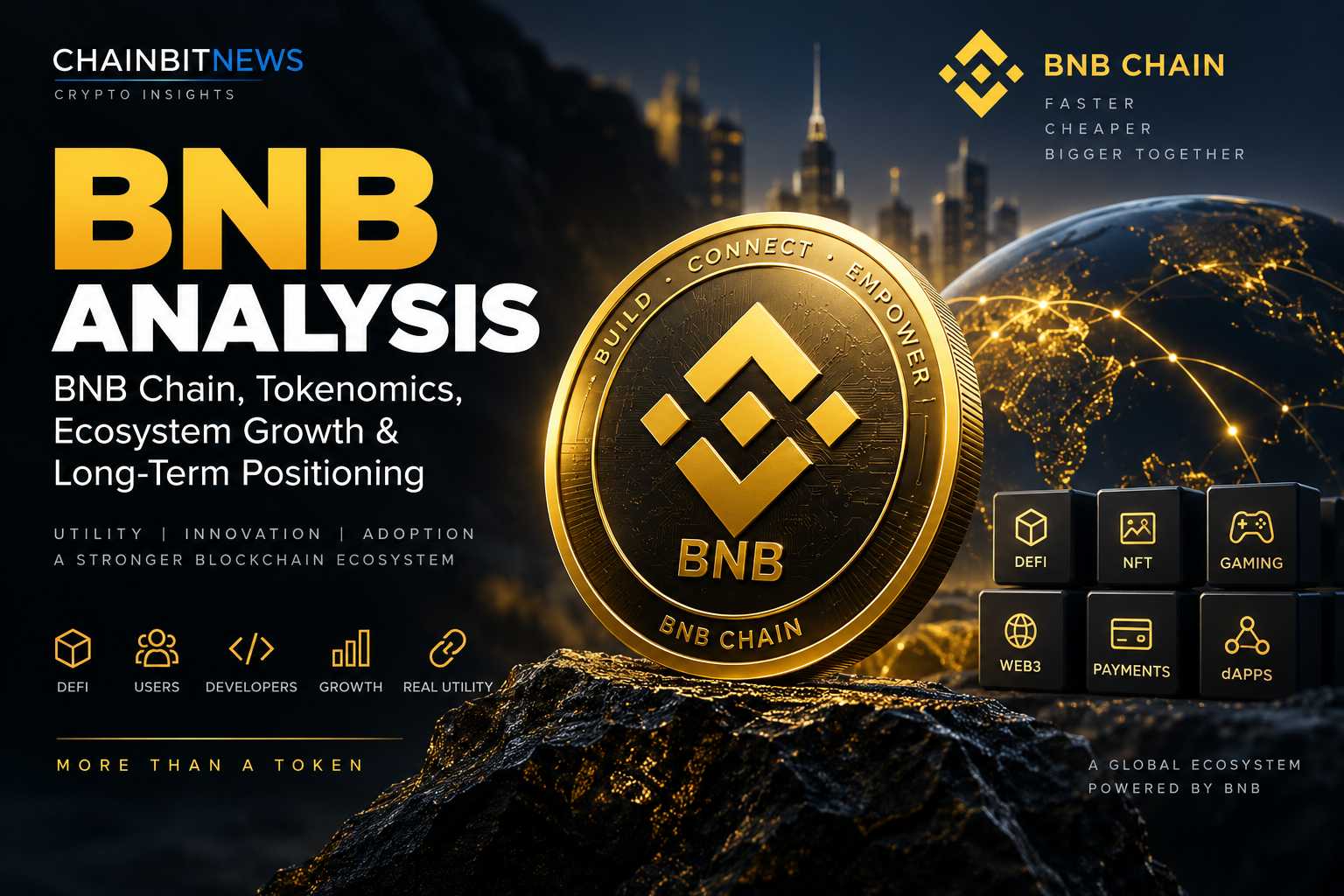
BNB has developed into one of the largest crypto assets in the market.
Originally launched as a utility token connected to the Binance ecosystem, BNB has expanded far beyond its initial purpose.
Today, BNB plays a central role within BNB Chain, where it is used for transaction fees, staking, governance-related functions and participation across a large ecosystem of decentralized applications.
This creates an interesting position within the cryptocurrency market.
BNB is not simply an exchange-related token.
It is also the native economic asset of a major smart contract ecosystem competing for users, developers, liquidity and applications.
At the same time, its historical and economic connection to Binance creates both advantages and risks that investors should understand.
Evaluating BNB therefore requires looking at several layers:
the token, the blockchain ecosystem, the supply structure, adoption and the long-term competitive position of BNB Chain.
In This Analysis, We’ll Explore:
- What BNB is
- How BNB evolved beyond an exchange token
- How BNB Chain works
- BNB Smart Chain and its role in the ecosystem
- BNB utility
- BNB staking
- Tokenomics and supply
- BNB token burns
- DeFi and application growth
- Scalability and transaction costs
- Developer and user adoption
- BNB Chain vs Ethereum
- BNB Chain vs Solana
- The relationship between BNB and Binance
- Decentralization considerations
- Regulatory and ecosystem risks
- The BNB bull case
- The BNB bear case
- Long-term positioning
- What investors should monitor
What Is BNB?
BNB is the native cryptocurrency at the center of the BNB Chain ecosystem.
The token originally launched in 2017 and was initially closely associated with Binance.
Its early utility included providing benefits within the Binance trading ecosystem, including discounted trading fees.
But BNB’s role expanded considerably as the ecosystem developed.
Today, BNB can be used for functions including:
- Paying network transaction fees
- Participating in staking
- Interacting with decentralized applications
- Providing liquidity
- Using DeFi protocols
- Participating in parts of the wider BNB ecosystem
This transformation is important.
An exchange utility token depends heavily on the usefulness of a centralized platform.
A native blockchain asset can potentially derive demand from an entire decentralized application ecosystem.
BNB increasingly sits across both worlds.
That gives the token substantial utility, but also creates a more complicated investment thesis.
From Binance Coin to BNB
BNB was originally known as Binance Coin.
That name reflected its close connection to Binance.
Over time, however, the ecosystem expanded and BNB became increasingly associated with a broader blockchain infrastructure.
The branding eventually shifted toward simply:
BNB
with the wider network known as:
BNB Chain.
This evolution represents an attempt to position BNB as more than a token used within a cryptocurrency exchange.
The long-term thesis increasingly depends on whether BNB Chain can remain a significant blockchain ecosystem in its own right.
That means investors should evaluate BNB using more than Binance’s trading activity.
They should also examine:
- Blockchain users
- Transaction activity
- DeFi liquidity
- Application development
- Developer activity
- Stablecoin usage
- Competitive positioning
The stronger the independent economic activity on BNB Chain becomes, the broader the potential foundation supporting demand for BNB.
What Is BNB Chain?
BNB Chain is a blockchain ecosystem designed to support decentralized applications and digital assets.
Its most recognizable component has historically been BNB Smart Chain.
BNB Smart Chain provides smart contract functionality and allows developers to build applications across areas such as:
- Decentralized finance
- Decentralized exchanges
- Gaming
- NFTs
- Stablecoins
- Infrastructure
- Payments
- Web3 applications
One of the major reasons BNB Chain gained adoption was accessibility.
During periods when Ethereum transaction fees became expensive, BNB Chain provided users with an alternative environment offering relatively low transaction costs and fast execution.
This helped attract both developers and retail users.
BNB Chain also benefits from compatibility with Ethereum development infrastructure.
Developers familiar with Ethereum-based tools can more easily deploy applications within the BNB ecosystem than they could on an entirely different technical architecture.
This lowered barriers to ecosystem expansion.
BNB Smart Chain Explained
BNB Smart Chain is an EVM-compatible blockchain.
EVM stands for:
Ethereum Virtual Machine.
EVM compatibility is strategically important because Ethereum has one of the largest developer ecosystems in crypto.
Instead of forcing developers to learn an entirely new programming environment, EVM-compatible networks can support many familiar Ethereum tools, smart contracts and development frameworks.
This can make application migration and deployment easier.
For BNB Chain, this provided a major advantage during its early growth.
Developers could build applications with familiar technology while users benefited from lower transaction costs.
However, EVM compatibility is no longer unusual.
Many competing blockchains and Layer-2 networks now provide similar compatibility.
BNB Chain therefore cannot rely on EVM support alone as a long-term competitive advantage.
It must compete through:
users, liquidity, cost, performance, applications and ecosystem strength.
How BNB Is Used
The investment case for a blockchain token depends partly on whether the token has genuine economic utility.
BNB has several important functions.
Transaction Fees
BNB is used to pay gas fees for transactions on BNB Chain.
When users interact with decentralized applications, transfer assets or execute smart contracts, network fees can create recurring demand for the native token.
Staking
BNB can participate in the network’s staking and validation structure.
This connects the token directly to network security and operation.
DeFi
BNB can be used throughout decentralized finance applications.
This may include:
- Providing liquidity
- Collateral
- Decentralized trading
- Lending-related activity
- Yield strategies
Ecosystem Utility
BNB has historically had additional utility throughout the wider Binance-related ecosystem.
This broader range of uses differentiates BNB from tokens whose primary purpose is speculative trading.
But utility alone does not guarantee price appreciation.
Investors also need to understand how demand interacts with token supply.
BNB Tokenomics
Tokenomics can significantly influence long-term cryptocurrency returns.
Even a growing blockchain can produce disappointing token performance if supply expands too aggressively.
BNB has a different supply structure from many inflationary crypto assets.
A major component of its tokenomics is the reduction of supply through token burns.
A token burn permanently removes tokens from circulation.Conceptually:
Lower supply + sustained or increasing demand = potentially stronger scarcity dynamics
However, investors should be careful with this simplified relationship.
Reducing supply does not automatically increase price.
Demand still matters.
If ecosystem activity declines significantly, lower supply alone cannot guarantee long-term value creation.
BNB’s tokenomics should therefore be evaluated alongside:
- Network activity
- User growth
- DeFi activity
- Developer adoption
- Token utility
- Broader ecosystem demand
Supply reduction can strengthen an investment thesis.
It cannot replace one.
Tokenomics in Crypto: Why Supply Design Determines Long-Term Value
How BNB Token Burns Work
BNB has used mechanisms designed to permanently reduce the token supply over time.
This is one of the most recognizable elements of BNB’s economic model.
Tokens removed through burns can no longer circulate or be sold.
Over sufficiently long periods, repeated burns can reduce total available supply.
This contrasts with cryptocurrencies where substantial new token issuance continuously enters the market.
Supply matters because crypto valuation ultimately depends on the relationship between:
available tokens
and
demand for those tokens.
If BNB Chain continues attracting meaningful economic activity while BNB supply decreases, scarcity can become increasingly relevant.
But the strongest scenario requires both sides of the equation:
supply reduction + sustainable demand.
Investors focusing only on burn statistics risk ignoring the more important question:
Is the ecosystem creating enough long-term demand for BNB?
DeFi on BNB Chain
Decentralized finance has been one of the major drivers of BNB Chain activity.
DeFi allows users to interact with financial applications without relying entirely on traditional intermediaries.
Activities can include:
- Token swaps
- Lending
- Borrowing
- Liquidity provision
- Yield strategies
- Stablecoin transactions
BNB Chain’s relatively low transaction costs helped make these activities accessible to smaller users.
This was particularly important during periods when performing similar transactions on Ethereum could become expensive.
A successful DeFi ecosystem can strengthen BNB because economic activity creates demand for block space and transaction fees.
But DeFi activity is highly competitive.
Liquidity can move between ecosystems quickly.
Users may migrate toward networks offering:
- Better applications
- Higher yields
- Lower fees
- Better user experience
- Greater security
- Stronger incentives
The long-term question is therefore not whether BNB Chain has DeFi.
It clearly does.
The question is whether it can continue attracting and retaining meaningful liquidity as blockchain competition increases.
Stablecoins and BNB Chain
Stablecoins are another important part of blockchain adoption.
They allow users to transfer dollar-linked value through blockchain networks and serve as a major source of liquidity within DeFi.
Strong stablecoin activity can support:
- Trading
- Payments
- Lending
- DeFi liquidity
- Cross-border transfers
- Application activity
For a smart contract network, stablecoin adoption can therefore provide a useful indication of real economic activity.
BNB Chain benefits when users actively move and deploy stablecoins within its ecosystem.
This matters because blockchain activity driven entirely by speculative token trading can disappear rapidly when market conditions weaken.
Stablecoin infrastructure can support a wider range of economic uses.
Stablecoins Explained: How They Work, Types, Benefits, Risks & Their Role in the Crypto Ecosystem
Scalability and Transaction Costs
Blockchain networks face a difficult challenge.
They need to process large numbers of transactions while remaining:
- Fast
- Affordable
- Secure
- Reliable
- Decentralized
BNB Chain has historically emphasized relatively fast and inexpensive transactions.
This helped it compete against Ethereum during periods of network congestion.
Low transaction costs can significantly improve user experience.
A $20 transaction fee may be acceptable for a large institutional transfer.
It can make little sense for someone attempting a $50 DeFi transaction.
Lower fees therefore make blockchain applications accessible to a wider group of users.
However, blockchain competition has changed.
Ethereum Layer-2 networks now provide lower-cost environments.
Solana competes aggressively on throughput and fees.
Other Layer-1 networks continue improving.
Low fees are therefore an advantage, but no longer a unique one.
Developer Adoption and Ecosystem Growth
Blockchains become more valuable when developers build applications people actually want to use.
Infrastructure without applications has limited economic value.
For long-term BNB analysis, investors should therefore monitor whether developers continue creating and maintaining:
- DeFi protocols
- Wallet infrastructure
- Games
- Payment applications
- Trading platforms
- Consumer applications
- Blockchain tools
Developer activity can be especially important during bear markets.
Bull markets attract projects because capital is abundant.
Bear markets reveal which ecosystems continue building when speculation declines.
A healthy long-term ecosystem should not depend entirely on token incentives to attract developers.
Eventually, applications need users.
And users need reasons to remain.
BNB Chain vs Ethereum
Ethereum remains the most important comparison for many smart contract platforms.
Ethereum benefits from:
- Deep developer adoption
- Significant DeFi infrastructure
- Strong institutional recognition
- Large stablecoin activity
- Extensive Layer-2 development
- A long operating history
BNB Chain competes differently.
Its strengths have historically included:
- Lower transaction costs
- Faster user experience
- EVM compatibility
- Strong retail accessibility
- Connection to a massive crypto ecosystem
The competition is not simply about which blockchain processes transactions faster.
Ethereum increasingly scales through Layer-2 networks.
BNB Chain continues developing its own broader infrastructure.
The long-term competition is therefore about which ecosystems can attract:
users + developers + applications + liquidity + capital.
BNB Chain does not need to replace Ethereum to remain successful.
It needs to maintain enough economic activity to justify its position as a major smart contract ecosystem.
Ethereum (ETH) Analysis: Smart Contract Infrastructure, Layer-2 Scaling & Long-Term Positioning
BNB Chain vs Solana
Solana creates a different competitive challenge.
While BNB Chain grew partly through EVM compatibility and accessibility, Solana uses a different architecture designed around high throughput and low transaction costs.
Solana has built strong activity across areas including:
- DeFi
- Trading
- Consumer applications
- Payments
- Memecoins
- NFTs
Both ecosystems compete for many of the same users.But their positioning differs.
BNB Chain benefits from its established ecosystem, EVM compatibility and historical connection to Binance.
Solana emphasizes performance, integrated execution and a rapidly developing application environment.
For BNB investors, Solana matters because blockchain users are not permanently locked into one ecosystem.
Capital can migrate quickly.If another blockchain provides better applications, deeper liquidity or a stronger user experience, activity can move.
This makes ecosystem retention just as important as ecosystem growth.
Solana (SOL) Analysis: High-Speed Infrastructure, Scalability & Long-Term Positioning
The Central Question for BNB
BNB has already achieved something many crypto projects never do.
It developed from a relatively narrow utility token into the native asset of a major blockchain ecosystem.
That gives BNB multiple potential sources of demand.
But it also creates a more complicated long-term question.
BNB’s future does not depend on one factor.
It depends on the interaction between:
BNB Chain adoption
token utility
supply reduction
developer activity
liquidity
competition
and
the continuing influence of Binance.
That final factor is particularly important.
The connection to Binance has helped BNB achieve enormous distribution and visibility.
But the same connection creates concentration, regulatory and perception risks that must be considered alongside the ecosystem’s strengths.
Those risks—and whether BNB can continue strengthening its position as an independent blockchain asset—form the other half of the long-term investment thesis.
The Relationship Between BNB and Binance
Any serious analysis of BNB needs to address its relationship with Binance.
BNB has expanded far beyond its original role as an exchange utility token, and BNB Chain operates as a broader blockchain ecosystem.
However, Binance remains an important part of BNB’s history, distribution and market positioning.
This relationship has provided significant advantages.
Binance helped expose BNB to a large global crypto audience and created practical utility for the token from an early stage.
The broader ecosystem has also helped connect users with:
- BNB
- BNB Chain
- Wallet infrastructure
- Trading markets
- Blockchain applications
Few blockchain ecosystems have had access to such a large existing crypto user base.
But this connection also creates risk.
Problems affecting Binance can influence investor perception of BNB even when BNB Chain itself continues operating normally.
For long-term investors, this creates an important distinction:
BNB Chain should increasingly be evaluated on the strength of its own ecosystem rather than relying entirely on the success of Binance.
The more independent economic activity BNB Chain generates, the stronger that separation becomes.
Is BNB Chain Decentralized?
Decentralization is one of the most debated aspects of BNB Chain.
Different blockchain networks make different trade-offs between:
- Decentralization
- Performance
- Cost
- Scalability
- Governance
BNB Chain has historically used a relatively limited validator structure compared with networks designed around much larger validator participation.
This can improve efficiency and help maintain fast, inexpensive transactions.
But it also raises questions about how distributed network control actually is.
This matters because decentralization can influence:
- Censorship resistance
- Network resilience
- Governance
- Trust assumptions
- Resistance to coordinated control
There is no simple rule stating that the blockchain with the most validators will automatically become the most successful.
Users often prioritize cost, speed and application availability.
However, investors should understand the trade-off.
BNB Chain’s performance characteristics do not exist independently from its network architecture.
Long-term analysis should therefore consider whether the network can continue improving scalability and accessibility while maintaining sufficient decentralization and resilience.
Security and Network Reliability
A blockchain ecosystem can attract millions of users, but long-term value also depends on security.
Smart contract platforms contain substantial economic value.
This makes them attractive targets for:
- Exploits
- Bridge attacks
- Smart contract vulnerabilities
- Protocol manipulation
- Infrastructure attacks
Not every security failure originates from the underlying blockchain.
Applications and cross-chain infrastructure can introduce their own vulnerabilities.
But users often experience these risks as part of the broader ecosystem.
Repeated security problems can damage trust and cause liquidity to migrate elsewhere.
For BNB Chain, long-term success therefore requires more than processing transactions cheaply.
The ecosystem needs to demonstrate that significant economic activity can operate reliably over time.
Security becomes increasingly important as the amount of capital using the network grows.
Crypto Security Explained: Wallets, Private Keys, Scams & How Investors Protect Digital Assets
Regulatory Risk
BNB also carries regulatory considerations that differ somewhat from purely decentralized crypto assets.
Its historical relationship with Binance means developments affecting the exchange can influence market perception around BNB.
Regulatory pressure can potentially affect:
- Exchange operations
- Token availability
- Institutional participation
- Market access
- Investor confidence
This does not mean regulatory action against one company automatically determines the future of BNB Chain.
The blockchain ecosystem and Binance should not be treated as exactly the same thing.
But investors should also avoid pretending that the historical relationship does not matter.
This creates one of BNB’s most important long-term challenges:
Can BNB become increasingly valuable because of independent blockchain activity rather than primarily because of its connection to Binance?
Progress toward that outcome would strengthen the long-term thesis.
Competition Is Increasing
BNB Chain operates in one of the most competitive areas of cryptocurrency.
Smart contract platforms compete for the same scarce resources:
developers
users
liquidity
applications
capital
Ethereum continues expanding through its Layer-2 ecosystem.
Solana competes aggressively on performance and user activity.
Other Layer-1 networks continue developing new architectures.
And new blockchain infrastructure can emerge quickly.
This means BNB Chain cannot rely indefinitely on advantages that helped drive its earlier adoption.
Low fees are no longer unusual.
Fast transactions are no longer unusual.
EVM compatibility is no longer unusual.
Long-term differentiation increasingly depends on ecosystem effects.
If users already have wallets, applications, liquidity and communities on BNB Chain, leaving the ecosystem creates friction.
The stronger these network effects become, the harder they are for competitors to replicate.
Layer 1 vs Layer 2 vs Layer 3 Explained: Scalability, Blockchain Infrastructure & Why It Matters
The Importance of Real Economic Activity
Transaction count alone does not prove that a blockchain has sustainable adoption.
Networks can generate activity through:
- Incentive programs
- Airdrop farming
- Bots
- Speculation
- Memecoin trading
- Temporary yield opportunities
These activities can create impressive short-term statistics.
But long-term investors should look deeper.
A stronger ecosystem produces activity that users continue generating even when incentives decline.
This may include:
- Stablecoin transfers
- Sustainable DeFi usage
- Payments
- Trading
- Consumer applications
- Long-term liquidity
- Applications with recurring users
The distinction is important.
Activity can be purchased with incentives.
Sustainable demand is much harder to create.
For BNB Chain, maintaining genuine economic activity across different market cycles would strengthen the argument that the ecosystem has durable value.
Does BNB Capture Value From BNB Chain Growth?
A blockchain can become popular without its token necessarily becoming a strong investment.
Investors therefore need to understand value capture.
BNB has an advantage because it is directly integrated into the ecosystem.
Users require BNB for network transaction fees.
BNB participates in staking and network operation.
The token also has broader utility across the ecosystem.
At the same time, token burns can reduce supply.
This creates a relatively clear theoretical relationship:
More network activity → greater BNB utility
combined with:
Lower token supply → increasing scarcity if demand remains strong
But this relationship should not be oversimplified.
Transaction fees can remain inexpensive even with significant activity.
Users do not necessarily need to hold enormous quantities of BNB.
And speculative demand can still dominate token prices during bull markets.
The important long-term question is therefore whether BNB Chain growth creates enough persistent demand for BNB to strengthen the token’s economic position over time.
The BNB Bull Case
The strongest long-term case for BNB combines several factors.
A Large Existing Ecosystem
BNB Chain already has substantial infrastructure and recognition.
It does not need to build an ecosystem from zero.
Strong Token Utility
BNB has practical functions involving transaction fees, staking and ecosystem participation.
Supply Reduction
Token burns can create increasingly scarce supply if they continue reducing the amount of BNB available.
Low-Cost Blockchain Activity
Relatively inexpensive transactions make the ecosystem accessible to users who may find higher-cost networks impractical.
EVM Compatibility
Compatibility with Ethereum development infrastructure lowers barriers for developers and applications.
Strong Distribution
BNB benefits from enormous recognition throughout the crypto market.
Multiple Sources of Demand
BNB’s role is broader than a token with only one narrow function.
If BNB Chain continues expanding while BNB supply declines, the combination could strengthen long-term scarcity and utility.
The strongest bull case therefore looks something like:
growing ecosystem + sustainable users + increasing economic activity + continued BNB utility + declining supply.
The BNB Bear Case
The risks are equally important.
Dependence on Binance Perception
Even as BNB Chain develops independently, BNB remains strongly associated with Binance in the minds of many investors.
Problems affecting Binance could therefore influence BNB.
Centralization Concerns
Investors prioritizing maximum decentralization may prefer competing blockchain architectures.
Intense Competition
Ethereum, Solana and other ecosystems continuously compete for users and developers.
BNB Chain must keep evolving simply to maintain its position.
Regulatory Uncertainty
The historical connection between BNB and a major centralized exchange creates additional regulatory complexity.
Ecosystem Quality
High transaction counts do not automatically mean sustainable economic activity.
Investors need to distinguish genuine adoption from temporary speculation.
Token Demand
Supply reduction is valuable only if sufficient demand remains.
Burning tokens cannot compensate indefinitely for declining ecosystem relevance.
The bear case is therefore not simply that BNB Chain disappears.
A more realistic risk is gradual relative decline.
The network could continue functioning while losing:
users, developers, liquidity and market shareto faster-growing competitors.
That could weaken BNB’s long-term positioning even without a catastrophic failure.
BNB as an Investment vs BNB Chain as a Network
This distinction is critical.
A blockchain can be technologically successful while its token underperforms.
Likewise, a token can appreciate dramatically during speculative markets even when fundamental network growth is limited.
Investors should therefore ask two separate questions.
Is BNB Chain Becoming Stronger?
Look at:
- Users
- Applications
- Liquidity
- Developers
- Stablecoin activity
- Transaction demand
- Competitive positioning
Is BNB Benefiting From That Growth?
Look at:
- Token utility
- Staking demand
- Supply changes
- Token burns
- Economic value capture
The strongest investment thesis exists when both answers are positive.
Network growth without token value capture is incomplete.
Token scarcity without network demand is also incomplete.
What Investors Should Monitor
Rather than focusing only on BNB’s price, long-term investors can monitor several structural indicators.
Network Activity
Is meaningful usage increasing or declining?
DeFi Liquidity
Does capital continue using applications within the ecosystem?
Stablecoin Activity
Stablecoins can provide useful evidence of economic activity beyond native-token speculation.
Developer Growth
Are developers continuing to build applications and infrastructure?
BNB Supply
How is circulating and total supply changing over time?
Token Burns
Do supply reductions remain meaningful?
Validator Structure
Is network decentralization improving, weakening or remaining stable?
Competitive Market Share
Is BNB Chain maintaining relevance relative to Ethereum, Solana and other networks?
Binance-Related Risk
Could developments surrounding Binance materially affect BNB demand or market access?
These indicators provide more useful long-term information than short-term price movements alone.
Can BNB Remain a Major Blockchain Ecosystem?
BNB does not need to become the largest smart contract platform to justify continued relevance.
Crypto can support multiple major blockchain ecosystems simultaneously.
Different networks may specialize in different combinations of:
- Trading
- Payments
- DeFi
- Consumer applications
- Institutional activity
- Gaming
- Digital assets
BNB Chain’s advantage is that it already has scale.The challenge is maintaining it.
Early blockchain markets rewarded networks simply for offering faster and cheaper alternatives.
The next stage of competition is harder.
Users increasingly expect:
speed + low costs + security + liquidity + strong applications + good user experience.
Meeting only one or two of those requirements may no longer be enough.
BNB Chain’s long-term position will depend on whether it continues evolving as quickly as the market around it.
BNB Long-Term Positioning
BNB occupies an unusual position within crypto.
It combines characteristics of:
a blockchain infrastructure asset
with
a token historically connected to one of crypto’s largest centralized ecosystems.
That combination has helped BNB achieve enormous adoption.
It also prevents the investment thesis from being as straightforward as evaluating a blockchain such as Bitcoin purely on its own network characteristics.
BNB’s long-term positioning depends on whether several trends can continue simultaneously:
- BNB Chain remains widely used
- Developers continue building
- Liquidity remains deep
- Stablecoin and DeFi activity remain relevant
- BNB retains meaningful utility
- Token supply continues declining
- Competitive networks do not capture excessive market share
- Binance-related risks remain manageable
If these conditions remain favorable, BNB has a credible path to remaining one of the major assets within the broader cryptocurrency ecosystem.
If ecosystem activity gradually migrates elsewhere, token burns alone are unlikely to preserve that position.
Conclusion
BNB has evolved significantly since its original launch.
What began as a token closely associated with a cryptocurrency exchange has become the native economic asset of a major smart contract ecosystem.
That evolution is central to understanding BNB’s long-term potential.
The strongest parts of the thesis are clear:
established adoption
low-cost blockchain activity
EVM compatibility
significant ecosystem infrastructure
multiple forms of token utility
and
a supply-reduction mechanism.
But BNB also carries risks that should not be ignored.
Its historical connection to Binance creates regulatory and perception risk.
Its network architecture raises decentralization questions.
And BNB Chain competes in an increasingly crowded market where Ethereum, Solana and emerging blockchain ecosystems continue improving.
For long-term investors, the most important question is therefore not whether BNB has been successful.
It clearly has.
The more important question is:
Can BNB Chain continue generating enough independent economic activity to remain one of crypto’s major ecosystems as competition intensifies?
If network adoption, developer activity and liquidity remain strong while BNB supply continues declining, the token has a structurally interesting combination of utility and scarcity.
But if ecosystem relevance declines, scarcity alone will not create sustainable value.
BNB’s long-term investment case ultimately depends on both.
A strong network.
And a token that continues capturing value from that network.
Chainlink (LINK) Analysis: Oracles, Cross-Chain Infrastructure & Long-Term Positioning
Sui (SUI) Analysis: Architecture, Scalability, Tokenomics & Long-Term Positioning
Aptos (APT) Analysis: Architecture, Scalability, Tokenomics & Long-Term Positioning
Disclaimer: This article is for educational and informational purposes only and does not constitute financial or investment advice. Cryptocurrency investments involve substantial risk and can experience extreme volatility. Always conduct your own research and consider your financial situation and risk tolerance before investing.