
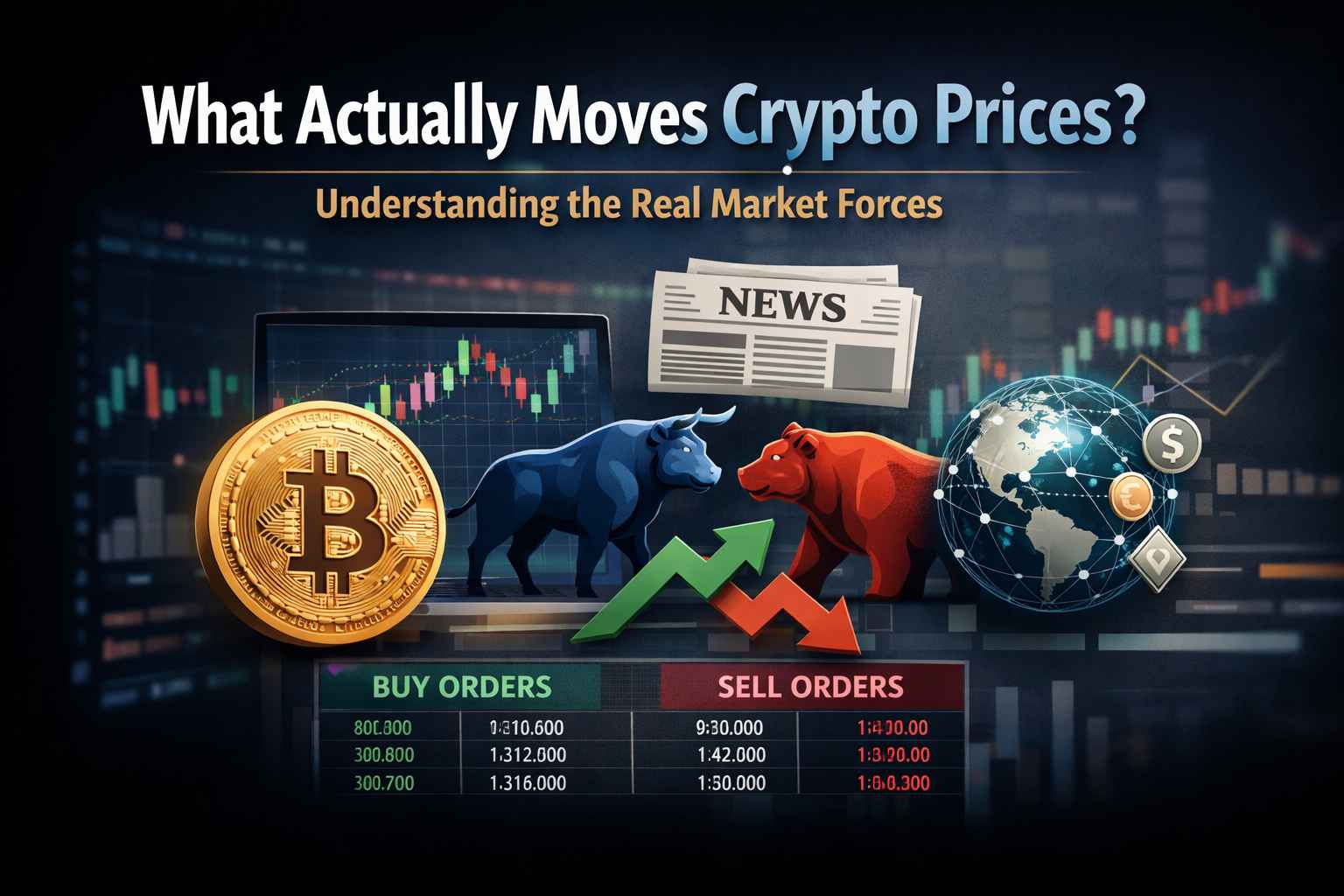
Cryptocurrency markets often appear unpredictable.
Bitcoin rises despite negative headlines.
Ethereum falls after seemingly positive news.
Altcoins rally without obvious catalysts.
Sharp corrections occur during periods of optimism, while major recoveries sometimes begin when sentiment remains overwhelmingly pessimistic.
For many investors, these price movements seem random.
In reality, cryptocurrency markets are driven by a relatively small number of underlying forces that interact continuously.
Liquidity.
Supply and demand.
Market structure.
Investor psychology.
Macroeconomic conditions.
Institutional positioning.
Rather than acting independently, these factors combine to determine how prices evolve over time.
Many investors mistakenly believe that news headlines directly cause market movements.
Although important events certainly influence prices, markets often begin moving long before news becomes public.
Professional investors focus less on headlines and more on the forces operating beneath the surface.
Understanding these market drivers does not allow investors to predict every short-term price movement.
Markets will always remain uncertain.
However, understanding why prices move helps investors interpret market conditions more objectively while reducing emotional decision-making.
Instead of reacting to every candle on a chart, disciplined investors learn to evaluate liquidity, positioning, risk appetite and broader market structure before making investment decisions.
In This Analysis, We’ll Explore:
- What actually moves crypto prices
- Why prices often move before the news
- Supply and demand
- Liquidity
- Market structure
- Trading volume
- Institutional investors
- Retail investors
- Market makers
- Derivatives and leverage
- Investor psychology
- Macroeconomic conditions
- Bitcoin dominance
- Capital rotation
- Why markets often appear irrational
- Common investor mistakes
- Strengths and limitations of market analysis
What Actually Moves Crypto Prices?
At the most basic level, cryptocurrency prices move because buyers and sellers continuously compete to determine an asset’s value.
However, this explanation only scratches the surface.
Behind every price movement lies a complex interaction between multiple market forces.
Some of the most important include:
- Supply and demand.
- Market liquidity.
- Investor sentiment.
- Institutional positioning.
- Macroeconomic conditions.
- Trading activity.
- Leverage.
- Capital flows.
Rather than acting independently, these forces constantly influence one another.
For example, improving macroeconomic conditions may encourage institutional investors to increase exposure to risk assets.
Additional buying increases liquidity.
Higher prices improve investor sentiment.
Positive sentiment attracts more buyers.
Demand strengthens further.
Conversely, tighter monetary policy may reduce liquidity.
Institutional investors become more cautious.
Selling pressure increases.
Confidence declines.
Retail investors panic.
Prices fall.
Understanding this chain reaction helps investors focus on causes rather than simply observing price movements after they occur.
Supply and Demand: The Foundation of Every Market
Every financial market ultimately operates according to supply and demand.
Cryptocurrency markets are no different.
When demand exceeds available supply, prices generally rise.
When sellers outnumber buyers, prices tend to decline.
Although this principle appears simple, many different factors influence supply and demand within cryptocurrency markets.
Examples include:
- Institutional accumulation.
- Retail participation.
- ETF inflows.
- Exchange reserves.
- Whale transactions.
- Long-term holder activity.
- Mining supply.
- Market sentiment.
These forces change continuously.
As a result, prices constantly adjust to reflect changing market conditions.
One important characteristic of cryptocurrency markets is that available supply is not always the same as total supply.
Many long-term investors hold Bitcoin or Ethereum for years without selling.
This reduces the amount of cryptocurrency actively available for trading.
If demand suddenly increases while available supply remains limited, prices can rise rapidly.
Likewise, if large holders begin selling into relatively weak demand, prices may decline sharply.
Professional investors therefore monitor supply dynamics rather than focusing exclusively on price charts.
Understanding where supply is becoming constrained—or expanding—often provides valuable insight into future market conditions.
Liquidity Is the Real Driver
Liquidity is one of the most important concepts in cryptocurrency investing.
Yet it remains one of the least understood.
Liquidity refers to how easily assets can be bought or sold without causing significant price changes.
Markets with deep liquidity generally experience:
- Smaller price swings.
- Narrower bid-ask spreads.
- Greater trading efficiency.
- Smoother long-term trends.
Markets with limited liquidity often display:
- Larger price swings.
- Increased volatility.
- Wider spreads.
- Sudden price spikes.
- More frequent liquidation cascades.
Liquidity explains why cryptocurrency markets sometimes move dramatically even when no major news appears.
Rather than news creating the movement, changing liquidity conditions often determine how strongly markets react.
Professional investors therefore pay close attention to liquidity because it influences nearly every aspect of market behavior.
Many analysts consider liquidity to be the single most important force driving long-term cryptocurrency price movements.
Liquidity in Crypto Markets: Why Capital Flows Move Prices
Market Structure Determines Direction
While liquidity influences how prices move, market structure helps explain where they are likely to move.
Professional investors rarely focus on individual candles.
Instead, they analyze the broader structure developing over weeks and months.
Market structure refers to the overall framework of price action.
Rather than reacting to every short-term fluctuation, investors evaluate whether the underlying trend remains healthy or is beginning to weaken.
Important components of market structure include:
- Higher highs.
- Higher lows.
- Lower highs.
- Lower lows.
- Support levels.
- Resistance levels.
- Trend continuation.
- Trend reversals.
- Liquidity zones.
When higher highs and higher lows continue forming, the market generally remains in an uptrend.
Conversely, a sequence of lower highs and lower lows often indicates that sellers have gained control.
Understanding market structure allows investors to distinguish between normal volatility and genuine changes in trend.
Instead of assuming every correction signals the beginning of a bear market, experienced investors examine whether the broader market framework has actually changed.
This perspective helps reduce emotional decision-making during periods of heightened volatility.
Understanding Crypto Market Structure – Part 1 Who Actually Moves the Crypto Market?
Trading Volume Confirms Price
Price movements alone rarely provide the complete picture.
Trading volume helps investors understand how much conviction exists behind those movements.
Volume measures the amount of an asset being bought and sold over a given period.
Although volume does not predict future prices, it provides valuable confirmation of market strength.
Several general observations are common:
- Rising prices accompanied by increasing volume often suggest stronger buying conviction.
- Rising prices with declining volume may indicate weakening momentum.
- Sharp increases in volume frequently occur near important market turning points.
- Low-volume environments often produce less reliable price movements.
Professional investors therefore analyze price and volume together rather than treating either indicator in isolation.
Large institutional investors also pay close attention to volume because executing significant trades requires sufficient market liquidity.
Without adequate volume, even relatively modest institutional orders can move prices considerably.
For this reason, volume remains one of the most widely monitored indicators across both cryptocurrency and traditional financial markets.
Volume Analysis in Crypto: Market Participation, Trend Strength & Why Volume Matters
Institutions vs Retail Investors
Cryptocurrency markets consist of many different participants.
Each group behaves differently and influences prices in unique ways.
Retail investors often react quickly to:
- News headlines.
- Social media discussions.
- Fear of missing out.
- Short-term price movements.
- Market sentiment.
Institutional investors generally follow a different approach.
They typically focus on:
- Long-term capital allocation.
- Liquidity conditions.
- Portfolio diversification.
- Risk-adjusted returns.
- Macroeconomic developments.
- Execution quality.
Rather than chasing rapidly rising markets, institutions often accumulate positions gradually over extended periods.
This difference in behavior helps explain why retail investors frequently buy near periods of peak optimism while institutions may already be reducing exposure.
Understanding these behavioral differences provides important context when interpreting market movements.
Price action often reflects changing positioning among different groups of market participants rather than simple reactions to daily news.
Why Retail Investors Always Arrive Late in Crypto Cycles
Market Makers and Liquidity
Another important group influencing cryptocurrency markets consists of market makers.
Market makers provide continuous buy and sell orders, helping markets remain liquid.
Their primary objective is not predicting future prices.
Instead, they facilitate trading by ensuring buyers and sellers can transact efficiently.
Because market makers continuously manage inventory and liquidity, they sometimes contribute to short-term price movements around important support, resistance and liquidity zones.
This helps explain why cryptocurrency prices occasionally produce:
- Sharp wicks.
- Stop-loss hunts.
- False breakouts.
- Rapid reversals.
Although these movements often appear random, they frequently occur where liquidity is concentrated.
Professional investors therefore pay close attention to liquidity zones rather than focusing solely on chart patterns.
Understanding how market makers operate helps explain why markets sometimes move in ways that appear irrational to less experienced participants.
Derivatives and Leverage
One of the most powerful forces influencing cryptocurrency prices is the derivatives market.
Unlike spot markets, where investors buy and sell the underlying asset directly, derivatives allow participants to speculate on future price movements without necessarily owning the cryptocurrency itself.
The most common derivative products include:
- Futures contracts.
- Perpetual futures.
- Options.
- Leveraged positions.
Because derivatives often involve leverage, they can significantly amplify both upward and downward price movements.
Understanding Crypto Market Structure – Part 4: Derivatives, Leverage and Liquidations
How Leverage Magnifies Price Movements
Leverage allows traders to control positions much larger than their actual capital.
For example, a trader using 10× leverage can control a $10,000 position with only $1,000 of capital.
While leverage increases potential profits, it also magnifies losses.
Even relatively small market movements may trigger forced liquidations.
These liquidations can create chain reactions throughout the market.
For example:
- Falling prices trigger long liquidations.
- Liquidations create additional selling pressure.
- Selling pushes prices even lower.
- More leveraged positions are liquidated.
This process is commonly known as a liquidation cascade.
The opposite can also occur during strong rallies, when short sellers are forced to buy back positions, creating a short squeeze that accelerates price appreciation.
Because cryptocurrency markets frequently use higher leverage than many traditional financial markets, these liquidation events often produce rapid and dramatic price movements.
Why Prices Often Move Before the News
One of the biggest misconceptions among newer investors is believing that news causes every market movement.
In reality, prices often begin moving before headlines appear.
Professional investors continuously evaluate expectations, positioning and probabilities long before major announcements become public.
Markets are forward-looking.
Rather than reacting only to current events, they constantly attempt to price in future expectations.
This explains why:
- Positive news sometimes leads to falling prices.
- Negative headlines occasionally have little market impact.
- Expected announcements often produce limited volatility.
- Unexpected developments create the strongest reactions.
By the time financial media reports a story, professional investors may already have adjusted their positions.
Retail investors, meanwhile, often react after much of the move has already occurred.
For this reason, experienced investors frequently focus more on positioning than on headlines themselves.
Investor Psychology
Markets are ultimately driven by people.
Human emotions therefore remain one of the most powerful forces influencing cryptocurrency prices.
Despite advances in technology and algorithmic trading, fear and greed continue shaping market behavior just as they have throughout financial history.
Several recurring emotions appear during nearly every market cycle.
Fear
Fear dominates during corrections and bear markets.
Negative headlines spread quickly.
Many investors become convinced prices will continue falling indefinitely.
Panic selling often increases near periods of maximum pessimism.
Greed
Greed becomes increasingly powerful during strong bull markets.
Rapid gains encourage investors to take larger risks.
Position sizes increase.
Risk management weakens.
Speculation expands.
Historically, excessive optimism has frequently appeared near major market tops.
Fear of Missing Out (FOMO)
FOMO encourages investors to chase rapidly rising prices simply because others appear to be making money.
Rather than following a disciplined investment strategy, decisions become driven by emotional pressure.
This often results in buying near periods of heightened optimism.
Panic
Sharp market declines frequently trigger panic.
Instead of evaluating long-term fundamentals, investors focus exclusively on recent losses.
Selling accelerates.
Volatility increases.
Markets often overshoot to the downside before eventually stabilizing.
Euphoria
Euphoria represents the final stage of excessive optimism.
At this point, many investors believe prices can only continue rising.
Risk management is frequently ignored.
Speculative behavior becomes widespread.
Historically, this emotional environment has often coincided with the later stages of major bull markets.
Understanding these recurring psychological patterns helps investors recognize that market sentiment often becomes most extreme near important turning points.
Professional investors therefore monitor emotions just as carefully as they monitor price charts.
Why Crypto Rallies Fail at Resistance: Market Structure, Liquidity & Investor Psychology Explained
Macroeconomic Conditions
Although cryptocurrencies operate on decentralized blockchain networks, they do not exist in isolation.
Over the past decade, digital assets have become increasingly integrated with the global financial system.
As institutional participation has expanded, macroeconomic conditions have become one of the most important drivers of cryptocurrency prices.
Several macroeconomic factors influence investor behavior.
Interest Rates
Interest rates play a central role in determining global liquidity.
When central banks raise interest rates:
- Borrowing becomes more expensive.
- Liquidity often contracts.
- Investors become more risk-averse.
- Demand for speculative assets may decline.
Cryptocurrencies, particularly smaller altcoins, often experience increased volatility during periods of tighter monetary policy.
Conversely, lower interest rates generally encourage greater investment in higher-risk assets.
As liquidity expands, cryptocurrencies often attract stronger capital inflows.
Inflation
Inflation influences cryptocurrency markets in multiple ways.
Some investors view Bitcoin as a potential long-term store of value because of its limited supply.
Others reduce overall exposure to risk assets during periods of economic uncertainty.
As a result, inflation does not always produce the same market reaction.
Its impact depends largely on broader economic conditions, monetary policy and investor expectations.
Global Liquidity
Many professional investors consider global liquidity one of the most important long-term drivers of cryptocurrency markets.
When financial conditions become more accommodative, capital often flows toward higher-risk investments.
These may include:
- Technology stocks.
- Growth companies.
- Venture capital.
- Cryptocurrencies.
When liquidity contracts, the opposite frequently occurs.
Investors prioritize safety.
Risk appetite declines.
Volatility increases.
Understanding changes in global liquidity helps investors interpret broader market trends rather than focusing exclusively on short-term price movements.
Risk Appetite
Not every investor responds to uncertainty in the same way.
During periods of economic stability, many investors become more willing to allocate capital toward emerging technologies and higher-risk assets.
During periods of uncertainty, defensive positioning often increases.
Capital may shift toward:
- Cash.
- Government bonds.
- Gold.
- Defensive equities.
Because cryptocurrencies generally belong to the higher-risk segment of financial markets, changes in global risk appetite often influence crypto prices even when blockchain fundamentals remain unchanged.
Bitcoin Dominance and Capital Rotation
The cryptocurrency market rarely moves as a single asset class.
Instead, capital continuously rotates between different sectors.
Bitcoin frequently leads these movements.
During periods of uncertainty, investors often concentrate capital in Bitcoin because it is viewed as the most established cryptocurrency.
As confidence improves, capital gradually begins flowing into:
- Ethereum.
- Large-cap altcoins.
- Mid-cap cryptocurrencies.
- Smaller, higher-risk projects.
This process is commonly known as capital rotation.
One metric frequently monitored by investors is Bitcoin Dominance, which measures Bitcoin’s share of the total cryptocurrency market capitalization.
Changes in Bitcoin Dominance often provide valuable insight into where capital is flowing within the broader digital asset market.
Although no indicator guarantees future performance, understanding capital rotation helps investors interpret changing market conditions more effectively.
Bitcoin (BTC) Analysis: Liquidity, Market Dominance, Institutional Adoption & Long-Term Positioning
Why Markets Often Feel Irrational
Many investors become frustrated because cryptocurrency markets sometimes appear disconnected from logic.
Good news leads to falling prices.
Negative headlines fail to move the market.
Strong projects underperform while speculative assets rally sharply.
In reality, markets are not always reacting to current events.
They are continuously pricing future expectations.
Professional investors understand that prices reflect:
- Expectations.
- Liquidity.
- Positioning.
- Risk appetite.
- Investor psychology.
—not simply today’s headlines.
Because expectations constantly change, markets frequently move in ways that appear irrational from a short-term perspective.
This is why experienced investors spend less time asking:
“Why did today’s news move the market?”
and more time asking:
“What had the market already expected before the news arrived?”
Understanding this distinction helps explain many of the seemingly illogical movements that occur throughout every cryptocurrency market cycle.
Common Investor Mistakes
Even experienced investors occasionally misunderstand what truly drives cryptocurrency prices.
Many losses occur not because markets are impossible to understand, but because investors focus on the wrong signals.
Some of the most common mistakes include:
- Believing every price movement is caused by news.
- Ignoring liquidity conditions.
- Chasing rapidly rising markets.
- Panic selling during normal corrections.
- Confusing short-term volatility with long-term trend changes.
- Ignoring macroeconomic developments.
- Overestimating the importance of social media narratives.
- Assuming every market cycle will unfold exactly like previous ones.
- Using excessive leverage.
- Focusing only on price instead of market structure.
Recognizing these mistakes helps investors develop a more objective framework for evaluating cryptocurrency markets.
Strengths of Understanding Market Drivers
Learning what actually moves crypto prices provides several important advantages.
Rather than attempting to predict every short-term movement, investors gain a broader understanding of how markets function.
Some of the key benefits include:
- Improving long-term decision-making.
- Reducing emotional investing.
- Better understanding market structure.
- Recognizing liquidity-driven movements.
- Evaluating macroeconomic conditions more effectively.
- Identifying shifts in investor sentiment.
- Supporting stronger risk management.
- Providing context beyond daily headlines.
Although understanding market drivers cannot eliminate uncertainty, it significantly improves an investor’s ability to interpret changing market conditions.
Limitations of Market Analysis
Despite the value of understanding market forces, no analytical framework can perfectly predict future price movements.
Several important limitations remain.
Markets constantly evolve.
Institutional participation continues expanding.
Regulations change.
Technology develops.
Unexpected geopolitical events can rapidly influence investor sentiment.
In addition:
- No single indicator explains every market movement.
- Liquidity conditions can change quickly.
- Investor psychology is difficult to measure precisely.
- Market expectations may shift before public information becomes available.
- Unexpected events can temporarily override normal market behavior.
For these reasons, experienced investors rarely rely on one analytical approach.
Instead, they combine market structure, liquidity analysis, macroeconomic research, technical analysis, on-chain data and disciplined risk management to build probabilities rather than certainty.
Advanced Crypto Investing Strategies – Part 3: Reading On-Chain Data & Indicators
Conclusion
Cryptocurrency prices are driven by far more than daily headlines.
Behind every rally, correction and consolidation lies a complex interaction between liquidity, supply and demand, market structure, trading volume, investor psychology and macroeconomic conditions.
Professional investors understand that markets are forward-looking.
Prices often reflect expectations long before news reaches the public.
Rather than reacting emotionally to every short-term movement, they focus on identifying changes in liquidity, capital flows, positioning and broader market conditions.
No investor can predict every market move with complete accuracy.
However, understanding the forces that consistently influence cryptocurrency prices provides a significant long-term advantage.
By combining objective market analysis with disciplined risk management and emotional control, investors place themselves in a much stronger position to navigate changing market cycles while avoiding many of the mistakes driven by fear, greed and short-term market noise.
Understanding Crypto Market Structure – Part 6 How to Read the Crypto Market Like a Professional
When Does Bitcoin Actually Pump After the Halving? (Real Timeline Explained)
Disclaimer: This article is for educational purposes only and does not constitute financial or investment advice. Crypto markets are volatile and involve risk. Always do your own research.