
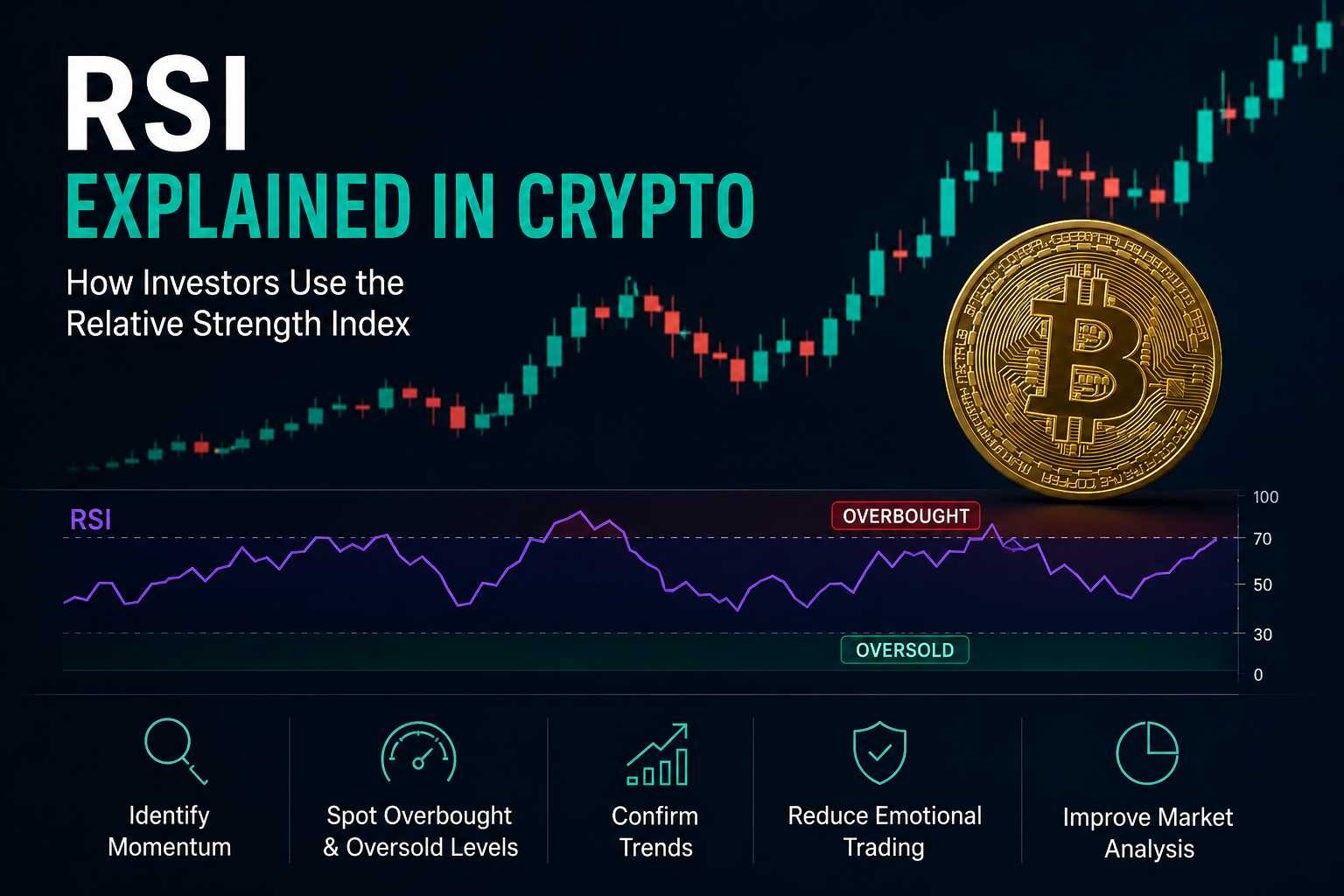
Cryptocurrency markets are highly emotional, fast-moving, and extremely volatile. Prices can rise aggressively within days, collapse unexpectedly, and reverse direction before most investors fully understand what happened.
Because of this volatility, many crypto investors rely on market indicators to better understand momentum, sentiment, and potential turning points. One of the most widely used indicators in crypto markets is the Relative Strength Index — commonly known as RSI.
The RSI is popular because it helps investors identify whether market momentum may be overheating or weakening. However, while many beginners use RSI as a simple “buy” or “sell” signal, experienced investors understand that the indicator is far more nuanced.
In this article, we’ll explain:
- what RSI actually measures
- how RSI works in crypto markets
- how investors use RSI during bull and bear markets
- why RSI can sometimes failhow RSI fits into broader market analysis
Understanding RSI properly can help investors improve discipline, reduce emotional trading, and better interpret crypto market momentum.
What Is the RSI Indicator?
The Relative Strength Index (RSI) is a momentum indicator developed by J. Welles Wilder that measures the speed and strength of recent price movements.
RSI moves between 0 and 100 and is typically used to identify:
- overbought conditions
- oversold conditions
- momentum shifts
- potential trend reversals
The indicator compares recent upward price movements against recent downward movements over a specific period, most commonly 14 periods. In simple terms:
- rising RSI = stronger bullish momentum
- falling RSI = weakening momentum
- extreme RSI readings = possible market exhaustion
RSI does not predict the future directly. Instead, it measures how aggressively buyers or sellers currently control the market.
How RSI Works in Crypto Markets
Crypto markets are driven heavily by:
Because momentum plays such a major role, RSI often becomes especially useful during periods of emotional extremes.
Standard RSI Levels
Most investors use these common RSI zones:
- RSI above 70 → potentially overbought
- RSI below 30 → potentially oversold
These levels do not guarantee reversals, but they may suggest momentum is becoming stretched. For example:
- Bitcoin(BTC) reaching RSI 85 after a vertical rally may indicate euphoric momentum
- Ethereum (ETH) falling to RSI 20 during panic selling may suggest extreme fear
However, context matters enormously. Strong crypto trends can remain overbought or oversold far longer than many investors expect.
Why Beginners Often Misuse RSI
One of the biggest mistakes in crypto investing is treating RSI as a guaranteed reversal signal. Many beginners assume:
- RSI above 70 = automatic sell
- RSI below 30 = automatic buy
In reality, strong bull markets can keep RSI elevated for weeks while prices continue rising aggressively.
Similarly, during severe bear markets, RSI can remain deeply oversold while prices continue falling.This is why experienced investors use RSI as a contextual tool — not as a standalone system.
RSI During Bull Markets
In strong bull markets, RSI often behaves differently than expected.
Instead of quickly reversing after becoming overbought, momentum may remain elevated as:
- retail participation increases
- FOMO intensifies
- liquidity flows accelerate
- trend-following investors enter aggressively
During powerful Bitcoin rallies, RSI levels above 70 can actually confirm trend strength rather than signal immediate danger.
This is why many experienced investors avoid aggressively shorting markets purely because RSI appears high.
Strong trends can stay irrational longer than expected.
RSI During Bear Markets
During bear markets, RSI often reflects:
- panic selling
- emotional capitulation
- liquidity stress
- reduced buyer demand
Extremely low RSI readings can sometimes indicate exhaustion among sellers.However, oversold conditions alone do not guarantee market bottoms.
In prolonged crypto bear markets, prices may continue declining despite deeply oversold RSI levels.
This is why investors often combine RSI with:
RSI becomes significantly more useful when viewed as part of a broader market framework.
Understanding RSI Divergences
One of the more advanced ways investors use RSI involves divergences.
A divergence occurs when price action and RSI move in opposite directions.
Bullish Divergence
A bullish divergence happens when:
- price makes lower lows
- RSI makes higher lows
This may suggest selling momentum is weakening beneath the surface.
Bearish Divergence
A bearish divergence happens when:
- price makes higher highs
- RSI makes lower highs
This may indicate weakening bullish momentum despite rising prices.
Divergences can sometimes provide early warning signs of trend exhaustion.
However, they are not perfectly reliable and often require confirmation from other indicators.
Why RSI Works Well With Bitcoin and Ethereum
Bitcoin and Ethereum markets tend to move in cycles driven by:
- liquidity conditions
- investor sentiment
- institutional flows
- macroeconomic expectations
Because these cycles involve strong emotional swings, RSI often reflects changing momentum effectively.
Investors commonly use RSI to identify:
- overheated euphoric phases
- panic-driven selloffs
- weakening trend momentum
- potential accumulation periods
However, the larger the timeframe, the more meaningful RSI often becomes. For example:
- daily RSI signals generally carry more weight than 5-minute RSI signals
- weekly RSI trends can sometimes help identify broader market cycles
Long-term investors usually focus on higher timeframes to reduce market noise.
Combining RSI With Other Indicators
Professional investors rarely rely on RSI alone.
Instead, RSI is commonly combined with:
Moving Averages
Moving averages help identify overall trend direction. For example:
- RSI oversold during a strong uptrend may create better opportunities
- RSI overbought during a weak trend may signal greater risk
Volume Analysis
Volume helps confirm whether momentum is supported by real market participation.
High RSI combined with weak volume may indicate unsustainable rallies.
On-Chain Data
In crypto markets, investors increasingly combine RSI with:
- exchange flows
- whale activity
- long-term holder behavior
- network activity
This creates a more complete picture of market conditions.
The Psychological Side of RSI
RSI is ultimately a reflection of investor behavior. High RSI levels often reflect:
- greed
- FOMO
- euphoric momentum
- aggressive speculation
Low RSI levels often reflect:
- fear
- panic selling
- uncertainty
- emotional exhaustion
Understanding this psychological component is critical.
Many successful investors use RSI not to predict exact price movements, but to better understand emotional conditions inside the market.
In crypto investing, emotional extremes often matter more than perfect technical precision.
The Limitations of RSI
While RSI is extremely popular, it has important limitations. RSI cannot:
- predict news events
- forecast macroeconomic shocks
- guarantee reversals
- eliminate risk
Additionally:
- false signals occur frequently
- strong trends can invalidate RSI expectation
- slow-liquidity altcoins may produce unreliable RSI behavior
This is why risk management remains essential regardless of which indicators investors use. No technical indicator is perfect.
Why Long-Term Investors Still Use RSI
Despite its limitations, RSI remains valuable because it helps investors structure decision-making more rationally.
Instead of reacting emotionally to every market move, RSI provides a framework for analyzing momentum objectively.
Long-term investors often use RSI to:
- avoid emotional FOMO entries
- recognize overheated market conditions
- identify periods of extreme fear
- improve patience and discipline
Used correctly, RSI becomes less about predicting exact tops and bottoms — and more about understanding market psychology.
Conclusion
The Relative Strength Index (RSI) is one of the most widely used momentum indicators in cryptocurrency markets because it helps investors analyze market strength, emotional conditions, and potential momentum shifts.
While many beginners misuse RSI as a simple buy-or-sell signal, experienced investors understand that the indicator works best when combined with:
- market structure
- volume analysis
- trend analysis
- on-chain data
- risk management
RSI is not a magic formula for predicting crypto prices. However, when used correctly, it can help investors improve discipline, avoid emotional decision-making, and better understand how momentum drives cryptocurrency markets.
In volatile markets like crypto, understanding investor psychology is often just as important as understanding price action itself. Also Read ->
How to Do Your Own Research (DYOR) in Crypto
Market Cap vs Fully Diluted Valuation: How to Value a Cryptocurrency Properly
How to Evaluate a Cryptocurrency Project: A Fundamental Analysis Guide
Disclaimer: This article is for educational purposes only and does not constitute financial advice. Always do your own research before investing in cryptocurrencies.