
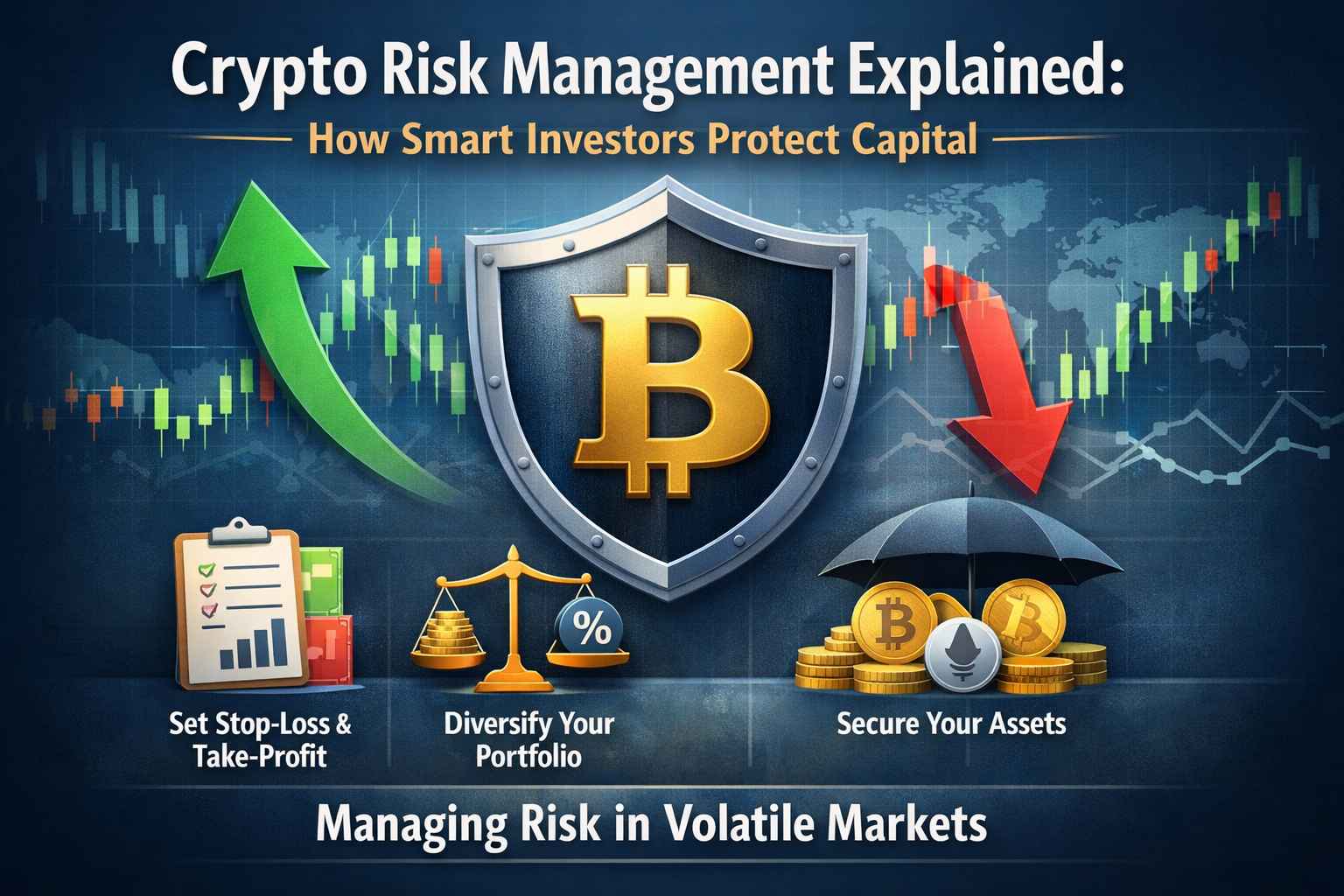
Cryptocurrency investing offers enormous opportunities.
It also involves significant risk.
Large gains often receive the most attention, but experienced investors understand that long-term success depends just as much on protecting capital as generating returns.
Every market cycle produces stories of investors who multiplied their portfolios.
It also produces countless examples of investors who lost most—or all—of their capital after taking excessive risks.
The difference is rarely intelligence.It is usually risk management.
Successful investors accept that losses are unavoidable.
No strategy wins every time.
No analysis is always correct.
Instead of attempting to eliminate risk entirely, disciplined investors focus on controlling it.
By limiting downside, managing position sizes and avoiding catastrophic mistakes, they ensure they remain invested long enough to benefit from future opportunities.
This mindset separates investing from gambling.
Rather than asking:
“How much money can I make?”
Professional investors often begin with a different question:
“How much could I lose if I’m wrong?”
Understanding this principle changes how every investment decision is made.
Whether markets are rising, falling or moving sideways, effective risk management provides the foundation for long-term success.
In This Analysis, We’ll Explore:
- What crypto risk management is
- Why protecting capital matters more than maximizing returns
- Understanding risk versus reward
- Position sizing
- Portfolio diversification
- Volatility and drawdowns
- Dollar-Cost Averaging (DCA)
- Emotional risk management
- Liquidity risk
- Leverage and liquidation risk
- Common investor mistakes
- Strengths and limitations of risk management
- Long-term investing principles
What Is Crypto Risk Management?
Crypto risk management is the process of controlling potential losses while maintaining exposure to long-term investment opportunities.
Rather than attempting to predict every market movement, investors develop strategies that help protect their capital regardless of market conditions.
Risk management does not eliminate uncertainty.
Cryptocurrency markets remain among the most volatile financial markets in the world.
Prices can rise rapidly.
They can also decline sharply.
Unexpected news, macroeconomic events, regulatory developments and changing investor sentiment can all influence prices within hours.
Because uncertainty cannot be removed, successful investors prepare for it instead.
Good risk management focuses on questions such as:
- How much of my portfolio should I invest in one asset?
- What happens if this investment falls by 50%?
- Can my portfolio survive a prolonged bear market?
- Am I taking risks I fully understand?
By asking these questions before investing, disciplined investors reduce the likelihood that a single mistake permanently damages their portfolio.
Why Capital Protection Comes First
Many new investors focus almost entirely on maximizing returns.
They search for the next cryptocurrency capable of increasing tenfold.
They chase rapidly rising prices.
They constantly ask which coin will perform best next.
Professional investors often think differently.
Their first objective is preserving capital.
This philosophy may appear conservative, but it reflects an important mathematical reality.
Recovering from large losses becomes increasingly difficult.
For example:
- A 20% loss requires a 25% gain to recover.
- A 50% loss requires a 100% gain.
- An 80% loss requires a 400% gain.
- A 90% loss requires a 900% gain.
As losses become larger, the returns required simply to break even increase dramatically.
This is why avoiding catastrophic drawdowns is often more important than maximizing gains during strong bull markets.
Protecting capital also creates flexibility.
Investors who preserve their portfolios during difficult market conditions remain able to take advantage of future opportunities.
Those who lose most of their capital may no longer have sufficient resources to participate when markets eventually recover.
For long-term investors, survival is not simply important.
It is essential.
How to Protect Your Capital in Crypto: A Survival Guide for Long-Term Investors
Understanding Risk vs Reward
Every investment involves balancing potential reward against potential risk.
Higher expected returns generally require accepting greater uncertainty.
However, higher risk does not automatically produce higher returns.
Instead, it increases the range of possible outcomes.
Professional investors therefore evaluate investments based not only on their upside potential but also on the probability and magnitude of possible losses.
Several questions help frame this analysis:
- What is the realistic upside?
- What is the worst-case downside?
- How likely is each outcome?
- Does the potential reward justify the risk being taken?
For example, an investment offering a possible 20% gain while exposing the investor to a potential 80% loss may represent an unattractive risk-reward profile.
Conversely, an investment with moderate upside but limited downside may fit better within a diversified long-term portfolio.
Rather than pursuing maximum returns at any cost, experienced investors seek opportunities where the balance between risk and reward remains favorable over time.
This disciplined approach supports consistency across multiple market cycles rather than relying on a few highly speculative bets.
Think Like a Smart Crypto Investor Part 3: Risk & Reward Framework
Position Sizing: Your Most Important Decision
One of the most overlooked aspects of investing is position sizing.
Many investors spend hours researching which cryptocurrency to buy while giving very little thought to how much they should invest.
In reality, position sizing often has a greater impact on long-term performance than choosing the perfect entry price.
No investor is correct every time.
Even the strongest investment thesis can prove wrong.
Position sizing ensures that when this happens, the damage remains manageable.
A well-sized position allows investors to:
- Survive unexpected market events.
- Reduce emotional decision-making.
- Avoid catastrophic portfolio losses.
- Stay invested through multiple market cycles.
Large positions increase both potential returns and potential losses.
Smaller positions reduce portfolio volatility while allowing investors to diversify across multiple opportunities.
Rather than placing excessive confidence in a single investment, professional investors recognize that uncertainty always exists.
For this reason, position sizing becomes one of the most powerful risk management tools available.
Position Sizing in Crypto: How to Allocate Capital Without Destroying Your Portfolio
Portfolio Diversification
Diversification is one of the oldest principles in investing, yet it is often misunderstood.
Some investors believe diversification means owning as many cryptocurrencies as possible.
In reality, effective diversification is about reducing unnecessary risk rather than maximizing the number of holdings.
A diversified portfolio helps ensure that poor performance from one investment does not determine the outcome of the entire portfolio.
Rather than relying on a single asset, investors spread risk across different segments of the cryptocurrency market.
Advanced Crypto Investing Strategies – Part 1: Portfolio Allocation & Diversification
Bitcoin as the Foundation
Many long-term investors consider Bitcoin the core of their cryptocurrency portfolio.
Its advantages include:
- The largest market capitalization.
- Strong institutional adoption.
- Deep global liquidity.
- The longest operating history.
- Broad market recognition.
Although Bitcoin remains volatile, many investors view it as the lowest-risk cryptocurrency within the digital asset ecosystem.
Bitcoin (BTC) Analysis: Liquidity, Market Dominance, Institutional Adoption & Long-Term Positioning
Ethereum and Smart Contract Platforms
Ethereum often represents the second-largest allocation in diversified crypto portfolios.
Unlike Bitcoin, Ethereum focuses on programmable blockchain infrastructure through smart contracts.
Its ecosystem supports:
- Decentralized finance (DeFi).
- NFTs.
- Tokenized assets.
- Blockchain gaming.
- Web3 applications.
Some investors also diversify into other smart contract platforms after conducting careful research.
Smart Contracts Explained: How Blockchain Automation Works & Why It Matters for Investors
Selective Altcoin Exposure
Altcoins can offer higher growth potential than Bitcoin.
However, they generally involve significantly greater risk.
Many projects fail to achieve widespread adoption.
Others lose developer activity or market relevance over time.
Instead of chasing every new trend, disciplined investors often limit altcoin exposure to projects with:
- Strong development activity.
- Real-world utility.
- Sustainable ecosystems.
- Healthy liquidity.
- Long-term adoption potential.
Quality generally matters more than quantity.
Stablecoins and Cash Allocation
Diversification is not limited to cryptocurrencies that appreciate in value.
Holding a portion of a portfolio in stablecoins or cash equivalents can provide important flexibility.
Benefits include:
- Reduced overall portfolio volatility.
- Available capital during market corrections.
- Greater flexibility when opportunities arise.
- Improved risk management.
Maintaining liquidity allows investors to respond to changing market conditions without being forced to sell existing positions during periods of market stress.
Stablecoins Explained: How They Work, Types, Benefits, Risks & Their Role in the Crypto Ecosystem
Understanding Drawdowns
One of the realities of cryptocurrency investing is experiencing drawdowns.
A drawdown refers to the decline in portfolio value from a previous high.Every investor experiences them.
The objective of risk management is not to eliminate drawdowns.
It is to prevent temporary declines from becoming permanent financial damage.
Normal Market Corrections
Corrections are a natural feature of every financial market.
Even healthy bull markets frequently experience pullbacks of 10–30%.
These corrections help remove excessive speculation and often strengthen longer-term trends.
Investors who understand this are generally less likely to panic during temporary declines.
Bear Markets
Bear markets represent much larger and more prolonged declines.
Historically, cryptocurrency bear markets have produced significant drawdowns across nearly every digital asset.
Although these periods are emotionally challenging, they have also created opportunities for disciplined investors willing to remain focused on long-term fundamentals rather than short-term fear.
The Mathematics of Recovery
Understanding recovery mathematics highlights why managing downside risk is so important.
Consider the following examples:
Portfolio Loss → Gain Needed to Recover
10% → 11%
20% → 25%
30% → 43%
50% → 100%
75% → 300%
90% → 900%
As losses become larger, recovering becomes exponentially more difficult.
This is why professional investors often place greater emphasis on limiting losses than maximizing gains.
Protecting capital today increases the likelihood of participating in tomorrow’s opportunities.
Dollar-Cost Averaging (DCA)
Dollar-Cost Averaging, commonly known as DCA, is one of the simplest and most effective risk management strategies available to long-term investors.
Instead of attempting to predict the perfect entry point, investors commit fixed amounts at regular intervals.
This approach offers several advantages.
Reduces Timing Risk
No investor consistently buys at the exact market bottom.
By investing gradually, DCA reduces the impact of entering the market at unfavorable prices.
Removes Emotion
Because investments occur according to a predefined schedule, investors become less influenced by fear, greed and short-term market headlines.
Discipline replaces emotional decision-making.
Encourages Long-Term Thinking
Rather than focusing on daily price movements, DCA encourages investors to think in years rather than weeks.
This mindset aligns well with long-term wealth building and helps investors remain consistent throughout changing market cycles.
Although DCA does not guarantee profits or eliminate losses, it remains one of the most widely used strategies for managing investment risk in volatile markets.
What Is Dollar Cost Averaging (DCA) in Crypto — And Why It Works Long Term
Emotional Risk Management
Risk in cryptocurrency markets is not limited to price volatility.
One of the greatest threats to long-term investing often comes from within the investor.
Fear, greed and impatience regularly influence decisions far more than objective analysis.
Successful investors recognize that managing emotions is an essential part of managing financial risk.
Fear
Fear typically dominates during market corrections and bear markets.
As prices decline, many investors begin questioning their entire investment strategy.
Negative headlines become more persuasive.
Social media fills with predictions of further losses.
This often causes investors to sell after significant declines have already occurred.
Experienced investors understand that volatility is a normal characteristic of cryptocurrency markets.
Rather than reacting emotionally, they compare current market conditions with their long-term investment thesis before making major portfolio decisions.
Greed
Greed often appears during strong bull markets.
As prices rise rapidly, many investors become increasingly confident that the trend will continue indefinitely.
This can lead to:
- Buying after large rallies.
- Ignoring valuation.
- Taking excessive risks.
- Increasing position sizes unnecessarily.
- Abandoning risk management.
History has repeatedly shown that excessive optimism frequently appears near the later stages of major market advances.
Fear of Missing Out (FOMO)
FOMO remains one of the most common emotional traps in cryptocurrency investing.
When investors see others generating significant profits, they often feel pressured to buy immediately without performing proper research.
This frequently results in purchasing assets after substantial price appreciation.
Successful investors understand that opportunities continually appear throughout different market cycles.
Missing one trade is rarely as damaging as entering a poor investment purely because of emotional pressure.
Panic Selling
Panic selling often occurs after sudden market declines.
Rather than evaluating whether market fundamentals have changed, investors sell simply because prices are falling.
While protecting capital is important, reacting emotionally to temporary volatility can transform unrealized losses into permanent ones.
Disciplined investors distinguish between:
- Short-term market noise.
- Structural changes.
- Long-term investment fundamentals.
This helps them respond rationally rather than emotionally.
Advanced Crypto Investing Strategies – Part 4: Managing Emotions & Avoiding FOMO
Liquidity Risk
Liquidity risk is often overlooked by newer investors.
It refers to the possibility that an asset cannot be bought or sold quickly without significantly affecting its market price.
Large cryptocurrencies such as Bitcoin and Ethereum generally possess deep liquidity.
Smaller cryptocurrencies may not.
Limited liquidity can create several challenges:
- Large bid-ask spreads.
- Increased price volatility.
- Difficulty exiting positions.
- Greater susceptibility to market manipulation.
Before investing in any digital asset, experienced investors often evaluate trading volume and market liquidity alongside the project’s fundamentals.
A strong project with extremely limited liquidity may still present considerable investment risk.
Liquidity in Crypto Markets: Why Capital Flows Move Prices
Leverage: The Fastest Way to Lose Capital
Leverage allows investors to control larger positions using borrowed funds.
Although leverage can increase potential returns, it also magnifies losses.
Even relatively small price movements can trigger liquidation when leverage is excessive.
For example:
- A modest market correction may completely eliminate a highly leveraged position.
- Temporary volatility can force investors out of otherwise promising long-term investments.
- Emotional decision-making often increases dramatically when leverage is involved.
Because cryptocurrency markets are already highly volatile, many long-term investors avoid excessive leverage altogether.
Rather than attempting to maximize short-term gains, they prioritize capital preservation and long-term consistency.
Successful investing rarely depends on taking the greatest possible risk.
It more often depends on remaining invested through multiple market cycles.
Crypto Day Trading: Structural Risks and Capital Erosion
Risk Management During Bull Markets
Bull markets often create the illusion that risk has disappeared.
As prices rise and optimism spreads, many investors become increasingly confident.
This is often when discipline becomes most important.
Risk management during bull markets includes:
- Avoiding oversized positions.
- Maintaining portfolio diversification.
- Taking profits according to a predefined strategy.
- Avoiding emotional decision-making driven by euphoria.
- Continuing to evaluate risk rather than focusing only on potential rewards.
History shows that many investors experience their largest losses shortly after periods of excessive optimism.
Maintaining discipline during strong markets helps preserve capital for future opportunities.
Common Crypto Risk Management Mistakes
Many portfolio losses are not caused by unpredictable market events.
Instead, they result from avoidable mistakes.
Some of the most common include:
- Investing too much in a single cryptocurrency.
- Ignoring diversification.
- Using excessive leverage.
- Chasing rapidly rising prices.
- Selling during periods of panic.
- Investing without a long-term plan.
- Following social media instead of independent research.
- Believing every market cycle will unfold exactly like the previous one.
- Ignoring liquidity risk.
- Underestimating the impact of emotions.
Recognizing these mistakes before they occur is often one of the most effective forms of risk management.
Strengths of Crypto Risk Management
A disciplined approach to risk management offers several long-term advantages.
These include:
- Protecting capital during volatile markets.
- Reducing the impact of investment mistakes.
- Supporting consistent long-term growth.
- Improving emotional decision-making.
- Encouraging realistic expectations.
- Increasing portfolio resilience.
- Helping investors remain active across multiple market cycles.
- Creating opportunities to benefit from future market recoveries.
Rather than limiting returns, effective risk management often increases the likelihood of achieving sustainable long-term performance.
Limitations of Risk Management
Although risk management significantly improves decision-making, it cannot eliminate uncertainty.
Several limitations should always be recognized.
No strategy can:
- Prevent every loss.
- Predict every market movement.
- Eliminate volatility.
- Remove regulatory uncertainty.
- Guarantee positive investment returns.
- Protect against every unexpected market event.
Risk management should therefore be viewed as a framework for improving probabilities rather than guaranteeing success.
Successful investors focus on making consistently good decisions instead of expecting perfect outcomes.
Conclusion
Risk management is one of the most important skills any cryptocurrency investor can develop.
While many market participants focus primarily on maximizing returns, experienced investors understand that protecting capital is what makes long-term compounding possible.
By combining thoughtful position sizing, portfolio diversification, disciplined risk management, emotional control and realistic expectations, investors can navigate both bull and bear markets with greater confidence.
No investment strategy can eliminate uncertainty.
Markets will always experience volatility, unexpected news and changing economic conditions.
However, investors who consistently manage risk place themselves in a much stronger position to benefit from future opportunities while avoiding the catastrophic losses that prevent many participants from reaching their long-term goals.
In cryptocurrency investing, success is rarely determined by one extraordinary trade.
More often, it is achieved through hundreds of disciplined decisions made consistently across multiple market cycles.
Crypto Swing Trading: Strategy, Risk and Market Structure Explained
Long-Term Investing in Crypto: Strategy, Psychology and Capital Allocation
Understanding Crypto Market Structure – Part 1 Who Actually Moves the Crypto Market?
Disclaimer: This article is for educational purposes only. It does not constitute financial advice. Crypto investments carry risk, and past performance is not indicative of future results.