
Cryptocurrency markets can appear chaotic at first glance.
Prices move rapidly, narratives change quickly and volatility can make it difficult to determine what is actually driving market behavior.
However, professional investors rarely view markets as random. Instead, they analyze several structural elements that together shape price movements.
By understanding how liquidity, market participants, derivatives activity and capital flows interact, investors can develop a clearer framework for interpreting market dynamics.
This final part of the series brings together the key concepts discussed throughout the previous articles.
Professional investors rarely rely on one single indicator, one news headline, or one social media narrative.
Instead, they interpret markets through a combination of:
- liquidity
- market structure
- capital flows
- derivatives positioning
- investor psychology
- macro conditions
- risk sentiment
This broader framework helps experienced investors stay rational during volatility while avoiding emotional reactions to short-term noise.
Understanding how these forces interact is one of the biggest differences between reactive retail behavior and structured professional market analysis.
Understanding Market Participants
The first step in reading the market is recognizing who is involved.
Crypto markets consist of several major participants:
- retail investors
- institutional investors
- market makers
Each group behaves differently. Retail traders often react quickly to price momentum and news, while institutions usually operate with longer-term strategies.
Market makers focus on providing liquidity and facilitating trading activity.
Understanding these different roles helps investors interpret market behavior more accurately.
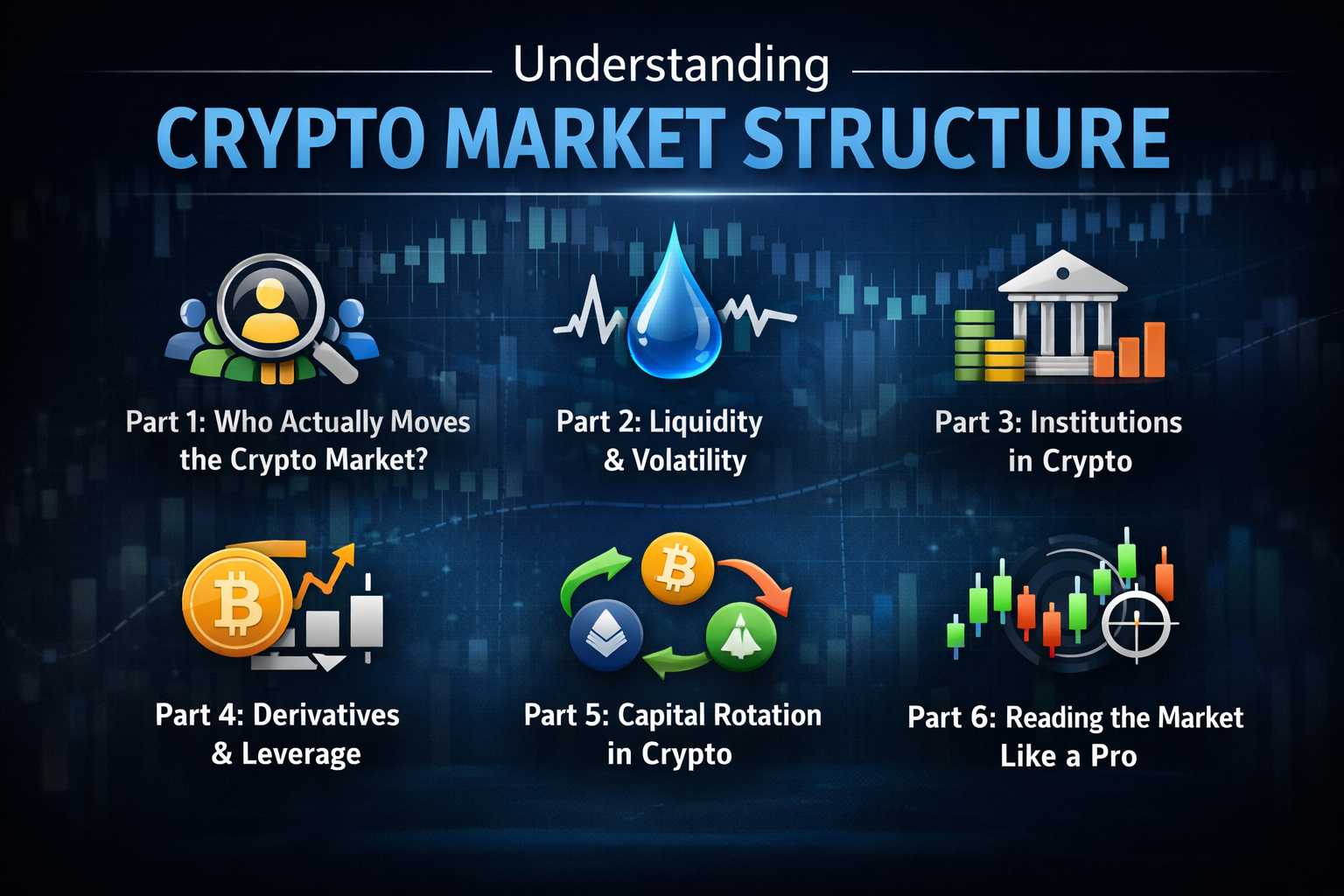
Understanding Crypto Market Structure – Part 1 Who Actually Moves the Crypto Market?
Why Most Retail Investors Misread the Market
Many retail investors focus almost entirely on short-term price action.
They often react emotionally to:
- green candles
- breaking news
- social media narratives
- influencer opinions
- sudden volatility
However, professional investors usually focus less on individual price movements and more on the underlying structure driving those movements.
For example, experienced investors often analyze:
- liquidity conditions
- leverage exposure
- capital rotation
- market sentiment
- macro trends
- institutional positioning
This broader perspective helps reduce emotional decision-making and improves long-term market interpretation.
One of the biggest differences between professional and inexperienced investors is not intelligence — it is framework and discipline.
Understanding Crypto Market Structure – Part 3: The Role of Institutions in Crypto
Observing Liquidity Conditions
Liquidity plays a major role in determining how markets move.
High liquidity generally allows markets to absorb large trades without extreme price changes. Low liquidity, on the other hand, can lead to sharp volatility when large orders enter the market.
Monitoring trading volume, order book depth and overall participation levels can provide clues about current liquidity conditions.
Professional investors often consider liquidity before entering or exiting large positions.
Understanding Crypto Market Structure – Part 2: Liquidity and Why It Controls Volatility
Monitoring Derivatives Activity
Derivatives markets now represent a large share of crypto trading activity.
Leverage allows traders to control positions larger than their actual capital, which can amplify both gains and losses.
Because of this, derivatives activity frequently influences short-term price movements.
Indicators such as funding rates, open interest and liquidation levels can reveal how leveraged traders are positioned within the market.
These signals sometimes help explain sudden volatility spikes.
Understanding Crypto Market Structure – Part 4: Derivatives, Leverage and Liquidations
Tracking Capital Flows
Another important factor is the movement of capital across different parts of the market.
As discussed earlier in the series, capital often rotates between:
- Bitcoin
- Ethereum
- large-cap altcoins
- smaller speculative assets
When capital shifts toward higher-risk assets, it may indicate growing investor confidence. When capital moves back toward more established assets, it can signal a more cautious market environment.
Tracking these flows can provide insight into broader market sentiment.
Understanding Crypto Market Structure – Part 5 Capital Rotation in Crypto Markets
Combining the Signals
Professional market analysis rarely relies on a single indicator.
Instead, experienced investors combine multiple signals to form a broader perspective.
For example:
- rising liquidity and increasing capital inflows may support bullish momentum
- declining liquidity combined with heavy leverage can increase the risk of volatility
- large institutional activity may influence longer-term market trends
By evaluating several structural elements together, investors can develop a more balanced understanding of market conditions.
Why Context Matters More Than Individual Indicators
Professional investors rarely rely on isolated indicators.
For example:
- a bullish technical signal during weak liquidity conditions may fail quickly
- high leverage combined with euphoric sentiment may increase liquidation risk
- strong capital inflows during improving macro conditions may strengthen bullish momentum
This is why context matters more than any single indicator by itself.
Many inexperienced investors search for one perfect signal or prediction tool.
In reality, markets are influenced by multiple interacting forces simultaneously.
Understanding the broader environment often matters far more than reacting to one chart pattern or headline.
Building a Market Framework
Rather than reacting emotionally to every price movement, successful investors often rely on structured frameworks for interpreting market behavior.
Such frameworks may include:
- monitoring macro trends
- evaluating liquidity conditions
- observing derivatives positioning
- tracking capital rotation
- understanding market participants
This approach helps investors remain disciplined even during periods of strong volatility.
Why Professional Investors Focus on Probabilities, Not Certainty
One of the biggest misconceptions in crypto investing is believing markets can be predicted with complete certainty.
Professional investors rarely think in absolutes.
Instead, they focus on:
- probabilities
- risk management
- market structure
- liquidity conditions
- positioning
- changing market environments
Even experienced investors are frequently wrong on short-term market direction.
The difference is that professional investors usually manage risk carefully, remain emotionally disciplined, and adapt when conditions change.
This probabilistic mindset helps investors avoid emotional overconfidence while improving long-term consistency across multiple market cycles.
Conclusion
Reading crypto markets like a professional is not about predicting every price movement correctly.
It is about understanding the structural forces that drive market behavior.
Liquidity, derivatives activity, institutional participation, capital rotation, leverage, sentiment, and market psychology all interact continuously to shape crypto volatility and long-term trends.
Professional investors rarely rely on isolated indicators or emotional reactions. Instead, they use structured frameworks to interpret changing market conditions more rationally.
By combining:
- market structure analysis
- liquidity awareness
- risk management
- capital flow interpretation
- emotional discipline
- long-term thinking
Investors can develop a more balanced understanding of crypto markets instead of reacting impulsively to short-term noise.
No framework can eliminate uncertainty completely.
However, understanding how crypto markets function beneath the surface can significantly improve decision-making, emotional stability, and long-term investing discipline.
This concludes the Understanding Crypto Market Structure series.
Part 1: Mindset – Think Like a Smart Crypto Investor
Part 1: Portfolio Allocation & Diversification – Advanced Crypto Investing Strategies
Disclaimer: This article is for informational purposes only and does not constitute financial advice. Cryptocurrency markets are volatile and involve significant risk. Always conduct your own research before making investment decisions.